Category Archives: Coal

NRC Power Reactor Status Reports Graphed

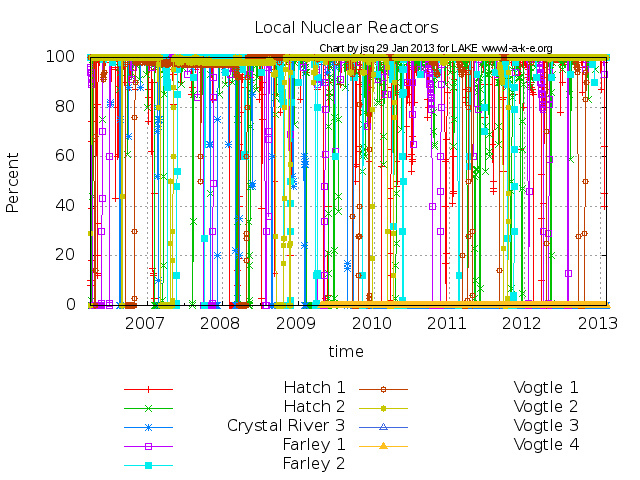
Do you know how many outages nuclear reactors near here have had?
Probably not, because that’s usually not in the news,
and you have to dig into day by day NRC reactor status reports
to find out.
It turns out nuclear power is 0/7 instead of 24/7 on many a day.

Looking at all nine
nuclear reactors within 200 miles of here,
the graph drips downtime like tears.


Reactors within 200 miles

The available data on NRC’s website and graphed here goes back to 31 March 2006,
through 29 January 2013.
Let’s look at each of our closest reactors one by one. Hatch 1 on the Altamaha River,
in addition to its recent

40% power on 21 January and 87% on 5 January
,
has had quite a few outages:

Continue reading

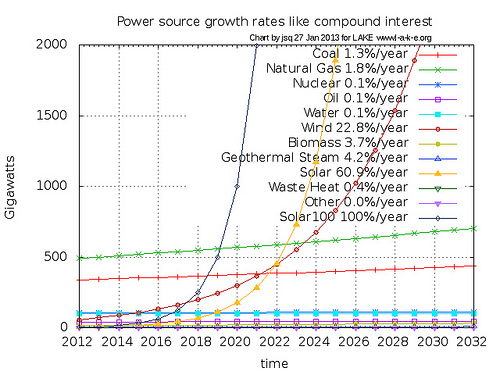
Power source growth rates like compound interest

What if instead of
projecting percentages
, we project gigawatts from
FERC’s December 2012 Installed Operating Generating Capacity table?
Solar and wind still win in less than a decade.


FERC 2012 power source gigawatts and growth rates projected 20 years

Ignore the fastest-growing curve for a moment; I added that.
All the other curves start with the December 2012 gigawatts
for each power source in the FERC table, and an annual compound
growth rate computed by comparing that installed operating capacity
to the capacity added in 2012 for that power source.
That compound annual growth rate for solar is 60.9% and for wind is 22.8%.
Nothing else comes close.

Solar passes coal in about 8 years, wind in about 9, and natural gas in
about

Continue reading

Georgia Power to announce 20-year plan Thursday

What will Georgia Power announce for a 20 year energy plan Thursday?
Will they (1) just double down on their rate-hike boondoggles for

nuclear
and

gas
,
or (2) they could flip like

Austin Energy in 2003
and

Cobb EMC in 2012

and suddenly go solar?
The wording here looks like it’s going to be the former.
That they even feel compelled to announce some sort of formal plan instead of just

shovelling disinformation out another 50 years

indicates they’re feeling

the pressure to change direction

to real sustainable energy: wind and solar power.

Matt Shedd wrote for WUGATV today,

Georgia Power To Release Energy Plan
,

Georgia Power is set to release a 20-year energy plan on Thursday


which will outline a way for the company and the state to be less
reliant on coal power. The AJC reports that just 5 years ago, the
company’s reliance on coal was at 70 percent.

That number has now dropped to 47 percent. These changes are coming
in the wake of Georgia Power’s parent, the Southern Co., being
pushed by environmental rules to rely less on coal. Georgia Power
won approval to buy electricity produced by natural gas from its
sister company Southern Power, which may be part of the company’s
future plans.

Thomas A. Fanning, CEO of Georgia Power’s parent The Southern Company (SO),
has been touting 70% to 35% reduction in coal since at least

May 2012 at the SO shareholder meeting.

Fanning continues to

emphasize nuclear, gas, and “clean coal”

instead of real sustainable energy, namely wind and solar power.
He also continues to assert electricity demand will increase,
while

ignoring conservation and efficiency,
which for Georgia
could remove all need for new energy,
enabling solar and wind to shut down more coal and gas plants,
as well as nukes.

So, get out the popcorn and take your bets.
Will it be (1) or will it be (2)?
I’m betting this time it will be (1), but sooner or later it will be (2),
and even Georgia Power, and yes, even Southern Company,
will stop digging in their heels and get on the solar
train to profits, jobs, energy independence, and oh, by the way, clean
air and plenty of clean water.

-jsq
Solar energy growth like compound interest

Some nuclear backers only want to look at the
next table in that FERC report,

Office of Energy Projects
Energy Infrastructure Update
For December 2012
,
which shows solar energy as 0.34% of total U.S. energy production,
and then they stop thinking.
But what about

that 30% increase in solar power deployed
between 2011 and 2012?

Think of it like compound interest.

Total Installed Operating Generating Capacity
Installed Capacity (GW) % of Total Capacity % Growth 2011-2012
Coal 337.71 29.17% 1.3%
Natural Gas 491.82 42.48% 1.8%
Nuclear 107.01 9.24% 0.1%
Oil 41.32 3.57% 0.1%
Water 98.12 8.47% 0.1%
Wind 57.53 4.97% 22.8%
Biomass 15.00 1.30% 3.7%
Geothermal Steam 3.70 0.32% 4.2%
Solar 3.90 0.34% 60.9%
Waste Heat 0.69 0.06% 0.4%
Other 1.04 0.09% 0.0%
Total 1,157.86 100.00% 23.3%

Source: Data derived from Ventyx Global LLC, Velocity Suite.

Growth rates computed by jsq for LAKE www.l-a-k-e.org 24 January 2013.

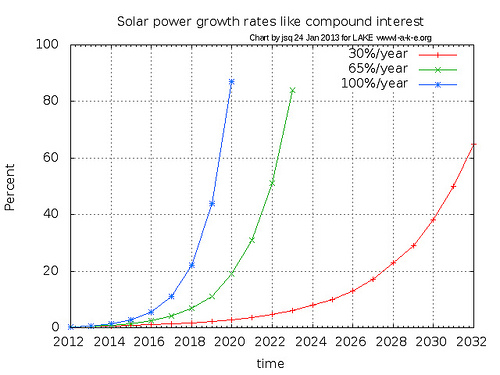
Let’s look what happens if we assume 30% growth in solar power deployed per year:


Solar power growth rates like compound interest

At 30% annual growth,
we’re up to solar as 50% of all generation
within

Continue reading

New U.S. energy in 2012 —FERC


What new energy sources are being deployed the fastest in the U.S.?
According to FERC, the Federal Energy Regulatory Commission,
it’s not what you may think.
The big winners are coal, wind, and solar.

According to the report

Office of Energy Projects
Energy Infrastructure Update
For December 2012
,
Coal, while accounting for only 17% of new capacity in 2012,
unfortunately increased by 133% over new capacity installed in 2011.
Natural gas did account for the second most new installed capacity in 2012,
33%, but the amount in megawatts installed actually decreased by 20%
from 2011.

The most new capacity installed in 2012?
Wind, at 40%, with a 56% increase over new installations in 2011.
That’s right, wind beat natural gas 40% to 33% in total new capacity in 2012,
and whomped gas in increase in new capacity in 2011, by 56% to -20%.

While solar only accounted for 5.59% of new capacity in 2012,
that was an increase of 30% over new capacity in 2011,
which is way more than gas and after only coal and wind.

New Generation In-Service (New Build and Expansion)
December 2012 January – December 2012 Cumulative January – December 2011 Cumulative Percent of Total New 2012 Percent Increase 2011- 2012
Primary Fuel Type No. of Units Installed Capacity (MW) No. of Units Installed Capacity (MW) No. of Units Installed Capacity (MW)
Coal 4 1,434 8 4,510 15 1,932 17.1% 133%
Natural Gas 6 2,306 94 8,746 108 11,020 33.1% -20.6%
Nuclear 0 0 1 125 0 0 0.474% -%
Oil 0 0 19 49 66 136 0.186% -64%
Water 2 4 13 99 41 94 0.375% 5.32%
Wind 45 3,095 164 10,689 146 6,844 40.5% 56.2%
Biomass 5 91 100 543 131 446 2.06% 21.7%
Geo- thermal Steam 2 9 13 149 9 56 0.565% 166%
Solar 16 77 240 1,476 354 1,131 5.59% 30.5%
Waste Heat 0 0 1 3 2 136 0.0114% -97.8%
Other 2 0 5 0 11 0 0% -%
Total 82 7,016 658 26,387 883 21,795 100% 21.1%

Source: Data derived from Ventyx Global LLC, Velocity Suite.

Last two columns added by jsq for LAKE www.l-a-k-e.org 24 January 2013.

Biomass unfortunately accounted for

Continue reading

China, etc., mining uranium in Niger and Mali

A commenter on
Mali: a French War for Uranium
suggested that if "that zone" (presumably
the Sahara in Mali and Niger)
were such an El Dorado the U.S. and the Chinese would have long been interested.
Actually, it turns out numerous countries are involved, especially along
the
Uranium Highway in the Uranium Province in Niger.
Not the Americans so much, but definitely the Chinese.


According to

World Information Service on Energy Uranium Project
,
in

Mali
, it's the Canadians (Cascade Resources Ltd.,
Northern Canadian Uranium Inc., Rockgate Capital Corp.) and
the Australians (Oklo Uranium Ltd).:

The following companies are performing uranium prospection and/or exploration in Mali:


Cascade Resources Ltd. ,
Northern Canadian Uranium Inc. ,
Rockgate Capital Corp. ,
Oklo Uranium Ltd


Faléa uranium/silver project

> View deposit info
Opposition to uranium mining in Faléa: Association des ressortissants et
amis de la Commune de Faléa (ARACF)

Pre-Feasibility study on Faléa mine project started:


On Nov. 15, 2012, Rockgate Capital Corp. announced the commencement of a Pre-Feasibility study on its Faléa U-Ag-Cu project in south-west Mali. Rockgate has engaged the services of the DRA Group of Johannesburg, South Africa to complete the study.

Environmental and social baseline studies commissioned on Faléa mine project:
On April 26, 2010, Rockgate Capital Corp. announced that it has commissioned environmental and social baseline studies on the Faléa Project, Mali.

Apparently Niger has more recoverable Uranium than either the U.S. or Canada;
more than Kazakhstan; more than any country except Australia.


In Niger
, it's Russia, Korea, India, and here are a few notes
about Chinese involvement:


Areva ready to give Chinese access to Imouraren uranium mine:

French nuclear giant Areva is ready to open up to a Chinese partner the

Continue reading

Overwhelming majority of Americans want clean water and renewable energy –poll


A
new poll
says 94% want new energy balanced with clean air and water, 86% want to shift from coal and nuclear to wind and water power, and 79% are concerned about shale gas fracking affecting water quality.

A few excerpts from the PR

Water is High Priority for Bipartisan Majority of Americans
,
10 January 2013,

  • 92 percent of Americans think “U.S. energy planning and
    decision making” should be based on “a comprehensive
    understanding of what our national water resources are”
    — a national water roadmap that Congress asked for, but which
    was never produced. The national water roadmap attracts the support
    of 92 percent of Republicans, 89 percent of Independents, and 94
    percent of Democrats.
  • 86 percent of Americans want leadership on shifting from coal and
    nuclear energy to wind and solar. Support for this approach exists
    across party lines, including 72 percent of Republicans, 83 percent
    of Independents, and 97 percent of Democrats.
  • 86 percent of Americans “support more studies of the health
    and environmental consequences of the chemicals” used in
    fracking. Supporters of this approach include 81 percent of
    Republicans, 84 percent of Independents, and 89 percent of
    Democrats.
  • Three quarters of Americans have heard of fracking, with 51 percent
    saying they are very or somewhat familiar with it. 79 percent of
    Americans are concerned about fracking “as it relates to water
    quality.”

What is to be done?

Continue reading

The water is not lost. —Forrest H. Williams


Valdosta resident Forrest H. Williams replied in the VDT today to

my op-ed of 6 January.

His information seems a bit out of date.
For example, he cites

Progress Energy’s Crystal River nuke

as a good example, when it’s been

down since 2009

and is still

producing zero percent power
,
both according to the NRC.
Readers of this blog know that

the blog version of my op-ed

already links to sources for everything I said.
I may respond more later, but no doubt there are other people
who want to get involved in this discussion.
And I do thank Forrest H. Williams for airing the sort of disinformation
that is out there, so others can dispel it.

Oh, and saying water that is evaporated is not lost is like saying trees that are burned are not lost. Evaporated water is not available for agricultural or wildlife or drinking water use, and thus is indeed lost.

Continue reading

Help Sierra Club send a message to Georgia Power CEO Bowers


Georgia Sierra Club’s Beyond Coal campaign probably contributed to

Georgia Power’s recent decision
to shut down some coal plants.
Now Sierra Club offers a petition to ask Georgia Power CEO Paul Bowers
to go farther, and replace those coal plants with solar offshore wind power
for jobs and health for Georgia.


Dirty Coal is Out, Help Usher Clean Energy In!

Georgia Power recently announced their plans to retire three of
their oldest and dirtiest coal fired power plants.


Now, we must send
a clear message to Georgia Power’s leadership that we want to keep
Georgia Jobs by investing in homegrown clean energy and energy
efficiency to power our homes and businesses.

Send a message to Georgia Power CEO Paul Bowers telling him to
replace dirty coal with investments in homegrown clean energy and
energy efficiency that can produce thousands of lasting Georgia
jobs.

It’s a petition; details here.

Seth Gunning
explained why

in Sierra Club PR:

Continue reading

Nukes economically hard to justify —GE CEO Immelt

The CEO of General Electric,
the company that designed the reactors

at Fukushima and Hatch 1 and 2,

said nukes are economically hard to justify.
And that was back in July, before
the first new nukes permitted in 30 years,
at Plant Vogtle on the Savannah River,

slipped 15 months.

What’s winning? Shale gas, temporarily, but that’s just a bump
in the road on the way to wind and solar power.

Pilita Clark wrote for Financial Times 30 July 2012,

Nuclear ‘hard to justify’, says GE chief
,


Nuclear power is so expensive compared with other forms of energy
that it has become “really hard” to justify, according
to the chief executive of General Electric, one of the world’s
largest suppliers of atomic equipment.

“It’s really a gas and wind world today,” said Jeff
Immelt, referring to two sources of electricity he said most
countries are shifting towards as natural gas becomes
“permanently cheap”.

“When I talk to the guys who run the oil companies they say
look, they’re finding more gas all the time. It’s just hard to
justify nuclear, really hard. Gas is so cheap and at some point,
really, economics rule,” Mr Immelt told the Financial Times in
an interview in London at the weekend. “So I think some
combination of gas, and either wind or solar … that’s where we see
most countries around the world going.”


GE CEO Immelt may also want to talk to GE’s own research director

Continue reading