Tag Archives: EPA

What the sewer system is currently doing to our backyards —Gabe Fisher

Received today in response to

Tim Carroll’s email.


All, Gabe Fisher here—2420 Meadow Brook. I do not currently
have the time, nor mental capacity to fully think through this
issue, but I want you all to see what the sewer system is currently
doing to our backyards.

This video
was taken today, in by backyard,
after the flood. It has been spilling at least at this same rate for
the last 7 days.


What the sewer system is currently doing to our backyards —Gabe Fisher

Video by Gabe Fisher, Valdosta, Lowndes County, Georgia, 3 March 2013.

This contaminated water breached my crawlspace, around 24″ deep, and
must absolutely be dealt with ASAP. What is the city going to do for
me, and my neighbors who are in this same situation??

There is no other word for it—I am pissed. I have seen zero
results since the flood in 2009. Yes, maybe receiving 12″ inches of
rain is an act of God, but that does not account for all the man
made structures that force the flood waters higher at my location,
nor other obstacles it must overcome to quickly and efficiently
escape our area—such as the train trestle along Gornto. And it
absolutely does not account for the city’s poorly planned sewer
system..

This isn’t the first sewage spill since the flood of
2009—there have been countless others in my area. I have
photos and video evidence of at least 5 that would likely be
classified as ‘major’.

This cannot and will not be ‘swept under the rug’.. I am still
currently upside down on my property due to the flood of 2009 and
this current flood has only further degraded my property’s value.

Gabe

Looking at his address in the Lowndes County Tax Assessor’s maps,
and turning on Flood Map, Lakes and Rivers, and Aerial Photos,
you can see that his property and most of all his neighbors’
lots are in the flood plain:

Continue reading

The rest of the story on waste water —Tim Carroll

Received today from Valdosta City Council Tim Carroll, who
sent it to a long list of people,
apparently responding to
the VDT's recent article and editorials.

All,

During my tenure as a city councilman, I have tried to keep everyone
updated on events and issues with our city. I want to share and


email I sent out recently that hopefully you will agree is important
information. In regards to today's paper — the story has some
serious errors and omissions. First of all in 2009- all we saved
from the flood was the pump station. No sewage treatment was taking
place and contrary to what the VDT says, then as we are now —
raw sewage was going into the river. It lasted about a month in
2009. With the decision to pull equipment/tanks etc so they would
not be destroyed this year — we not only saved a lot of tax
payer money….but we will be able to bring the plant back on line
in about a week. Reducing by several weeks the amount of sewage
going into the river. In regards to city water systems being
compromised — considering our water plant is 10-15 miles north
of the WWTP and the amazing fact that the river flows south —
your water is completely safe. Do we like discharging raw sewage
into the river? Of course not. During the flood it was going to
happen either way.

I want to add one other note — the men and women in our
Utility department, fire, police, sanitation, engineering etc, etc

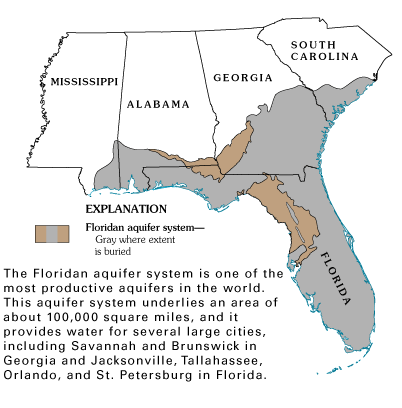
Floridan Aquifer

have been working long days this past week trying to manage flooding
issues. They deserve our thanks. It is very frustrating for those
whose homes and businesses were threatened by the flood. It is very
frustrating to our city employees who have worked so hard to manage
this crisis.

So as Paul Harvey says — “here is the rest of the
story”.

I think Council Carroll is a bit cavalier about
the city's wells being upstream of the wastewater treatment plant,
because while the river may flow south, it's not clear how
the Floridan Aquifer flows, especially with multiple 800 foot
deep wells sucking water out of it.
Also I wonder what people downstream of the Withlacoochee Wastewater
Treatment Plant think of all that raw sewage coming down at them,
especially considering some of them have wells downstream.

However, he makes a number of points that the VDT omitted,
including a plan to do something about the situation,
and appended is his "rest of the story".

Continue reading

VDT v Valdosta Re Wastewater

The VDT has apparently decided the City of Valdosta is to blame
for the
Withlacoochee Wastewater Woes,

and has made its case in a story and two editorials.
They seem to have forgotten about

the overflow in 2012
already.
And the VDT seems to have forgotten about it and its editor's own
apparent roles in the loss of the recent SPLOST election that
would have funded a new wastewater plant.

Jason Schaefer wrote for the VDT today,

Money saved at river's expense:
EPD investigates cause of sewage release as waters recede
,

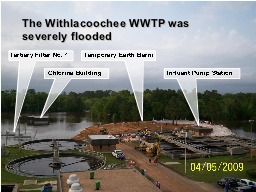
When the flooding occurred in April 2009, the City made


extraordinary efforts to hold back the flooding, bringing in dirt
and heavy machinery to build a berm around the influent pump station
and other treatment equipment, working round the clock.

The efforts were successful. The treatment plant remained on during
the duration of the flood, and Valdosta's raw sewage remained
contained, though the facility incurred damages to its electrical
and biological purification systems, according to Utilities Director
Henry Hicks.

This year, the City opted for a different approach—cut
electricity to the underwater portions of the plant, submit to the
flooding and clean up afterwards.

The plant was “taken offline” Thursday at 9 a.m.
“to prevent further damage to equipment and associated
electrical and control systems,” according to a statement
issued by the Department of the City Manager.

The City stated that as a result of the shutdown, “untreated
sewage will be discharging directly into the river” at a rate
of between five and six million gallons of raw sewage per day.

In addition, the floodwaters were allowed into the plant and around
the remaining portions of the berm that was constructed in 2009
during the rising flood. Only half of the berm now remains, as the
other half was removed to allow access to the lower portions of the
plant, Hicks said.

So far, this year's response strategy seems to have saved the City
money. In 2009, about $500,000 was spent in manpower, equipment and
supplies to build the berm alone, and the plant, kept running,
incurred significant damages though raw sewage was kept out of the
river. This year, the money was not spent on the berm or to prevent
the flooding, and at least 15 to 20 million gallons of raw sewage
will have been released into the Withlacoochee by the time the plant
is back online.

There's more in the story, which is well worth a read.
Also note this inserted in the middle of the story:

Editor Kay Harris contributed to this story.

The VDT cites the EPA report,

National Enforcement Initiative (FY 2011 – 2013)
Keeping Raw Sewage and Contaminated Stormwater Out of Our Nation’s Waters
,
(more about that EPA initiative

here
)
and continues:

Continue reading

The water is not lost. —Forrest H. Williams


Valdosta resident Forrest H. Williams replied in the VDT today to

my op-ed of 6 January.

His information seems a bit out of date.
For example, he cites

Progress Energy’s Crystal River nuke

as a good example, when it’s been

down since 2009

and is still

producing zero percent power
,
both according to the NRC.
Readers of this blog know that

the blog version of my op-ed

already links to sources for everything I said.
I may respond more later, but no doubt there are other people
who want to get involved in this discussion.
And I do thank Forrest H. Williams for airing the sort of disinformation
that is out there, so others can dispel it.

Oh, and saying water that is evaporated is not lost is like saying trees that are burned are not lost. Evaporated water is not available for agricultural or wildlife or drinking water use, and thus is indeed lost.

Continue reading

Putting conservation into conservatives —John S. Quarterman

My op-ed in the VDT today. -jsq

Gov. Deal
(WABE, 14 Nov 2012)
temporarily forgot that “conservative”
includes conserving something,


like

Theodore Roosevelt and national parks
,
or when

Franklin D. Roosevelt established the Okefenokee National Wildlife
Refuge
which also

administers Banks Lake,
when

Richard Nixon started the EPA,

and when

Jimmy Carter signed the Soil and Water Conservation Act.

If Gov. Deal wants to call conservation “liberal”, I’m happy to
be a liberal working for water for our state!


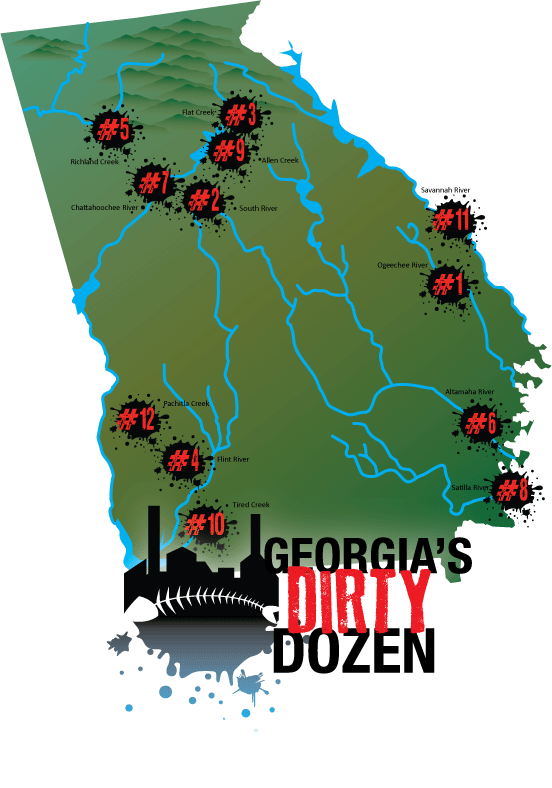
Georgia Water Coalition’s Dirty Dozen


listed the biggest boondoggle
of all as

#11: the nuclear reactors at Plant Vogtle

suck up more water from the Savannah River than all local agriculture and almost
as much as the city of Savannah.

If the new Plant Vogtle nukes

are ever completed,
all four will use more water than Savannah. In

2009 the legislature approved and Gov. Deal signed a law

letting Georgia
Power charge its customers in advance for building that boondoggle,
to the tune of

about $1.5 billion so far!

Let’s not forget

Continue reading

Renewables are Winning, Nukes are Dead, and Coal is Crashing


Somebody is willing to read the sunshine writing:

Renewables are Winning, Nukes are Dead and Coal is Crashing
, as
Kathleen Rogers and Danny Kennedy wrote for EcoWatch 14 Dec 2012.

As I wrote

back in April when formerly coal-plotting Cobb EMC went solar:

Coal is dead. Nuclear is going down.
Solar will eat the lunch of utilities that don’t start generating it.

Can Georgia Power and Southern Company (SO) read that handwriting on the wall?


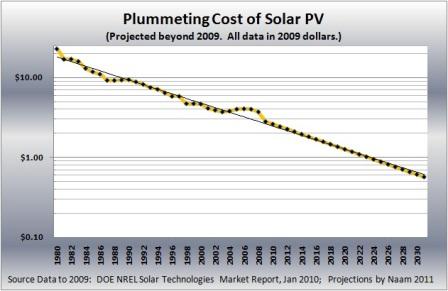
They can’t fight Moore’s Law, which has steadily brought the cost
of solar photovoltaic (PV) energy down for thirty years now, and
shows no signs of stopping.
This is the same Moore’s Law that has put a computer in your pocket
more powerful than a computer
that cost hundreds of thousands of dollars in 1982
and was used by an entire company.

Solar PV costs dropped 50% last year.

Already
all the new U.S. electric capacity installed this September
was solar and wind.

As this trend continues, solar will become so much more cost-effective
than any fossil or nuclear fuel power that nobody will be able to ignore it.

Rogers and Kennedy explained this phenomenon:

The seismic shift in how we all use cell phones and mobile technology to access the internet almost snuck up on the incumbent technologies and the monopolies that made money selling us landline telephones and a crappy service. Now, we’re all using apps on smartphones all of the time. So too, the shift to a scaled, solar-powered future built around the modular technology at the heart of solar power—the photovoltaic solar cell—will come as a surprise to many. We call it the solar ascent, and it is happening every day in a million ways.

Will SO and Georgia Power continue to prop up

that 1973 legal wall


that

inhibits solar financing in Georgia?

Companies and even economic development authorities are

starting to find ways around it,

and of course there’s

Georgia Solar Utilities (GaSU)
trying to

wedge into the law as a utility.

After Hurricane Sandy,

rooftop solar for grid outage independence

has suddenly hit the big time
(Austin Energy caught onto that back in 2003).
The

U.S. military got solar and renewable energy

back in Afghanistan and are now doing it bigtime everywhere.

SO and Georgia Power can try to ignore

Continue reading

How to implement trash, health, and safety?

Disposal of solid waste (trash/garbage) is a matter of

community public health and safety

and providing such service

is the responsibilty of the local governing bodies.

How should trash health and safety responsibly be implemented?


We cannot be left in a situation where residents are either “forced
to buy” service from a provider, or have no option but to burn
their trash. The government can levy a tax, but they cannot say that
residents are forbidden to buy a service from an independent provider.

Such a ruling is

  • unfriendly to those who currently own, or want to
    start

    a waste collection business in our county
    ,
  • unfriendly to the
    residents who are counting on the government to follow
    the state-legislated goals to

    “protect the health
    safety, and well-being of its citizens and to protect
    and enhance the quality of its environment” ,

  • unfriendly to the environment as trash ends up on the side of the
    road or polluting the air by being burned and leaves us to
    face a new problem on a different day.

Residents in the unincorporated areas of the county who want curb side
collection, for the most part, already purchase it. Those of us using

the collection centers
do so because it is our preference.

The county
should (in my opinion) create a special tax district for waste disposal
(it already makes special lighting districts) and tax the residents
for the maintenance of the collection centers.

-gretchen

Who implements trash, health, and safety?

As we’ve seen, solid waste is a matter of public health, safety,
well-being, and the environment,

according to Georgia state law.

Whose responsibility is it to protect the environment
and the public health, safety, and well-being from solid waste?

Many health and safety issues are handled through the health department,

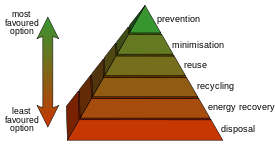
Diagram of the waste hierarchy


including the Georgia Department of Public Health,

and the

South Health District

(Ben Hill, Berrien, Brooks, Cook, Echols, Irwin, Lanier, Lowndes, Tift and Turner Counties).
Particularly, water quality (septic tanks, well water), food safety,
cleanliness of hotels, motels, restaurants, swimming pools and so on
are the responsibility of the local health department,
such as the

Lowndes County Health Department.

However, disposal of solid waste (trash/garbage) is handled by
the local municipality or governmental body (county).

The EPA has a variety of documents available about solid waste.

So does the state EPD, as enabled through Georgia Legislation:

Existing Rules and Corresponding Laws
.

So, where does this leave us?
See next post.

-gretchen

Energy experts making excuses for fracking

Numerous eminent current and former regulators, governors,
and legislators’ best advice for how to keep fracking from
polluting our aquifers and drinking water: “strict regulation”.
As Gandhi reputedly said about western civilization: that would be a good idea.
But in Georgia and many other places, where the regulatory agency
(GA PSC) and the legislature are pretty much captured by the utilities
they pretend to regulate, how will we get that “strict regulation”?

This was at a Politico event, sponsored by American Wind Power,
called Energy & the Presidency.

Join POLITICO for a lunch conversation with energy experts and
policy leaders

Energy & the Presidency panel

as they discuss current energy legislation, the
energy debates facing the nation, policy options and what’s ahead in
the year to come. Speakers include: ClearView Energy Partners’ Kevin
Book; former Administrator of the EPA and former Director of the
White House Office on Climate Change, Carol Browner; Rep. Ed Markey
(Mass.); former Gov. Bill Richardson (NM) and former Gov. Bill
Ritter (Colo.).

When: Wednesday, September 5, 2012 at 12:00 pm ET


This event was in North Carolina, where the late John Blackburn, Ph.D.
already reported two years ago that

the whole state could be powered by wind, sun, existing hydro, landfill gas, and less natural gas than is already in use,

why do we need fracking at all?

Georgia has similar real renewable energy potential,
plus studies by

Georgia Tech

and Duke
indicate that Georgia doesn’t need any additional total electric power
anyway, if it gets on with energy efficiency.
Add

solar
and

wind
instead of natural gas, and we can retire a lot of
coal plants.
With no need for fracking.

I have an idea:
let’s elect Public Service Commissioners and legislators who are not
beholden to the utilities they will regulate!

-jsq

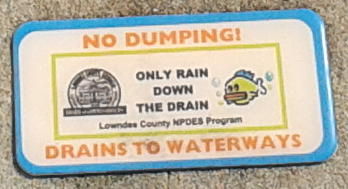
No dumping! Drains to waterways


No dumping


Rainwater only

Seen Saturday near old Pine Grove School.
NPDES is

National Pollutant Discharge Elimination System
:

Water pollution degrades surface waters making them unsafe for
drinking, fishing, swimming, and other activities. As authorized by
the Clean Water Act, the National Pollutant Discharge Elimination
System (NPDES) permit program controls water pollution by regulating
point sources that discharge pollutants into waters of the United
States. Point sources are discrete conveyances such as pipes or
man-made ditches. Individual homes that are connected to a municipal
system, use a septic system, or do not have a surface discharge do
not need an NPDES permit; however, industrial, municipal, and other
facilities must obtain permits if their discharges go directly to
surface waters. In most cases, the NPDES permit program is
administered by

authorized states.

Since its introduction in 1972, the NPDES permit program is
responsible for significant improvements to our Nation’s water
quality.

Yes, I know Valdosta also does this.
I like it that in a subdivision in an unincorporated part of Lowndes County
that the county does this.

-jsq