Category Archives: Renewable Energy

Solar Bangladesh

Georgia Power’s idea of “distributed” is 2 to 20 Megawatt solar farms
doled out over several years.
Bangladesh reminds us how distributed is really done.

Justin Guay wrote for ThinkProgress 18 Dec 2012,

Small Is Big: Bangladesh Installs One Million Solar Home Systems


In one of the poorest countries on earth, a renewable energy
company, Grameen Shakti, is busy installing nearly 1,000 solar home
systems each day. It turns out all that small-scale solar has
achieved something quite big.

In November, Grameen Shakti hit one million Solar Home Systems
installed. The company’s milestone reinforces a lesson that is
increasingly clear: Whether it’s Germany, the U.S., or even China,
distributed solar installations are driving the solar revolution.

How is this possible?

Continue reading

Bainbridge beats Valdosta!


Bainbridge City Hall now hums with solar energy
,
Tristan Baurick wrote for Kitsap Sun 2 August 2012:


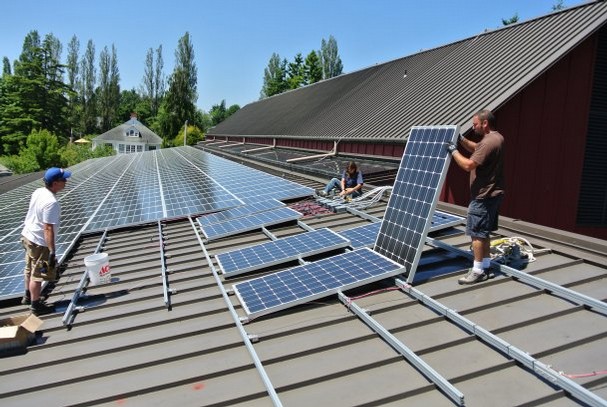
City Hall’s array of 297 rooftop solar panels is expected to produce
the equivalent of 20 percent of the building’s energy needs,
according to Joe Deets, executive director of Community Energy
Solutions, the Bainbridge nonprofit group that spearheaded the
privately-funded project.

“This is a great day for Bainbridge,” Deets said.

How many solar panels do you see on Valdosta City Hall?
Well, that’s a historic building.
But how about City Hall Annex?
The parking lot?
The

formerly “100% Paid by SPLOST” Lowndes County palace that
we’re now paying almost $9 million in bonds for?

Nope, not a solar panel in sight.

Oh, sorry, that’s

Continue reading

Fake fracking reports: professor and institute head quit, other institute disbanded

From Austin to Buffalo, fake science for fracking is increasingly being exposed,

Frack U

with academic consequences: lead professor resigns,
institute head quits, another institute disbanded.
The image on the right (Frack U) is not a reputation any university wants to see.
At least academia takes conflicts of interest seriously;
now if government and the voters would do the same….
Or energy companies.
Remember, shale gas (plus nuclear) is what Georgia Power and
Southern Company are shifting to from coal,
while shading us from the finances that would enable solar power
for jobs and energy independence in south Georgia.

Terrence Henry
wrote for NPR 6 December 2012,

Review of UT Fracking Study Finds Failure to Disclose Conflict of Interest (Updated)

The original report by UT Austin’s Energy Institute,


‘Fact-Based Regulation for Environmental Protection in the Shale Gas
Development,’
was released early this year, and claimed that there
was no link between fracking and water contamination. But this
summer, the

Public Accountability Initiative
, a watchdog group,
reported that the head of the study, UT professor Chip Groat, had
been sitting on the board of a drilling company the entire time. His
compensation totaled over $1.5 million over the last five years.
That prompted the University to announce an independent review of
the study a month later, which was released today.

The review finds many problems with the original study, chief among
them that Groat did not disclose what it calls a “clear
conflict of interest,” which “severely diminished”
the study. The study was originally commissioned as a way to correct
what it called “controversies” over fracking because of
media reports, but ironically ended up as a lightning rod itself for
failing to disclose conflicts of interest and for lacking scientific
rigor.

Unrepentant
as recently as July,
Professor Groat resigned in November.
Plus this:

Raymond Orbach of UT’s Energy Institute has resigned after the group
became engulfed in controversy over a study of fracking.

And elsewhere even more drastic results have ensued:

Continue reading

2012 Drought more expensive than Hurricane Sandy


You thought Hurricane Sandy was bad?
You were right, but economically, the ongoing drought is worse economically.
But we already know a much brighter path.

Weather Underground founder Dr. Jeff Masters wrote 16 November 2012,

Lessons from 2012: Droughts, not Hurricanes, are the Greater Danger
,

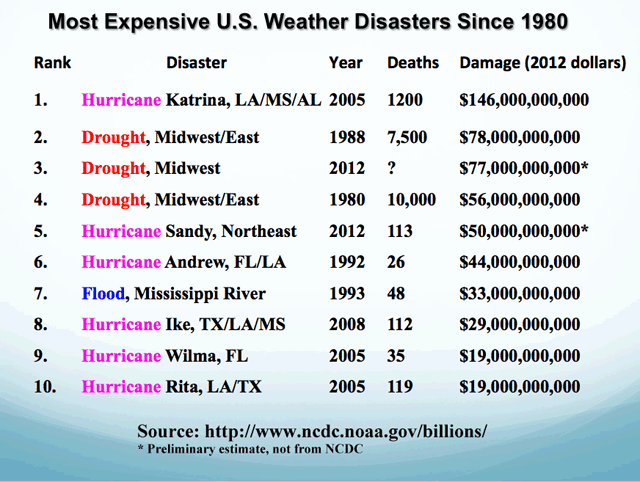
Sandy’s damages of perhaps $50 billion will likely be overshadowed
by the huge costs of the great drought of 2012.


By Dr. Masters’ estimate, the 2012 drought will cost more than half again
as much as Hurricane Sandy.

Also notice Hurricane Katrina still at the top of that table, with almost
three times the economic damage and far more deaths than Hurricane Sandy.
We could have gotten the message back in 2005, but hey, those were only
poor southern people, so who, in for example New York City, really cared?
Yes, I know many of us did and many of you actively helped, but I’m
sure you see my point that when greater New York gets the storm,
suddenly the country pays attention and a lot more people want to find
out how to keep that from happening again.

What’s that drought look like for us here in Georgia at the moment,
according to

U.S. Drought Monitor?

Continue reading

Decatur County already went from private prison to solar park

Decatur County, that’s

turning an industrial park into a solar park
;
why is that county familiar?


Because it’s

the other county that thought it was getting a CCA private prison last year!

Decatur County has already moved on from that boondoggle
that would
have prisoners competing with local workers

while

not increasing local employment
.
Decatur County is already well along towards a solar park that could bring

“400 hundred thousand a year in tax revenue”
.
Has our Industrial Authority got anything in negotiations for a solar park?
How about our Airport Authority?
And what is Georgia Power doing to help?

-jsq

West Point aiming for net zero energy use

U.S. Army is serious about solar, installing solar panels as a
“very visible and a very recognizable part of
our renewable energy initiative that can immediately click with the
general public”
as it makes its military academy net zero, while
encouraging cadets to become renewable energy leaders.
Hm, sounds like

Decatur County with its solar industrial park

and what we could do here with

solar Lowndes High.

Mike Strasser wrote Army PR 29 November 2012,

Solar panels deliver new energy to West Point’s Net Zero initiative,


The installation of solar panels on the roof of the Lichtenberg
Tennis Center—780 panels, to be exact—in recent weeks
represents West Point’s continuing efforts to achieve energy
sustainability.

Since becoming a Net Zero Energy pilot installation last April, West
Point has been making strides toward the ultimate goal of producing
as much energy as it uses by 2020. According to an environmental
assessment for the U.S. Army Environmental Command and West Point
Garrison, the installation currently generates less than .02 percent
of the energy it consumes from renewable sources. Matt Talaber,
Department of Public Works engineer and director, said the solar
panels will be a step in the right direction.

“The solar panels are very visible and a very recognizable part of
our renewable energy initiative that can immediately click with the
general public,” Talaber said. “It’s a positive image that shows
West Point is interested in renewable energy and is working on its
Net Zero energy goals.”

And they’re also improving conservation and efficiency.
Plus this:

Continue reading

Renewables are Winning, Nukes are Dead, and Coal is Crashing


Somebody is willing to read the sunshine writing:

Renewables are Winning, Nukes are Dead and Coal is Crashing
, as
Kathleen Rogers and Danny Kennedy wrote for EcoWatch 14 Dec 2012.

As I wrote

back in April when formerly coal-plotting Cobb EMC went solar:

Coal is dead. Nuclear is going down.
Solar will eat the lunch of utilities that don’t start generating it.

Can Georgia Power and Southern Company (SO) read that handwriting on the wall?


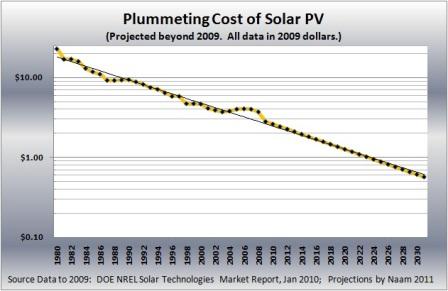
They can’t fight Moore’s Law, which has steadily brought the cost
of solar photovoltaic (PV) energy down for thirty years now, and
shows no signs of stopping.
This is the same Moore’s Law that has put a computer in your pocket
more powerful than a computer
that cost hundreds of thousands of dollars in 1982
and was used by an entire company.

Solar PV costs dropped 50% last year.

Already
all the new U.S. electric capacity installed this September
was solar and wind.

As this trend continues, solar will become so much more cost-effective
than any fossil or nuclear fuel power that nobody will be able to ignore it.

Rogers and Kennedy explained this phenomenon:

The seismic shift in how we all use cell phones and mobile technology to access the internet almost snuck up on the incumbent technologies and the monopolies that made money selling us landline telephones and a crappy service. Now, we’re all using apps on smartphones all of the time. So too, the shift to a scaled, solar-powered future built around the modular technology at the heart of solar power—the photovoltaic solar cell—will come as a surprise to many. We call it the solar ascent, and it is happening every day in a million ways.

Will SO and Georgia Power continue to prop up

that 1973 legal wall


that

inhibits solar financing in Georgia?

Companies and even economic development authorities are

starting to find ways around it,

and of course there’s

Georgia Solar Utilities (GaSU)
trying to

wedge into the law as a utility.

After Hurricane Sandy,

rooftop solar for grid outage independence

has suddenly hit the big time
(Austin Energy caught onto that back in 2003).
The

U.S. military got solar and renewable energy

back in Afghanistan and are now doing it bigtime everywhere.

SO and Georgia Power can try to ignore

Continue reading

Industrial park from green grass to a green solar future: Decatur County

Our Industrial Authority is

in favor of solar business now
;
what if they seeded some of

their industrial parks

with solar panels like Decatur County is doing?
They think it will make them look like a progressive county.
What do we think?

Ty Wilson wrote for WTXL 7 Dec 2012,

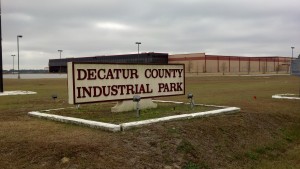
A solar park is coming to the Decatur County Industrial Park
,


The Decatur County Industrial park will go from having green grass
to having a green future.

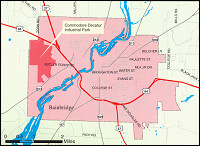
A Lenexa, Kansas company is building a solar farm at the Decatur
County Industrial Park.

The Decatur County Industrial park will go from having green grass
to having a green future.

Keith Lyle is the chairman of the Bainbridge Decatur Development
Authority, he says, “We are just extremely excited to have this come
for the community.”


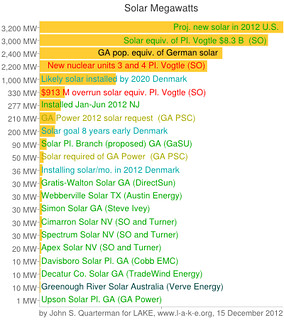
Decatur County Solar Park in solar Megawatt context

And, it’s private investment!


Trade Winds Energy
is leasing at least 100 acres to put in solar
panels at ten thousand dollars a year.

Company executives says they will invest 17 million dollars into the
project.

Lyle says, “This will add from the tax aspect a significant revenue
stream. When it is all said and done you are looking at a taxable
amount of 40 million is assets. On the project that is 400 hundred
thousand a year in tax revenue.”

Trade Wind Energy doesn’t list this project yet
(and all the projects they do list are wind projects),


but if we take a rule of thumb

Continue reading

Rooftop solar for grid outage independence

Solar power can bring for energy independence, not just from foreign countries,
also from the grid during storms and other outages.

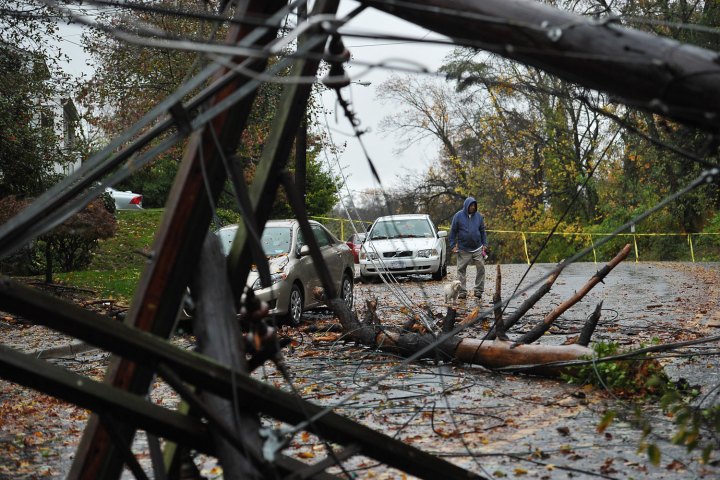
Inspired by the need to deal with downed power lines
in New York and New Jersey after Hurricane Sandy,
David Crane and Robert F. Kennedy Jr. wrote for NYTimes 12 Dec 2012,

Solar Panels for Every Home
,

Solar photovoltaic technology can significantly reduce our reliance

on fossil fuels and our dependence on the grid.
Electricity-producing photovoltaic panels installed on houses, on
the roofs of warehouses and big box stores and over parking lots can
be wired so that they deliver power when the grid fails.

Solar panels have dropped in price by 80 percent in the past five
years and can provide electricity at a cost that is at or below the
current retail cost of grid power in 20 states, including many of
the Northeast states. So why isn’t there more of a push for this
clean, affordable, safe and inexhaustible source of electricity?

First, the investor-owned utilities that depend on the existing
system for their profits have little economic interest in promoting
a technology that empowers customers to generate their own power.
Second, state regulatory agencies and local governments impose
burdensome permitting and siting requirements that unnecessarily
raise installation costs.

I can tell you by experience that solar panels on the roof
(with batteries) can supply power when the grid is out.

In regulatory-captured Georgia, the big impediment to solar is

financing, because of 1973 Territorial Electric Service Act.

When will Southern Company and Georgia Power admit their boondoogle
on the Savannah River has failed and get on with conservation,
efficiency, wind, and solar power?

-jsq

New biomass plant near Dublin, GA: what it’s really about

Not really about jobs, and not about feeding electricity into the grid:
the new biomass plant near Dublin, GA is about saving that company money on electricity: but at what cost to the state and to local residents?


Mike Stucka wrote for Macon.com 6 December 2012,

Deal announces $95 million biomass power plant for Laurens County
,

A new biomass power plant announced Thursday is expected to bring
hundreds of related jobs and a direct $95 million investment.

A statement from the office of Gov. Nathan Deal said the plant
itself will bring 35 permanent jobs to Laurens County.

Compare 35 permanent jobs for $95 million to

MAGE SOLAR’s 350 jobs for $30 million
.
That’s about $2,700,000 per job for this deal,
vs. $85,714 per job for MAGE SOLAR.
Which would make MAGE SOLAR’s facility more than 30 times more effective
at producing permanent jobs.

OK, but what’s this one supposed to do?

Continue reading