Category Archives: Nuclear

15 month delay for new Plant Vogtle nukes —state inspector at PSC


Southern Company's new nukes are delayed at least fifteen months,
at least a billion over budget and rising,
and not organized to meet safety filing requirements,
yet the Georgia PSC yesterday
let SO pass the buck to contractors and Georgia Power
continue charging customers for that boondoggle,
despite 40 to 1 opposition from attendees.

Ellen Reinhardt wrote for GPB News yesterday,

Plant Vogtle Construction Costs Rising
,

An independent auditor told utility regulators Plant Vogtle
construction will be delayed at least 15 months and go millions of
dollars over budget.

Nuclear engineer William Jacobs said poor construction material,
contractor mistakes and oversight delays will mean the Unit 3
reactor won't be ready until July of 2017.

That's 15 months later than planned.

Surprise!
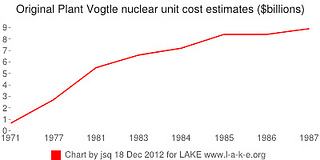
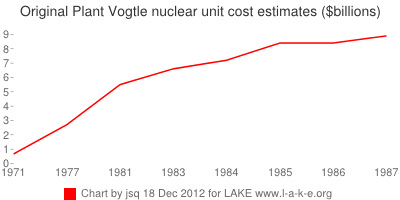
From $0.66 to $8.87 billion: original Plant Vogtle nuclear costs

Who could have expected that, given that back in the 1970s and
1980s

costs blew up 26 times the original estimate.

Back then SO complained about paperwork after Three Mile Island.
They're trying that same excuse now,
but even a former Commissioner-turned-lobbyist is incredulous,
as Kristi Swartz reported for the AJC yesterday,

Monitor: Paperwork problems a drag on Vogtle schedule
,

“It's taken eight months to handle paperwork
deficiencies?” asked Bobby Baker, a former PSC commissioner
who now represents Resource Supply Management, an energy consultant
that works with large commercial, institutional and industrial
electric customers.

A current Commissioner was almost as incredulous:
Continue reading

Original nuclear Plant Vogtle cost overruns

Why should we expect Southern Company to be any better at controlling
costs now than back in the 1970s and 1980s when its original
nukes on the Savannah River went massively over budget?
Massively as in 26 times as much per unit as originally projected.

Kristi Swartz wrote for the AJC 30 Jan 2012,

A financial look at Plant Vogtle nuclear projects
,


From $0.66 to $8.87 billion: original Plant Vogtle nuclear costs

When the two original nuclear units at Plant Vogtle were planned,
the total cost estimate was $660 million.

Yet, as

Jon Gertner reported for NYTimes 16 July 2006
,

The plant took almost 15 years to move from blueprints to being
operational. And by the time it began producing electricity in the
late 1980’s, its total cost, $8.87 billion, was so far overbudget
that Vogtle became yet another notorious example of the evils of
nuclear energy….

The grand plan was to have four reactors. Instead, it was scaled
back to two, Vogtle Unit 1 (finished in 1987) and Vogtle Unit 2
(1989).

That’s right, 4 nuclear units were planned for $660,000,000
fifteen (15) years later only 2 units were built,
for $8,870,000,000.
That’s more than $8 billion in cost overruns,
or more than 13 times the original cost estimate.
So per unit, that’s more than 26 times the original estimate,
or more than $4 billion per unit.

Swartz provided a handy table of cost estimates by year:

Continue reading

Renewables are Winning, Nukes are Dead, and Coal is Crashing


Somebody is willing to read the sunshine writing:

Renewables are Winning, Nukes are Dead and Coal is Crashing
, as
Kathleen Rogers and Danny Kennedy wrote for EcoWatch 14 Dec 2012.

As I wrote

back in April when formerly coal-plotting Cobb EMC went solar:

Coal is dead. Nuclear is going down.
Solar will eat the lunch of utilities that don’t start generating it.

Can Georgia Power and Southern Company (SO) read that handwriting on the wall?


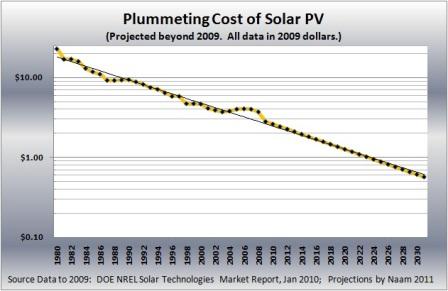
They can’t fight Moore’s Law, which has steadily brought the cost
of solar photovoltaic (PV) energy down for thirty years now, and
shows no signs of stopping.
This is the same Moore’s Law that has put a computer in your pocket
more powerful than a computer
that cost hundreds of thousands of dollars in 1982
and was used by an entire company.

Solar PV costs dropped 50% last year.

Already
all the new U.S. electric capacity installed this September
was solar and wind.

As this trend continues, solar will become so much more cost-effective
than any fossil or nuclear fuel power that nobody will be able to ignore it.

Rogers and Kennedy explained this phenomenon:

The seismic shift in how we all use cell phones and mobile technology to access the internet almost snuck up on the incumbent technologies and the monopolies that made money selling us landline telephones and a crappy service. Now, we’re all using apps on smartphones all of the time. So too, the shift to a scaled, solar-powered future built around the modular technology at the heart of solar power—the photovoltaic solar cell—will come as a surprise to many. We call it the solar ascent, and it is happening every day in a million ways.

Will SO and Georgia Power continue to prop up

that 1973 legal wall


that

inhibits solar financing in Georgia?

Companies and even economic development authorities are

starting to find ways around it,

and of course there’s

Georgia Solar Utilities (GaSU)
trying to

wedge into the law as a utility.

After Hurricane Sandy,

rooftop solar for grid outage independence

has suddenly hit the big time
(Austin Energy caught onto that back in 2003).
The

U.S. military got solar and renewable energy

back in Afghanistan and are now doing it bigtime everywhere.

SO and Georgia Power can try to ignore

Continue reading

Financing solar energy: Georgia’s special problem

In most states, financing solar energy is largely a matter of learning
all the local ropes.
In Georgia, there’s a bigger problem.

Michael Mendelsohn
wrote for RMI 5 December 2012,

How Do We Lower Solar Installation Costs and Open the Market to Securitized Portfolios: Standardize and Harmonize
,

Soft costs can be pretty tough. The cost of solar installations can
be generally separated into “hard” costs — representing
primary components such as modules, racking, inverters — and
soft costs including legal, permitting, and financing. While the
former group — particularly modules — have dropped
dramatically over the last several years, the latter have not.
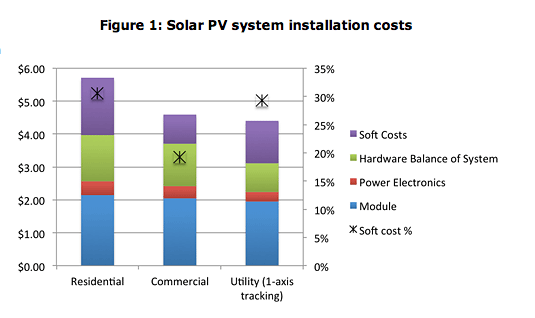
According to a recent NREL analysis, these costs represent roughly
30% of both residential and utility installations (slightly less for
commercial-host systems). See Figure 1.


In fact, soft costs are so critical to the overall success of solar
adoption, their reduction is a primary focus of the Department of
Energy’s SunShot Initiative to make solar energy cost-competitive.
In order to reduce the cost of financing, NREL recently completed
and continues to work on various efforts to tap public capital
markets and enable other vehicles that securitize project
portfolios.

We’ll come back to tapping public capital markets and the like,
because that’s the key to what

Georgia Solar Utilities (GaSU) is trying to do.

But there’s a special problem in Georgia, buried in the next paragraph:

Continue reading

GaSU wins at GA PSC, but will GaSU help all of us win in the legislature?

GA PSC Stan Wise’s 2009 nuclear CWIP lobbying points eerily matched Southern Company’s,
but suddenly he’s got separation-of-powers religion about Georgia Solar Utilities (GaSU).
The PSC recommended GaSU’s utility bid anyway.
When the legislature takes that up in a month or so, will GaSU CEO Robert Green,
unlike SO or Georgia Power or Stan Wise, help the rest of us little people
fix the 1973 Territoriality law so we can sell our solar electricity
on a free market?

Dave Williams wrote for the Atlanta Business Chronicle yesterday,

Georgia Public Service Commission moves ahead on solar energy
,


Georgia Power logo

The Georgia Public Service Commission approved a plan by Georgia
Power Co. Tuesday to acquire an additional 210 megawatts of solar
generating capacity, more than tripling its investment in solar
energy.


GA PSC PR about 20 November 2012 decisions

But a sharply divided PSC also gave a potential competitor to
Georgia Power its blessing to appeal to the General Assembly to
amend a 39-year-old law that gives the Atlanta-based utility the
exclusive right to continue serving existing customers.

Under Georgia Power’s Advanced Solar Initiative, the company will
buy solar power produced by both large “utility-scale”
solar farms and from smaller projects operated by residential and
commercial property owners.

Right, that’s actually

only 10 Megawatts from “smaller projects”,

maintaining Georgia Power’s monopoly while throwing throwing
a bone to the rest of us.

While the PSC supported Georgia Power’s plan unanimously, a
subsequent motion by McDonald encouraging other solar utilities
interested in serving Georgia to pursue their plans with the
legislature passed by the narrow margin of 3-2.

Georgia Solar Utilities Inc., a company launched in Macon, Ga.,
earlier this year, filed an application with the PSC in September
for authority to generate solar energy in Georgia on a utility
scale.

The two Nay votes were from the two recently-reelected PSC members,
apparently now thoroughly in the pocket of the incumbent utilities.
Here’s one of them now:

Continue reading

Help the military stop climate change through sustainable renewable energy

In memory of Armistice Day, the eleventh hour of the eleventh day of the
eleventh month, when World War I ended,
let’s help the military get us off of oil
and to deal with climate change so fewer people will die in wars.

John M. Broder wrote for NYTimes 9 November 2012,

Climate Change Report Outlines Perils for U.S. Military
,

Climate change is accelerating, and it will place unparalleled strains on


American military and intelligence agencies in coming years
by causing ever more disruptive events around the globe,
the nation’s top scientific research group said in a
report
issued Friday.

The group, the National
Research Council
, says in a study commissioned by the
C.I.A. and other intelligence agencies that
clusters of apparently unrelated events exacerbated by a warming climate
will create more frequent but unpredictable crises in water supplies,
food markets, energy supply chains and public health systems.


Hurricane Sandy provided a foretaste
of what can be expected more often in the near future, the report’s
lead author, John D. Steinbruner, said in an interview.

“This is the sort of thing we were talking about,” said
Mr. Steinbruner, a longtime authority on national security. “You
can debate the specific contribution of global warming to that storm. But
we’re saying climate extremes are going to be more frequent, and
this was an example of what they could mean. We’re also saying it
could get a whole lot worse than that.”

Climate-driven crises could lead to internal instability or international
conflict and might force the United States to provide humanitarian
assistance or, in some cases, military force to protect vital energy,
economic or other interests, the study said.


This is in addition to the even more obvious
connection between war and U.S. dependence on foreign oil

which the veterans in Operation Free want to fix

by helping us shift to clean renewable energy.

“In Iraq… the lines would stretch up to ten miles long under
the hot sun, under constant risk of attack by extremists. I realized
then just how vulnerable it makes any country to be dependent on
oil, especially the United States, which uses nearly a quarter of
the world’s supply.”

We also heard last year from

Col. Dan Nolan (U.S. Army ret.) that the Marines in Afghanistan
realized

Continue reading

Solar up 50% over last year in Germany


July in Germany

wasn’t a fluke:
solar PV electricity production in Germany is up 50% over last year.
Maybe we hould consider a Feed-in Tariffs (FIT) in Georgia like that in Germany.
Unlike the Construction Work in Progress (CWIP) charge on Georgia Power
bills for nuclear power people won’t get for years, if ever, FIT charges
only apply after solar power is flowing.

Bloomberg Businessweek via AP 5 November 2012,

German solar power production up 50 pct on year
,


The German utilities’ industry association BDEW said Monday the
solar power output rose to 25,000 gigawatt hours in the January to
September period, from 16,500 gigawatt hours a year earlier.

It says solar power’s share in the country’s electricity production
rose to 6.1 percent from 4.1 percent. Wind power gained slightly to
8.6 percent from 8.0 percent. Biomass plants accounted for almost 6
percent.

It says all renewable energies combined accounted for about 26
percent of electricity production over the first nine months.

Germany decided last year to phase out nuclear power by 2022 and
replace it with renewable energies.


If you’re tired of Georgia Power and its parent Southern Company
pouring your customer and tax dollars down that nuclear pit near
the Savannah River, or if you’d just rather have solar or wind power,
you can send in your CWIP charge as a separate check, with a note on it.
Even if you’re not a Georgia Power customer, you can

contact them or Southern Company (or the GA PSC or the legislature)
about this.

-jsq

Georgia Power raising rates


Georgia Power is raising rates
in January, despite its recent announcement that it would lower
rates because of lower fuel bills.
Why raising?
Mostly the new nukes and for a new natural gas plant.
And 16% of the rise is for energy efficiency.
Does that seem like the right proportion to you?

Kristi Swartz wrote for the AJC 1 Nov 2012,

Georgia Power bills to increase
,

The average Georgia Power bill will increase about 44 cents a month
starting in January, not decrease as many might have expected when
the company announced last month its fuel costs had dropped.

The utility, which serves 2.4 million customers, notified state
regulators in October that it would be applying for a residential
rate reduction because the amount it pays for fuel has fallen 7
percent, saving $122 million. The utility cannot profit from lower
fuel costs and must pass those savings on to customers.

So why are customer rates going up?

About $1.05 of the typical residential bill will go toward paying
for a new natural gas unit at Plant McDonough-Atkinson in Smyrna.
That increase already was approved as part of a three-tiered rate
hike set in 2010.

Yep, that’s that

set-in-2010 and keep-rising-’till-2013 natural gas
rate hike

that Georgia Power got away with while complaining about
any potential solar subsidies.
The one
AJC complained would be “on autopilot”:

Continue reading

Nuclear reactors near here

If you think of nuclear reactors as something far away,
or as much safer than Fukushima,
you’re in for a surprise.
The most notorious reactors are the ones not yet built,
units 3 and 4 at Plant Vogtle near Augusta and their

famous financial boondoggle.

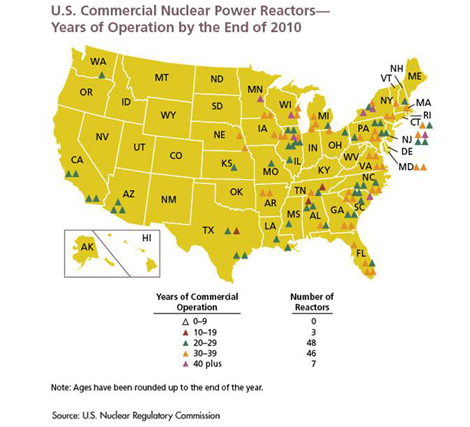
But others are closer, older, and more numerous than you may know.

Here’s a map by the Nuclear Regulatory Commission (NRC).


That map’s not clickable, so here’s a table,
selected from an

NRC table

by distance from Valdosta:

Name Owner Where Distance
from
Valdosta
Hatch 1 & 2* SNOC 11 miles N of Baxley, GA 100 miles
Farley 1 & 2 SNOC 18 miles SE of Dothan, AL 125 miles
Crystal River 3 PGN 80 miles N of Tampa, FL 160 miles
Vogtle 1 & 2 SNOC 26 miles SE of Augusta, GA 200 miles
Summer SCEG 26 miles NW of Columbia, SC 300 miles
Saint Lucie 1 & 2 FPL 10 miles SE of Ft. Pierce, FL 325 miles
Oconee 1,2,3 Duke 30 miles W of Greenville, SC 330 miles
Robinson 2 PGN 26 miles NW of Florence, SC 350 miles
Sequoya 1 & 2 TVA 16 miles NE of Chattanooga, TN 360 miles
Catawba 1 & 2 Duke 18 miles S of Charlotte, NC 390 miles
McGuire 1 & 2 Duke 17 miles N of Charlotte, NC 410 miles
Browns Ferry 1,2,3* TVA 32 miles W of Huntsville, AL 410 miles
Turkey Point 3 & 4 FPL 20 miles S of Miami, FL 440 miles
Brunswick 1 & 2* PGN 40 miles S of Wilmington, NC 480 miles
Waterford 3 Entergy 25 miles W of New Orleans, LA 495 miles
Shearon Harris 1 PGN 20 miles SW of Raleigh, NC 498 miles
* GE Mark I;
Duke: Duke Energy Power Company, LLC;
Entergy: Entergy Nuclear Operations, Inc.;
FPL: Florida Power & Light Co.;
PGN: Progress Energy;
SCEG: South Carolina Electric & Gas Co.;
SNOC: Southern Nuclear Operating Company;
TVA: Tennessee Valley Authority

Five operating nuclear power reactors are closer to us

Continue reading

Calvert Cliffs nuke terminated

Yesterday on Nuclear Information and Resource Service’s

website
:


Update, November 1, 2012: UniStar is seeking review of decision by
NRC Commissioners, Nuclear Energy Institute filed motion in
support. NIRS and NRC staff support the ASLB decision. We
will post the Commissioners’ decision when filed. However,
today the ASLB officially issued an order terminating the
Calvert Cliffs-3 licensing proceeding.

That continues

what happened after EDF pulled out

and

neither Southern Company (SO)
nor Duke would step in.
Another one down, SO:
watch out for your

three-legged nuclear regulatory-capture stool

at Plant Vogtle on the Savannah River!

-jsq

PS: Owed to Star Priscilla.