Category Archives: Climate change

Circular wastewater firing squad continues

The VDT's Sunday front page was covered with wastewater stories,
continuing the circular firing squad of the local powers that be.
Meanwhile

in Dublin, GA, they're breaking ground for solar panels
at the local high school
, using a bond financing
model that we could use here, if local leaders would look up.



In addition to

some detail about the city's FEMA application

and

following up on flooded yards
,
the VDT followed up on

its EPD and EPA scrutiny story

with one saying

City received help from EPD to keep EPA away.

It's good the VDT is covering these issues, but it's still leaving out
important parts of the local water story.

Apparently firing back at



Thursday's Valdosta City Council session
,
perhaps especially

Robert Yost's very pointed criticisms of the VDT,

the VDT concluded its

rather rich Sunday editoral:

City leaders, please, no more of the blame game. The citizens of
this community are imploring you to just accept responsibility and
fix it.

Yet the VDT has

spent the last week blaming the city
,
and has accepted no responsibility for its own role, or that of
its editor, Kay Harris, in the recent loss of the SPLOST referendum
that would have further funded wastewater work in Valdosta.

Now, I agree with the VDT that

Continue reading

Nuclear is over —Jeremy Rifkin


Economist, author, and advisor to governments

Jeremy Rifkin

told an agent of the world's largest uranium field operator
at a conference of global investors that there's no business
future in nuclear power.

Jeremy Rifkin answered a question at the

Wermuth Asset Management


5th Annual Investors Event
26 September 2012,

Nuclear Power is Dead,

I don't spend much time on nuclear technology, unless somebody asks


me about it, because frankly from a business perspective, I think
it's over….

Here's

the video,
followed by more transcript and discussion.

Nuclear power was pretty well dead in the water in
the 1980s after Three Mile Island and Chernobyl. It had a comeback.
The comeback was the industry said "we are part of the solution for
climate change because we don't emit CO2 with nuclear; it's
polluting, but there's no CO2".

Here's the issue though,

Continue reading

Carbon tax soon in China


If China can tax CO2, so can the U.S.

Hou Qiang wrote for Xinhua 19 February 2013,

China to introduce carbon tax: official

China will proactively introduce a set of new taxation policies


designed to preserve the environment, including a tax on carbon
dioxide emissions, according to a senior official with the Ministry
of Finance (MOF).

The government will collect the environmental protection tax instead
of pollutant discharge fees, as well as levy a tax on carbon dioxide
emissions, Jia Chen, head of the ministry’s tax policy division,
wrote in an article published on the MOF’s website.

-jsq

2012 Drought more expensive than Hurricane Sandy


You thought Hurricane Sandy was bad?
You were right, but economically, the ongoing drought is worse economically.
But we already know a much brighter path.

Weather Underground founder Dr. Jeff Masters wrote 16 November 2012,

Lessons from 2012: Droughts, not Hurricanes, are the Greater Danger
,

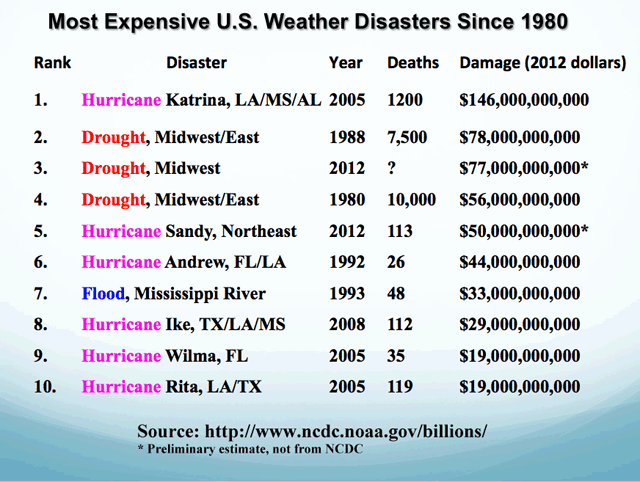
Sandy’s damages of perhaps $50 billion will likely be overshadowed
by the huge costs of the great drought of 2012.


By Dr. Masters’ estimate, the 2012 drought will cost more than half again
as much as Hurricane Sandy.

Also notice Hurricane Katrina still at the top of that table, with almost
three times the economic damage and far more deaths than Hurricane Sandy.
We could have gotten the message back in 2005, but hey, those were only
poor southern people, so who, in for example New York City, really cared?
Yes, I know many of us did and many of you actively helped, but I’m
sure you see my point that when greater New York gets the storm,
suddenly the country pays attention and a lot more people want to find
out how to keep that from happening again.

What’s that drought look like for us here in Georgia at the moment,
according to

U.S. Drought Monitor?

Continue reading

West Point aiming for net zero energy use

U.S. Army is serious about solar, installing solar panels as a
“very visible and a very recognizable part of
our renewable energy initiative that can immediately click with the
general public”
as it makes its military academy net zero, while
encouraging cadets to become renewable energy leaders.
Hm, sounds like

Decatur County with its solar industrial park

and what we could do here with

solar Lowndes High.

Mike Strasser wrote Army PR 29 November 2012,

Solar panels deliver new energy to West Point’s Net Zero initiative,


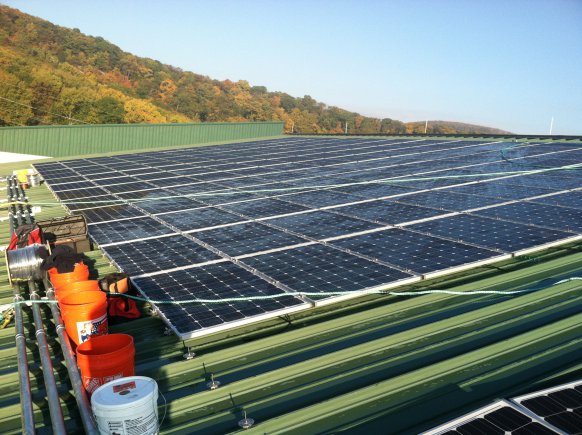
The installation of solar panels on the roof of the Lichtenberg
Tennis Center—780 panels, to be exact—in recent weeks
represents West Point’s continuing efforts to achieve energy
sustainability.

Since becoming a Net Zero Energy pilot installation last April, West
Point has been making strides toward the ultimate goal of producing
as much energy as it uses by 2020. According to an environmental
assessment for the U.S. Army Environmental Command and West Point
Garrison, the installation currently generates less than .02 percent
of the energy it consumes from renewable sources. Matt Talaber,
Department of Public Works engineer and director, said the solar
panels will be a step in the right direction.

“The solar panels are very visible and a very recognizable part of
our renewable energy initiative that can immediately click with the
general public,” Talaber said. “It’s a positive image that shows
West Point is interested in renewable energy and is working on its
Net Zero energy goals.”

And they’re also improving conservation and efficiency.
Plus this:

Continue reading

Renewables are Winning, Nukes are Dead, and Coal is Crashing


Somebody is willing to read the sunshine writing:

Renewables are Winning, Nukes are Dead and Coal is Crashing
, as
Kathleen Rogers and Danny Kennedy wrote for EcoWatch 14 Dec 2012.

As I wrote

back in April when formerly coal-plotting Cobb EMC went solar:

Coal is dead. Nuclear is going down.
Solar will eat the lunch of utilities that don’t start generating it.

Can Georgia Power and Southern Company (SO) read that handwriting on the wall?


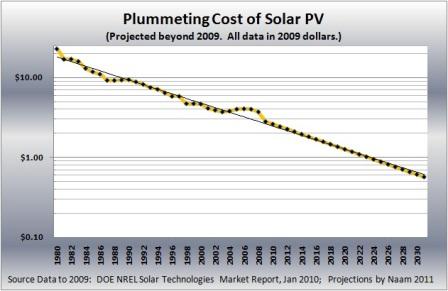
They can’t fight Moore’s Law, which has steadily brought the cost
of solar photovoltaic (PV) energy down for thirty years now, and
shows no signs of stopping.
This is the same Moore’s Law that has put a computer in your pocket
more powerful than a computer
that cost hundreds of thousands of dollars in 1982
and was used by an entire company.

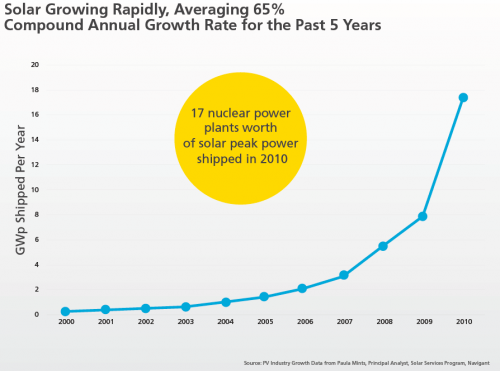
Solar PV costs dropped 50% last year.

Already
all the new U.S. electric capacity installed this September
was solar and wind.

As this trend continues, solar will become so much more cost-effective
than any fossil or nuclear fuel power that nobody will be able to ignore it.

Rogers and Kennedy explained this phenomenon:

The seismic shift in how we all use cell phones and mobile technology to access the internet almost snuck up on the incumbent technologies and the monopolies that made money selling us landline telephones and a crappy service. Now, we’re all using apps on smartphones all of the time. So too, the shift to a scaled, solar-powered future built around the modular technology at the heart of solar power—the photovoltaic solar cell—will come as a surprise to many. We call it the solar ascent, and it is happening every day in a million ways.

Will SO and Georgia Power continue to prop up

that 1973 legal wall


that

inhibits solar financing in Georgia?

Companies and even economic development authorities are

starting to find ways around it,

and of course there’s

Georgia Solar Utilities (GaSU)
trying to

wedge into the law as a utility.

After Hurricane Sandy,

rooftop solar for grid outage independence

has suddenly hit the big time
(Austin Energy caught onto that back in 2003).
The

U.S. military got solar and renewable energy

back in Afghanistan and are now doing it bigtime everywhere.

SO and Georgia Power can try to ignore

Continue reading

Arctic sea ice melting faster than expected —WMO

A major source of the water for the

sea level rise already affecting Savannah and Jacksonville

is melting Arctic Ocean sea ice.

WMO Press Release No. 966:
2012: Record Arctic Sea Ice Melt, Multiple Extremes and High Temperatures
,

“Naturally occurring climate variability due to phenomena such
as El Niño and La Niña impact on temperatures and precipitation on
a seasonal to annual scale. But they do not alter the underlying
long-term trend of rising temperatures due to climate change as a
result of human activities,” said WMO Secretary-General Michel
Jarraud.

“The extent of Arctic sea ice reached a new record low. The
alarming rate of its melt this year highlighted the far-reaching
changes taking place on Earth’s oceans and biosphere. Climate change
is taking place before our eyes and will continue to do so as a
result of the concentrations of greenhouse gases in the atmosphere,
which have risen constantly and again reached new records,”
added Mr Jarraud.


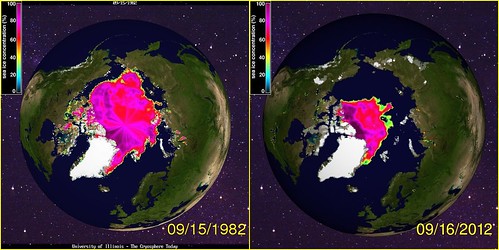
30 years of Arctic sea ice


15 September 1982 vs 16 September 2012

The Arctic reached its lowest annual sea ice extent since the start
of satellite records on 16 September at 3.41 million square
kilometers. This was 18% less than the previous record low of 18
September, 2007. The 2012 minimum extent was 49 percent or nearly
3.3 million square kilometers (nearly the size of India) below the
1979—2000 average minimum. Some 11.83 million square
kilometers of Arctic ice melted between March and September 2012.

WMO noted other effects of climate change outside the arctic, including:

Continue reading

Savannah and Jacksonville most vulnerable to rising sea level

Savannah and Jacksonville are among the east coast cities most vulnerable
to rising sea levels due to climate change, a study finds.
Savannah, Georgia’s main seaport, with storm surges, hurricanes,
and waves on top:
what will that look like?

Suzanne Goldenberg wrote for the Guardian today,

US coastal cities in danger as sea levels rise faster than expected, study warns:
Satellite measurements show flooding from storms like Sandy will put low-lying population centres at risk sooner than projected
,

A

study published last March by Climate Central
found sea-level rise
due to global warming had already doubled the risk of extreme flood
events — so-called once in a century floods — for dozens
of locations up and down the Atlantic and Pacific coasts.

It singled out the California cities of Los Angeles and San Diego on
the Pacific coast and Jacksonville, Florida, and Savannah, Georgia,
on the Atlantic, as the most vulnerable to historic flooding due to
sea-level rise.

Sandy, which produced a 9ft storm surge at Battery Park in New York
City, produced one example of the dangerous combination of storm
surges and rising sea level. In New York, each additional foot of
water puts up to 100,000 additional people at risk, according to a
map published with the study.

That study projected 6 inches rise at Fort Pulaski by 2030 (minimum 3 inches)
and 13 inches by 2050 (maximum 24 inches).
But projections have gotten worse since then:


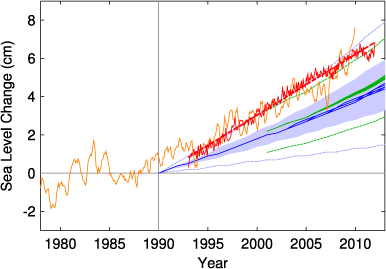
Sea level changes measured and projected

The latest research,

published on Wednesday in Environmental Research Letters,

found global sea-levels rising at a rate of 3.2mm a year, compared to the best estimates by the IPCC of 2mm a year, or 60% faster.

So that would be more like 9 inches by 2030 and 20 inches by 2050.

Add to a higher base sea level bigger storms like Hurricane Sandy,
and Savannah and Jacksonville have a problem.
Sure, Savannah is

Continue reading

How to stop climate change: divest from fossil fuel companies

In response to a very downbeat

diatribe by Bill McKibben in Rolling Stone on the occasion
of the U.N.’s Rio+20 conference
being some sound and less fury accomplishing
not much about stopping climate change,
[Bill McKibben, Rolling Stone, 19 July 2012, “Global Warming’s Terrifying New Math: Three simple numbers that add up to global catastrophe – and that make clear who the real enemy is”]


Chloe Maxmin, Divest Harvard

Harvard student Chloe Maxmin

followed up McKibben’s problem statement with a plan for what to do:

divest from fossil fuel companies. [“In Honor of Kalamazoo: An Open Letter to Bill McKibben,” NextGenJournal, 25 July 2012, no longer online, referred to in a post the same day by Chloe Maxmin on First Here, Then Everywhere.]

Maxmin didn’t just wish, either,
she joined up with McKibben’s 350.org and helped organize
Harvard students to do something about it:
persuade Harvard to divest its shares of fossil fuel companies.
Students at the University of Georgia, or at Valdosta State University,
for that matter, could do the same.

Alli Welton wrote for 350.org 18 November 2012,

72% of Harvard Students Vote to Divest from Fossil Fuels
,

Last Friday night, the Harvard College Undergraduate Council
announced that the student body had voted 72% in favor of Harvard
University divesting its $30.7 billion endowment from fossil fuels.

Members of the Harvard chapter of Students for a Just and Stable
Future have been campaigning since September to divest Harvard’s
endowment from the top 200 publicly-traded fossil fuel corporations
that own the majority of the world’s oil, coal, and gas reserves.

Harvard actually already has divested its shares of one fossil fuel company
due to public pressure.

Continue reading