Category Archives: Renewable Energy

Nuclear reactors near here

If you think of nuclear reactors as something far away,
or as much safer than Fukushima,
you’re in for a surprise.
The most notorious reactors are the ones not yet built,
units 3 and 4 at Plant Vogtle near Augusta and their

famous financial boondoggle.

But others are closer, older, and more numerous than you may know.

Here’s a map by the Nuclear Regulatory Commission (NRC).
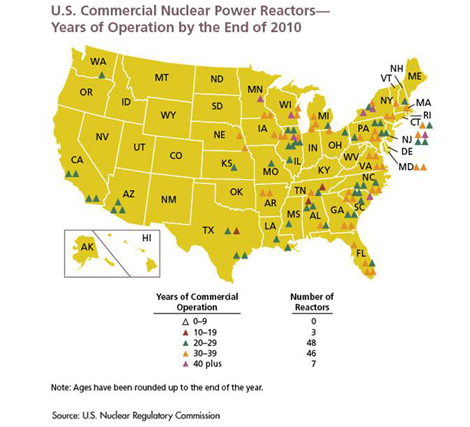

That map’s not clickable, so here’s a table,
selected from an

NRC table

by distance from Valdosta:

Name Owner Where Distance
from
Valdosta
Hatch 1 & 2* SNOC 11 miles N of Baxley, GA 100 miles
Farley 1 & 2 SNOC 18 miles SE of Dothan, AL 125 miles
Crystal River 3 PGN 80 miles N of Tampa, FL 160 miles
Vogtle 1 & 2 SNOC 26 miles SE of Augusta, GA 200 miles
Summer SCEG 26 miles NW of Columbia, SC 300 miles
Saint Lucie 1 & 2 FPL 10 miles SE of Ft. Pierce, FL 325 miles
Oconee 1,2,3 Duke 30 miles W of Greenville, SC 330 miles
Robinson 2 PGN 26 miles NW of Florence, SC 350 miles
Sequoya 1 & 2 TVA 16 miles NE of Chattanooga, TN 360 miles
Catawba 1 & 2 Duke 18 miles S of Charlotte, NC 390 miles
McGuire 1 & 2 Duke 17 miles N of Charlotte, NC 410 miles
Browns Ferry 1,2,3* TVA 32 miles W of Huntsville, AL 410 miles
Turkey Point 3 & 4 FPL 20 miles S of Miami, FL 440 miles
Brunswick 1 & 2* PGN 40 miles S of Wilmington, NC 480 miles
Waterford 3 Entergy 25 miles W of New Orleans, LA 495 miles
Shearon Harris 1 PGN 20 miles SW of Raleigh, NC 498 miles
* GE Mark I;
Duke: Duke Energy Power Company, LLC;
Entergy: Entergy Nuclear Operations, Inc.;
FPL: Florida Power & Light Co.;
PGN: Progress Energy;
SCEG: South Carolina Electric & Gas Co.;
SNOC: Southern Nuclear Operating Company;
TVA: Tennessee Valley Authority

Five operating nuclear power reactors are closer to us
Continue reading

The power of going solar —John S. Quarterman


Solar panels on farm workshop --John S. Quarterman

My op-ed in the VDT today. Remember
to vote today or Tuesday.
-jsq

This spring,

the University at Buffalo
turned on 750 kilowatts of
solar electricity.

Rutgers U., in New Jersey,
installed 1.4
megawatts in 2009 and started on 8 MW this summer. Down here with a
lot more sun, how about solar panels on VSU parking lots?

There’s

plenty of private solar financing available.
Also in New
Jersey, a company installed 6 MW of solar on high school land and
leased the power to the school supplying most of its needs win-win.


You can go see a solar farm already working fine here,

200 kilowatts at Mud Creek Wastewater Plant.

Why not do the same


View Larger Map


at Lowndes High School,
where all the world on I-75 could see,

attracting business to our community?

Why not?

Continue reading

New solar in New Jersey, Massachusetts, Florida: where’s Georgia?

What are these

new solar projects?

Here are a few FERC lists,
in New Jersey, Massachusetts, and Florida,
and there are more in Texas.
Not so many in Georgia.


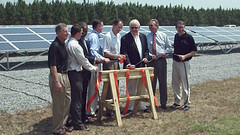
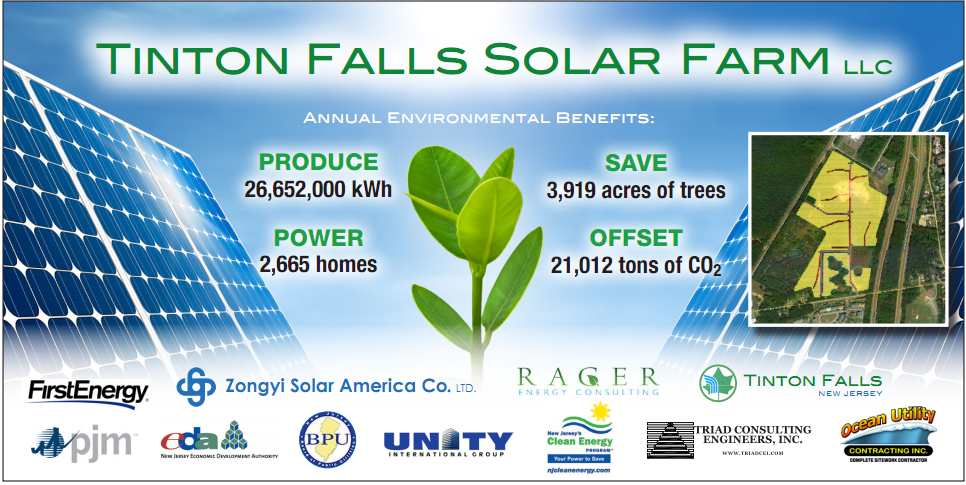
  • Zongyi Solar America’s 20 MW Tinton Falls Solar in Monmouth County,
    New Jersey, is online. Tinton Falls Solar is the largest
    photovoltaic project in New Jersey.
  • Southern Sky Renewable Energy LLC’s 5.6 MW Canton Landfill Solar
    Project in Canton County, Massachusetts is online. This photovoltaic
    project is built on the closed and capped Canton Landfill. It is the
    largest solar facility in New England. The electricity generated is
    sold to the Town of Canton under a long-term agreement.

New Jersey again!
20 Megawatts is even larger than the

6.1 MW at Lawrenceville School.

And Massachusetts, even farther north.
Let’s also look just south of us:


  • SunEdison’s 3.6 MW Phase 2 Lakeland Regional Airport Solar Project
    expansion in Polk County, Florida is online. The Lakeland Regional
    Airport Solar has a total capacity of 6.3 MW. It is the largest
    photovoltaic project in Florida. The electricity generated is sold
    under long-term contract to Lakeland Department of Electric Water
    Utilities.

Ah, but

that’s illegal in Georgia!

Here you can sell electricity only to your one and only monopoly utility,
predetermined for you by the 1973 Territorial Electric Service Act.
Maybe we should change that?

The Lakeland Chamber of Commerce

helped promote that solar project.

Maybe better PR than

feuding with the newspaper?

Also only slightly farther south of us,

Continue reading

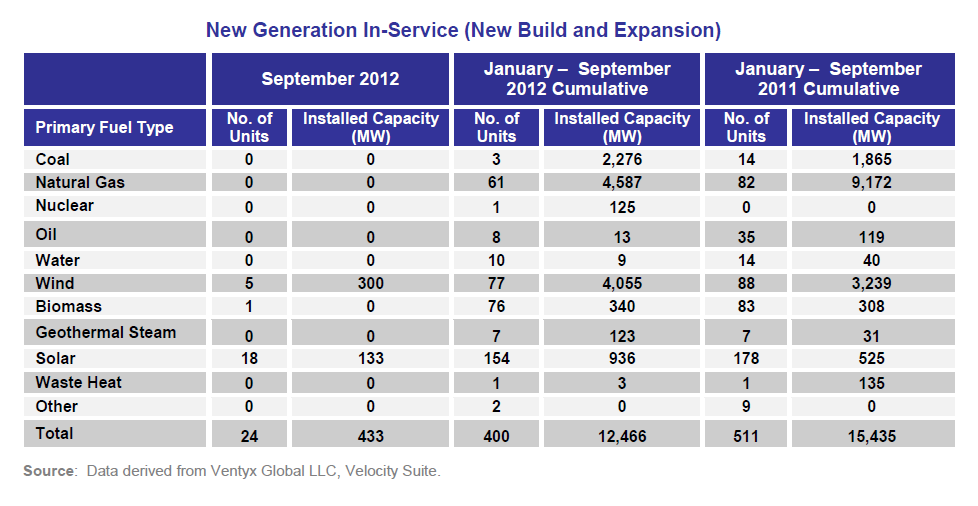
Wind and solar were all the new U.S. electric generation in September 2012

Wind and sun provided all the new electric power generation
deployed in September 2012.
As Moore’s Law continues to decrease solar prices, solar
power gets deployed still more rapidly,
and wind also gets installed on time and on budget.
Meanwhile, nuclear takes a

three-legged nuclear regulatory-capture stool

and hardly any new reactors get finished anyway.


Stephen Lacey wrote for TP Climate Progress 24 October 2012,

Wind And Solar Make Up 100% Of New U.S. Electricity Capacity In September
,

September was tied for the

hottest of any September
on record
globally. It was also a very hot month for renewable energy in the
U.S. According

to figures
from the Federal Energy Regulatory
Commission, wind and solar accounted for all new electricity
capacity added to America’s grid in September.

New wind is up 25% Jan-Sep 2012 over the same period last year,
and new solar is up 78%.
For comparison, new coal is

Continue reading

VDT and Chamber feuding about which is the most negative


popcorn


Image courtesy Fir0002/Flagstaffotos under GFDL v1.2

Break out the popcorn!
The VDT and the Chamber of Commerce are feuding.
About which one is the most negative!
Also, the Chamber hates agriculture.
And everything good around here is to the Chamber’s credit,
but anything bad is not their fault; just ask them.

The VDT editorialized 18 October 2012,

Is Valdosta really one of the poorest?

mostly criticizing

the recent report
that ranked
Valdosta MSA as the third poorest in the country.
The VDT added:

Now that the world wide web has broadcast this story, what can be
done locally to combat this image? And what are the various entities
involved in job and business recruitment, i.e. the Chamber of
Commerce and the Industrial Authority primarily, doing to fix the
underlying problem — low household income and the high
percentage of individuals living below the poverty line.

Valdosta can attract retailers. But can Valdosta step it up and
attract larger industries offering high paying jobs? Has the
community turned away from what made this a successful, viable up
and comer in the state, namely manufacturing and agriculture? These
industries sustained Valdosta for many years and provided good, well
paying, solid blue collar and middle income jobs. Educational
opportunities are far greater today, there are more high school,
tech and college graduates in the area than ever, and blaming the
quality of the work force is starting to lose its luster as a viable
excuse for not bringing in industry. We have the land, we have the
workers, we have the infrastructure and we have a great location
with a good quality of life.

Perhaps the community leadership should focus on the assets that are
already here and less on what’s not. Then maybe the next time a
story like this appears on the Internet, Valdosta won’t be cast in
such a poor light.

The Chamber fired back a broadside to its members, which
I’ve included below here, since I don’t think you can find it online elsewhere.
Here’s the most precious part:

Second, while there is still farmland in Lowndes County, it’s
shrinking and when it sells, it’s for uses at prices that rule out
agricultural use. Agriculture had begun moving to nearby more rural
counties even before the cotton field at the end of Baytree Road
was paved over for Valdosta Mall. Our largest tractor and farm
implement dealers followed.

That’s right, farmland is good for nothing but paving over,
so says the Chamber!
Nevermind that knowledge-based workers generally like

Continue reading

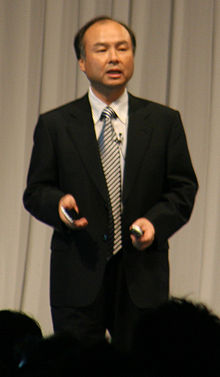
Softbank’s Son to install solar in Japan: watch out, Georgia Power!

The same Masayoshi Son who shook up Japan’s Internet market

and is about to do the same in the U.S.

is moving to modify Japan’s power market from nuclear to solar.
Watch out, Georgia Power and Southern Company!
If you don’t get a move on, Son-san will eat your lunch, too.

Mariko Yasu wrote for Bloomberg Businessweek 23 June 2011,

Softbank’s CEO Wants a Solar-Powered Japan
,


Masayoshi Son

Billionaire Masayoshi Son made a fortune taking on Japan’s phone
monopoly. Now he aims to shake up its power utilities after the
worst nuclear crisis in 25 years. The 53-year-old chief executive
officer of Softbank says he will build solar farms to generate
electricity, with support from at least 33 of Japan’s 47
prefectures. He’s asking for access to transmission networks owned
by the 10 regional utilities and an agreement that they buy his
electricity. No other company has secured unlimited access to the
those transmission networks. The utilities would not comment.
Japan’s main business organization, the Keidanren, called for
“careful analysis” before any drastic change in the power system
took place.

If Japan ever felt ready to back Son’s ambitious plan, this is the
moment. Radiation has spread across at least 600 square kilometers
(230 square miles) in the northeast since the Mar. 11 earthquake and
tsunami led to meltdowns at the Fukushima Dai-Ichi nuclear plant.
Outgoing Prime Minister Naoto Kan said in May he will rethink a plan
to increase atomic power to 50 percent of the nation’s energy output
from 30 percent. Renewable energy already accounts for 10 percent,
according to Japan’s Agency for Natural Resources and Energy. Son
wants to see that tripled by 2020. “The question is how this nation
is going to survive after cutting nuclear power,” he said at a
government panel meeting on June 12.


Complacent Georgia Power and SO,
you maybe don’t think he can do it?
NTT probably thought that, too:

Continue reading

Solar college campuses far to the north: why not at VSU?

This spring,
the University at Buffalo did it
,
and now
Rutgers is doing it:
installing solar arrays for power and profit.
Rutgers is in New Jersey,

the #2 state in solar power.

We have a lot more sun down here.
How about we catch up and get ahead in solar power,
starting with VSU?

Brita Belli wrote for ecoemagination 25 September 2012,

Renewable U: College Campuses Invest in Renewable Energy


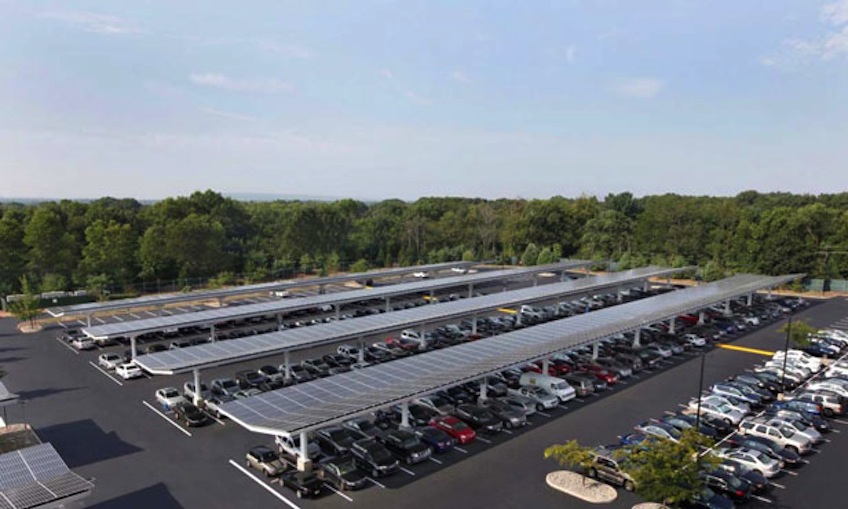
Over the summer, crews at Rutgers University's Livingston Campus
began transforming a 32-acre, 3,500-spot parking lot into one of the
largest solar canopy arrays in the nation. The array will have a
capacity of 8 megawatts, enough to power 1,000 homes.

The canopy is more than just eco window dressing — Antonio
Calcado, Rutgers vice president for facilities and capital planning,
expects that with the financing structure, grants and energy
credits, the investment will return about $28 million to the
university over the next 20 years. A previous solar project had a
similarly rapid payback.

“Combined with the electricity we produce, it's a winner all
around,” says Calcado. “We're an institution of higher
learning—we teach this stuff—so we should also lead by
example. It's a living laboratory in many respects.”

Lead by example: now there's an idea!
An idea that might even attract businesses.

-jsq

Videos @ 30Club 2012-10-22


Here's

a video playlist

of the Candidate Forum last night organized by the 30 Club at Serenity Church.
Probably more commentary later; for now, in the interests of speed, just the raw videos.


Candidates Forum, 30 Club,
J.D. Rice, President

Video by John S. Quarterman for Lowndes Area Knowledge Exchange (LAKE),

Valdosta, Lowndes County, Georgia, 22 October 2012.

-jsq

Solar yes, nuclear expansion no —David Staples for GA PSC


After

he spoke at last Thursday’s Political Forum
,
David Staples said something interesting out in the hall and I asked
him to repeat it for the video camera.

Here’s

the video,

followed by
a transcript.


Video by John S. Quarterman for Lowndes Area Knowledge Exchange (LAKE),
Valdosta, Lowndes County, Georgia, 18 October 2012.

Here’s the
transcript:

I think right now we need to look at solar.
The two new nuclear reactors probably shouldn’t be built right now.
You look at the wholesale power rate curves,
and where it’s most expensive, and it’s during peak hours.
Wholesale power is 50 cents a kilowatt-hour,
and the electric companies are buying at wholesale rates,
What do we need to offset that with?
We’ve got something to do that with: solar.
The cost has come so far down that that’s something
we should be spending our money on rather than
than building nuclear reactors right now.


Solar PV costs

dropped 50% last year.

Southern Company’s new nukes

continue to run farther over budget.

If

Denmark can do it

maybe

Southern Company and Georgia Power should stop manufacturing buggy whips

and

help get Georgia on the solar train.

Staples is

on record for solar

and as he says
ethics matter:
all the incumbent GA PSC members
have taken campaign donations from
people closely associated with the industries they regulate,

(including

Stan Wise
)
and Staples
has apparently

only accepted donations from clean sources.

-jsq


TV ad by Steve Oppenheimer for GA PSC


According to Ted Terry,

We are the first PSC campaign in over a decade to go up on the
broadcast airwaves!

Here’s

the video:

About those rate hikes:

Georgia Power hikes prices for gas and nuclear, then complains about solar

and

We can charge you even if it’s cancelled! —CWIPped Georgia Power

About

the GA PSC incumbents all accepting campaign contributions from people
closely associated with the industries they regulate.

Steve Oppenheimer is on the record as

wanting more energy efficiency
and renewable energy (including solar energy)
.

-jsq