Category Archives: Renewable Energy

Georgia Power hikes prices for gas and nuclear, then complains about solar

Back in February,

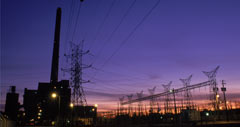
Georgia Power's natural gas Plant McDonough

Georgia Power argued that a free market in solar power would cause
price increases.
Yet they already increased prices for natural gas and
for nuclear plants that won’t produce electricity for years, if ever,
and are already massively overbudget and behind schedule.
Why should we believe them about solar when it’s their archaic projects
they already
are deploying that already have increased customer prices?

In February,

Greg Roberts of Georgia Power argued,

Another reason is that the customers of Georgia Power, Georgia’s

Georgia Power is the snail in the way of solar power in Georgia

EMC’s and Municipal Electric Authority of Georgia are paying for the
poles and wires to transmit power, and the back-up generation to
cover the electricity needs when the sun isn’t shining. These costs
will have to be recovered from other customers not getting the
privileged deal from the developer, raising everyone else’s rates.

While there are already numerous federal and state tax and other
incentives for solar development in Georgia, it is still much more
costly than the service provided by utilities. But what if
third-party solar developers could get other electric customers in
Georgia to foot the bill? That would be the result of this
legislation.

It’s like asking Sally’s Café to pay the electric bill of Joe’s
Cafe across the street, thus allowing Joe to undercut Sally’s
prices.

Georgia Power well knows they could take a percentage of any power
transmitted through their lines, so that wires and poles and
backup generation argument is ludicrous.
And as far as subsidies, how about this one,

Georgia Power, Get the Facts, Investing in Georgia’s Energy Future:
Continue reading

Another $3.5 billion nuclear cost overruns coming —David Staples @ HBA 2012-10-18


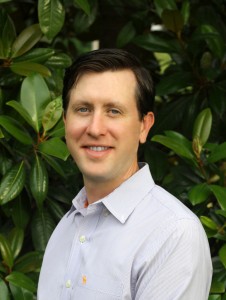
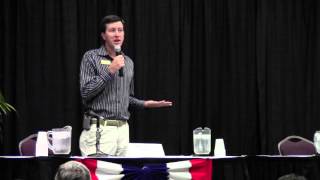
David A. Staples
running for the Georgia Public Service Commission for District 5,
talked about the ethical conflicts of the incumbents who take
almost all of their campaign contributions from people associated
with the utilities they regulate.
Then he mentioned that the new nuclear reactors Georgia Power
is building for Southern Company at Plant Vogtle
have
another $3.5 billion in cost overruns coming.

This is after

the PSC incumbents just rubberstamped the Vogtle budget in August
,
and on top of the

$900 million in cost overruns we already knew about.

That $900 million was already more than 6% of the originally-projected $14 billion
total cost.
If it’s now $3.5 + $0.9 = $4.4 billion, that’s more than 31% over
the original total.
Maybe we should vote in some PSC members and legislators who will stop this nonsense.

Here’s

the video:

Continue reading

Valdosta: 3rd poorest city

Valdosta #3! Followed by Albany #4! In poorest cities in the country.
What can we do about that?

Michael B. Sauter, Alexander E.M. Hess and Samuel Weigley, 24/7 Wall St.,
wrote for NBC News 14 October 2012,

America’s richest and poorest cities
,


3. Valdosta, Ga.

  • Median household income: $32,446
  • Population: 140,599 (87th lowest)
  • Unemployment rate: 9.2 percent(140th highest)
  • Percent households below poverty line: 27.6 percent (ninth highest)

From 2007 to 2011, the unemployment rate in Valdosta increased by
130 percent, from 4 percent of workers to 9.2 percent. The number of
employed workers declined by more than 6,000 during that time. Those
jobs remaining often pay a lower salary. Last year, nearly 17
percent of the work force was employed in the generally low-paying
retail industry, the sixth highest percentage of all metro areas. In
2007, just 11.3 percent of the labor force worked in retail.
Valdosta, however, has an improving and active housing market. Home
prices rose nearly 12 percent between 2007 and 2011. Despite these
positives, 14.4 percent of housing units were vacant last year,
higher than the national vacancy rate of 13.1 percent. Also, 15.3
percent of homes were worth less than $50,000 versus 8.8 percent
nationwide.

The study is actually for “U.S. metropolitan statistical areas, or MSAs”
and this population is not just for Valdosta, it’s for the

Valdosta MSA
,
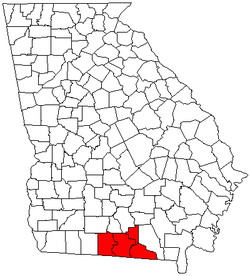
which includes Brooks, Echols, Lanier, and Lowndes Counties.

Look who’s next on the list:

Continue reading

Denmark reaches 200 MW solar goal 8 years ahead of schedule

If tiny Denmark, farther north than Edmonton, Alberta, has already deployed
200 MW of solar capacity, why can't Georgia Power do it?
We know why:

Southern Company's three-legged nuclear regulatory-capture stool

is too profitable for SO and Georgia Power.


Molly Cotter wrote for Inhabitant 15 October 2012,

Denmark Hits 200 Megawatt Solar Capacity Goal 8 Years Ahead of Schedule,

Lets face it — its rare we see a government goal reached on
time, let alone early. Not too long ago, the Danish Government
announced an ambitious goal to reach 200 megawatts of solar capacity
by 2020, and as of last week, they have already met it! The country
is currently installing an average of 36 megawatts of solar panels
each month. At this rate, their resulting capacity by 2020 will be
over five times the original goal. Denmark's power is currently
20% supplied by renewable sources, and the nation has set a goal of
sourcing 100% of its energy from renewable sources by 2050.


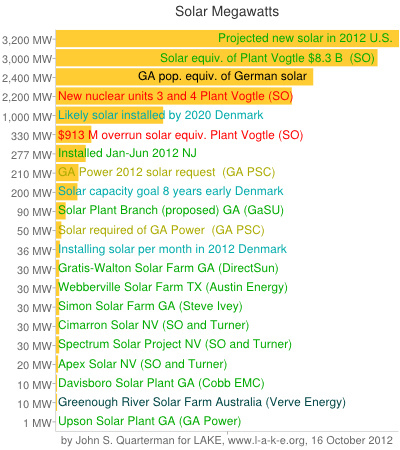
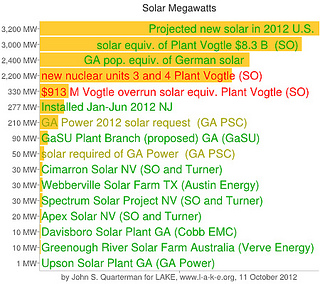
Solar Megawatts 2012-10-16

So Denmark has already deployed four times as much solar capacity
as GA PSC required of Georgia Power,
and almost as much solar capacity as Georgia Power has just asked GA PSC to approve.
While deploying more per month than Southern Company's largest solar farms anywhere.

Maybe it's time to

elect Georgia Public Service Commissioners to represent you.

-jsq

Elect Georgia Public Service Commissioners to represent you


GA PSC

The Georgia Public Service Commission decides how much you pay for energy.
If you’re tired of Georgia Power’s

three-legged nuclear regulatory-capture stool

and
Georgia lagging far behind other states in solar and wind energy
,
or you just want

PSC members who will represent you

and who do not

accept massive campaign contributions from the utilities they regulate
or their employees or lawyers
like the incumbents do;

the incumbents who can’t even be bothered to show up for debates
or to answer questionnaires.


David Staples for GA PSC


Steve Oppenheimer for GA PSC

Here are two GA PSC challengers who did answer a questionnaire:

Democrat Steve Oppenheimer

and

Libertarian David Staples
.
Early voting has already started:
you can vote for them today.


let the sun shine on Georgia

While you’re at it, you can

vote for statehouse legislators who will let the sun shine on Georgia.

-jsq

GA PSC questionnaire answers: Steve Oppenheimer


Steve Oppenheimer

The Georgia Sierra Club sent a questionnaire to all candidates for
Georgia Public Service Commission.
None of the incumbents answered.
The two challengers did.
Here’s the one from
Steve Oppenheimer
for District 3.
-jsq

  1. As a Candidate for Public Service Commission, what is your campaign strategy for achieving 50% +1 of the votes cast?

    [I’m omitting the answers to this question. -jsq]

  2. How should the Public Service Commission consider and
    weight the impacts to community health (asthma, cancer rates, etc.)
    and on Georgia’s environmental (water quantity, air quality etc.)
    when making decisions about a utility’s generation portfolio?

    The PSC has a major role shaping energy policy for Georgia. I would
    like to schedule PSC hearings on the relationship of power
    production and our air, water, morbidity and mortality and our
    general quality of life. My professional background in dentistry &
    health care provides a keen understanding of the relationship of
    power generation and health. Dr David Satcher, former US Surgeon
    General and Executive Director Satcher Health Leadership Institute
    at Morehouse University has become a friend and part of my
    professional network during the campaign. I would like to see PSC
    convene hearings on the topic. Georgians for a Healthy Future, a
    relatively new, broad based, organization would provide another
    forum for discussion of these issues. Membership in Georgians for a
    Healthy Future includes Georgia Legislators on both sides of the
    aisle. The PSC must be a leader on these issues—as the
    legislature as a body will likely not be progressive on these
    issues.

Continue reading

GA PSC questionnaire: David Staples


David Staples

The Georgia Sierra Club sent a questionnaire to all candidates for
Georgia Public Service Commission.
None of the incumbents answered.
The two challengers did.
Here’s the one from
David A. Staples for District 5.
-jsq

  1. As a Candidate for Public Service Commission, what is your
    campaign strategy for achieving 50% +1 of the votes cast?

    [I’m omitting the answers to this question. -jsq]

  2. How should the Public Service Commission consider and weight the
    impacts to community
    health (asthma, cancer rates, etc.) and on Georgia’s environmental
    (water quantity, air quality
    etc.) when making decisions about a utility’s generation portfolio?

    Impacts to community health and the environment have to be considered
    very carefully. I know
    there are a number of different ways of viewing the situation but the
    explanation I’ve found
    that works best with Republicans in trying to get their support is that
    it comes down to a private
    property matter. The right to swing ones fist ends at the other
    person’s nose. Does anyone have
    the right to pollute the air that I breathe or the water that I drink?

    If I buy a piece of property for
    instance along the Savannah River or Ogeechee River, does someone
    upstream from me have
    the right to pollute the water that then flows onto my land, carrying
    those pollutants with it?

    Absolutely not.

Continue reading

“Great, big” SO is 1/10 Australia for solar farm deployment in Georgia


Solar Megawatts 2012-10-11

So if Southern Company is a “great, big company” similar to Australia,
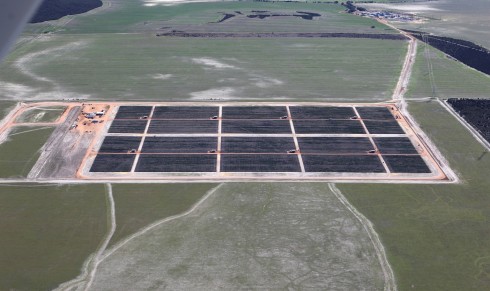
why did Australia just deploy a solar farm ten times the size of
the biggest one SO has in Georgia?

Back in May, Southern Company (SO) CEO

Thomas A. Fanning said:

From an energy standpoint, Southern Company is a little bit smaller,
but similar to, the energy production profile of the nation of
Australia. We are a great, big company from an energy production
standpoint.

Meanwhile in Australia,
Giles Parkinson wrote for Clean Technica 10 October 2012,

Australia’s 1st Utility-Scale Solar Farm Now On!


At about 11am local time near the Western Australian town of
Geraldton this morning, Australia’s first-utility scale solar farm
was officially switched on.

It was a suitably sunny day (blighted by three million flies) and
although just 10MW in size, and built courtesy of funding from the
local government, a state-owned utility and by one of the wealthiest
companies on the planet, it may presage a dramatic change in the way
this country produces energy.

So what’s SO or Georgia Power’s biggest solar plant in Georgia?
You remember,

1 MW in Upson.

OK, to be fair, that’s just Georgia Power.
SO does have larger solar farms elsewhere, including

Now I know Georgia Power’s party line is that solar is only good in the U.S.
southwest.
But I don’t know how that explains

Continue reading

Solar and broadband are good for the economy and for PR

When

the Industrial Authority came out for solar and broadband

WCTV noticed.
It seems solar and broadband are good not only in themselves,
but also for good PR for the community.
PR that might attract the kinds of businesses the Industrial Authority
is looking for.


WCTV wrote 9 September 2012,

Solar Power and Broadband Internet Could Boost Local Job Growth
,

The Valdosta-Lowndes County Industrial Authority has put a spot
light on solar power and broadband internet. That’s according to a
new analysis of regional businesses and employment. They say it will
be a way to generate job growth going forward. Many in the community
agree.

Valdosta Resident Mark Yates said “if they could bring those all in,
it would be great for the economy and bring a lot of jobs for a lot
of people in town here.”

That’s how Saginaw, Michigan, attracted that second Suniva plant
away from Georgia:


it has a plan for solar industry and it gets it in the news.

Way better than

worrying what Albany thinks,
don’t you think?

By the way, Saginaw also goes for wind manufacturing jobs,
and we already have one wind manufacturing business right here; more on that
later.

It sure would be good if the Industrial Authority,
with its 1 mil tax rate or almost $3 million a year,
could succeed in attracting some jobs here:

Continue reading

What Georgia Power is afraid of: GaSU and Dr. Smith; and you

So what is Georgia Power afraid of

that made their CEO Paul Bowers double down on old-style baseload?

Competition, that’s what!
What could be more scary in the power-monopoly state of the

1973 Territorial Electric Service Act?


GaSU sun

On one side, Georgia Power faces

GaSU and its 80 or 90 MW solar plant proposal.

Walter C. Jones wrote for OnlineAthens 24 September 2012,

Proposed solar company could stir up Georgia’s utility structure
,

A proposal from a start-up business promises to lower electricity
rates by rebating profits to customers if given a chance to compete
as Georgia Power Co.’s “mirror image.”


GaSU fb profile image

To proceed with its long-range plan of developing 2 gigawatts of
solar power, the start-up, Georgia Solar Utilities Inc., wants to
start by building an 80-megawatt “solar farm” near
Milledgeville as soon as it gets a green light from the Georgia
Public Service Commission. GaSU filed its request last week, and as
of Monday, it’s still too fresh for public evaluation.

So radical is the proposal that spokespersons for Georgia Power and
the Georgia Solar Energy Association said they still were evaluating
it and could not comment.

Groups that normally advocate for customers also are staying quiet.

GaSU executives recognize such a big change won’t come easily.

Continue reading