Tag Archives: energy conservation

Energy efficiency rebates, Austin, Texas


The central city of a major MSA,
Austin, Texas, publishes its own video reporting on
local issues, like this one on local energy efficiency.

AustinEnergy has brought back its best offer ever deal,
which allows customers to receive both rebates and a loan
to make energy efficiency improvements.
The rebates can total as much as $3200,
and can cover as much as a third of the cost of the improvements,
including the air conditioning unit.
Remaining costs after the rebates can be financed through a
low interest loan through the Austin Credit Union.

The best offer ever is financed in part by a $10 million
better buildings grant from the U.S. Department of Energy….

Here’s

the video:

Continue reading

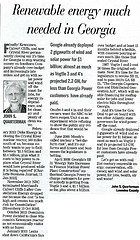
Renewable energy much needed in Georgia —John S. Quarterman

My op-ed in the VDT today; I’ve added links, plus some more after the op-ed.


Finally! Kewaunee, Calvert Cliffs, and now Crystal River
permanently closing say it’s time for Georgia to stop wasting money
on Southern Company’s already over-budget and increasingly-late
nukes and get on with solar power and wind off the coast: for
jobs, for energy independence, and for clean air and plenty of
clean water.

February 2013:

Duke Energy is closing
the Crystal River nuclear
reactor

(Tampa Bay Times, 6 Feb 2013)
,
160 miles south of us, because

nobody wants to pay to fix it
:
between “$1.5 billion and $3.4 billion,
plus what it costs to buy power to replace
what Crystal River would have produced while it is
being repaired”

[Charlotte Business Journal, 11 Jan 2013]
.
November 2012:

NRC terminated
Maryland’s Calvert Cliffs 3

(NRC 1 Nov 2012)

after

Constellation Energy dropped out
because the cost “is too high
and creates too much risk for Constellation”

[Bloomberg 10 Oct 2010]
.

Continue reading

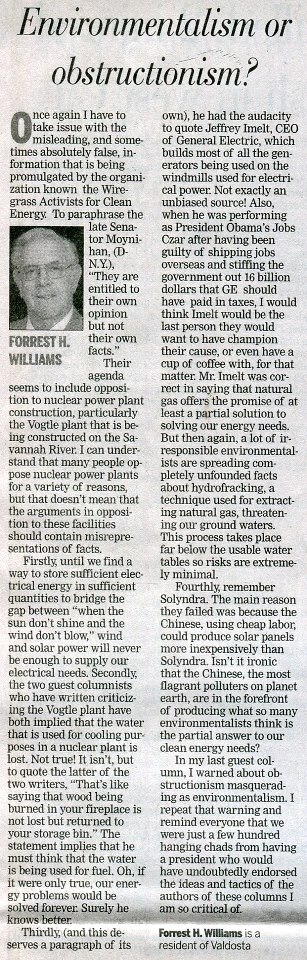
Return of water misinformation by Forrest H. Williams in the VDT

Seen today on the
WACE facebook page
is an image of an op-ed in the VDT, and alongside it I include here
Michael Noll’s initial comments, plus a few links.


There is good reason why Stephen Hawkins once said “the greatest
enemy of knowledge is not ignorance, it is the illusion of
knowledge.” When entities like Fox News can claim that “solar won’t
work in America because it’s not as sunny as Germany”, we shouldn’t
be surprised by the results of such “educational” efforts. The fact
is that we have a number of clean and renewable forms of energy
(e.g. wind, solar, geothermal) that already work. Just go to

Spain
,

Germany
,

Denmark
, Iceland, or simply stay in the US and visit places
like from

New Jersey

and

New York

to

California

and

Arizona
. Combine
these pieces of a larger energy puzzle with meaningful initiatives
of

energy conservation and energy efficiency
, and we find a way out
of our current predicament (i.e. continuing dependence on finite and
dirty sources of energy), while saving money (see

solar vs. nuclear
),
preserving our natural resources (e.g. water, forests),
and providing clean, healthy and safe environments to live in (e.g.
wind and solar do not produce radioactive waste, pollute our air and
groundwater).

The guest columnist appearing above is the same individual who
thought

Continue reading

HB 267 Financing costs; construction of nuclear generating plant


As promised,

a bipartisan bill was filed Thursday to stop Georgia Power from
charging for nuclear cost overruns on Plant Vogtle; this could free up some financing for Georgia to move ahead on solar and wind power.


2013-2014 Regular Session – HB 267
Financing costs; construction of nuclear generating plant; change calculation that utility can recover from customers
,

A BILL to be entitled an Act to amend Code Section 46-2-25 of the
Official Code of Georgia Annotated, relating to the procedure for
changing any rate, charge, classification, or service and the
recovery of financing costs, so as to change the calculation used
under certain circumstances to determine the costs of financing
associated with the construction of a nuclear generating plant that
a utility may recover from its customers; to provide for related
matters; to provide an effective date; to repeal conflicting laws;
and for other purposes.

The bill would add this text to Georgia Code:

…provided, however, that in the event the amounts recorded in the
utility’s construction work in progress accounts plus the amount of
all financing costs accrued on any construction work in progress
accounts exceeds the costs approved by the commission in the
original certificate of the nuclear generating plant granted under
Code Section 46-3A-5, the cost of equity portion of the financing
costs shall be calculated using a rate no higher than the utility’s
actual cost of debt.

Let’s see what Georgia Power does to fight this one.
So far, it’s

Continue reading

Denmark beats Georgia Power’s 20 year plan


As

anticipated,

Georgia Power released
that

20-year energy plan Thursday,

because they have file one every three years with the PSC.
It includes far less solar power than tiny little far-north-of-here
Denmark is busily deploying.


The good news:
Georgia Power is closing a bunch of coal plants.
And this plan makes a nod towards
"demand response programs, energy efficiency programs, pricing
tariffs and other activities".

The bad news:
they're replacing those coal plants with natural gas, and of course
"two new state-of-the-art nuclear facilities at Plant Vogtle";
you know, the two

Georgia Power has been charging customers for since 2009
while they deliver no electricity.

Georgia Power
can't even seem to deliver the reactor containment vessels.

But what about renewable energy?

Continue reading

Georgia Power to announce 20-year plan Thursday

What will Georgia Power announce for a 20 year energy plan Thursday?
Will they (1) just double down on their rate-hike boondoggles for

nuclear
and

gas
,
or (2) they could flip like

Austin Energy in 2003
and

Cobb EMC in 2012

and suddenly go solar?
The wording here looks like it’s going to be the former.
That they even feel compelled to announce some sort of formal plan instead of just

shovelling disinformation out another 50 years

indicates they’re feeling

the pressure to change direction

to real sustainable energy: wind and solar power.

Matt Shedd wrote for WUGATV today,

Georgia Power To Release Energy Plan
,

Georgia Power is set to release a 20-year energy plan on Thursday


which will outline a way for the company and the state to be less
reliant on coal power. The AJC reports that just 5 years ago, the
company’s reliance on coal was at 70 percent.

That number has now dropped to 47 percent. These changes are coming
in the wake of Georgia Power’s parent, the Southern Co., being
pushed by environmental rules to rely less on coal. Georgia Power
won approval to buy electricity produced by natural gas from its
sister company Southern Power, which may be part of the company’s
future plans.

Thomas A. Fanning, CEO of Georgia Power’s parent The Southern Company (SO),
has been touting 70% to 35% reduction in coal since at least

May 2012 at the SO shareholder meeting.

Fanning continues to

emphasize nuclear, gas, and “clean coal”

instead of real sustainable energy, namely wind and solar power.
He also continues to assert electricity demand will increase,
while

ignoring conservation and efficiency,
which for Georgia
could remove all need for new energy,
enabling solar and wind to shut down more coal and gas plants,
as well as nukes.

So, get out the popcorn and take your bets.
Will it be (1) or will it be (2)?
I’m betting this time it will be (1), but sooner or later it will be (2),
and even Georgia Power, and yes, even Southern Company,
will stop digging in their heels and get on the solar
train to profits, jobs, energy independence, and oh, by the way, clean
air and plenty of clean water.

-jsq

Rural AIDS: poverty the cause, solar power part of the solution


Director Lisa Biagiotti
spent two years travelling around the South
interviewing people about AIDS to make a film,
deepsouth.
She found rural AIDS is a bigger and faster-growing problem
than AIDS in center cities,
yet most health and prevention funding goes to urban areas.
The root cause seemed clear to her: poverty.
Here’s some deeper dirt (literally) on rural poverty in the U.S.,
and one thing we know can help with that: distributed solar power,
for jobs, for reduced electrical bills, and for energy independence.
What politician wouldn’t want jobs for their constituents?

The director said the screening at

VSU at the end of November
drew more people than the
day before in Little Rock.
There were clearly more than 150 in the audience in Valdosta.
It’s a topic very relevant to here, as

Dean Poling wrote in the VDT 26 November 2012,

Organizers note that Georgia is ranked sixth highest nationally for
its cumulative number of AIDS cases reported through December 2009.
More than 40,000 known HIV/AIDS cases were reported in Georgia as of
2010.

The South Health District’s 10 counties, which include Lowndes and


surrounding counties, report 950 confirmed cases of HIV/AIDS, while
many more are likely infected and risk becoming sick because they
are not being treated. More specifically, there are about 460
reported cases in Lowndes County.

In reporting these numbers, HIV is the virus (HIV disease) and AIDS
is the medical diagnosis made by a doctor of the symptoms, according
to South Health District.

It’s a great movie and I highly recommend it.
Director Biagiotti spent a substantial amount of her own money and two years to make
this film, yet there are aspects she could only note in passing,
such as incarceration.
She can’t be expected to have researched every aspect;
maybe somebody else can step up and help follow more threads.

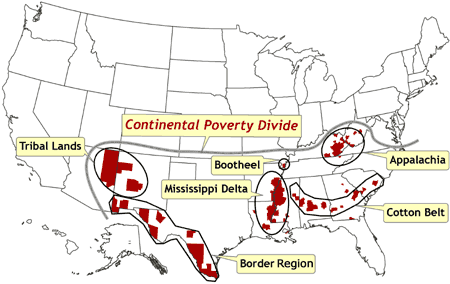
The movie starts with some maps about poverty and AIDS in the South.
It did not, however, look outside the South for poverty.
Here are better
poverty maps, from the CDC:

Continue reading

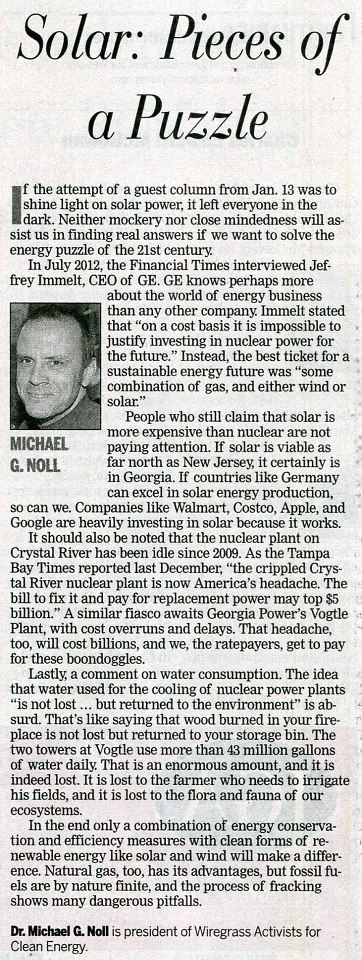
Solar: Pieces of a Puzzle —Dr. Michael G. Noll

Op-ed in the VDT today, responding to

a response

to

my op-ed.
-jsq


If the attempt of

a guest column from Jan 13
was to shine light on solar power,
it left everyone in the dark.
Neither mockery nor close mindedness will assist us in finding real answers
if we want to solve

the energy puzzle of the 21st century.


In July 2012, the Financial Times interviewed Jeffrey Immelt, CEO of GE.

GE knows perhaps more about the world of energy business than any other company.
Immelt stated that

“on a cost basis it is impossible to justfy investing in nuclar power for the future.”

People who sitll claim that solar is more expensive
than nuclear are not paying attention.
If solar is viable as far north as

New Jersey
, it certainly is in Georgia.
If countries like

Germany
can excel in solar energy production,
so can we.
Companies like Walmart, Costco, Apple, and

Google

are havily investing in solar because it works.

It should also be noted that the nuclear plant on

Crystal River has been idle since 2009.

As

the Tampa Bay Times reported last December,

Continue reading

The water is not lost. —Forrest H. Williams


Valdosta resident Forrest H. Williams replied in the VDT today to

my op-ed of 6 January.

His information seems a bit out of date.
For example, he cites

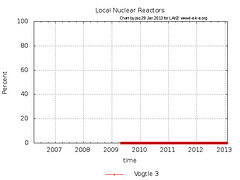
Progress Energy’s Crystal River nuke

as a good example, when it’s been

down since 2009

and is still

producing zero percent power
,
both according to the NRC.
Readers of this blog know that

the blog version of my op-ed

already links to sources for everything I said.
I may respond more later, but no doubt there are other people
who want to get involved in this discussion.
And I do thank Forrest H. Williams for airing the sort of disinformation
that is out there, so others can dispel it.

Oh, and saying water that is evaporated is not lost is like saying trees that are burned are not lost. Evaporated water is not available for agricultural or wildlife or drinking water use, and thus is indeed lost.

Continue reading

Putting conservation into conservatives —John S. Quarterman

My op-ed in the VDT today. -jsq

Gov. Deal
(WABE, 14 Nov 2012)
temporarily forgot that “conservative”
includes conserving something,


like

Theodore Roosevelt and national parks
,
or when

Franklin D. Roosevelt established the Okefenokee National Wildlife
Refuge
which also

administers Banks Lake,
when

Richard Nixon started the EPA,

and when

Jimmy Carter signed the Soil and Water Conservation Act.

If Gov. Deal wants to call conservation “liberal”, I’m happy to
be a liberal working for water for our state!


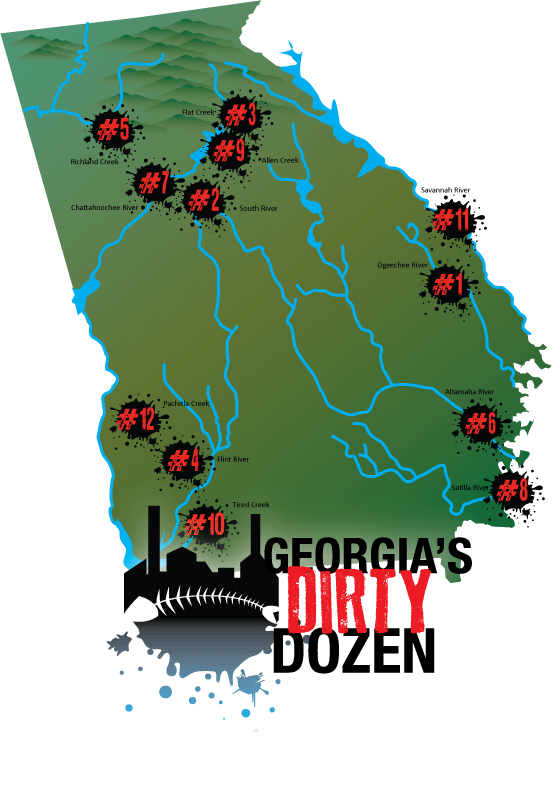
Georgia Water Coalition’s Dirty Dozen


listed the biggest boondoggle
of all as

#11: the nuclear reactors at Plant Vogtle

suck up more water from the Savannah River than all local agriculture and almost
as much as the city of Savannah.

If the new Plant Vogtle nukes

are ever completed,
all four will use more water than Savannah. In

2009 the legislature approved and Gov. Deal signed a law

letting Georgia
Power charge its customers in advance for building that boondoggle,
to the tune of

about $1.5 billion so far!

Let’s not forget

Continue reading