Tag Archives: energy conservation

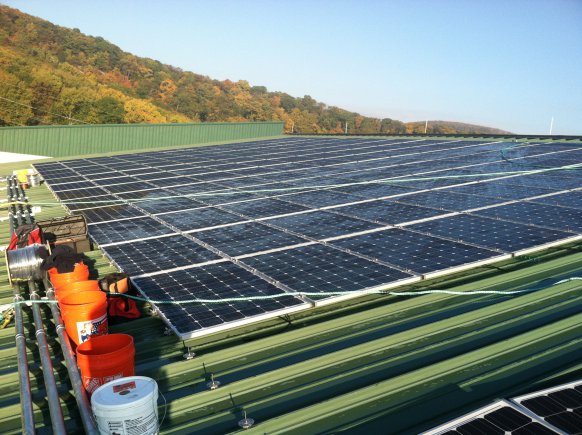
Net zero school in Bowling Green KY


Why stop with
solar Lowndes High or VHS?
Why not have all our elementary and middle schools
generate more solar electricity than they use, and
change their power bills into profits to help pay for education?
A school in Bowling Green, Kentucky is already doing that.

Chuck Mason wrote for bgdailynews.com 22 December 2012,

‘Net-zero’ school pays off
,

The district received a check for $37,227.31 this year. The
Tennessee Valley Authority paid the school district for electricity
it generated. The school district doesn’t have a power plant, per
se, like the utility company. But it does have an energy producer,


the first “net-zero” school in the nation: Richardsville
Elementary School.

The check is tangible evidence that net-zero pays for itself and
then some.

“It has exceeded expectations. We’re seeing a savings of
millions of dollars in energy costs,” state Rep. Jim DeCesare,
R-Bowling Green, said of the net-zero schools concept developing
across the nation.

This is the same Bowling Green, Kentucky that has fast Internet access.
Maybe that’s another reason

the Chamber might want to consider comparing Bowling Green and Warren County
to here.

-jsq

Fracking: coming soon to a state near you?

Lest you think fracking is something that happens only in faraway
places like

Alberta

or Pennsylvania,
look at
this map of North American shale gas basins,
extending right through the Appalachians from Pennsylvania through
West Virginia, Virginia, Tennessee, and North Carolina into Georgia, Alabama,
and Mississippi.


Source:

Canada fracking creates ‘test tube‘ residents in B.C., Alberta
,
by Lynn Herrmann for Digital Journal 5 January 2012.

How long before Georgia Power or Southern Company decide natural
gas would be even cheaper if they fracked in Georgia or Alabama or Mississippi?
How long until

unavoidable human error

starts fracking polluting our local groundwater and rivers?
For that matter, isn’t it bad enough already that other people’s
water is fracked for cheap gas in Georgia?

We could just

get on with solar power
,
which doesn’t spill.

-jsq

Frack human error

What do you get in a solar spill?
A sunny day.
What do you get in a fracking spill?
Polluted groundwater and drinking water.
When do you get it?
Whenever somebody makes a mistake, which turns out to be frequently.


Alberta Finds Mismanagement of Errors Causes Fracking Water Contamination
,

“There is no amount of regulation that can overcome human error,”


said Alberta’s Energy Resources Conservation Board (ERCB) spokesman
Darin Barter. ERCB released an investigation report that cites
inadequate management of risks as one of the main causes of a
September 2011 accident that contaminated groundwater with toxic
hydraulic fracturing chemicals, including the cancer causing agent
known as BTEX (benzene, toulene, ethylbenzene, and xylene).

At least the company involved in this particular incident did something about it:

Personnel from Crew Energy told the Calgary Herald the company is
“embarrassed” about the accident. Rob Morgan, chief operating
officer for Crew said, “there’s no question of our appreciation of
the severity of this,” adding, “pretty much all of the personnel who
were involved in this particular circumstance are no longer with the
company.”

But the groundwater is still contaminated.
And where will they find replacement personnel who will never make mistakes?

Meanwhile, a solar spill is called a nice day.

-jsq


Fake fracking reports: professor and institute head quit, other institute disbanded

From Austin to Buffalo, fake science for fracking is increasingly being exposed,

Frack U

with academic consequences: lead professor resigns,
institute head quits, another institute disbanded.
The image on the right (Frack U) is not a reputation any university wants to see.
At least academia takes conflicts of interest seriously;
now if government and the voters would do the same….
Or energy companies.
Remember, shale gas (plus nuclear) is what Georgia Power and
Southern Company are shifting to from coal,
while shading us from the finances that would enable solar power
for jobs and energy independence in south Georgia.

Terrence Henry
wrote for NPR 6 December 2012,

Review of UT Fracking Study Finds Failure to Disclose Conflict of Interest (Updated)

The original report by UT Austin’s Energy Institute,


‘Fact-Based Regulation for Environmental Protection in the Shale Gas
Development,’
was released early this year, and claimed that there
was no link between fracking and water contamination. But this
summer, the

Public Accountability Initiative
, a watchdog group,
reported that the head of the study, UT professor Chip Groat, had
been sitting on the board of a drilling company the entire time. His
compensation totaled over $1.5 million over the last five years.
That prompted the University to announce an independent review of
the study a month later, which was released today.

The review finds many problems with the original study, chief among
them that Groat did not disclose what it calls a “clear
conflict of interest,” which “severely diminished”
the study. The study was originally commissioned as a way to correct
what it called “controversies” over fracking because of
media reports, but ironically ended up as a lightning rod itself for
failing to disclose conflicts of interest and for lacking scientific
rigor.

Unrepentant
as recently as July,
Professor Groat resigned in November.
Plus this:

Raymond Orbach of UT’s Energy Institute has resigned after the group
became engulfed in controversy over a study of fracking.

And elsewhere even more drastic results have ensued:

Continue reading

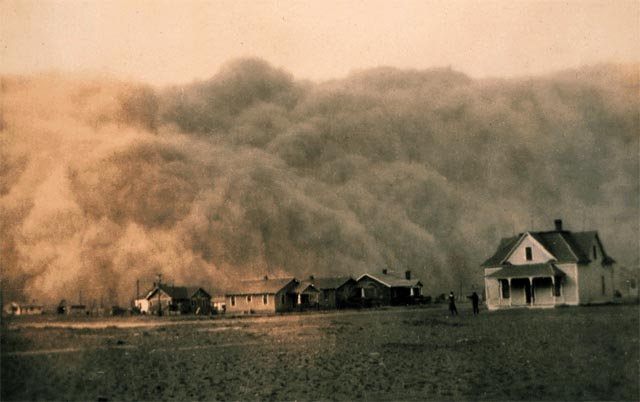
2012 Drought more expensive than Hurricane Sandy


You thought Hurricane Sandy was bad?
You were right, but economically, the ongoing drought is worse economically.
But we already know a much brighter path.

Weather Underground founder Dr. Jeff Masters wrote 16 November 2012,

Lessons from 2012: Droughts, not Hurricanes, are the Greater Danger
,

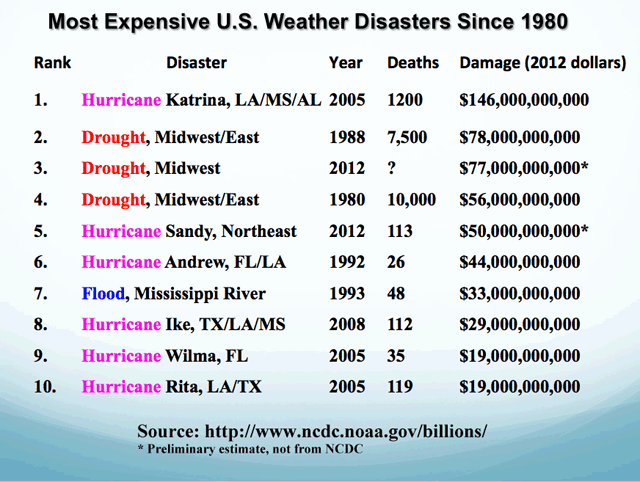
Sandy’s damages of perhaps $50 billion will likely be overshadowed
by the huge costs of the great drought of 2012.


By Dr. Masters’ estimate, the 2012 drought will cost more than half again
as much as Hurricane Sandy.

Also notice Hurricane Katrina still at the top of that table, with almost
three times the economic damage and far more deaths than Hurricane Sandy.
We could have gotten the message back in 2005, but hey, those were only
poor southern people, so who, in for example New York City, really cared?
Yes, I know many of us did and many of you actively helped, but I’m
sure you see my point that when greater New York gets the storm,
suddenly the country pays attention and a lot more people want to find
out how to keep that from happening again.

What’s that drought look like for us here in Georgia at the moment,
according to

U.S. Drought Monitor?

Continue reading

West Point aiming for net zero energy use

U.S. Army is serious about solar, installing solar panels as a
“very visible and a very recognizable part of
our renewable energy initiative that can immediately click with the
general public”
as it makes its military academy net zero, while
encouraging cadets to become renewable energy leaders.
Hm, sounds like

Decatur County with its solar industrial park

and what we could do here with

solar Lowndes High.

Mike Strasser wrote Army PR 29 November 2012,

Solar panels deliver new energy to West Point’s Net Zero initiative,


The installation of solar panels on the roof of the Lichtenberg
Tennis Center—780 panels, to be exact—in recent weeks
represents West Point’s continuing efforts to achieve energy
sustainability.

Since becoming a Net Zero Energy pilot installation last April, West
Point has been making strides toward the ultimate goal of producing
as much energy as it uses by 2020. According to an environmental
assessment for the U.S. Army Environmental Command and West Point
Garrison, the installation currently generates less than .02 percent
of the energy it consumes from renewable sources. Matt Talaber,
Department of Public Works engineer and director, said the solar
panels will be a step in the right direction.

“The solar panels are very visible and a very recognizable part of
our renewable energy initiative that can immediately click with the
general public,” Talaber said. “It’s a positive image that shows
West Point is interested in renewable energy and is working on its
Net Zero energy goals.”

And they’re also improving conservation and efficiency.
Plus this:

Continue reading

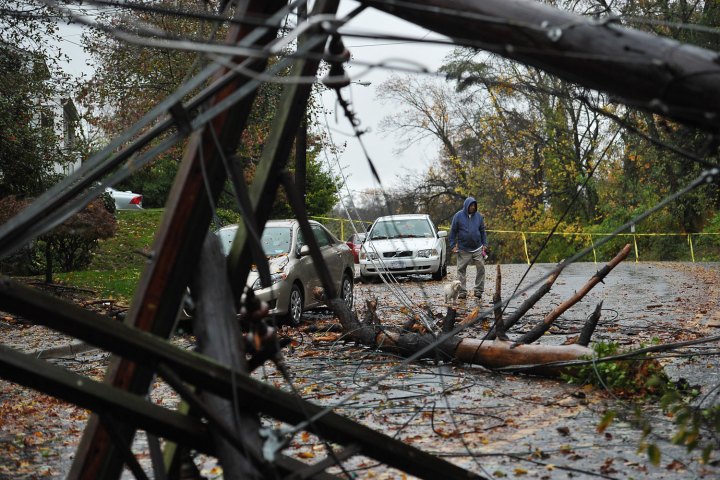
Rooftop solar for grid outage independence

Solar power can bring for energy independence, not just from foreign countries,
also from the grid during storms and other outages.

Inspired by the need to deal with downed power lines
in New York and New Jersey after Hurricane Sandy,
David Crane and Robert F. Kennedy Jr. wrote for NYTimes 12 Dec 2012,

Solar Panels for Every Home
,

Solar photovoltaic technology can significantly reduce our reliance


on fossil fuels and our dependence on the grid.
Electricity-producing photovoltaic panels installed on houses, on
the roofs of warehouses and big box stores and over parking lots can
be wired so that they deliver power when the grid fails.

Solar panels have dropped in price by 80 percent in the past five
years and can provide electricity at a cost that is at or below the
current retail cost of grid power in 20 states, including many of
the Northeast states. So why isn’t there more of a push for this
clean, affordable, safe and inexhaustible source of electricity?

First, the investor-owned utilities that depend on the existing
system for their profits have little economic interest in promoting
a technology that empowers customers to generate their own power.
Second, state regulatory agencies and local governments impose
burdensome permitting and siting requirements that unnecessarily
raise installation costs.

I can tell you by experience that solar panels on the roof
(with batteries) can supply power when the grid is out.

In regulatory-captured Georgia, the big impediment to solar is

financing, because of 1973 Territorial Electric Service Act.

When will Southern Company and Georgia Power admit their boondoogle
on the Savannah River has failed and get on with conservation,
efficiency, wind, and solar power?

-jsq

New biomass plant near Dublin, GA: what it’s really about

Not really about jobs, and not about feeding electricity into the grid:
the new biomass plant near Dublin, GA is about saving that company money on electricity: but at what cost to the state and to local residents?


Mike Stucka wrote for Macon.com 6 December 2012,

Deal announces $95 million biomass power plant for Laurens County
,

A new biomass power plant announced Thursday is expected to bring
hundreds of related jobs and a direct $95 million investment.

A statement from the office of Gov. Nathan Deal said the plant
itself will bring 35 permanent jobs to Laurens County.

Compare 35 permanent jobs for $95 million to

MAGE SOLAR’s 350 jobs for $30 million
.
That’s about $2,700,000 per job for this deal,
vs. $85,714 per job for MAGE SOLAR.
Which would make MAGE SOLAR’s facility more than 30 times more effective
at producing permanent jobs.

OK, but what’s this one supposed to do?

Continue reading

GaSU wins at GA PSC, but will GaSU help all of us win in the legislature?

GA PSC Stan Wise’s 2009 nuclear CWIP lobbying points eerily matched Southern Company’s,
but suddenly he’s got separation-of-powers religion about Georgia Solar Utilities (GaSU).
The PSC recommended GaSU’s utility bid anyway.
When the legislature takes that up in a month or so, will GaSU CEO Robert Green,
unlike SO or Georgia Power or Stan Wise, help the rest of us little people
fix the 1973 Territoriality law so we can sell our solar electricity
on a free market?

Dave Williams wrote for the Atlanta Business Chronicle yesterday,

Georgia Public Service Commission moves ahead on solar energy
,


Georgia Power logo

The Georgia Public Service Commission approved a plan by Georgia
Power Co. Tuesday to acquire an additional 210 megawatts of solar
generating capacity, more than tripling its investment in solar
energy.


GA PSC PR about 20 November 2012 decisions

But a sharply divided PSC also gave a potential competitor to
Georgia Power its blessing to appeal to the General Assembly to
amend a 39-year-old law that gives the Atlanta-based utility the
exclusive right to continue serving existing customers.

Under Georgia Power’s Advanced Solar Initiative, the company will
buy solar power produced by both large “utility-scale”
solar farms and from smaller projects operated by residential and
commercial property owners.

Right, that’s actually

only 10 Megawatts from “smaller projects”,

maintaining Georgia Power’s monopoly while throwing throwing
a bone to the rest of us.

While the PSC supported Georgia Power’s plan unanimously, a
subsequent motion by McDonald encouraging other solar utilities
interested in serving Georgia to pursue their plans with the
legislature passed by the narrow margin of 3-2.

Georgia Solar Utilities Inc., a company launched in Macon, Ga.,
earlier this year, filed an application with the PSC in September
for authority to generate solar energy in Georgia on a utility
scale.

The two Nay votes were from the two recently-reelected PSC members,
apparently now thoroughly in the pocket of the incumbent utilities.
Here’s one of them now:

Continue reading

Help the military stop climate change through sustainable renewable energy

In memory of Armistice Day, the eleventh hour of the eleventh day of the
eleventh month, when World War I ended,
let’s help the military get us off of oil
and to deal with climate change so fewer people will die in wars.

John M. Broder wrote for NYTimes 9 November 2012,

Climate Change Report Outlines Perils for U.S. Military
,

Climate change is accelerating, and it will place unparalleled strains on


American military and intelligence agencies in coming years
by causing ever more disruptive events around the globe,
the nation’s top scientific research group said in a
report
issued Friday.

The group, the National
Research Council
, says in a study commissioned by the
C.I.A. and other intelligence agencies that
clusters of apparently unrelated events exacerbated by a warming climate
will create more frequent but unpredictable crises in water supplies,
food markets, energy supply chains and public health systems.


Hurricane Sandy provided a foretaste
of what can be expected more often in the near future, the report’s
lead author, John D. Steinbruner, said in an interview.

“This is the sort of thing we were talking about,” said
Mr. Steinbruner, a longtime authority on national security. “You
can debate the specific contribution of global warming to that storm. But
we’re saying climate extremes are going to be more frequent, and
this was an example of what they could mean. We’re also saying it
could get a whole lot worse than that.”

Climate-driven crises could lead to internal instability or international
conflict and might force the United States to provide humanitarian
assistance or, in some cases, military force to protect vital energy,
economic or other interests, the study said.


This is in addition to the even more obvious
connection between war and U.S. dependence on foreign oil

which the veterans in Operation Free want to fix

by helping us shift to clean renewable energy.

“In Iraq… the lines would stretch up to ten miles long under
the hot sun, under constant risk of attack by extremists. I realized
then just how vulnerable it makes any country to be dependent on
oil, especially the United States, which uses nearly a quarter of
the world’s supply.”

We also heard last year from

Col. Dan Nolan (U.S. Army ret.) that the Marines in Afghanistan
realized

Continue reading