Category Archives: Economy

Jerome Tucker honored at Civic Roundtable

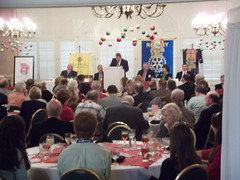
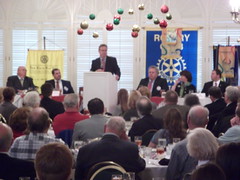
The Civic Roundtable honored Jerome Tucker for some of the many things he has done for Lowndes County and south Georgia. And as usual he hit the nail on the head.

Dawn Castro wrote for the VDT yesterday:

“We do have one of the best communities,” Tucker said. “The toughest part of me standing before you is knowing how much better we could be if all the little groups would work together.”
He also said:
“I am still blessed to have my dad with me,” Tucker began. “He always asks me, ‘Where have you been?’ and ‘Did you do any good?’
Here are a few good things Jerome Tucker has done recently: Continue reading

Port St. Joe biomass developer gives up

Another biomass plant bites the dust, this time less than 200 miles southwest of here in Port St. Joe, Florida.

Tim Croft wrote for the Star Thursday, Developer pulls out of energy center project

Citing an inability to secure financing Rentech, Inc., the developer of the Northwest Florida Renewable Energy Center has pulled out of the project.
What project? Down at the fourth paragraph the article finally says:
…a 55 megawatt energy plant to be built in Port St. Joe.

The plant, as proposed, would produce steam to drive generators to produce electricity, the fuel source woody biomass, or forest residue. Progress Energy had an agreement in place to purchase electricity from the plant.

The article blames the economy, but that wasn’t all that did in Continue reading

Marijuana prohibition had nothing to do with smoking it

It had everything to do with the king of yellow journalism newspapers not wanting competition for his yellow paper and the king of the new plastics not wanting competition with them: competition from hemp.

Kathleen Murphy wrote for the Washington Free Press 3 June 2009 about How Marijuana Became Illegal,

As the methods for processing hemp into paper and plastics were becoming more readily available and affordable, business leaders including William Randolph Hearst and DuPont stood to lose fortunes. They did everything in their power to have it outlawed. Luckily for Hearst, he was the owner of a chain of newspapers. DuPont’s chief financial backer Andrew Mellon (also the Secretary of the Treasury during President Hoover) was responsible for appointing Harry J. Anslinger, in 1931 as the head of the Federal Bureau of Narcotics and Dangerous Drugs.
Anslinger and Hearst made up whatever propaganda they thought might scare the public into supporting prohibiting hemp: Continue reading

Video playlist, GLPC 28 November 2011

Here’s a video playlist for the entire Greater Lowndes Planning Commission (GLPC) Regular Session of 28 November 2011. We’ve already blogged a couple of them separately: And we’ll probably blog more of these videos separately. But you don’t have to wait.

Here’s the playlist:


Video playlist, GLPC 28 November 2011
Comprehensive Plan,
Regular Session, Greater Lowndes Planning Commission (GLPC),
Valdosta, Lowndes County, Georgia, 28 November 2011.
Videos by Gretchen Quarterman for LAKE, the Lowndes Area Knowledge Exchange.

-jsq

Fighting gangs by legalizing pot

Just like alcohol prohibition produced gansters such as Al Capone, drug prohibition doesn’t prevent crime: it causes it. Legalize, tax, and regulate, end that crime, reduce drug use, and fund government services. While massively reducing the prison population and removing any excuse for private prisons. Sweden is pioneering the way.

Richard Orange wrote for GlobalPost yesterday, A win-win on drugs? Fighting gangs by legalizing pot,

Copenhagen’s city municipality voted in recent weeks, 39 votes to 9, to empower its social affairs committee to draw up a detailed plan to legalize cannabis.

If that plan is approved by Denmark’s new left-of-centre parliament next year, the city could become the first to legalize marijuana, rather than simply tolerate it, as police do in the Netherlands.

“We are thinking of perhaps 30 to 40 public sales houses, where the people aren’t interested in selling you more, they’re interested in you,” Mikkel Warming, the mayor in charge of social affairs at Copenhagen City Council told GlobalPost. “Who is it better for youngsters to buy marijuana from? A drug pusher, who wants them to use more, who wants them to buy hard drugs, or a civil servant?”

Not just drug toleration. Legalization: Continue reading

Solar tipping point within a few years

Why is anyone still building fossil fuel (or nuclear for that matter) power plants when solar is within a few years of being cheaper? In other words, by the time those other plants can be built, solar is very likely to be more cost-effective?

Marcia Goodrich wrote for physorg yesterday, Affordable solar: It’s closer than you think,

It’s a matter of economics. A new analysis by [Michigan Technical University Associate Professor Joshua] Pearce and his colleagues at Queen’s University in Kingston, Ontario, shows that solar photovoltaic systems are very close to achieving the tipping point: they can make electricity that’s as cheap—sometimes cheaper—as what consumers pay their utilities.

Here’s why. First, the price of solar panels has plummeted. “Since 2009, the cost has dropped 70 percent,” says Pearce. But more than that, the assumptions used in previous studies have not given solar an even break.

“Historically, when comparing the economics of solar and conventional energy, people have been very conservative,” says Pearce.

It’s not just that the cost of equipment keeps dropping; older panels remain more efficient than most previous estimates:
For example, most analyses assume that the productivity of solar panels will drop at an annual rate of 1 percent or more, a huge overestimation, according to Pearce. “If you buy a top-of-the-line solar panel, it’s much less, between 0.1 and 0.2 percent.”
There’s more in the news article, and in the journal article it references, A review of solar photovoltaic levelized cost of electricity, K. Brankera, M.J.M. Pathaka, J.M. Pearce, Renewable and Sustainable Energy Reviews, Volume 15, Issue 9, pages 4470-4482. doi:10.1016/j.rser.2011.07.104

-jsq

We’re not done working on this —Jason Davenport @ GLPC 28 November 2011

Continuing the Comprehensive Plan Short Term Work Program (STWP) updates, the chairman asked if the board was ready

Lowndes County Planner Jason Davenport responded:

We’re not done working on this. But if you think it’s time to bring it before y’all.
Later, at about 11:40 in, Davenport clarified:
And the only that’s different right now is Lowndes County. Because Lowndes County did not hold a public hearing as required, so we’re on a different timeline. And if Mrs. Quarterman would have given me about until December 13th she would have seen that.

Because our initial resolution was not the same as the other communities. We’re on a little bit of a different timeline because we have to address that issue. That’s one thing; the county in this instance will be handled a little different than some of the smaller cities and Valdosta.

That would be the initial resolution the county did not provide in response to an open records request about the draft the county did not publish as required by the state. If the county had answered questions weeks ago, instead of waiting until they had to do makeup homework, nobody would have had to ask about it at that GLPC meeting….

Anyway, the County Planner has said there will be a public hearing. However, remember it was the County Chairman who said that the public hearing item on the agenda was not really a public hearing. It’s the Chairman, not the Planner, who sets the agendas for the County Commission. We’ll see what’s on the 13th December County Commission Agenda, and whether it really is handled as a public hearing in that meeting.

Then GLPC Board Member John Page expressed his concerns: Continue reading

Saturday: Small business for economic development

Received yesterday. -gretchen
The House Democratic Caucus presents:

Small Business—BIG CHANGE!

Entrepreneurial development is an effective economic development strategy. It can also be used as a vehicle for leveraging existing community strengths and diversifying local economies. In Georgia, small businesses are key to the state’s well-being. They account for a significant share of the state’s economic production and hiring. Small firms make up 97.8% of the state’s employers.

Creating economic security in any community first begins with understanding the impact of fiscal responsibility. Democrats are hosting this series of statewide seminars to build financial literacy for families, help with the information for startups and provide useful intel for existing small businesses.

Goals:

  • Provide information on financial literacy for individuals
  • Encourage financial security and support entrepreneurship.
  • Provide opportunities for entrepreneurs to connect with one another.
  • Provide fledgling businesses with access to support services.
  • Help entrepreneurs’ access capital.
Saturday, December 3 from 9am-2pm, Valdosta, GA
Goodwill Industries
Career Center
1000-E North Saint Augustine Street
Valdosta, GA 31601

Brought to you by:
Georgia House of Representatives Democratic Caucus
Cash Prosperity Campaign
Georgia Pro Bono Project

Don’t we still need farmers to feed us? —Gretchen Quarterman @ GLPC 28 November 2011

What was it that the Lowndes County government didn’t want its citizens to see in the draft it didn’t publish and didn’t provide in response to an open records request, and the hearing it didn’t hold about its updates to the Comprehensive Plan? Could it be the many items the county is deleting, having to do with feeding seniors, health care, transportation, work ethics and life skills, environmental impacts, agriculture, wells, wetlands, and many other topics, some of which Gretchen Quarterman detailed to the Greater Lowndes Planning Commission yesterday?

After Valdosta and Hahira City Planner Matt Martin explained how all the local city governments had or were going to have hearings about their Comprehensive Plan Short Term Work Program updates, the GLPC Chairman asked if any citizens wanted to speak on that topic. One citizen did, Gretchen Quarterman. She apologized for missing the September GLPC meeting because she would have raised some of these issues then.

I have an appointment with [Lowndes County Planner] Jason [Davenport] tomorrow to address some of my questions.

But I want to let you know that at the County Commission did not hold a public hearing after the changes. I was at the [Valdosta] City Council meeting, and the City Council did hold a public hearing, but the County Commission did not.

And I believe that is in violation of DCA’s guidelines. They sent a transmission letter that said they followed DCA’s guidelines. DCA’s guidelines say hold a public hearing. It was on the agenda, the public hearing, but no public hearing was held. So I didn’t have an opportunity to see the document, or to comment, before the county sent it.

She said she would provide written comments to Jason the next morning, and asked if GLPC would like to hear some of them. They said they would, so she read some of them. For example:
In Section 1.3 it was struck from the document:
Ensure supporting senior services such as health care,
Continue reading

Transparent government is totally what my heart is about. —Gretchen Quarterman

I repeatedly apologized to County Planner Jason Davenport about an earlier misunderstanding about the “public hearing” agenda item, which the Chairman stated was not really a public hearing and for which no citizens were allowed to speak:
7.b. Greater Lowndes 2030 Comprehensive Plan Updates – Lowndes County Report of Accomplishments (ROA) and Short Term Work Program (STWP)
Then I said:
Transparent government is totally what my heart is about. And I think that people trust the government more when we can see the business done in public. And I really appreciate when you do things in public and you ask questions in the work sessions so everybody can hear.
The VDT’s version was:
The lone citizen to be heard, Gretchen Quarterman, thanked commissioners for their observance of open government and apologized to County Planner Jason Davenport for things she said to him prior to the meeting, due to a “misunderstanding,” she said.

After the meeting adjourned, Chairman Ashley Paulk apologized to me in public Continue reading