Tag Archives: History

CUEE demolishes its own case

CUEE still doesn’t have a plan for improving education.


When asked for any concrete examples of education improving
because of school consolidation, not one person could come up
with one: not CUEE, not the Chamber, not their invited experts.
Their invited experts established that consolidation in Troup County
not only didn’t save money, it required a bond issue.
And it took four or five years of the hardest work they’d ever done,
even though they couldn’t give any evidence that it improved education.
It was like that on almost every point: the Chamber and CUEE either
couldn’t answer the simplest questions, or even more frequently
demolished their own case.

The last question asked to give an example of any company that
had declined to come in because of multiple school systems.
Not only could nobody give an example, but someone, I believe it was
Walter Hobgood, stood up at the podium and said when he was working
for a large company he had never encountered a case where they looked
at the number of school systems.

Early on Chamber Chair Tom Gooding went on at great length about

Continue reading

Lowndes County: commuter rail hub

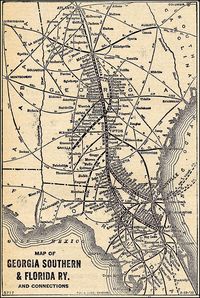
Look at all those other railroads converging on Valdosta in


that GFRR project proposal map.

Valdosta is a historical rail hub for passenger traffic to Atlanta,
Savannah, Jacksonville, Orlando, Thomasville, Tallahasssee, and
beyond. All the tracks are still in place and still in use for freight.
With some rolling stock and a few deals with the railroads, Valdosta
and Lowndes County could become again a passenger rail hub with a mass
transit system for local commuting to jobs and for long distance travel.


Add

a bus system
and local commuting becomes very practical.
People could take the train to town and catch a bus to work.
Many people could walk or take a bicycle to their work from the
train station.
This could work the other way around, too.
People could live in Valdosta and work in Ray City or Lakeland or
Hahira or Lake Park or Clyattville and not have to drive to get there.
That would save

a lot of wasted time and wasted fuel.

This kind of mass transit would attract the knowledge-based workers
we supposedly want around here.


Including jobs our high school and college graduates could take,
so they wouldn’t have to move elsewhere.

And upgrading the railroads, building stations, building
and refurbishing houses and apartments near the stations, etc.,
would employ a lot of construction workers;
probably as many as road projects and sprawling subdivision projects,
but without the sprawl.

-jsq

Georgia and Florida Railway (GFRR) – Valdosta to Willacoochee Rehabilitation $6.25 million T-SPLOST

Now here’s a T-SPLOST project I like:
upgrading the railroad that runs


from Valdosta to Moody AFB
and on to Ray City and Nashville in Berrien County,
and Willacoochee in Atkinson County.
This proposal is to aid freight, but with this upgrade to the track,
the same track would be even more readily usable for passenger rail.
That same track was used for passenger travel up into the 1950s.
My mother used to catch the train at Barretts (just north of Moody) to go visit her relatives in Pearson (a bit east of Willacoochee).

It’s true the project sheet talks about “potential customers in the region”:

This project will provide for more efficient train operations along
the rail corridor to accommodate the increase rail traffic serving the
existing and potential customers in the region.

However, rail promotes development in existing population
centers and at stations, unlike all along automobile roadways.

This project is also another example of how
the economic area of Moody AFB includes

Continue reading

Time to divest from private prison companies

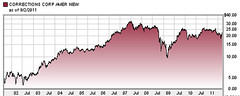
It’s time to stop private prison profiteering by refusing to take
their profit: divest private prison company stock from personal,
pension, and church funds.

There’s no need to speculate that private prison companies have
incentive to keep more people locked up: CCA says so.
Kanya D’Almeida wrote for IPS 24 August 2011,

‘Profiteers of Misery’: The U.S. Private Prison Industrial Complex
:


CCA’s 2010 annual report
states categorically that, “The demand for our
facilities and services could be adversely affected by the relaxation
of enforcement efforts, leniency in conviction or parole standards
and sentencing practices or through the decriminalization of certain
activities that are currently proscribed by our criminal laws — for
instance, any changes with respect to drugs and controlled substances
or illegal immigration could affect the number of persons arrested,
convicted, and sentenced, thereby potentially reducing demand for
correctional facilities to house them.”

CCA continues, “Legislation has been proposed in numerous jurisdictions
that could lower minimum sentences for some non-violent crimes and
make more inmates eligible for early release based on good behaviour,
(while) sentencing alternatives under consideration could put some
offenders on probation who would otherwise be incarcerated. Similarly,
reductions in crime rates or resources dedicated to prevent and enforce
crime could lead to reductions in arrests, convictions and sentences
requiring incarceration at correctional facilities.”

What’s this got to do with Georgia?

Continue reading

NAACP on MLK on War on Drugs

I hate to

repeat a preacher
, but it’s Sunday, and
Robert Rooks wrote for NAACP 24 August 2011

U.S. Approach to War on Drugs Ignores Dr. King’s Lessons on Justice, Compassion.


After forty years of the war on drugs, America continues to have laws
that stratify society based on race and class and continues to ignore
Dr. King’s lessons on justice, compassion and love.

My favorite quote from Dr. King speaks to the heart of the problem with
America’s criminal justice system. “Power without love is reckless
and abusive, and love without power is sentimental and anemic. Power
at its best is love implementing the demands of justice, and justice at
its best is power correcting everything that stands against love.”

America’s criminal justice system is reckless and discriminate. America
has five percent of the world’s population but 25 percent of the
world’s prisoners. Blacks are incarcerated at four to five times the
rate of whites for drug crimes, even though the majority of those who
use and sell drugs are white. The majority of those incarcerated are
people who have a history with mental health and substance abuse.

Not only does incarceration impact individuals but it undermines families,

Continue reading

NAACP paradigm shift

Why does it matter that the NAACP wants an end to the War on Drugs?

Leonard Pitts Jr. wrote for the Miami Herald 30 July 2011,

NAACP’s paradigm shift on ending the Drug War


Here’s why this matters. Or, more to the point, why it matters more than
if such a statement came from Jesse Jackson or Al Sharpton. The NAACP is
not just the nation’s oldest and largest civil rights organization. It
is also its most conservative.

Conservative as in:

…denoting a propensity toward caution and a distrust of the bold, the
risky, the new. And that’s the NAACP all over.


…there has always been something determinedly middle class and cautious
about the NAACP. This is the group whose then-leader, Roy Wilkins,
famously detested Martin Luther King for his street theatrics.

For that group, then, to demand an end to the Drug War represents a
monumental sea change.

How monumental?

Continue reading

“about as fruitful as trying to squeeze information out of the Kremlin”

Which organization was this judge referring to?


Schuster told the directors that he thought [that organization] was
supplying “vague” information and he directed that henceforth
the sides meet monthly in his office for updates on the liquidation
process. In short, Schuster is learning first hand — just like members,
the media and the public at large have learned — that prying information
out of [that organization] is usually about as fruitful as trying to
squeeze information out of the Kremlin.

No, not that city council!
No, not that county commission!
Not even the state board of corrections.
(Although some of them might want to try that bureaucratic shoe on to see
if it fits.) Here’s who:

Continue reading

Quitman 10, Rally & News Media Whiteout! Nearly 200 Citizens Ignored! —George Boston Rhynes


Received yesterday. It’s a YouTube video. -jsq


Video by George Boston Rhynes for

K.V.C.I. Keeping Valdosta Citizen Informed

George has written up most of this in K.V.C.I. with pictures and YouTube videos.

Also, I appreciate the shoutout, George, and I’m sure the other people involved
with LAKE and this blog do, as well.

-jsq

School consolidation report: can cause irreversible damage

People ask me: why do the NAACP and the SCLC oppose school consolidation?
Well, here’s some recent research that backs up their position, followed
by their positions.
My summary: because it caused great damage last time, and this time would be no different.


Craig Howley, Jerry Johnson, Jennifer Petrie wrote 1 February 2011,

Consolidation of Schools and Districts: What the Research Says and What it Means
:

…the review of research evidence detailed in this brief suggests that
a century of consolidation has already produced most of the efficiencies
obtainable. Research also suggests that impoverished regions in particular
often benefit from smaller schools and districts, and they can suffer
irreversible damage if consolidation occurs.

Isn’t such irreversible damage what

Rev. Floyd Rose got Mrs. Ruth Council to admit?


Rev. Rose: “…we were told about the world, where we came from, how we got here.”

Mrs. Council: “I think we did receive a better education.”

They are referring to black schools before desegregation in the 1960s.

Rev. Floyd Rose is president of the local SCLC,
and here is a statement by
Leigh Touchton, president of the local NAACP:

Continue reading

Private prisons spend millions lobbying to lock people up —Justice Policy Institute

Andrea Nill Sanchez wrote 23 June 2011 in ThinkProgress,

Private Prisons Spend Millions On Lobbying To Put More People In Jail
:


Yesterday, the Justice Policy Institute (JPI) released

a report

chronicling the political strategies of private prison companies
“working to make money through harsh policies and longer sentences.”
The report’s authors note that while the total number of people in
prison increased less than 16 percent, the number of people held in
private federal and state facilities increased by 120 and 33 percent,
correspondingly. Government spending on corrections has soared since
1997 by 72 percent, up to $74 billion in 2007. And the private prison
industry has raked in tremendous profits. Last year the two largest
private prison companies — Corrections Corporation of America (CCA)
and GEO Group — made over $2.9 billion in revenue.

JPI claims the private industry hasn’t merely responded to the
nation’s incarceration woes, it has actively sought to create the
market conditions (ie. more prisoners) necessary to expand its business.

We already knew that, but JPI has quantified it:

Continue reading