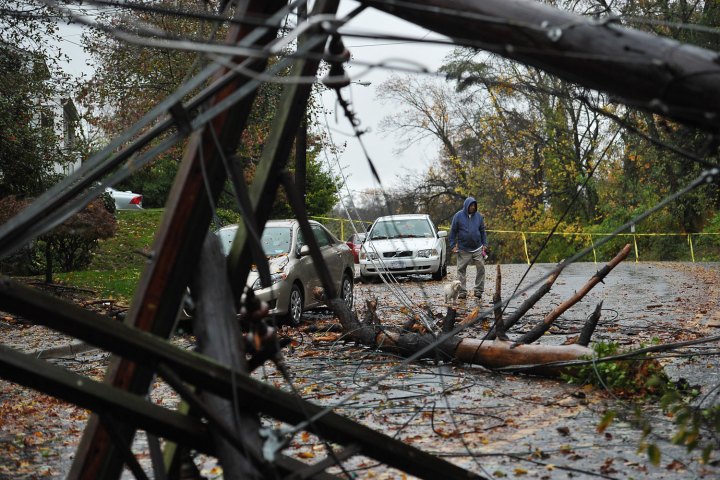
Category Archives: energy efficiency

Rural AIDS: poverty the cause, solar power part of the solution


Director Lisa Biagiotti
spent two years travelling around the South
interviewing people about AIDS to make a film,
deepsouth.
She found rural AIDS is a bigger and faster-growing problem
than AIDS in center cities,
yet most health and prevention funding goes to urban areas.
The root cause seemed clear to her: poverty.
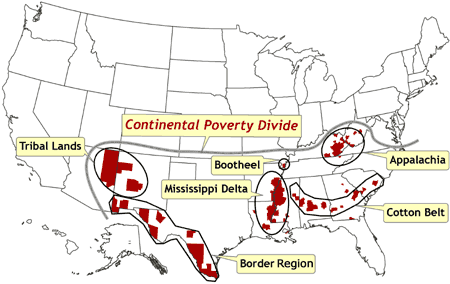
Here’s some deeper dirt (literally) on rural poverty in the U.S.,
and one thing we know can help with that: distributed solar power,
for jobs, for reduced electrical bills, and for energy independence.
What politician wouldn’t want jobs for their constituents?

The director said the screening at

VSU at the end of November
drew more people than the
day before in Little Rock.
There were clearly more than 150 in the audience in Valdosta.
It’s a topic very relevant to here, as

Dean Poling wrote in the VDT 26 November 2012,

Organizers note that Georgia is ranked sixth highest nationally for
its cumulative number of AIDS cases reported through December 2009.
More than 40,000 known HIV/AIDS cases were reported in Georgia as of
2010.

The South Health District’s 10 counties, which include Lowndes and


surrounding counties, report 950 confirmed cases of HIV/AIDS, while
many more are likely infected and risk becoming sick because they
are not being treated. More specifically, there are about 460
reported cases in Lowndes County.

In reporting these numbers, HIV is the virus (HIV disease) and AIDS
is the medical diagnosis made by a doctor of the symptoms, according
to South Health District.

It’s a great movie and I highly recommend it.
Director Biagiotti spent a substantial amount of her own money and two years to make
this film, yet there are aspects she could only note in passing,
such as incarceration.
She can’t be expected to have researched every aspect;
maybe somebody else can step up and help follow more threads.

The movie starts with some maps about poverty and AIDS in the South.
It did not, however, look outside the South for poverty.
Here are better
poverty maps, from the CDC:
Continue reading

Solar: Pieces of a Puzzle —Dr. Michael G. Noll

Op-ed in the VDT today, responding to

a response

to

my op-ed.
-jsq


If the attempt of

a guest column from Jan 13
was to shine light on solar power,
it left everyone in the dark.
Neither mockery nor close mindedness will assist us in finding real answers
if we want to solve

the energy puzzle of the 21st century.


In July 2012, the Financial Times interviewed Jeffrey Immelt, CEO of GE.

GE knows perhaps more about the world of energy business than any other company.
Immelt stated that

“on a cost basis it is impossible to justfy investing in nuclar power for the future.”

People who sitll claim that solar is more expensive
than nuclear are not paying attention.
If solar is viable as far north as

New Jersey
, it certainly is in Georgia.
If countries like

Germany
can excel in solar energy production,
so can we.
Companies like Walmart, Costco, Apple, and

Google

are havily investing in solar because it works.

It should also be noted that the nuclear plant on

Crystal River has been idle since 2009.

As

the Tampa Bay Times reported last December,

Continue reading

The water is not lost. —Forrest H. Williams


Valdosta resident Forrest H. Williams replied in the VDT today to

my op-ed of 6 January.

His information seems a bit out of date.
For example, he cites

Progress Energy’s Crystal River nuke

as a good example, when it’s been

down since 2009

and is still

producing zero percent power
,
both according to the NRC.
Readers of this blog know that

the blog version of my op-ed

already links to sources for everything I said.
I may respond more later, but no doubt there are other people
who want to get involved in this discussion.
And I do thank Forrest H. Williams for airing the sort of disinformation
that is out there, so others can dispel it.

Oh, and saying water that is evaporated is not lost is like saying trees that are burned are not lost. Evaporated water is not available for agricultural or wildlife or drinking water use, and thus is indeed lost.

Continue reading

Putting conservation into conservatives —John S. Quarterman

My op-ed in the VDT today. -jsq

Gov. Deal
(WABE, 14 Nov 2012)
temporarily forgot that “conservative”
includes conserving something,


like

Theodore Roosevelt and national parks
,
or when

Franklin D. Roosevelt established the Okefenokee National Wildlife
Refuge
which also

administers Banks Lake,
when

Richard Nixon started the EPA,

and when

Jimmy Carter signed the Soil and Water Conservation Act.

If Gov. Deal wants to call conservation “liberal”, I’m happy to
be a liberal working for water for our state!


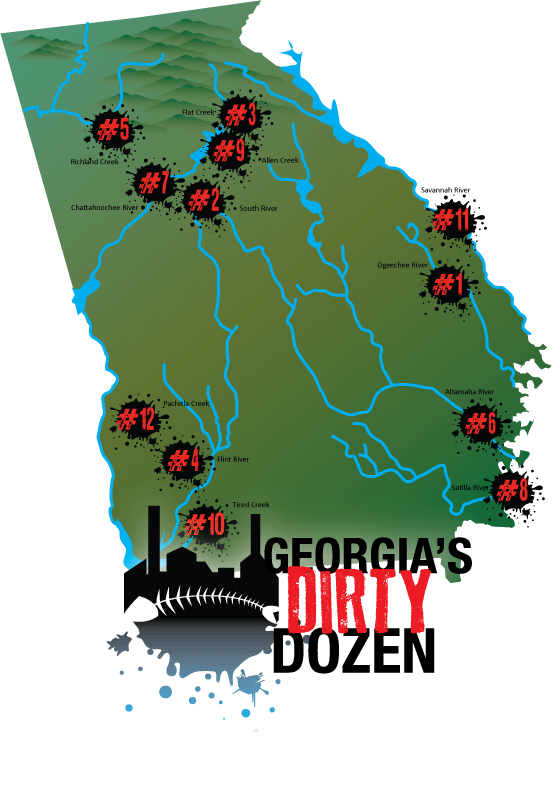
Georgia Water Coalition’s Dirty Dozen


listed the biggest boondoggle
of all as

#11: the nuclear reactors at Plant Vogtle

suck up more water from the Savannah River than all local agriculture and almost
as much as the city of Savannah.

If the new Plant Vogtle nukes

are ever completed,
all four will use more water than Savannah. In

2009 the legislature approved and Gov. Deal signed a law

letting Georgia
Power charge its customers in advance for building that boondoggle,
to the tune of

about $1.5 billion so far!

Let’s not forget

Continue reading

Net zero school in Bowling Green KY


Why stop with
solar Lowndes High or VHS?
Why not have all our elementary and middle schools
generate more solar electricity than they use, and
change their power bills into profits to help pay for education?
A school in Bowling Green, Kentucky is already doing that.

Chuck Mason wrote for bgdailynews.com 22 December 2012,

‘Net-zero’ school pays off
,

The district received a check for $37,227.31 this year. The
Tennessee Valley Authority paid the school district for electricity
it generated. The school district doesn’t have a power plant, per
se, like the utility company. But it does have an energy producer,


the first “net-zero” school in the nation: Richardsville
Elementary School.

The check is tangible evidence that net-zero pays for itself and
then some.

“It has exceeded expectations. We’re seeing a savings of
millions of dollars in energy costs,” state Rep. Jim DeCesare,
R-Bowling Green, said of the net-zero schools concept developing
across the nation.

This is the same Bowling Green, Kentucky that has fast Internet access.
Maybe that’s another reason

the Chamber might want to consider comparing Bowling Green and Warren County
to here.

-jsq

Fake fracking reports: professor and institute head quit, other institute disbanded

From Austin to Buffalo, fake science for fracking is increasingly being exposed,

Frack U

with academic consequences: lead professor resigns,
institute head quits, another institute disbanded.
The image on the right (Frack U) is not a reputation any university wants to see.
At least academia takes conflicts of interest seriously;
now if government and the voters would do the same….
Or energy companies.
Remember, shale gas (plus nuclear) is what Georgia Power and
Southern Company are shifting to from coal,
while shading us from the finances that would enable solar power
for jobs and energy independence in south Georgia.

Terrence Henry
wrote for NPR 6 December 2012,

Review of UT Fracking Study Finds Failure to Disclose Conflict of Interest (Updated)

The original report by UT Austin’s Energy Institute,


‘Fact-Based Regulation for Environmental Protection in the Shale Gas
Development,’
was released early this year, and claimed that there
was no link between fracking and water contamination. But this
summer, the

Public Accountability Initiative
, a watchdog group,
reported that the head of the study, UT professor Chip Groat, had
been sitting on the board of a drilling company the entire time. His
compensation totaled over $1.5 million over the last five years.
That prompted the University to announce an independent review of
the study a month later, which was released today.

The review finds many problems with the original study, chief among
them that Groat did not disclose what it calls a “clear
conflict of interest,” which “severely diminished”
the study. The study was originally commissioned as a way to correct
what it called “controversies” over fracking because of
media reports, but ironically ended up as a lightning rod itself for
failing to disclose conflicts of interest and for lacking scientific
rigor.

Unrepentant
as recently as July,
Professor Groat resigned in November.
Plus this:

Raymond Orbach of UT’s Energy Institute has resigned after the group
became engulfed in controversy over a study of fracking.

And elsewhere even more drastic results have ensued:

Continue reading

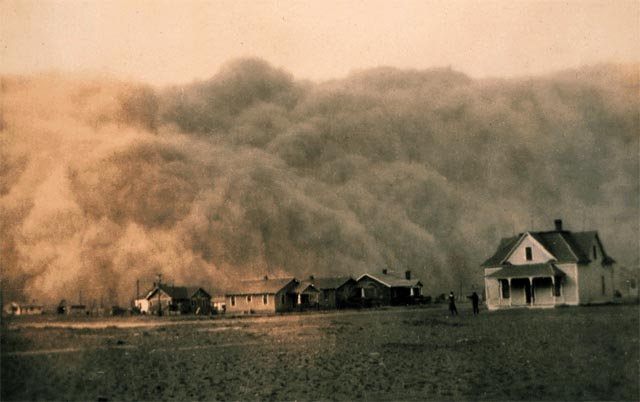
2012 Drought more expensive than Hurricane Sandy


You thought Hurricane Sandy was bad?
You were right, but economically, the ongoing drought is worse economically.
But we already know a much brighter path.

Weather Underground founder Dr. Jeff Masters wrote 16 November 2012,

Lessons from 2012: Droughts, not Hurricanes, are the Greater Danger
,

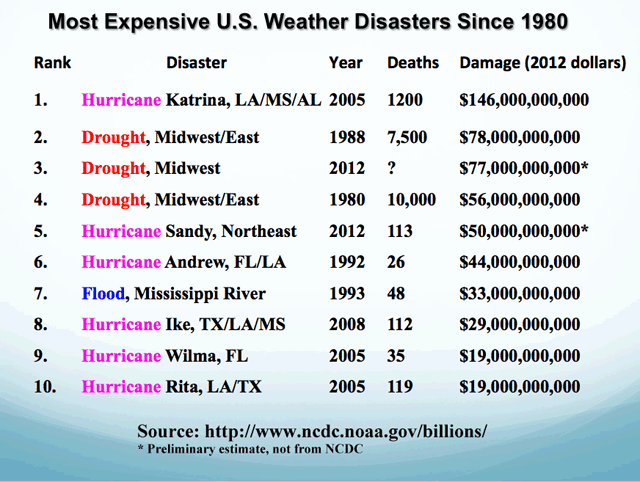
Sandy’s damages of perhaps $50 billion will likely be overshadowed
by the huge costs of the great drought of 2012.


By Dr. Masters’ estimate, the 2012 drought will cost more than half again
as much as Hurricane Sandy.

Also notice Hurricane Katrina still at the top of that table, with almost
three times the economic damage and far more deaths than Hurricane Sandy.
We could have gotten the message back in 2005, but hey, those were only
poor southern people, so who, in for example New York City, really cared?
Yes, I know many of us did and many of you actively helped, but I’m
sure you see my point that when greater New York gets the storm,
suddenly the country pays attention and a lot more people want to find
out how to keep that from happening again.

What’s that drought look like for us here in Georgia at the moment,
according to

U.S. Drought Monitor?

Continue reading

West Point aiming for net zero energy use

U.S. Army is serious about solar, installing solar panels as a
“very visible and a very recognizable part of
our renewable energy initiative that can immediately click with the
general public”
as it makes its military academy net zero, while
encouraging cadets to become renewable energy leaders.
Hm, sounds like

Decatur County with its solar industrial park

and what we could do here with

solar Lowndes High.

Mike Strasser wrote Army PR 29 November 2012,

Solar panels deliver new energy to West Point’s Net Zero initiative,


The installation of solar panels on the roof of the Lichtenberg
Tennis Center—780 panels, to be exact—in recent weeks
represents West Point’s continuing efforts to achieve energy
sustainability.

Since becoming a Net Zero Energy pilot installation last April, West
Point has been making strides toward the ultimate goal of producing
as much energy as it uses by 2020. According to an environmental
assessment for the U.S. Army Environmental Command and West Point
Garrison, the installation currently generates less than .02 percent
of the energy it consumes from renewable sources. Matt Talaber,
Department of Public Works engineer and director, said the solar
panels will be a step in the right direction.

“The solar panels are very visible and a very recognizable part of
our renewable energy initiative that can immediately click with the
general public,” Talaber said. “It’s a positive image that shows
West Point is interested in renewable energy and is working on its
Net Zero energy goals.”

And they’re also improving conservation and efficiency.
Plus this:

Continue reading

Rooftop solar for grid outage independence

Solar power can bring for energy independence, not just from foreign countries,
also from the grid during storms and other outages.

Inspired by the need to deal with downed power lines
in New York and New Jersey after Hurricane Sandy,
David Crane and Robert F. Kennedy Jr. wrote for NYTimes 12 Dec 2012,

Solar Panels for Every Home
,

Solar photovoltaic technology can significantly reduce our reliance


on fossil fuels and our dependence on the grid.
Electricity-producing photovoltaic panels installed on houses, on
the roofs of warehouses and big box stores and over parking lots can
be wired so that they deliver power when the grid fails.

Solar panels have dropped in price by 80 percent in the past five
years and can provide electricity at a cost that is at or below the
current retail cost of grid power in 20 states, including many of
the Northeast states. So why isn’t there more of a push for this
clean, affordable, safe and inexhaustible source of electricity?

First, the investor-owned utilities that depend on the existing
system for their profits have little economic interest in promoting
a technology that empowers customers to generate their own power.
Second, state regulatory agencies and local governments impose
burdensome permitting and siting requirements that unnecessarily
raise installation costs.

I can tell you by experience that solar panels on the roof
(with batteries) can supply power when the grid is out.

In regulatory-captured Georgia, the big impediment to solar is

financing, because of 1973 Territorial Electric Service Act.

When will Southern Company and Georgia Power admit their boondoogle
on the Savannah River has failed and get on with conservation,
efficiency, wind, and solar power?

-jsq

New biomass plant near Dublin, GA: what it’s really about

Not really about jobs, and not about feeding electricity into the grid:
the new biomass plant near Dublin, GA is about saving that company money on electricity: but at what cost to the state and to local residents?


Mike Stucka wrote for Macon.com 6 December 2012,

Deal announces $95 million biomass power plant for Laurens County
,

A new biomass power plant announced Thursday is expected to bring
hundreds of related jobs and a direct $95 million investment.

A statement from the office of Gov. Nathan Deal said the plant
itself will bring 35 permanent jobs to Laurens County.

Compare 35 permanent jobs for $95 million to

MAGE SOLAR’s 350 jobs for $30 million
.
That’s about $2,700,000 per job for this deal,
vs. $85,714 per job for MAGE SOLAR.
Which would make MAGE SOLAR’s facility more than 30 times more effective
at producing permanent jobs.

OK, but what’s this one supposed to do?

Continue reading