Category Archives: Community

Public schools to be treated less favorably than state-dictated charter schools?

Do you want to pay more local taxes for state-dictated and state-run
charter schools?

Ellis Black (R-174)

In

HB 797
,
one of the state laws we’re being asked to ratify with the charter school referendum
on the ballot in November,
in addition to the magic accounting rules that would

grant charter schools much more money per student than public schools,

it would create a state-wide charter school board that will take away
all oversight from the local school board for any charter schools the
state imposes on any locality.
Yet it does not provide additional state funding for the extra
money per student for charter schools, and it does
explicitly address assessed valuation of local taxes.

The state takes all control over local chartered
schools from the local school board in section 2A(7), last paragraph:


Amy Carter (R-175)

The local board shall not be responsible for the fiscal management,
accounting, or oversight of the state chartered special school.

Yet the state provides no additional funding for the additional money
per student for charter schools:


Jason Shaw (R-176)

2A(5) No deduction shall be made to any state funding which a local school
system is otherwise authorized to receive pursuant to this chapter
as a direct result or consequence of the enrollment in a state
charter school of a specific student or students who reside in the
geographical area of the local school system.

(6) Funding for state chartered special schools pursuant to this
subsection shall be subject to appropriations by the General
Assembly and such schools shall be treated consistently with all
other public schools in this state, pursuant to the respective
statutory funding formulas and grants.

The bill also inserts each of those paragraphs again elsewhere,
in case the point wasn’t clear enough.

So where is the extra money to come from?
Here’s a hint:
Continue reading

Industrial Authority goes solar, broadband, and conversational!

The Industrial Authority apparently listened to its focus groups,
and discovered that broadband and solar energy are important
to attract industry.
Andrea Schruijer even recommends conversation,
which has been sorely lacking in recent years.
Congratulations, Industrial Authority!

Jason Schaefer wrote for the VDT today,

Authority analyzes Valdosta business:
Broadband, solar power, professional services targeted for growth,


The Authority also plans to work toward the availability of more
broadband Internet service and solar power in Valdosta and
surrounding communities. These amenities would help support local
industries as well as draw new ones to the greater Valdosta area for
the creation of new jobs.

That’s a good start. Although it’s not clear from the writeup that VLCIA quite got it about
Internet access.

As part of presenting Valdosta as an attractive package for


prospective industries, the Authority attempts to ready the land set
aside for development before beginning the recruitment process. This
means investing in infrastructure, including broadband internet.

“It’s not that we don’t have broadband,” Schruijer said.
“What we’re looking at is the technology behind the broadband.
We have it in certain areas, but in order for us to grow some of
these core targets, such as professional services, we need that
infrastructure.”

Well, actually, no,


we don’t have broadband.

6Mbps is the fastest most people can get around here,
and 30Mbps is the slowest you can even buy in many countries.
Plus, it’s not just fast Internet to industrial sites that’s needed:

it’s fast Internet access everywhere knowledge-based employees
may want to live.

But they’re on the right track:

Because the Authority can’t “buy” industries into coming
to Valdosta—though it can offer tax abatements—it is
necessary to make sure that new businesses have what they will need
before ground is even broken, Schruijer said. To this effect, the
Authority will “stimulate the conversation” to actively
attract more broadband companies to the area.

A conversation!
Now there’s something we’ve been needing around here.
And it’s a refreshing change from only
a year ago when all we heard was


“Debate is not allowed.”

Maybe the Industrial Authority will be the organization that will show the
rest of us how to hold civil discussions about things that affect all of us!

The VDT’s writeup skips quickly over another big change:

Continue reading

Change the Atomic Energy Act? How about change the Georgia Electric Territorial Act?

In reaction to

the NRC denying a nuclear permit for Calvert Cliffs,


some nuclear backers suggest

changing the
Atomic Energy Act of 1954 to permit majority foreign ownership
of nuclear reactors.

What will they suggest next?
Asking Iran to invest in U.S. nukes?

Steve Skutnik wrote for http://theenergycollective.com 5 September 2012,

A cost-free way to open up nuclear investment
,

If this seems entirely backward in a world of global production and
investment, that’s because it is. The current regulation is an


artifact of the Atomic Energy Act of 1954, which first authorized
private ownership of nuclear facilities. (Prior to this—per
the Atomic Energy Act of 1946, all nuclear technology was considered
a state secret, during the short time in which the U.S. enjoyed a
monopoly on the technology.)

Is there any real compelling reason for restrictions on foreign
ownership and investment in nuclear facilities to exist at a time
when the U.S. holding a monopoly on the technology has long since
passed? Issues of safety here of course are irrelevant—the
facilities would be licensed and regulated by the NRC, just as any
other nuclear facility is now. About the only salient objection is
the political one—i.e., the implications of a foreign entity
maintaining controlling ownership in key infrastructure. (Although
it’s hard to see anyone getting particularly upset about the
reverse—U.S. entities owning a controlling stake in
infrastructure in other nations.)

Yeah, sure, strict regulation
will deal with that, just like it prevents fracking from setting
drinking water on fire, or BP from poisoning the Gulf.
The new NRC head is

maybe well-meaning
,
but it’s the same NRC

that gave Vogtle 1 a clean bill just before it had to shut down

and the same NRC that’s ignoring

cancer in Shell Bluff.

Oh, by the way, the article gets to the main point eventually:

Continue reading

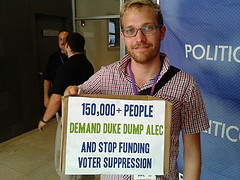
Duke Dump ALEC @ DNC 2012-09-05


150,000+ People Demand Duke Dump ALEC --Whit Jones

Leaving another event, I saw this on the street in Charlotte.
Whit Jones said they’d just had a demonstration demanding Duke Energy dump ALEC.
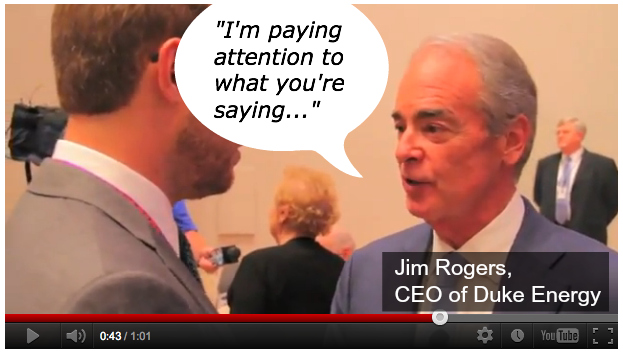
Also that he had encountered Duke CEO Jim Rogers and asked him when
Duke would dump ALEC.
Rogers was uncommittal.
Here’s

Jones’ blogged account of that encounter:

In short, I asked Duke’s CEO Jim Rogers if he would listen


to the
over 100,000 people who are calling on him to have Duke Dump ALEC
and stop funding voter repression. He responded that “he’d be
listening,” and when I pressed him for a commitment to drop ALEC he
said “I’m not going to give you [a commitment right now] but you can
trust that I’m paying attention to what you’re saying, and you’ll
know in due time.”

Here’s

video of the event.

Continue reading

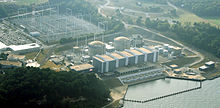
NRC rejects nuke permit for EDF in Maryland

French nuclear operator Électricité de France (EDF)


was denied a license last week for the proposed Calvert Cliffs

nuclear reactor in Maryland, because the
Atomic Energy Act of 1954 prohibits majority foreign ownership
of nuclear plants.
EDF now has 60 days to find a U.S. partner, or give up the project.
Who could the possible suitors be?
Hint: think southeast.

The handwriting was on the wall two years ago when
Constellation Energy pulled out of the project.
Jim Polson and Alan Katz wrote for Bloomberg 10 October 2010,

Constellation Drops Nuclear Plant, Denting EDF’s U.S. Plans
,

Constellation Energy Group Inc. pulled out of negotiations on a $7.5


billion loan guarantee to build a nuclear reactor in Maryland with
Electricite de France SA, potentially damaging the French utility’s
U.S. expansion plans and the companies’ partnership.

The cost of the U.S. government loan guarantee that the companies’
joint venture, UniStar Nuclear Energy, would need to build the
Calvert Cliffs 3 reactor is too high and creates too much risk for
Constellation, the Baltimore-based utility said in a statement
yesterday. The statement said the next step is up to EDF. Enlarge
image U.S. Deputy Energy Secretary Daniel Poneman

In a letter Oct. 8 to Daniel Poneman, deputy secretary of the U.S.
Department of Energy, Constellation said it received a government
estimate that the venture would have to pay about $880 million to
the U.S. Treasury for the loan guarantee, “dramatically out of
line with both our own independent assessments and of what the
figure should reasonably be.”

Constellation’s decision may make it more likely that the U.S.
utility will exercise a put option forcing EDF to buy as much as $2
billion of Constellation’s non-nuclear power plants, said Ingo
Becker, head of utilities sector research at Kepler Capital Markets.

“EDF very clearly said if they exercise the put, this thing is
over,” Becker said. “Constellation may have just turned
around the calendar and pulled out of the new build before
exercising the put, anticipating EDF’s reaction.”

In a letter Oct. 8 to Daniel Poneman, deputy secretary of the U.S.
Department of Energy, Constellation said it received a government
estimate that the venture would have to pay about $880 million to
the U.S. Treasury for the loan guarantee, “dramatically out of
line with both our own independent assessments and of what the
figure should reasonably be.”

Meanwhile, Southern Company

is still trying to reduce what it has to pay for its
$8.3 billion federal loan guarantee
.

Back in Maryland, the news got worse for the nuke last year.
EDF

asked for the state’s help
,
but didn’t get the answer it wanted.
Scott Dance wrote for Baltimore Business Journal 16 December 2011,

EDF: Constellation-Exelon settlement hurts Maryland nuclear industry
,

Continue reading

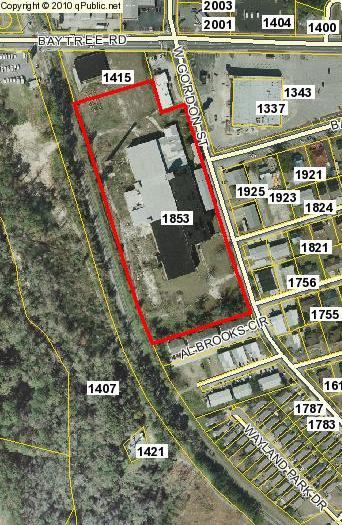
Who are the owners of the Remerton Mill?

Somebody asked:

Who are the owners of the Remerton Mill?


Remerton Mill Map by Lowndes County Tax Assessor database

It’s not a secret; some of them are usually at the Remerton City Council
meetings that discuss the mill.

According to

the Lowndes County Tax Assessor’s database
,
the owner of the property at 1853 W Gordon Street (aka Old Mill Site)
is Remerton Mills, LLC.
According to

Georgia Secretary of State’s corporation database
,
the registered agent is Joseph H. Tillman, Sr.,
its articles were filed by Barry Chapman, and the LLC’s management
consists of
Richard J. Nijem,
Joseph H. Tillman, Sr.,
Jesse L. Maranville,
J. Glenn Gregory,
and Eric M. Tillman.

According to the Tax Assessor’s Database,
the adjoining property at 1415 Baytree Road is owned by
Richard J. Nijem, Jesse L. Maranville, Eric M. Tillman, Joseph H. Tillman,
and J. Glenn Gregory:
the same people as Remerton Mill, LLC.

-jsq

Save the Remerton Mill! —Ransom Gladwin

LTE in the VDT yesterday. -jsq

Part of my teaching load as a professor consists of supervising


student teachers at schools throughout Valdosta State University’s
46-county service area. I have traveled many South Georgia back
roads. What was once a charming rural landscape of unique little
towns has slowly morphed into sameness. Chain-brand retail stores,
fast food, and gas stations are interrupted by strip malls and
storage units. The region’s character has receded in the face of
nationalization and globalization. However, historical features, be
they a restored courthouse or a crumbling tobacco barn, light this
bleakness. They give character, history, and pride to communities.
One such structure is Remerton’s Strickland Mill, now in danger of
complete destruction.

As a member of the Save the Strickland Mill Committee of the
Valdosta Heritage Foundation, we recently toured the mill, with the
approval of the owners and accompanied by Remerton officials. The
original mill is structurally solid. The 1899 structure reflects

Continue reading

WTOC on wind energy on Tybee Island: rally tonight 2012-08-31


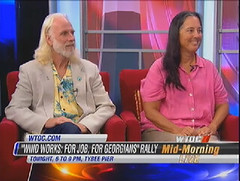
This morning WTOC interviewed
Paul Wolff, Tybee City Council, and
Karen Grainey, Coastal Chapter, Georgia Sierra Club,

Wind Works for Jobs for Georgians

about

Wind Works: for Jobs, for Georgians, 6-9 PM tonight 31 August 2012 Tybee Pier.

Paul Wolff said we have a potential for 14.5 gigawatts off the Georgia coast,
without interfering with shipping lanes or the ocean ecology.
He noted big wind turbines need everything down to ball bearings,
much of which can be (and some already is) produced in Georgia.
LAKE blog readers know Paul Wolff
as somebody who has put his money where his mouth is, with

solar on his roof.

Here’s
the video.
Also

PR from SACE

and

a facebook event.


WTOC-TV: Savannah, Beaufort, SC, News, Weather

-jsq

PS: Owed to Seth Gunning.

-jsq

Green from the Grassroots —Elinor Ostrom


On the day she died, Nobel Prize-winning economist Elinor
Ostrom published
her last article, in Project Syndicate, 12 June 2012,

Green from the Grassroots
,

This grassroots diversity in “green policymaking” makes
economic sense. “Sustainable cities” attract the
creative, educated people who want to live in a pollution-free,
modern urban environment that suits their lifestyles. This is where
future growth lies. Like upgrading a mobile phone, when people see
the benefits, they will discard old models in a flash.

Of course, true sustainability goes further than pollution control.
City planners must look beyond municipal limits and analyze flows of
resources —

energy
,

food
,

water
, and

people


into
and

out of
their cities.

Worldwide, we are seeing a heterogeneous collection of cities
interacting in a way that could have far-reaching influence on how
Earth's entire life-support system evolves. These cities are
learning from one another, building on good ideas and jettisoning
poorer ones. Los Angeles took decades to implement pollution
controls, but other cities, like Beijing, converted rapidly when
they saw the benefits. In the coming decades, we may see a global
system of interconnected sustainable cities emerging. If successful,
everyone will want to join the club.


And counties, and regions, and watersheds, of course.
As Mayor Julian Castro of San Antonio said, there is a

"nexus between sustainability and job creation."

We don't have to wait for San Antonio or Los Angeles or Beijing or
Atlanta to lead the way:

we can get on with it right here where we are.

-jsq

Industrial Authority has to be congratulated —Michael G. Noll

Received yesterday on

WCTV on biomass site VLCIA v. Sterling Planet
. -jsq

Wiregrass Activists for Clean Energy (WACE) have made it clear from


the start that biomass plants have a number of issues: 1) biomass
plants bear significant health risks; 2) biomass plants waste
enormous amounts of water; 3) biomass plants are risky investments
in an increasingly competitive energy sector; and 4) biomass plants
contribute to global warming.

In the light of rising global temperatures, worsening drought
conditions, and dropping prices for solar panels, an increasing
number of people are understanding these simple truths.

The Industrial Authority has to be congratulated for the courage to
admit that energy from biomass plants is indeed more expensive than
energy from solar plants, and we have not even figured in the costs
associated with the consequences of air pollution coming from
biomass plants.

(For more information on biomass plants, here a testimony I recently
gave:

http://www.bredl.org/pdf3/120828_WACE-Comments-Docket_NO-E-100_SUB113.pdf
)

Although this point has already been made earlier, note again that
solar plants are much better alternatives, economically and
environmentally: they do not pollute our air, they do not need any
water, and a huge spill of solar energy is simply called a sunny day
… of which we have plenty here in the south.

-Michael G. Noll

-jsq