Tag Archives: GA PSC

Centralized Nuclear Bad Investment?

A writer for Forbes spells out the question of nuclear investment:
how can something that expensive, over-budget, late, and phenomenally
risky be a good investment, especially when cheaper and faster energy
sources are readily available?

Peter Kelly-Detwiler wrote for Forbes today,

New Centralized Nuclear Plants: Still an Investment Worth Making?


Just a few years ago, the US nuclear renaissance seemed at hand. It
probably shouldn’t have been. Cost overruns from Finland to France
to the US were already becoming manifest, government guarantees were
in doubt, and shale gas drillers were beginning to punch holes into
the ground with abandon.

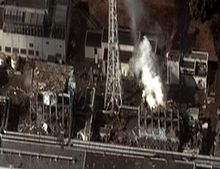
Then came Fukushima. The latter proved a somewhat astonishing
reminder of forgotten lessons about nuclear power risks, unique to
that technology: A failure of one power plant in an isolated


location can create a contagion in countries far away, and even
where somewhat different variants of that technology are in use.
Just as Three Mile Island put the kaibosh on nuclear power in the US
for decades, Fukushima appears to have done the same for Japan and
Germany, at a minimum. It certainly did not help public opinion, and
at a minimum, the effect of Fukushima will likely be to increase
permitting and associated regulatory costs.

He goes into detail: they take too long (while gas and solar got cheaper),
they’re extremely expensive to build and run, and they’re all-or-nothing
investments.

I was going to compile this list of recent nuclear financial failures,
but he saves us all the trouble:
Continue reading

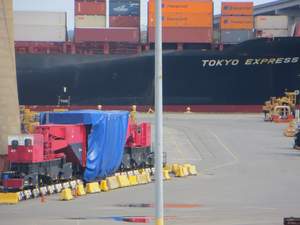
Vogtle reactor vessel sitting unprotected at Savannah port

What happened to Plant Vogtle’s new reactor vessel after

it was in a train wreck
a week ago?
It went back to Savannah port and sits there unprotected and unguarded.

Thomas Clements wrote for the Aiken Leader 14 January 2013,

Vogtle AP1000 Nuclear Reactor Vessel Discovered Unprotected, Stranded in Savannah Port since December 15 Shipment Failure
,


Tom Clements, Alliance for Nuclear Accountability

The reactor pressure vessel (RPV) for the chronically delayed Vogtle
AP1000 reactor construction project near Waynesboro, Georgia sits
stranded and seemingly unprotected in the port of Savannah. The
special railroad car carrying the 300-ton vessel had unknown
mechanical problems on December 15 on exiting the port. The NRC has
said that the vessel only got one-quarter mile before a sound was
heard and the car stopped. Plans by Westinghouse and Southern
Company to move the vessel are unknown. It is also unknown if the
railroad car can be repaired and used or if the railroad company
which owns the line is concerned that the rail car might break down
again on its line in an in accessible place. Meanwhile, the
apparently unguarded reactor might be subject to sabotage and sits
in apparent violation of NRC quality assurance and “administrative
control” regulations.

The article includes links to several more pictures
taken 13 January 2013 by Tom Clements of

Alliance for Nuclear Accountability,

such as this one with the bridge clearly visible:

Continue reading

Carbon bubble? Solar and wind erode coal, gas, and biomass credit quality —Moody’s


In Europe it’s already happening: solar and wind are causing
bond-rater Moody’s to warn of downgrades of energy companies
that depend on heat from burning coal, gas, or biomass.
Moody’s earlier even warned the Bank of England
of a potential carbon bubble developing.
If combustion energy plants are affected like this,
the credit effects will be even bigger on even-more-expensive
nuclear plants, which Moody’s called a

bet-the-farm risk
way back in 2009.

James Murray wrote for businessGreen 6 Nov 2012,

Moody’s: Renewables boom poses credit risk for coal and gas power plants:
Credit ratings agency warns increases in renewable power have had ‘a
profound negative impact’ on the competitiveness of thermal
generation companies
,

“Large increases in renewables have had a profound negative impact
on power prices and the competitiveness of thermal generation
companies in Europe,” said Scott Phillips, an assistant vice
president and analyst at Moody’s Infrastructure Finance Group, in a
statement.

“What were once considered stable companies have seen their business
models severely disrupted and we expect steadily rising levels of
renewable energy output to further affect European utilities’
creditworthiness.”

And not just rising, rising increasingly

Continue reading

Florida Crystal River nuke down $5 billion?


Only
160 miles from here,
the Crystal River nuclear reactor continues to run up a bad bill,
maybe as much as $5 billion,
and even other nuclear operators are reportedly starting to turn against it.
Should we wait for the new nukes on the Savannah River to run up a bill
that high before we cancel them?

Remember

back in May?

Florida is already experiencing a likely future for the new Plant
Vogtle nukes in Georgia: completion date pushed back, and customer
charges raised.

Yep, that’s the one.
And the bill keeps going up, as
Ivan Penn wrote for the Tampa Bay Times 30 December 2012,

Utilities nationwide could share the financial pain of the idled Crystal River nuclear plant
,

The crippled Crystal River nuclear plant is now America’s headache.

The bill to fix it and pay for replacement power may top $5 billion.
The problem?

The company that insures all 104 U.S. nuclear power plants has just
$3.6 billion on hand to pay for claims.

Broken nuclear plants in California, Texas and Michigan will vie for
some of that money. But Crystal River alone represents such a
financial threat that the insurance company, Nuclear Electric
Insurance Ltd., may demand that its member utilities pony up more
money.

Is NEIL the guarantor on the bonds for the new nukes at Plant Vogtle?
I think Southern Company was smarter (for SO, not for us)
and

got Congress to guarantee those.

If so,

Continue reading

Industrial Authority working for solar in south Georgia @ VLCIA 2012-12-18

The

Industrial Authority

is working to find locations for some of the
210 MW Georgia Power got the PSC to shift
from biomass to solar
back in September.
That’s a good next step.

Jason Schaefer wrote for the VDT 23 Dec 2012,

Solar power push has Authority working to establish connections
,

Since the Georgia Public Service Commission (PSC) approved Georgia

Allan Ricketts, Projects and Existing Industry Manager, VLCIA, 2012-12-18

Power Company’s plan Nov. 20 to add 210 megawatts of solar power to
its electrical grid, the Valdosta-Lowndes County Industrial
Authority has been devising strategies to draw solar energy
producers to South Georgia.

Georgia Power will issue a Request for Proposals (RFP) from solar
energy collection and production companies in early 2013, according
to the PSC, and the company will contract with the lowest bidders to
purchase their energy and place it on the Georgia Power electrical
grid for public consumption.

Georgia Power plans to add 90 megawatts to its grid from distributed
generation (small companies producing between 100 kilowatts and 1
megawatt), and 120 megawatts of large utility-scale projects
producing up to 20 megawatts each. The company plans to price the
solar energy at $0.13 per kWh for distributed generation and up to
$0.12 per kWh for utility-scale projects, according to the PSC.

This government-approved commercial push for solar energy could be a
boon to sunny South Georgia as well as the greater Valdosta area
specifically, and the Authority is prepared to accommodate the solar
energy producers they expect.


Andrew Schruijer, Executive Director, VLCIA, 2012-12-18

“I think there’s a very good possibility of solar energy
coming to South Georgia,” Executive Director Andrea Schruijer
said. “Possibly in the near future.”

There’s more in the VDT story.
It’s pretty much what
Col. Ricketts also told me after the VLCIA meeting Tuesday a week ago.
He asked me if I knew what “distributed” meant.
I pointed out Georgia Power’s version of distributed was actually not
very distributed, compared to

Continue reading

First ALEC, now Heartland Institute: losing sponsors

Heartland Institute, one of only two organizations to field a speaker

for
continuing Plant Vogtle delays and cost overruns

at this week's GA PSC hearing,
has been dropped by every pharmaceutical company.
When you're down to Heartland Institute and

renewable-energy-opposing

and

astroturf-funding
super-lobby group ALEC,
itself
rapidly losing members
(so bad
even Bank of America has dumped ALEC);
and when your public hearing speakers are 40 to 1 against continuing
with Southern Company and Georgia Power's nuclear boondoggle,
maybe it's time to end it.

Brad Johnson wrote for thinkprogress 19 December 2012,

Heeding Public Outrage, Pfizer Drops Climate Denial And Tobacco Front Group Heartland Institute
,

The pharmaceutical giant Pfizer (PFE) has confirmed that it will no
longer support the Heartland Institute, a political advocacy group
that questions the science of climate change and tobacco smoking.


Forecast the Facts, which is leading the

campaign calling on
corporations to drop Heartland,
was informed of the decision by
Pfizer's Corporate Secretary Matthew Lepore. Pfizer was a major
donor to Heartland, giving $45,000 in 2012 alone.

Pfizer's decision means that there are no longer any pharmaceutical
companies known to support the Heartland Institute.

Pfizer's last contribution to Heartland was in 2012. Pfizer's
decision follows a groundswell of public outrage over the corporate
support for the Heartland Institute's toxic behavior, including a
billboard campaign that equated believers in climate change with
serial killers such as the Unabomber. Over 150,000 people have
signed petitions to corporate leaders to drop Heartland. Pfizer is
the 21st company to end its support for Joseph Bast's organization,
joining its competitors Amgen (AMGN), Eli Lilly (LLY), Bayer
(BAYRY), and GlaxoSmithKline (GSK), as well as major companies like
General Motors (GM), State Farm, and PepsiCo (PEP).

That’s the best you’ve got for support, PSC, and you’re pretending continuing
to let Southern Company and Georgia Power run up a bill of $billions is in the
best interests of the people of Georgia?

-jsq

Fake fracking reports: professor and institute head quit, other institute disbanded

From Austin to Buffalo, fake science for fracking is increasingly being exposed,

Frack U

with academic consequences: lead professor resigns,
institute head quits, another institute disbanded.
The image on the right (Frack U) is not a reputation any university wants to see.
At least academia takes conflicts of interest seriously;
now if government and the voters would do the same….
Or energy companies.
Remember, shale gas (plus nuclear) is what Georgia Power and
Southern Company are shifting to from coal,
while shading us from the finances that would enable solar power
for jobs and energy independence in south Georgia.

Terrence Henry
wrote for NPR 6 December 2012,

Review of UT Fracking Study Finds Failure to Disclose Conflict of Interest (Updated)

The original report by UT Austin’s Energy Institute,


‘Fact-Based Regulation for Environmental Protection in the Shale Gas
Development,’
was released early this year, and claimed that there
was no link between fracking and water contamination. But this
summer, the

Public Accountability Initiative
, a watchdog group,
reported that the head of the study, UT professor Chip Groat, had
been sitting on the board of a drilling company the entire time. His
compensation totaled over $1.5 million over the last five years.
That prompted the University to announce an independent review of
the study a month later, which was released today.

The review finds many problems with the original study, chief among
them that Groat did not disclose what it calls a “clear
conflict of interest,” which “severely diminished”
the study. The study was originally commissioned as a way to correct
what it called “controversies” over fracking because of
media reports, but ironically ended up as a lightning rod itself for
failing to disclose conflicts of interest and for lacking scientific
rigor.

Unrepentant
as recently as July,
Professor Groat resigned in November.
Plus this:

Raymond Orbach of UT’s Energy Institute has resigned after the group
became engulfed in controversy over a study of fracking.

And elsewhere even more drastic results have ensued:

Continue reading

15 month delay for new Plant Vogtle nukes —state inspector at PSC


Southern Company's new nukes are delayed at least fifteen months,
at least a billion over budget and rising,
and not organized to meet safety filing requirements,
yet the Georgia PSC yesterday
let SO pass the buck to contractors and Georgia Power
continue charging customers for that boondoggle,
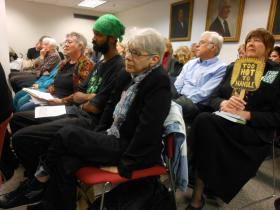
despite 40 to 1 opposition from attendees.

Ellen Reinhardt wrote for GPB News yesterday,

Plant Vogtle Construction Costs Rising
,

An independent auditor told utility regulators Plant Vogtle
construction will be delayed at least 15 months and go millions of
dollars over budget.

Nuclear engineer William Jacobs said poor construction material,
contractor mistakes and oversight delays will mean the Unit 3
reactor won't be ready until July of 2017.

That's 15 months later than planned.

Surprise!

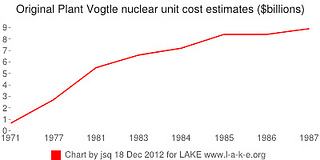
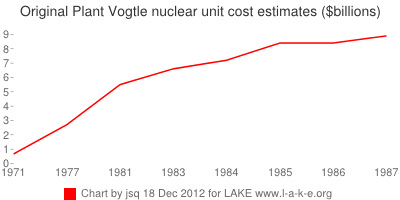
From $0.66 to $8.87 billion: original Plant Vogtle nuclear costs

Who could have expected that, given that back in the 1970s and
1980s

costs blew up 26 times the original estimate.

Back then SO complained about paperwork after Three Mile Island.
They're trying that same excuse now,
but even a former Commissioner-turned-lobbyist is incredulous,
as Kristi Swartz reported for the AJC yesterday,

Monitor: Paperwork problems a drag on Vogtle schedule
,

“It's taken eight months to handle paperwork
deficiencies?” asked Bobby Baker, a former PSC commissioner
who now represents Resource Supply Management, an energy consultant
that works with large commercial, institutional and industrial
electric customers.

A current Commissioner was almost as incredulous:

Continue reading

Original nuclear Plant Vogtle cost overruns

Why should we expect Southern Company to be any better at controlling
costs now than back in the 1970s and 1980s when its original
nukes on the Savannah River went massively over budget?
Massively as in 26 times as much per unit as originally projected.

Kristi Swartz wrote for the AJC 30 Jan 2012,

A financial look at Plant Vogtle nuclear projects
,


From $0.66 to $8.87 billion: original Plant Vogtle nuclear costs

When the two original nuclear units at Plant Vogtle were planned,
the total cost estimate was $660 million.

Yet, as

Jon Gertner reported for NYTimes 16 July 2006
,

The plant took almost 15 years to move from blueprints to being
operational. And by the time it began producing electricity in the
late 1980’s, its total cost, $8.87 billion, was so far overbudget
that Vogtle became yet another notorious example of the evils of
nuclear energy….

The grand plan was to have four reactors. Instead, it was scaled
back to two, Vogtle Unit 1 (finished in 1987) and Vogtle Unit 2
(1989).

That’s right, 4 nuclear units were planned for $660,000,000
fifteen (15) years later only 2 units were built,
for $8,870,000,000.
That’s more than $8 billion in cost overruns,
or more than 13 times the original cost estimate.
So per unit, that’s more than 26 times the original estimate,
or more than $4 billion per unit.

Swartz provided a handy table of cost estimates by year:

Continue reading

Videos, Solar Energy Forum @ CSC 2012-12-01


Solar Energy Forum at Center for a Sustainable Coast, Savannah, Chatham County, Georgia, 1 December 2012

Here are videos of Saturday’s

Solar Energy Forum

at the

Center for a Sustainable Coast
(CSC)
in Savannah,
with

We will probably post more later on the presentations by Paul Wolff
and Robert Green, and the ensuing questions and answers.
Meanwhile,
here’s

a video playlist

of the entire event:


Videos, Solar Energy Forum

Solar Energy Forum, Center for a Sustainable Coast (CSC),

Videos by Gretchen Quarterman for Lowndes Area Knowledge Exchange (LAKE),

Savannah, Chatham County, Georgia, 1 December 2012.

-jsq