Tag Archives: GA PSC

Already: Solar grid parity without subsidies in India and Italy

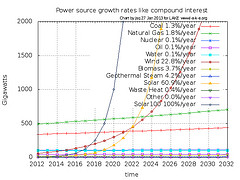
Solar power is going so well worldwide that Deutsche Bank has just
increased its projections for global demand,
noting that India and Italy have already in 2013 reached grid parity
without subsidies with other sources of energy,
and it expects the rest of the world to follow as early as 2014.
The big winner is rooftop solar.

Is Georgia paying attention?

Becky Beetz wrote for Global PV 26 February 2013,

Deutsche Bank: Sustainable solar market expected in 2014
,


Buoyed by bullish demand forecasts, and increasing utilization rates
and pricing, Deutsche Bank forecasts a solar market transition from
subsidized to sustainable in 2014. Italy REC solar photovoltaic
plant

The German bank has raised its 2013 global solar demand forecast to
30 GW — representing a 20% year-on-year increase — on
the back of suggestions of strong demand in markets including India,
the U.S., China (around 7 to 10 GW), the U.K. (around 1 to 2 GW),
Germany and Italy (around 2 GW).

Rooftop installations are, in particular, expected to be a main
focus, says Deutsche Bank. A trend for projects being planned with
either “minimal/no incentives” has also been observed, despite the
belief that solar policy outlooks are improving, particularly in the
U.S., China and India, and “other emerging markets”.

More analysis by
Jeff Spross in ThinkProgress 3 March 2013,

Solar Report Stunner: Unsubsidized ‘Grid Parity Has Been Reached In India’, Italy–With More Countries Coming in 2014
.

As Renew Economy also
points out
, this is the third report in the past month
Continue reading

Levy Co. FL nuke likely not to be built

Cost already sunk Kewaunee, Calvert Cliffs, Crystal River, and are gnawing
away at San Onofre: now it looks like new owner Duke is not
likely to build Progress Energy's Levy County, Florida reactor.
All that plus even in Georgia, even against all-powerful Georgia Power,
there's a reaction against the cost of the always-later always-more-expensive
new nukes at Plant Vogtle on the Savannah River.
A reaction that's getting written up in the Valdosta Daily Times.

In the VDT today from AP,

Some leaders souring on nuclear power costs
.
I'm quoting from the abcNews version
because it includes the author's name, Ray Henry,
and the original date, 3 March 2013.
I added all the links and images.


As the cost of building a new nuclear plant soars, there are signs
of buyer's remorse.

The second-guessing from officials in Georgia and Florida is a sign
that maybe the nation is not quite ready for a nuclear renaissance.
On top of construction costs running much higher than expected, the
price of natural gas has plummeted, making it tough for nuclear
plants to compete in the energy market.

In Georgia last week, Southern Co. told regulators it needed to
raise its construction budget for Plant Vogtle in eastern Georgia by
$737 million to $6.85 billion. At about the same time, a Georgia
lawmaker sought to penalize the company for going over budget,
announcing a proposal to cut into Southern Co.'s profits by trimming
some of the money its subsidiary Georgia Power makes.

And Southern Company and Georgia Power slipped the Plant Vogtle schedule
still more,

from 15 to 19 months late
.

The legislation has a coalition of tea party, conservative and
consumer advocacy groups behind it, but faces a tough sale in the
Republican-controlled General Assembly. GOP Rep. Jeff Chapman found
just a single co-sponsor, Democratic Rep. Karla Drenner.


That's

HB 267: Financing costs; construction of nuclear generating plant
.
And AP failed to mention

Georgia Sierra Club's support for HB 267
.

As a regulated monopoly, Georgia Power currently earns about 11
percent in profits when it invests its own money into power
projects. Chapman's legislation would reduce those profits if the
nuclear project is over budget, as is the current projection.

In Florida, there's a move to completely
eliminate Construction Work in Progress (CWIP)
such as is being used in Georgia to pre-fund the new Plant Vogtle nukes.

In Florida, lawmakers want to end the practice of utilities
collecting fees from customers before any electricity is produced.

Florida only recently got CWIP, but Progress Energy has been quick to profit by it:

Continue reading

HB 267 Would Limit Georgia Power’s Profits on Vogtle’s Cost Overruns —GA Sierra Club

There’s still time to contact your state legislators about stopping
Georgia Power profitting from cost overruns on the new nukes
at Plant Vogtle.
Georgia Sierra Club spells out why.


Georgia Power’s expansion at Plant Vogtle will bring us power that
is dangerous, expensive and unnecessary.

You may remember a controversial bill the Georgia Legislature
approved in 2009,

SB 31, the Nuclear Construction Work in Progress
(CWIP) bill
, which forces Georgia Power ratepayers to pay the
financing costs during construction, rather than over the life of
the plant. Large users of electricity are exempt from the charge,
but residential and mom and pop businesses have been paying for two
years.

Even after that sweetheart deal, the Public Service Commissioners
scrapped their staff

proposal
to stop the company from profiting on
cost overruns for the project after they top $300 million.

The most recent reports from the independent monitor established by
the PSC says

that the project is months behind and as of December,
$88 million over budget. Georgia Power gets to earn 11.15% return on
all expenses approved by the PSC, so the more they have to spend,
the more they get to make and the more ratepayers get to pay!

Putting the profit issue aside for the moment, if the Georgia PSC
ever decided to disapprove cost overruns, Georgia Power could take a
page from the Mississippi Power playbook and just get the
Legislature to let them issue bonds to pay for the work.


HB 267
by freshman Rep. Jeff Chapman excludes the collection of any
profits on cost overruns beyond the

$6.4 billion the Public Service Commission has approved
.
The bill is co-sponsored by Avondale
Estates Democrat Karla Drenner, who is a member of the Utilities
Committee, to which the bill was assigned. Passage of this bill
would provide an incentive for Georgia Power to keep expenses down
at Vogtle, something that SB 31 failed to do.

It isn’t fair for Georgia Power to profit to the tune of over 11% on
delays, overruns and mismanagement, so

ask your State Representative to support HB 267
.

-jsq

From 15 to 19 months late: Plant Vogtle nukes

Surprise!
The already-billing but not-built new nukes at Plant Vogtle
are going to be even later and cost even more.
In December they were to be
15 months late;
now it’s 19 months late,
and the cost overrun expected is $740 million.
History is repeating itself from

the last time Southern Company
and Georgia Power built nukes on the Savannah River.

How about we pass

HB 267
to stop Georgia Power from charging that cost overrun to customers?

Kristi Swartz wrote for the AJC yesterday,

Vogtle nuclear project to take longer, cost more
,

Georgia Power’s Plant Vogtle nuclear expansion project will take
about 19 months longer to complete than originally expected and cost
about $740 million more than originally thought, the company said
Thursday.


Joseph A. “Buzz” Miller, Executive Vice President – Nuclear Development Southern Nuclear Operating Company

Georgia Power said its share of the estimated $14 billion project
will rise to $6.85 billion, up from $6.11 billion, because of
increased capital costs and additional financing costs. Customers,
who have been paying the financing costs since 2011, now will pay
them for a longer period of time.

And the amount Georgia Power customers have to pay
for

Construction Work in Progress (CWIP)
keeps
ratchetting up:

Continue reading

“It has to close because of the pocketbook.” —Kyle Jones on Maine Yankee nuclear power plant

Instead of demonstrating to influence legislators, sometimes it's better
to get elected and legislate: that's what Kyle Jones did in Maine,
and he closed the Maine Yankee nuke,
de-monopolized the state's electrical utilities,
and instituted a 30% renewable energy goal.
All this was helped by the nuclear industry's own incompetence.

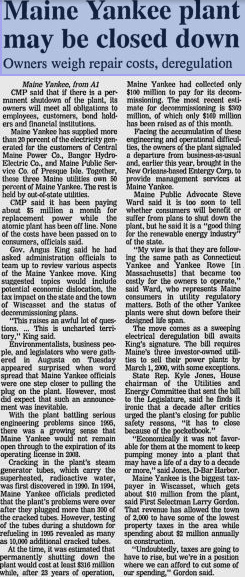
Bangor Daily News, Page A2, 28 May 1997,

Maine Yankee plant may be closed down: Owners weigh repair costs, deregulation
,


Page 2A Bangor Daily News 28 May 1997

Cracking in the plant's steam generator tubes, which carry the superheated,
radioactive water, was first discovered in 1990.
In 1994, Main Yankee officials predicted that the plant's problems
were over after they plugged more than 300 of the cracked tubes.
However, testing of the tubes during a shutdown for refueling in 1995
revealed as many as 10,000 additional cracked tubes.

Sounds a lot like

San Onofre.

At the time, it was estimated that permanently shutting down
the plant would cost at least $316 million while,
after 23 years of operation, Maine Yankee had collected only
$100 million to pay for its decommissioning. The most recent
estimate for decommissioning is $369 million, of which
only $169 million has been raised as of this month.

Facing the accumulation of these engineering and operational difficulties,
the owners of the plant signaled a departure from business-as-usual
and, earlier this year, brought in the New Orleans-based Entergy Corp.
to provide management services at Maine Yankee.

Oh, my!
The same Entergy that's now

likely to close Vermont Yankee.

And Vermont Yankee wasn’t the first to follow this financial path to closure:

Continue reading

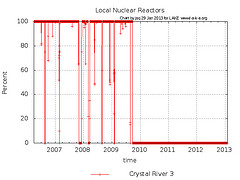
Duke Energy is closing Crystal River nuclear reactor


Finally!
The reactor
only 160 miles from here

that

nobody wanted to pay to fix

is closing for good: Duke is closing Crystal River.
After Kewaunee and Crystal River closing, which one is next?
San Onofre?
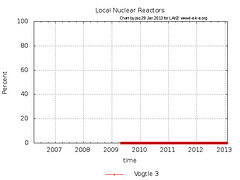
The never-opened Vogtle 3 and 4?

Ivan Penn wrote for Tampa Bay Times today,

Duke Energy announces closing of Crystal River nuclear power plant
,

Duke Energy announced early Tuesday it will permanently close the
Crystal River nuclear plant that has been shut down since late 2009.


The company said it is reviewing alternatives, including building a
new natural gas plant, to replace the power produced by the nuclear
facility.

Duke's four coal-fired plants will remain in service at the same
Citrus County complex where the nuclear plant, known as CR3, is
located.


How about they build
offshore wind farms
and solar farms
instead, like

TEPCO is doing near Fukushima
?
Those can be built on time and on budget, use no fuel, and cause no pollution.
And how about

rooftop solar for jobs
and energy independence?

There's more in

the article,

including this:

Continue reading

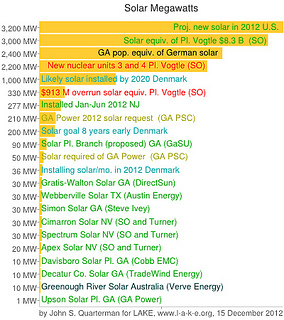
Denmark beats Georgia Power’s 20 year plan


As

anticipated,

Georgia Power released
that

20-year energy plan Thursday,

because they have file one every three years with the PSC.
It includes far less solar power than tiny little far-north-of-here
Denmark is busily deploying.


The good news:
Georgia Power is closing a bunch of coal plants.
And this plan makes a nod towards
"demand response programs, energy efficiency programs, pricing
tariffs and other activities".

The bad news:
they're replacing those coal plants with natural gas, and of course
"two new state-of-the-art nuclear facilities at Plant Vogtle";
you know, the two

Georgia Power has been charging customers for since 2009
while they deliver no electricity.

Georgia Power
can't even seem to deliver the reactor containment vessels.

But what about renewable energy?

Continue reading

Rural AIDS: poverty the cause, solar power part of the solution


Director Lisa Biagiotti
spent two years travelling around the South
interviewing people about AIDS to make a film,
deepsouth.
She found rural AIDS is a bigger and faster-growing problem
than AIDS in center cities,
yet most health and prevention funding goes to urban areas.
The root cause seemed clear to her: poverty.
Here’s some deeper dirt (literally) on rural poverty in the U.S.,
and one thing we know can help with that: distributed solar power,
for jobs, for reduced electrical bills, and for energy independence.
What politician wouldn’t want jobs for their constituents?

The director said the screening at

VSU at the end of November
drew more people than the
day before in Little Rock.
There were clearly more than 150 in the audience in Valdosta.
It’s a topic very relevant to here, as

Dean Poling wrote in the VDT 26 November 2012,

Organizers note that Georgia is ranked sixth highest nationally for
its cumulative number of AIDS cases reported through December 2009.
More than 40,000 known HIV/AIDS cases were reported in Georgia as of
2010.

The South Health District’s 10 counties, which include Lowndes and


surrounding counties, report 950 confirmed cases of HIV/AIDS, while
many more are likely infected and risk becoming sick because they
are not being treated. More specifically, there are about 460
reported cases in Lowndes County.

In reporting these numbers, HIV is the virus (HIV disease) and AIDS
is the medical diagnosis made by a doctor of the symptoms, according
to South Health District.

It’s a great movie and I highly recommend it.
Director Biagiotti spent a substantial amount of her own money and two years to make
this film, yet there are aspects she could only note in passing,
such as incarceration.
She can’t be expected to have researched every aspect;
maybe somebody else can step up and help follow more threads.

The movie starts with some maps about poverty and AIDS in the South.
It did not, however, look outside the South for poverty.
Here are better
poverty maps, from the CDC:


Continue reading

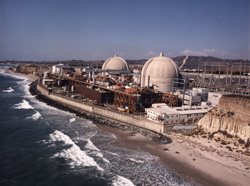
Shutdown at San Onofre: permanent this time?

California only has a couple of nuclear reactor locations (unlike the
32 reactors within 500 miles of here),
and one is in even worse shape than the other: San Onofre,
almost as bad as
Crystal River.
I’m sure Southern Company would never cut corners or have
design or

construction problems
at Plant Vogtle, right?

Harvey Wasserman wrote for AlterNet 7 January 2013,

Showdown at San Onofre: Why the Nuclear Industry May Be Dealt a Big Blow
,

Perched on an ocean cliff between Los Angeles and San Diego, the


reactors’ owners cut unconscionable corners in replacing their
multi-million-dollar steam generators. According to Russell Hoffman,
one of California’s leading experts on San Onofre, inferior metals
and major design failures turned what was meant to be an upgrade
into an utter fiasco.

Installed by Mitsubishi, the generators simply did not work. When
they were shut nearly a year ago, tubes were leaking, banging
together and overall rendering further operations impossible.

Southern California Edison and San Diego Gas & Electric have
unofficially thrown in the towel on Unit 3. But they’re lobbying
hard to get at least Unit 2 back up and running. Their technical
problems are so serious that they’ve asked the Nuclear Regulatory
Commission to let them run Unit 2 at 70% capacity. In essence, they
want to “see what happens” without daring to take the
reactor to full power.

The NRC has expressed serious doubts. On December 26 it demanded
answers to more than 30 questions about the plant’s technical realities.
There have been assertions that unless San Onofre can be shown as operable
at full power, its license should be negated.

It’s good the NRC got around to doing something, after

Continue reading

Failed concrete: the bane of nuclear reactors

Let’s not forget the failed concrete on which

Plant Vogtle’s unprotected stranded reactor vessel
is supposed to sit.

A week before

the reactor vessel train wreck,
news stories
said concrete pouring was delayed due to “noncompliant rebar”.
Thomas Clements elaborated for the Aiken Leader 14 January 2013,

Vogtle AP1000 Nuclear Reactor Vessel Discovered Unprotected, Stranded in Savannah Port since December 15 Shipment Failure
,


Due to chronic delays in the pouring of “nuclear
concrete” for the basemat of the AP1000 units at Vogtle and VC
Summer, it remains unknown when or if any reactor vessels can
actually be placed into the excavated holes at the sites. A January
10 meeting of the NRC confirmed that another basemat-related
“license amendment request” (LAR) was soon to be filed
by SCE&G for its AP1000 project and that the target date for
granting of the LAR was March 18. It appears that the Vogtle project
has fallen behind the V.C. Summer project and no strategy for the
filing of a similar and necessary LAR by Southern Company is known.


Concrete, the long-time bane of

Seabrook Station

and also what’s keeping

Crystal River
shut down because nobody wants to pay the
billions of dollars it would take to fix it.


What say we call the whole thing off, like
Dominion Power did with its existing

Kewaunee nuke
,
and
TEPCO and NRG did

with their plans for new South Texas nukes
.


Maybe it’s a sign that meanwhile

Google has invested a billion dollars in wind and solar
and gotten
2 gigawatts of power, almost as much as the 2.2 GW the two new Vogtle nukes
were supposed to produce, except Google’s solar and wind projects
are online on time, and for less than just the cost overruns at Vogtle.

The Georgia legislature is in session.
You can contact

your legislator or the PSC
today
about

toppling Southern Company’s three-legged nuclear regulatory-capture stool

and

fixing that 1973 Territoriality Law

so we can get on with solar and wind in Georgia,
for jobs and energy independence, and oh by the way clean air and
plenty of clean

water
.

-jsq