Tag Archives: GA PSC

GaSU wins at GA PSC, but will GaSU help all of us win in the legislature?

GA PSC Stan Wise’s 2009 nuclear CWIP lobbying points eerily matched Southern Company’s,
but suddenly he’s got separation-of-powers religion about Georgia Solar Utilities (GaSU).
The PSC recommended GaSU’s utility bid anyway.
When the legislature takes that up in a month or so, will GaSU CEO Robert Green,
unlike SO or Georgia Power or Stan Wise, help the rest of us little people
fix the 1973 Territoriality law so we can sell our solar electricity
on a free market?

Dave Williams wrote for the Atlanta Business Chronicle yesterday,

Georgia Public Service Commission moves ahead on solar energy
,


Georgia Power logo

The Georgia Public Service Commission approved a plan by Georgia
Power Co. Tuesday to acquire an additional 210 megawatts of solar
generating capacity, more than tripling its investment in solar
energy.


GA PSC PR about 20 November 2012 decisions

But a sharply divided PSC also gave a potential competitor to
Georgia Power its blessing to appeal to the General Assembly to
amend a 39-year-old law that gives the Atlanta-based utility the
exclusive right to continue serving existing customers.

Under Georgia Power’s Advanced Solar Initiative, the company will
buy solar power produced by both large “utility-scale”
solar farms and from smaller projects operated by residential and
commercial property owners.

Right, that’s actually

only 10 Megawatts from “smaller projects”,

maintaining Georgia Power’s monopoly while throwing throwing
a bone to the rest of us.

While the PSC supported Georgia Power’s plan unanimously, a
subsequent motion by McDonald encouraging other solar utilities
interested in serving Georgia to pursue their plans with the
legislature passed by the narrow margin of 3-2.

Georgia Solar Utilities Inc., a company launched in Macon, Ga.,
earlier this year, filed an application with the PSC in September
for authority to generate solar energy in Georgia on a utility
scale.

The two Nay votes were from the two recently-reelected PSC members,
apparently now thoroughly in the pocket of the incumbent utilities.
Here’s one of them now:
Continue reading

Solar up 50% over last year in Germany


July in Germany

wasn’t a fluke:
solar PV electricity production in Germany is up 50% over last year.
Maybe we hould consider a Feed-in Tariffs (FIT) in Georgia like that in Germany.
Unlike the Construction Work in Progress (CWIP) charge on Georgia Power
bills for nuclear power people won’t get for years, if ever, FIT charges
only apply after solar power is flowing.

Bloomberg Businessweek via AP 5 November 2012,

German solar power production up 50 pct on year
,


The German utilities’ industry association BDEW said Monday the
solar power output rose to 25,000 gigawatt hours in the January to
September period, from 16,500 gigawatt hours a year earlier.

It says solar power’s share in the country’s electricity production
rose to 6.1 percent from 4.1 percent. Wind power gained slightly to
8.6 percent from 8.0 percent. Biomass plants accounted for almost 6
percent.

It says all renewable energies combined accounted for about 26
percent of electricity production over the first nine months.

Germany decided last year to phase out nuclear power by 2022 and
replace it with renewable energies.


If you’re tired of Georgia Power and its parent Southern Company
pouring your customer and tax dollars down that nuclear pit near
the Savannah River, or if you’d just rather have solar or wind power,
you can send in your CWIP charge as a separate check, with a note on it.
Even if you’re not a Georgia Power customer, you can

contact them or Southern Company (or the GA PSC or the legislature)
about this.

-jsq

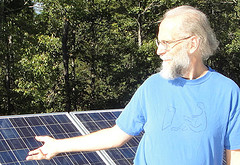
The power of going solar —John S. Quarterman


Solar panels on farm workshop --John S. Quarterman

My op-ed in the VDT today. Remember
to vote today or Tuesday.
-jsq

This spring,

the University at Buffalo
turned on 750 kilowatts of
solar electricity.

Rutgers U., in New Jersey,
installed 1.4
megawatts in 2009 and started on 8 MW this summer. Down here with a
lot more sun, how about solar panels on VSU parking lots?

There’s

plenty of private solar financing available.
Also in New
Jersey, a company installed 6 MW of solar on high school land and
leased the power to the school supplying most of its needs win-win.


You can go see a solar farm already working fine here,

200 kilowatts at Mud Creek Wastewater Plant.

Why not do the same


View Larger Map


at Lowndes High School,
where all the world on I-75 could see,

attracting business to our community?

Why not?

Continue reading

New solar in New Jersey, Massachusetts, Florida: where’s Georgia?

What are these

new solar projects?

Here are a few FERC lists,
in New Jersey, Massachusetts, and Florida,
and there are more in Texas.
Not so many in Georgia.


  • Zongyi Solar America’s 20 MW Tinton Falls Solar in Monmouth County,
    New Jersey, is online. Tinton Falls Solar is the largest
    photovoltaic project in New Jersey.
  • Southern Sky Renewable Energy LLC’s 5.6 MW Canton Landfill Solar
    Project in Canton County, Massachusetts is online. This photovoltaic
    project is built on the closed and capped Canton Landfill. It is the
    largest solar facility in New England. The electricity generated is
    sold to the Town of Canton under a long-term agreement.

New Jersey again!
20 Megawatts is even larger than the

6.1 MW at Lawrenceville School.

And Massachusetts, even farther north.
Let’s also look just south of us:


  • SunEdison’s 3.6 MW Phase 2 Lakeland Regional Airport Solar Project
    expansion in Polk County, Florida is online. The Lakeland Regional
    Airport Solar has a total capacity of 6.3 MW. It is the largest
    photovoltaic project in Florida. The electricity generated is sold
    under long-term contract to Lakeland Department of Electric Water
    Utilities.

Ah, but

that’s illegal in Georgia!

Here you can sell electricity only to your one and only monopoly utility,
predetermined for you by the 1973 Territorial Electric Service Act.
Maybe we should change that?

The Lakeland Chamber of Commerce

helped promote that solar project.

Maybe better PR than

feuding with the newspaper?

Also only slightly farther south of us,

Continue reading

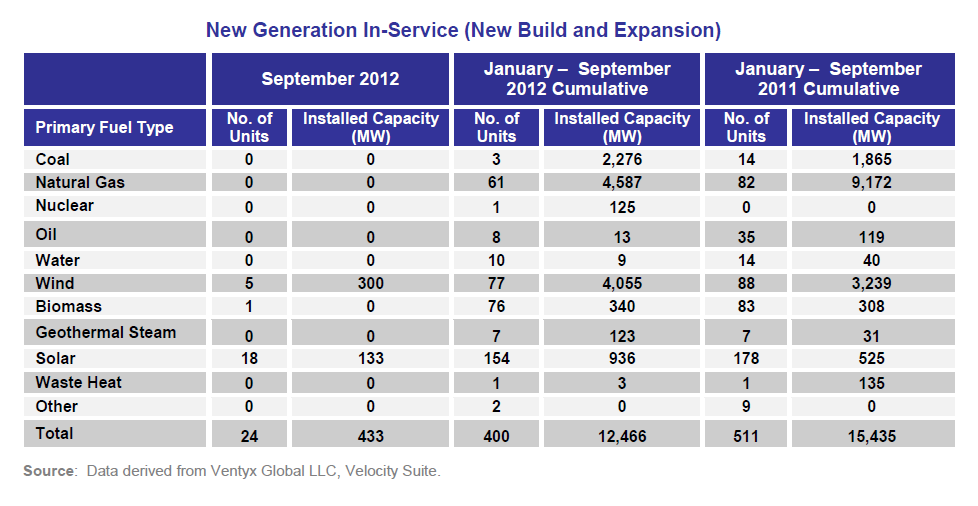
Wind and solar were all the new U.S. electric generation in September 2012

Wind and sun provided all the new electric power generation
deployed in September 2012.
As Moore’s Law continues to decrease solar prices, solar
power gets deployed still more rapidly,
and wind also gets installed on time and on budget.
Meanwhile, nuclear takes a

three-legged nuclear regulatory-capture stool

and hardly any new reactors get finished anyway.


Stephen Lacey wrote for TP Climate Progress 24 October 2012,

Wind And Solar Make Up 100% Of New U.S. Electricity Capacity In September
,

September was tied for the

hottest of any September
on record
globally. It was also a very hot month for renewable energy in the
U.S. According

to figures
from the Federal Energy Regulatory
Commission, wind and solar accounted for all new electricity
capacity added to America’s grid in September.

New wind is up 25% Jan-Sep 2012 over the same period last year,
and new solar is up 78%.
For comparison, new coal is

Continue reading

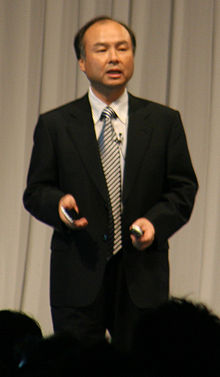
Softbank’s Son to install solar in Japan: watch out, Georgia Power!

The same Masayoshi Son who shook up Japan’s Internet market

and is about to do the same in the U.S.

is moving to modify Japan’s power market from nuclear to solar.
Watch out, Georgia Power and Southern Company!
If you don’t get a move on, Son-san will eat your lunch, too.

Mariko Yasu wrote for Bloomberg Businessweek 23 June 2011,

Softbank’s CEO Wants a Solar-Powered Japan
,


Masayoshi Son

Billionaire Masayoshi Son made a fortune taking on Japan’s phone
monopoly. Now he aims to shake up its power utilities after the
worst nuclear crisis in 25 years. The 53-year-old chief executive
officer of Softbank says he will build solar farms to generate
electricity, with support from at least 33 of Japan’s 47
prefectures. He’s asking for access to transmission networks owned
by the 10 regional utilities and an agreement that they buy his
electricity. No other company has secured unlimited access to the
those transmission networks. The utilities would not comment.
Japan’s main business organization, the Keidanren, called for
“careful analysis” before any drastic change in the power system
took place.

If Japan ever felt ready to back Son’s ambitious plan, this is the
moment. Radiation has spread across at least 600 square kilometers
(230 square miles) in the northeast since the Mar. 11 earthquake and
tsunami led to meltdowns at the Fukushima Dai-Ichi nuclear plant.
Outgoing Prime Minister Naoto Kan said in May he will rethink a plan
to increase atomic power to 50 percent of the nation’s energy output
from 30 percent. Renewable energy already accounts for 10 percent,
according to Japan’s Agency for Natural Resources and Energy. Son
wants to see that tripled by 2020. “The question is how this nation
is going to survive after cutting nuclear power,” he said at a
government panel meeting on June 12.


Complacent Georgia Power and SO,
you maybe don’t think he can do it?
NTT probably thought that, too:

Continue reading

Solar yes, nuclear expansion no —David Staples for GA PSC


After

he spoke at last Thursday’s Political Forum
,
David Staples said something interesting out in the hall and I asked
him to repeat it for the video camera.

Here’s

the video,

followed by
a transcript.


Video by John S. Quarterman for Lowndes Area Knowledge Exchange (LAKE),
Valdosta, Lowndes County, Georgia, 18 October 2012.

Here’s the
transcript:

I think right now we need to look at solar.
The two new nuclear reactors probably shouldn’t be built right now.
You look at the wholesale power rate curves,
and where it’s most expensive, and it’s during peak hours.
Wholesale power is 50 cents a kilowatt-hour,
and the electric companies are buying at wholesale rates,
What do we need to offset that with?
We’ve got something to do that with: solar.
The cost has come so far down that that’s something
we should be spending our money on rather than
than building nuclear reactors right now.


Solar PV costs

dropped 50% last year.

Southern Company’s new nukes

continue to run farther over budget.

If

Denmark can do it

maybe

Southern Company and Georgia Power should stop manufacturing buggy whips

and

help get Georgia on the solar train.

Staples is

on record for solar

and as he says
ethics matter:
all the incumbent GA PSC members
have taken campaign donations from
people closely associated with the industries they regulate,

(including

Stan Wise
)
and Staples
has apparently

only accepted donations from clean sources.

-jsq


TV ad by Steve Oppenheimer for GA PSC


According to Ted Terry,

We are the first PSC campaign in over a decade to go up on the
broadcast airwaves!

Here’s

the video:

About those rate hikes:

Georgia Power hikes prices for gas and nuclear, then complains about solar

and

We can charge you even if it’s cancelled! —CWIPped Georgia Power

About

the GA PSC incumbents all accepting campaign contributions from people
closely associated with the industries they regulate.

Steve Oppenheimer is on the record as

wanting more energy efficiency
and renewable energy (including solar energy)
.

-jsq

We can charge you even if it’s cancelled! —CWIPped Georgia Power


Steve Willis

An excellent article about the problems with Georgia Power’s
new nukes on the Savannah River gets at something you may not know:
they can charge you for them even if they’re cancelled!

Steve Willis wrote for the Georgia Sierran Oct./Nov./Dec. 2012 page 5,

Overruns, Uncertainty Plague Vogtle Expansion
,

If Southern Company abandons this
project, the CWIP law not only allows
Southern Company to keep all of the
CWIP payments legally extorted from
customers, but allows them to keep
CWIP fees in place or even increase them
until all their costs and profits have been
fully recovered. Due to the run-away
cost overruns, the CWIP charge on your
monthly bill is already more than three
times what Southern Company confidently
claimed it would be at this time
when they presented their case to “your”
Georgia legislature in 2009.

And that

2009 legislature

rubberstamped CWIP so it appears on your Georgia Power bill as

Nuclear Construction Cost Recovery Rider
.
Willis reminds us that the 2 nukes already at Plant Vogtle were projected
to be four nukes for $600 million and ended up being two for $9 billion.

Everyone has heard the saying “Fool me once, shame on you;
fool me twice, shame on me.” If the Vogtle expansion costs
balloon, as many analysts expect, it will cost

Continue reading

Georgia Power hikes prices for gas and nuclear, then complains about solar

Back in February,

Georgia Power's natural gas Plant McDonough

Georgia Power argued that a free market in solar power would cause
price increases.
Yet they already increased prices for natural gas and
for nuclear plants that won’t produce electricity for years, if ever,
and are already massively overbudget and behind schedule.
Why should we believe them about solar when it’s their archaic projects
they already
are deploying that already have increased customer prices?

In February,

Greg Roberts of Georgia Power argued,

Another reason is that the customers of Georgia Power, Georgia’s

Georgia Power is the snail in the way of solar power in Georgia

EMC’s and Municipal Electric Authority of Georgia are paying for the
poles and wires to transmit power, and the back-up generation to
cover the electricity needs when the sun isn’t shining. These costs
will have to be recovered from other customers not getting the
privileged deal from the developer, raising everyone else’s rates.

While there are already numerous federal and state tax and other
incentives for solar development in Georgia, it is still much more
costly than the service provided by utilities. But what if
third-party solar developers could get other electric customers in
Georgia to foot the bill? That would be the result of this
legislation.

It’s like asking Sally’s Café to pay the electric bill of Joe’s
Cafe across the street, thus allowing Joe to undercut Sally’s
prices.

Georgia Power well knows they could take a percentage of any power
transmitted through their lines, so that wires and poles and
backup generation argument is ludicrous.
And as far as subsidies, how about this one,

Georgia Power, Get the Facts, Investing in Georgia’s Energy Future:

Continue reading