Category Archives: Forestry

Georgia Sierra Club against T-SPLOST

The Georgia Chapter of the Sierra Club opposes T-SPLOST, in all twelve regions, not just in Atlanta Metro.

Prepared by the Georgia Chapter RAIL Committee, April 2012, Metro Atlanta Can Do Better: Why Voters Should Say No to the T-SPLOST and Yes to ‘Plan B’

On July 31, 2012, Georgians in twelve regions around the state will vote on whether to impose a Transportation Special Purpose Local Option Sales Tax (T-SPLOST). After much deliberation, the Georgia Chapter of the Sierra Club is recommending a “no” vote on the T-SPLOST in all twelve regions. The decision to oppose the Metro Atlanta T-SPLOST involved the most discussion, because unlike the other twelve lists, it has a significant portion devoted to mass transit. Ultimately, the Chapter Executive Committee concluded that the project list is too heavily focused on sprawl-inducing road expansion and will have a negative overall impact from an environmental perspective.

As they say, they spent the most time on metro Atlanta, and that’s what most of their position paper, executive summary, press release, etc., is about. But many of their reasons apply equally well to our south Georgia Region 11, such as these ones:

  • The Project List Does Not Present a Cohesive Transportation Vision, offering a hodgepodge of conflicting priorities when what is needed is a bold and consistent vision for a sustainable transportation future.
  • It Does Too Little to Address the Current Road-Heavy Funding Imbalance, instead reinforcing a funding framework that already heavily favors highway expansion over commute alternatives.
  • It Locks the Region into a Dysfunctional, Undemocratic Decision-Making Process, both through the highly politicized “roundtable” process and the blatantly anti-urban method for distributing local set-aside funds.

It favors highway expansion so much that Region 11 doesn’t even
Continue reading

Better cities and counties make better watersheds

Want jobs, low taxes, and less flooding? Help maintain our watersheds with good local planning.

What’s a watershed? Kaid Benfield wrote for Atlantic Cities today, The Cost of Sprawl on Clean Water:

Watersheds are topographic areas where all the rain that falls eventually ends up in a namesake steam, river, lake, or estuary.

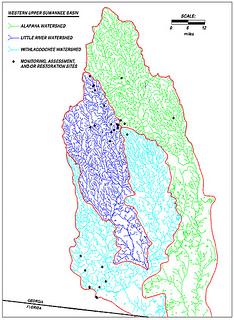
These are our local watersheds. Purple is the Little River Watershed, blue is the Withlacoochee Watershed, and Valdosta is where the Little River flows south into the Withlacoochee. Green is the Alapaha watershed, and Tifton is where all three meet. Every drop of rain or used well water or wastewater overflow or pesticide runoff or soapy shower water or clearcut mud that runs downhill into one of these rivers is in their (and our) watersheds.

Becoming greener doesn’t just mean a municipality’s adding a pleasant new park here and there, or planting more trees, although both components may be useful parts of a larger effort. How a town is designed and developed is related to how well it functions, how well it functions is related to how sustainable it really is, and how sustainable it is, is directly related to how it affects its local waters and those who use those same waters downstream.

Compact, mixed-use, well-designed in-town growth can take some of the pressure off of its opposite on the outskirts — or beyond the outskirts — of towns and cities. We know that sprawling growth is generally pretty bad for maintaining environmental quality in a region (air pollution from cars that become necessary in such circumstances, displacement of open land, water pollution from new roads and shopping centers that are begot by such growth patterns).

We also know, as UGA Prof. Dorfman told us several years ago,

Local governments must ensure balanced growth, as
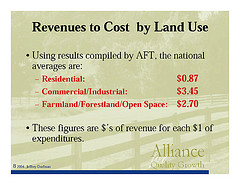
sprawling residential growth is a certain ticket to fiscal ruin*
* Or at least big tax increases.

Kaid Benfield explains how town planning is related to watersheds:

Continue reading

Videos @ LCC 2012 03 27


Here are videos of the entire 27 March 2012 Regular Session
of the Lowndes County Commission (LCC).
The audio feed is coming directly from the Commission’s own audio system.
We don’t know why County Manager Joe Pritchard is frequently barely audible,
nor why the microphone at the audience podium sometimes seems hardly to be working, nor why Commissioners ask people in the audience to speak when there is
no microphone pointing at the audience.

Some of these videos have already been blogged:

Here’s

a playlist:


Videos

Regular Session, Lowndes County Commission (LCC),

Valdosta, Lowndes County, Georgia, 27 March 2012.

Videos by Gretchen Quarterman for Lowndes Area Knowledge Exchange (LAKE).

-jsq

Industrial Authority got wetlands easement from Lowndes County for private prison site

Before selling it off to a private landowner who
who two years later got a contract with private prison company CCA

to resell it for almost 100% profit
,
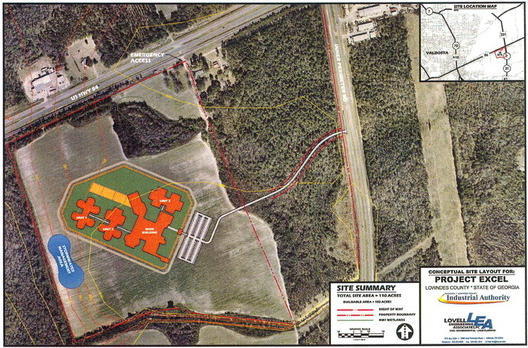
the Industrial Authority acquired a road easement through county-owned wetlands
from Lowndes County:

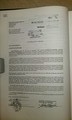
Further, Grantor hereby conveys a Non-Exclusive Ingress and Egress Easement
in that certain 0.685 acre tract or parcel of land
situate, lying and being in Land Lot 153 of th 11th
Land District of Lowndes County, Georgia.
Said 0.685 acre tract being designated as “0.685 acres — Ingress/Egress
Easement reserved for future right-of-way extension”
as depicted on that certain map or survey
“Valdosta-Lowndes County Industrial Authority” dated
September 8, 2004 and recorded September 9, 2004 in Plat Cabinet A, Page 2659,
Lowndes County records, to which
map and survey is hereby referred in further aid of description.

An easement that a private landowner might have more difficulty getting
from the county.
Isn’t that convenient?


This is the wetland that

has not yet been approved for that purpose by the Army Corps of Engineers,
according to Ashley Paulk.

By the way, that wetland easement in 2004 was

before Brad Lofton was hired in 2006 to be executive director of VLCIA
,
so the very peculiar history of this bit of land can’t all be blamed on him.
The appointed Industrial Authority board and the elected
Lowndes County Commission
and Valdosta City Council

are all also involved.

-jsq

VLCIA and local counties

In which of these five, seven, eleven, or thirteen counties
is
Athens, Georgia?

According to
Valdosta-Lowndes County Industrial Authority (VLCIA),

Regional Hub
,

Valdosta is a regional hub for eleven Georgia counties and two Florida
counties.
Valdosta-Lowndes County acts not only as the regional hub for retail,
medical, transportation and entertainment. Our community is also the
regional hub for employment for five contiguous, predominantly rural
Georgia counties and two Florida counties (as indicated in the chart
to the right) and supports a thirteen county region referenced from
the 2000 Census (see chart attached below).

The five Georgia counties are (alphabetically)
Brooks,
Cook,
Echols,
Lanier,
and
Lowndes,
and the
two Florida counties are Hamilton and Madison.
In which of those seven counties is Athens, Georgia?


The thirteen counties, barely legible on VLCIA’s webpage, are:
Berrien GA,
Brooks GA,
Clinch GA,
Colquitt GA,
Columbia FL,
Cook GA,
Dougherty GA,
Duval FL,
Echols GA,
Fulton GA,
Hamilton FL,
Lanier GA,
and
Madison FL.
Fulton County, Georgia?
OK, that’s odd.
Hm, the table is entitled

“Journeys To and From LOWNDES GA (Threshold = 50)”.

It’s about vehicles travelling in and out of Lowndes County.
So Fulton makes some sense, due to people travelling between here and Atlanta.
Local region, though?
Not Fulton.
Ditto Duval County, Florida. Jacksonville, local? I think not.

So maybe call it an eleven county region.
In which of those eleven or thirteen counties is Athens, Georgia?

-jsq

Why doesn’t VLCIA buy locally?

Col. Ricketts reminded VLCIA board members at their most recent
regular meeting (2012 01 17) that he had asked
them for input about trees for Miller and Westside Business Parks.


We have identified trees from a nursery,
Select Trees, in
Athens, Georgia,
with a special five year warranty on those trees,
that meet our landscape plans for both Miller and Westside Business Park.
As we discussed in our last board meeting, there is some cost savings
available to us, and the ability for us to
select trees now and hold them if we make a deposit.

OK, I commend VLCIA staff and board for trying to save we the taxpayers money.

But isn’t VLCIA supposed to be promoting local business and agriculture?
Why is our Industrial Authority outsourcing to a company halfway across
the state?
Why doesn’t it buy locally, even if it costs a little more?

For that matter, aren’t there plenty of local trees, like sycamores,
magnolias, and even longleaf pines that would cost very little to
transplant to a local business park?
Maybe those are the types of trees they’re buying.
We don’t know, because only the board got the list of trees.

For that matter, why didn’t VLCIA put out a public request for bids for the trees?

Here’s

the video:


Why doesn’t VLCIA buy locally?

Regular Meeting, Valdosta-Lowndes County Industrial Authority (VLCIA),

Norman Bennett, Tom Call, Roy Copeland chairman, Mary Gooding, Jerry Jennett,

Andrea Schruijer Executive Director, J. Stephen Gupton attorney, Allan Ricketts Project Manager,

Valdosta, Lowndes County, Georgia, 17 January 2012.

Videos by John S. Quarterman for LAKE, the Lowndes Area Knowledge Exchange.

-jsq

Local state legislative delegation at the Country Club

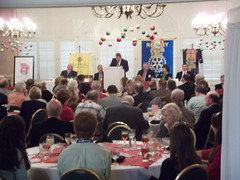
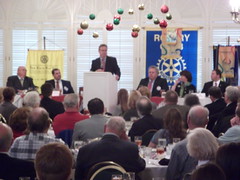
At the State Legislative Luncheon at the Country Club yesterday,
sponsored by the Rotary Club and the Chamber of Commerce,
I found it more interesting what the legislators didn’t mention
than what they did.


Frequent attendees told me the audience was much larger
than in previous years, and one attributed that to the recent
school consolidation referendum.
Sitting side by side were Chamber Chair Tom Gooding and
FVCS President Sam Allen.


Jeff Hanson introduced the legislators.
He’s the Chair of the Chamber’s

Government Affairs Council (GAC).

He said they are seeking more participants.
Hm, they have an Energy and Environment Policy Committee that’s chaired
by someone from Georgia Power….

Tim Golden announced that the local delegation’s highest priority
was to get $32 million for a Health Science Center for VSU.
VSU Interim President Dr. Levy was there, as was former president

“Dr. Z” as Tim Golden called him.

I was just talking to someone from SGMC in the food line about
how it would be nice if the Industrial Authority would promote
healthcare industries more.
It’s good that the legislators are doing that,
although it’s not clear that there are not other things
that should be even higher priority.

Tim Golden also wants to remove a sales tax

Continue reading

USDA Under Sec. to speak in Tifton Tuesday at forestry conference

From longleaf restoration to biomass, lots of interesting talks and tours.

Georgia Forestry Association wrote about the 30 October – 2 November 2011 Southern Woodland Owners Conference & Solutions Fair,

USDA Under Sec. to speak in Tifton Tuesday at forestry conference
:

9:00 a.m. – 10:00 a.m.
Opening Session


Welcome Remarks and Announcements –

Introduction of Conference Co-Chairs, Steve
McWilliams, President, Georgia Forestry Assoc.

KEYNOTE: Honorable Harris Sherman, Under
Secretary for Natural Resources and
Environment, U.S. Department of Agriculture,
Washington, DC/Introduced by Honorable Gary
Black, Commissioner, Georgia Department of
Agriculture

-jsq

Lowndes County Commission: presentations, appointment, resolutions, and contracts


No rezonings but a nomber of other things.
Too bad this one is only in the work session; sounds interesting:

6. Community Wildfire Protection Plan Presentation (Buck Kline) — Work Session Only

Here’s a writeup about

Chief Senior Ranger Buck Kline
.

There’s an appointment to

a relatively new (1994) board:

7. Appointment for Introduction – South Georgia Community Service Board-Sheila Wakeley

Here’s the

agenda:


LOWNDES COUNTY BOARD OF COMMISSIONERS
PROPOSED AGENDA

WORK SESSION, MONDAY, SEPTEMBER 26, 2011, 8:30 a.m.

REGULAR SESSION, TUESDAY, SEPTEMBER 27, 2011, 5:30 p.m.

327 N. Ashley Street – 2nd Floor

Continue reading

VSU Faculty Senate passes anti-biomass resolution

Karen Noll reported on WACE’s facebook page that
the VSU Faculty Senate passed a resolution Thursday 19 May 2011 that
biomass will not be considered renewable for VSU’s climate commitment goal.

Why?

Because

leading medical associations have identified woody biomass
incineration as increasing risks of
“a variety of illnesses, some life-threatening”,
because biomass incineration
produces more CO2, NOX, and fine particulates than existing coal plants,
and because it
“may lead to
unsustainable forestry practices and a net increase in global greenhouse
gas emissions”.

Who proposed this?

Continue reading