Category Archives: Renewable Energy

Solar: jobs, leadership, grid, independence, and health

Peak power when you need it: solar.
Somebody has been studying it, and addressing problems
local decisionmakers right here in south Georgia have been raising.


Solar Power Generation in the US:
Too expensive, or a bargain?

by
Richard Perez, ASRC, University at Albany,
Ken Zweibel, GW Solar Institute, George Washington University,
Thomas E. Hoff, Clean Power Research.
That’s Albany, New York, but it applies even more to Albany, Georgia
and Lowndes County, Georgia, since we’re so much farther south,
with much more sun.

Let’s cut to the chase:


The fuel of heat waves is the sun; a heat wave cannot take place without a
massive local solar energy influx. The bottom part of Figure 2 illustrates
an example of a heat wave in the southeastern US in the spring of 2010
and the top part of the figure shows the cloud cover at the same time:
the qualitative agreement between solar availability and the regional
heat wave is striking. Quantitative evidence has also shown that the
mean availability of solar generation during the largest heat wave
driven rolling blackouts in the US was nearly 90% ideal (Letendre et
al. 2006). One of the most convincing examples, however, is the August
2003 Northeast blackout that lasted several days and cost nearly $8
billion region wide (Perez et al., 2004). The blackout was indirectly
caused by high demand, fueled by a regional heat wave3. As little as 500
MW of distributed PV region wide would have kept every single cascading
failure from feeding into one another and precipitating the outage. The
analysis of a similar subcontinental scale blackout in the Western US
a few years before that led to nearly identical conclusions (Perez et
al., 1997).

In essence, the peak load driver, the sun via heat waves and A/C demand,
is also the fuel powering solar electric technologies. Because of this
natural synergy, the solar technologies deliver hard wired peak shaving
capability for the locations/regions with the appropriate demand mix
peak loads driven by commercial/industrial A/C that is to say, much
of America. This capability remains significant up to 30% capacity
penetration (Perez et al., 2010), representing a deployment potential
of nearly 375 GW in the US.
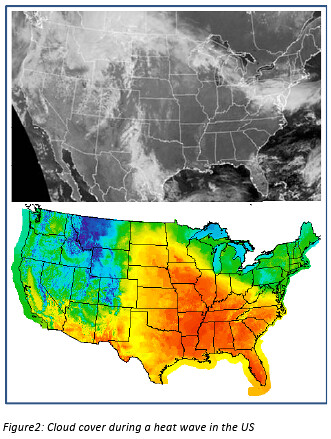
The sun supplies solar power when you need it:
at the same time the sun drives heat waves.

The paper identifies the problem I’ve encountered talking to local
policy makers, especially ones associated with power companies:

Continue reading

Solar cookers at Lowndes County Courthouse?

John Charles Griffin sent me this:

Mexico’s Solar Energy Taco Stands
:


In Oaxaca, Mexico taco street
vendors are using the solar energy from the sun to cook their tacos.
This is being done as part of a project run by Michael Gotz who is
trying to find to what degree they can transform the use of solar
energy.

This would be great at stalls at Downtown Valdosta Farm Days
at the historic Courthouse:
practical cooking and marketing for solar Valdosta and Lowndes County!


More about

Michael Götz
.

-jsq

Andrea Schruijer’s Opportunity —John S. Quarterman

Here’s my op-ed in the VDT today. -jsq

Welcome

Andrea Shuijer Schruijer
to a great opportunity as the new Executive
Director of the Valdosta-Lowndes County Industrial Authority (VLCIA)!


For a year I’ve been asking for a list of jobs attracted by the
Authority. We welcome your marketing expertise so we’ll know
the Authority’s successes!

We welcome your communications expertise to inform the community
affected by the process of bringing new jobs. VLCIA could publish
its agendas, minutes, and videos of its meetings, events, and
new jobs on its web pages, and facebook, maybe even twitter.

We welcome your stewardship of the Authority’s $3 million/year in taxes.
Maybe some

Continue reading

PSC lining up to vote for solar

Previously

PSC Chair Lauren McDonald
said he wanted Georgia Power to
“come up with options in the next 30 days for expanding the tiny amount of electricity generated from solar power”.
Yesterday,

PSC Commissioner Chuck Eaton

said “Solar is great for diversity, independence, research, and business,”
and added that until recently he had discounted solar, but now he had seen it.
And it turns out that Friday

PSC Commissioner Tim Echols

wrote an op-ed saying


It wasn’t until I entered the training room of Mage Solar in Dublin
and saw 40 subcontractors in their solar academy that I got it. The
growing solar industry is not just about funky collectors on a roof or
left-leaning environmentalists who hate fossil fuel. It is about skilled
jobs in manufacturing and construction, about economic development in
Georgia, about consumers saving money on their power bill so they can
spend it somewhere else, and about empowering people to essentially
create their own power plant. This could eventually be big.

That’s three out of

five commissioners.

I’d call that a majority shaping up to do something in the

PSC Energy Committee meeting of 16 July 2011.

I couldn’t say what, exactly, since there nothing

on the energy committee’s agenda

about this.
But something solar seems to be in the works.

-jsq

Georgia officials are getting it about solar


Chuck Eaton, Georgia Public Service Commissioner,
moderating a panel of Georgia’s Policy Makers at

Southern Solar Summit

said

Solar is great for
diversity,
independence,
research,
and
business.

He said that until recently he had discounted solar, but now he had seen it.

Continue reading

U.S. has plenty of solar energy everywhere —Jennifer DeCesaro of DoE


Jennifer DeCesaro of the U.S. Department of Energy (DoE)
said she liked showing a map of U.S. insolation
outside the U.S. southwest because
then she could point out that
Spain has not as good resources and a larger solar market,
while Germany, the world leader in deployed solar,
has solar resources like the state of Alaska.


So the U.S. has plenty of solar energy everywhere.

She made a few other comparisons between U.S. and Germany.
U.S.: 30% investment tax credit.
Germany: National Feed-in Tariff.

She talked about

SunShot: the Apollo mission of our time.

It aims to reduce solar costs by 75% by the end of the decade,
making solar cost-competitive with fossil fuels without subsidy.

Actual panels cost about the same in U.S. and Germany,
but the rest

Continue reading

Projects that can actually be built —Jeff Glavan of MP2 Capital


Representing a San Francisco venture capital firm,

MP2 Capital,

Jeff Glavan said he’s looking for
medium to large scale projects that can actually get built,
with partners in each geographic market, since development is very local.

MP2 also does projects with municipalities that can’t take tax credits
because they are tax exempt. MP2 funds instead.

It’s not just all about large systems….
There’s a market for 1 to 5 megawatt systems.

The three things they look at are
credit, commercial terms, and economic terms.
Commercial terms are what hold up most projects.
MP2 likes to be involved in negotiating a
Power Purchase Agreement (PPA)
to avoid terms like host may need to repair roof which could
involve removing the solar system for some undefined amount of time.

MP2 is actively looking for solar partners.

-jsq

SolarCity does everything —Will Arnold of SolarCity

Will Arnold spends a lot of time in Toronto for
SolarCity

but he came to Atlanta to talk to

Southern Solar Summit
.


SolarCity does
everything from financing to design, installation, monitoring, and maintenance.

SolarCity’s founders are all IT people.
The most famous is perhaps Elon Musk, who also founded Paypal and SpaceX.
Two other co-founders sold their previous company to Dell,
and SolarCity just got a
$280 million investment from Google.

I’ve been comparing the solar market now to Silicon Valley 20 years ago,
because of how fast it’s growing, how pragmatic and experimental it is,
and the general attitude of the people.
It turns out in SolarCity it is Silicon Valley.

Will Arnold talked a lot about state incentives that sometimes seemed
perpetually going to be solidified soon or other regulatory whims.

He remarked that SolarCity’s leases were predicated on people

Continue reading

Transparency is key —Steve Kalland of NCSC

The earth receives enough energy from the sun in one hour
to power the whole world for a year, reminded Steve Kalland of
the

North Carolina Solar Center (NCSC)
at the

Southern Solar Summit
.
So how do we get solar energy deployed?


Kalland said transparency is key.

Other speakers had said you could have too much transparency,
but Kalland pointed out that it was only through a hearing that
North Carolina found out a major power company was going to use up its
solar energy credits years ahead of schedule, and without transparency
there couldn’t be real competition because the customers wouldn’t
know who had which prices.

What else does it take to make a state competitive in solar?
Kalland discussed this table (reformatted here from the copy of
his presentation he gave me):

Foundational Steps to Focus on Solar

Installed Capacity Manufacturing
Interconnection Standards

Base Resources (economic or voices)

Early Adopters


Military or Large Federal

High Tech Firms

Corporate Greens

University Partnership Opportunities

Existing presence of businesses in multiple fields (diversification)

He said a lot more, but that’s a very interesting table to
consider not only for a state, but for a region, like south Georgia,
or a small metro area, like Valdosta MSA.

I know some people will react with: “but VSU is not a research university!”
Nope, but this could be a way to add some research capacity to VSU.

-jsq

91% of voters support using solar power in NC —Ivan Urlaub of NCSEA

Like

the previous speaker
,
Ivan Urlaub of the

North Carolina Sustainable Energy Association (NCSEA)

pointed out there are downsides to too many incentives, such as
too much dependence on them which means if they end, so can the industry.
So how to generate demand?

They’ve done it in North Carolina:


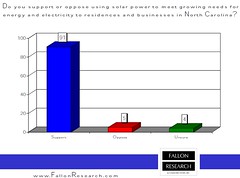
91% of voters support using solar power to meet our growing needs for energy and electricity

Solar is hands down the most popular energy source across NC,
across parties, ages, genders, etc.
Coal and nuclear are the politically charged energy sources,
and neither got a majority.
Number 2 was offshore wind with 83% and number 3 was onshore wind
with 82% support.
Here’s the

NCSEA press release.

Here’s

the survey.

How did they do this?

Continue reading