Category Archives: Nuclear

Hatch 1 nuclear reactor down to 40% power Sunday: why?

Why is Plant Hatch Unit 1 running at well below capacity?


Saturday 19 Jan 2013 that nuclear plant was

at 100%, according to the NRC,

yet Sunday it was down to 45%, then 40% Monday and 64% today.
What's going on at Hatch 1?
And what happened to nuclear supposedly being 24/7?

There's no

event report

about this from the NRC;
the last item the NRC has on Hatch 1 seems to be
from 2003.
Southern Company provides

no information on this event.

Another source (Platts, 4 January 2013)
says Hatch 2 (and Vogtle 2) are to refuel in the first half of this year,
among

Fifty-six US nuclear units to shut for refueling in 2013
.
But Hatch 1 is not on that list,
and a similar Hatch 1 brownout happened 5 and 6 January:

Continue reading

Rural AIDS: poverty the cause, solar power part of the solution


Director Lisa Biagiotti
spent two years travelling around the South
interviewing people about AIDS to make a film,
deepsouth.
She found rural AIDS is a bigger and faster-growing problem
than AIDS in center cities,
yet most health and prevention funding goes to urban areas.
The root cause seemed clear to her: poverty.
Here’s some deeper dirt (literally) on rural poverty in the U.S.,
and one thing we know can help with that: distributed solar power,
for jobs, for reduced electrical bills, and for energy independence.
What politician wouldn’t want jobs for their constituents?

The director said the screening at

VSU at the end of November
drew more people than the
day before in Little Rock.
There were clearly more than 150 in the audience in Valdosta.
It’s a topic very relevant to here, as

Dean Poling wrote in the VDT 26 November 2012,

Organizers note that Georgia is ranked sixth highest nationally for
its cumulative number of AIDS cases reported through December 2009.
More than 40,000 known HIV/AIDS cases were reported in Georgia as of
2010.

The South Health District’s 10 counties, which include Lowndes and


surrounding counties, report 950 confirmed cases of HIV/AIDS, while
many more are likely infected and risk becoming sick because they
are not being treated. More specifically, there are about 460
reported cases in Lowndes County.

In reporting these numbers, HIV is the virus (HIV disease) and AIDS
is the medical diagnosis made by a doctor of the symptoms, according
to South Health District.

It’s a great movie and I highly recommend it.
Director Biagiotti spent a substantial amount of her own money and two years to make
this film, yet there are aspects she could only note in passing,
such as incarceration.
She can’t be expected to have researched every aspect;
maybe somebody else can step up and help follow more threads.

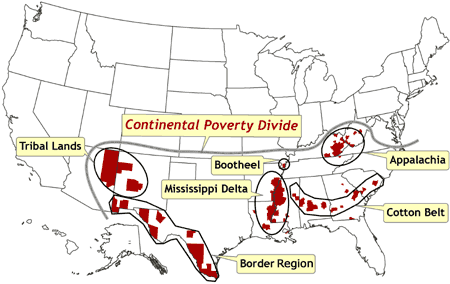
The movie starts with some maps about poverty and AIDS in the South.
It did not, however, look outside the South for poverty.
Here are better
poverty maps, from the CDC:

Continue reading

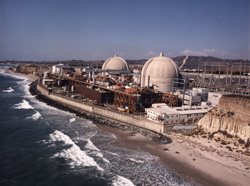
Shutdown at San Onofre: permanent this time?

California only has a couple of nuclear reactor locations (unlike the
32 reactors within 500 miles of here),
and one is in even worse shape than the other: San Onofre,
almost as bad as
Crystal River.
I’m sure Southern Company would never cut corners or have
design or

construction problems
at Plant Vogtle, right?

Harvey Wasserman wrote for AlterNet 7 January 2013,

Showdown at San Onofre: Why the Nuclear Industry May Be Dealt a Big Blow
,

Perched on an ocean cliff between Los Angeles and San Diego, the


reactors’ owners cut unconscionable corners in replacing their
multi-million-dollar steam generators. According to Russell Hoffman,
one of California’s leading experts on San Onofre, inferior metals
and major design failures turned what was meant to be an upgrade
into an utter fiasco.

Installed by Mitsubishi, the generators simply did not work. When
they were shut nearly a year ago, tubes were leaking, banging
together and overall rendering further operations impossible.

Southern California Edison and San Diego Gas & Electric have
unofficially thrown in the towel on Unit 3. But they’re lobbying
hard to get at least Unit 2 back up and running. Their technical
problems are so serious that they’ve asked the Nuclear Regulatory
Commission to let them run Unit 2 at 70% capacity. In essence, they
want to “see what happens” without daring to take the
reactor to full power.

The NRC has expressed serious doubts. On December 26 it demanded
answers to more than 30 questions about the plant’s technical realities.
There have been assertions that unless San Onofre can be shown as operable
at full power, its license should be negated.

It’s good the NRC got around to doing something, after

Continue reading

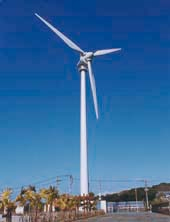
2 gigawatts of Wind Power off Fukushima, plus solar


Southern Company didn’t

do the renewable energy study for Georgia

when Mark Z. Jacobson’s study showed

All U.S. east coast electricity could come from offshore wind 3 seasons out of 4
.
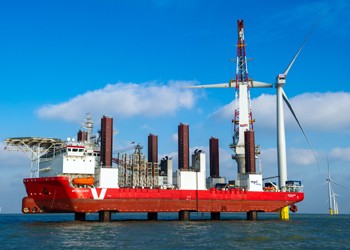
Now somebody else has, including how to build offshore wind turbines
to withstand hurricanes.

Rob Gilhooly wrote for New Scientist 16 January 2013,

Japan to build world’s largest offshore wind farm
,

The wind farm, which will generate 1 gigawatt of power once
completed, is part of a national plan to increase renewable energy


resources following the post-tsunami shutdown of the nation’s 54
nuclear reactors. Only two have since come back online.

The project is part of Fukushima’s plan to become completely energy
self-sufficient by 2040, using renewable sources alone. The
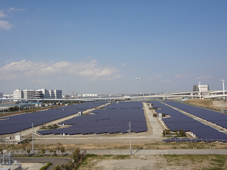
prefecture is also set to build the country’s biggest

solar park.


The wind farm will surpass the 504 megawatts generated by the 140
turbines at the Greater Gabbard farm off the coast of Suffolk, UK
— currently the world’s largest farm. This accolade will soon
pass to the London Array in the Thames Estuary, where 175 turbines
will produce 630 megawatts of power when it comes online later this
year. The Fukushima farm will beat this, too.

How will these wind turbines work?

Continue reading

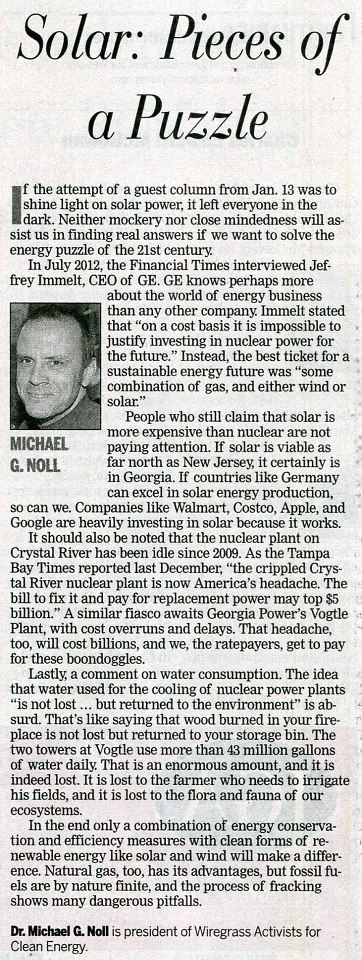
Solar: Pieces of a Puzzle —Dr. Michael G. Noll

Op-ed in the VDT today, responding to

a response

to

my op-ed.
-jsq


If the attempt of

a guest column from Jan 13
was to shine light on solar power,
it left everyone in the dark.
Neither mockery nor close mindedness will assist us in finding real answers
if we want to solve

the energy puzzle of the 21st century.


In July 2012, the Financial Times interviewed Jeffrey Immelt, CEO of GE.

GE knows perhaps more about the world of energy business than any other company.
Immelt stated that

“on a cost basis it is impossible to justfy investing in nuclar power for the future.”

People who sitll claim that solar is more expensive
than nuclear are not paying attention.
If solar is viable as far north as

New Jersey
, it certainly is in Georgia.
If countries like

Germany
can excel in solar energy production,
so can we.
Companies like Walmart, Costco, Apple, and

Google

are havily investing in solar because it works.

It should also be noted that the nuclear plant on

Crystal River has been idle since 2009.

As

the Tampa Bay Times reported last December,

Continue reading

China, etc., mining uranium in Niger and Mali

A commenter on
Mali: a French War for Uranium
suggested that if "that zone" (presumably
the Sahara in Mali and Niger)
were such an El Dorado the U.S. and the Chinese would have long been interested.
Actually, it turns out numerous countries are involved, especially along
the
Uranium Highway in the Uranium Province in Niger.
Not the Americans so much, but definitely the Chinese.


According to

World Information Service on Energy Uranium Project
,
in

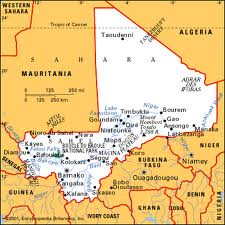
Mali
, it's the Canadians (Cascade Resources Ltd.,
Northern Canadian Uranium Inc., Rockgate Capital Corp.) and
the Australians (Oklo Uranium Ltd).:

The following companies are performing uranium prospection and/or exploration in Mali:


Cascade Resources Ltd. ,
Northern Canadian Uranium Inc. ,
Rockgate Capital Corp. ,
Oklo Uranium Ltd


Faléa uranium/silver project

> View deposit info
Opposition to uranium mining in Faléa: Association des ressortissants et
amis de la Commune de Faléa (ARACF)

Pre-Feasibility study on Faléa mine project started:


On Nov. 15, 2012, Rockgate Capital Corp. announced the commencement of a Pre-Feasibility study on its Faléa U-Ag-Cu project in south-west Mali. Rockgate has engaged the services of the DRA Group of Johannesburg, South Africa to complete the study.

Environmental and social baseline studies commissioned on Faléa mine project:
On April 26, 2010, Rockgate Capital Corp. announced that it has commissioned environmental and social baseline studies on the Faléa Project, Mali.

Apparently Niger has more recoverable Uranium than either the U.S. or Canada;
more than Kazakhstan; more than any country except Australia.


In Niger
, it's Russia, Korea, India, and here are a few notes
about Chinese involvement:


Areva ready to give Chinese access to Imouraren uranium mine:

French nuclear giant Areva is ready to open up to a Chinese partner the

Continue reading

Mali: a French War for Uranium


Google for Mali War in French, and it seems nobody in France is fooled:
France is going to war in Mali for oil, gas, gold and… uranium just across the border in Niger.
Have you ever heard of a war for sunshine or wind?
Let’s get on with solar and wind for energy independence,
including from wars for fuels.

Even Le Monde politely asks the question,

Pourquoi la France intervient-elle au Mali?

Why is France intervening in Mali?

matL : Quels sont les enjeux stratégiques majeurs que présente le Mali, non seulement pour la France mais pour la région entière ? matL : What are the important policy challenges posed by Mali, not only for France but for the entire region?
Les enjeux sur les ressources extractives, à savoir notamment le
pétrole et le gaz sur le site de Taoudenni qui se trouve à cheval sur
trois pays, Mauritanie, Mali et Algérie. Ensuite, l’uranium puisqu’il
en a été découvert dans l’Adar des Iforas. Mais ces trois ressources
extractives ne sont pas encore en état d’exploitation. En revanche,
le Mali est le troisième producteur d’or sur le continent africain. Ce
sont là les enjeux géostragégiques.
Issues of extractive resources, notably including oil and gas on the
site Taoudenni which straddles three countries, Mauritania, Mali
and Algeria. Then, since uranium has been discovered in the Adrar
des Iforas. But these three extractive resources are not yet ready to
use. However, Mali is the third largest gold producer in Africa. These
are the geostratigic issues.
S’il y avait implosion du Mali par la prise du pouvoir central par les
groupes armés djihadistes, il y aurait nécessairement des conséquences
négatives sur l’ensemble des pays de la sous-région.
If there was implosion of Mali by making the central government by armed
groups jihadists, there would have negative consequences for all countries
in the sub-region.
Visiteur : Bonjour, le gisement d’uranium exploité par Areva se trouve
au Niger à quelques centaines de kilomètres à l’est de la zone de
combats. Pensez-vous qu’il existe un lien entre l’intervention et la
protection éventuelle de cette source d’énergie vitale pour la France ?
Caller: Hello, the uranium deposit is operated by Areva in Niger a few
hundred kilometers east of the combat zone. Do you think there is a link
between the intervention and the possible protection of this vital energy
source for France?
En tout cas, l’hypothèse n’est pas du tout à écarter car il y aura
des conséquences sur l’ensemble de la sous-région.
In any case, the hypothesis is not at all ruled out
because there will be an impact on the entire sub-region.

Stéphane Lhomme was more blunt in Le nouvel Observateur yesterday,

Guerre au Mali : sécuriser notre approvisionnement en uranium
,
War in Mali: secure our provisions of uranium,

Continue reading

Failed concrete: the bane of nuclear reactors

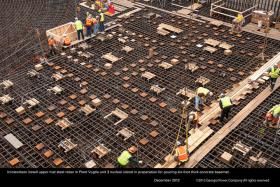
Let’s not forget the failed concrete on which

Plant Vogtle’s unprotected stranded reactor vessel
is supposed to sit.

A week before

the reactor vessel train wreck,
news stories
said concrete pouring was delayed due to “noncompliant rebar”.
Thomas Clements elaborated for the Aiken Leader 14 January 2013,

Vogtle AP1000 Nuclear Reactor Vessel Discovered Unprotected, Stranded in Savannah Port since December 15 Shipment Failure
,


Due to chronic delays in the pouring of “nuclear
concrete” for the basemat of the AP1000 units at Vogtle and VC
Summer, it remains unknown when or if any reactor vessels can
actually be placed into the excavated holes at the sites. A January
10 meeting of the NRC confirmed that another basemat-related
“license amendment request” (LAR) was soon to be filed
by SCE&G for its AP1000 project and that the target date for
granting of the LAR was March 18. It appears that the Vogtle project
has fallen behind the V.C. Summer project and no strategy for the
filing of a similar and necessary LAR by Southern Company is known.


Concrete, the long-time bane of

Seabrook Station

and also what’s keeping

Crystal River
shut down because nobody wants to pay the
billions of dollars it would take to fix it.


What say we call the whole thing off, like
Dominion Power did with its existing

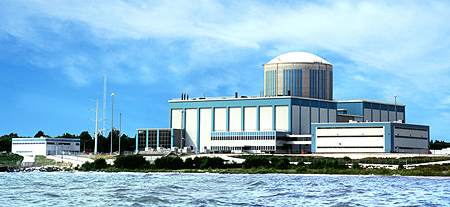
Kewaunee nuke
,
and
TEPCO and NRG did

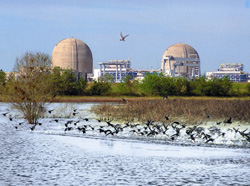
with their plans for new South Texas nukes
.


Maybe it’s a sign that meanwhile

Google has invested a billion dollars in wind and solar
and gotten
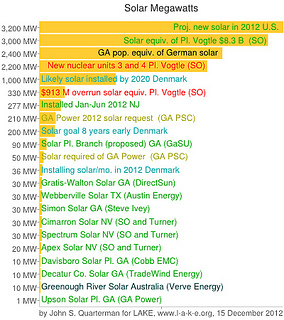
2 gigawatts of power, almost as much as the 2.2 GW the two new Vogtle nukes
were supposed to produce, except Google’s solar and wind projects
are online on time, and for less than just the cost overruns at Vogtle.

The Georgia legislature is in session.
You can contact

your legislator or the PSC
today
about

toppling Southern Company’s three-legged nuclear regulatory-capture stool

and

fixing that 1973 Territoriality Law

so we can get on with solar and wind in Georgia,
for jobs and energy independence, and oh by the way clean air and
plenty of clean

water
.

-jsq

Centralized Nuclear Bad Investment?

A writer for Forbes spells out the question of nuclear investment:
how can something that expensive, over-budget, late, and phenomenally
risky be a good investment, especially when cheaper and faster energy
sources are readily available?

Peter Kelly-Detwiler wrote for Forbes today,

New Centralized Nuclear Plants: Still an Investment Worth Making?


Just a few years ago, the US nuclear renaissance seemed at hand. It
probably shouldn’t have been. Cost overruns from Finland to France
to the US were already becoming manifest, government guarantees were
in doubt, and shale gas drillers were beginning to punch holes into
the ground with abandon.

Then came Fukushima. The latter proved a somewhat astonishing
reminder of forgotten lessons about nuclear power risks, unique to
that technology: A failure of one power plant in an isolated


location can create a contagion in countries far away, and even
where somewhat different variants of that technology are in use.
Just as Three Mile Island put the kaibosh on nuclear power in the US
for decades, Fukushima appears to have done the same for Japan and
Germany, at a minimum. It certainly did not help public opinion, and
at a minimum, the effect of Fukushima will likely be to increase
permitting and associated regulatory costs.

He goes into detail: they take too long (while gas and solar got cheaper),
they’re extremely expensive to build and run, and they’re all-or-nothing
investments.

I was going to compile this list of recent nuclear financial failures,
but he saves us all the trouble:

Continue reading

Forestry rebounds economically in Georgia


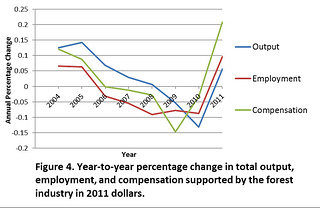
Figure 4. Year-to-year percentage change in total output, employment, and compensation supported by the forest industry in 2011 dollars.

Found via
VLCIA’s blog,
PR from Office of the Governor 11 January 2013,

Forestry industry earns jobs, dollars for Georgia
,
illustrated here with figures from

Economic Benefits of the Forest Industry in Georgia: 2011

by the Georgia Forestry Commission.
And let’s not forget that while paper pulp rules the roost
in Georgia at the moment, there are


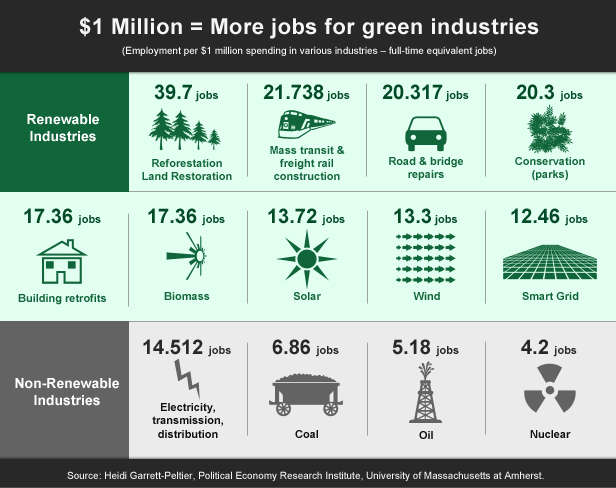
far more jobs in reforestation than in nuclear
,
even more than in wind or solar.

Gov. Nathan Deal today announced that a study by the Georgia
Institute of Technology for the Georgia Forestry Commission shows
that in 2011, economic activity generated by the forestry industry
topped $25 billion in output and provided 118,459 jobs.

“I am proud to see our state retain its position as a national
forestry leader,” said Deal. “Our 24 million acres of
forests are one of Georgia’s most valuable natural resources, and
the dedication of the men and women in the forestry community drive
that success. I’m confident our sustainably grown forests will be
providing both economic and environmental benefits for generations
of Georgians to come.”

Highlights of the “Economic Benefits of the Forest Industry in
Georgia: 2011” report include

Continue reading