Found via
VLCIA’s blog,
PR from Office of the Governor 11 January 2013,
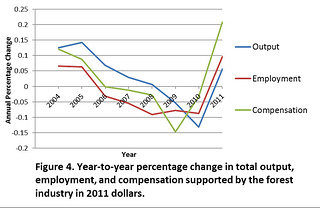
Forestry industry earns jobs, dollars for Georgia,
illustrated here with figures from
Economic Benefits of the Forest Industry in Georgia: 2011
by the Georgia Forestry Commission.
And let’s not forget that while paper pulp rules the roost
in Georgia at the moment, there are
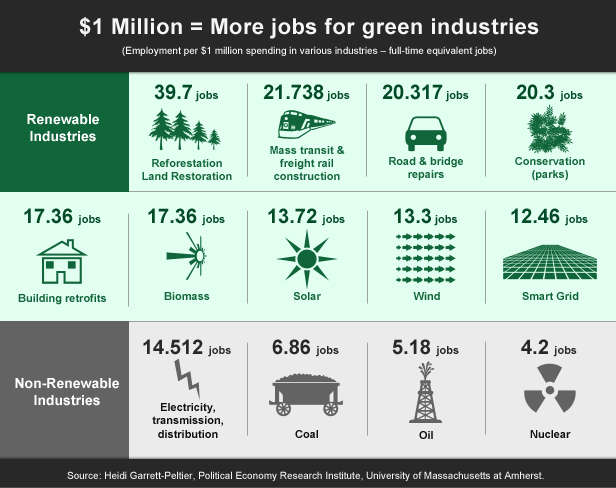
far more jobs in reforestation than in nuclear,
even more than in wind or solar.
Gov. Nathan Deal today announced that a study by the Georgia
Institute of Technology for the Georgia Forestry Commission shows
that in 2011, economic activity generated by the forestry industry
topped $25 billion in output and provided 118,459 jobs.“I am proud to see our state retain its position as a national
forestry leader,” said Deal. “Our 24 million acres of
forests are one of Georgia’s most valuable natural resources, and
the dedication of the men and women in the forestry community drive
that success. I’m confident our sustainably grown forests will be
providing both economic and environmental benefits for generations
of Georgians to come.”Highlights of the “Economic Benefits of the Forest Industry in
Georgia: 2011” report include
increases in output, compensation,
employment and total economic impact, as well as impact statistics
by region. The report shows that between 2010 and 2011:
- Revenue generated directly by the forestry industry rose 4 percent
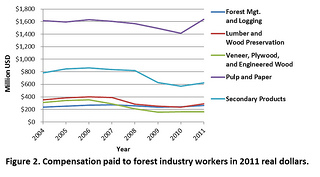
to $15.1 billion.- Forest industry workers earned $2.9 billion in
wages and salaries, up 13.3 percent.- Georgia’s forest industry
directly employed 46,378 people, up 6.8 percent, the first upward
trend in four years.
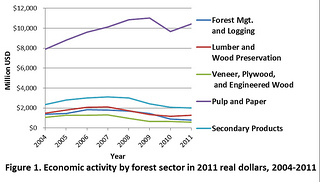
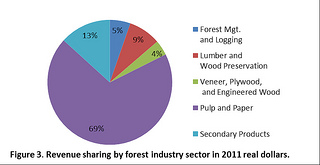
Georgia’s pulp and paper industry continued to
dominate all sectors within the forest industry (over forest
management/logging; lumber and wood preservation; veneer, plywood,
and engineered wood; and secondary products) in revenue output,
employment and compensation.- The industry generated more than $487
million in revenues for the state budget in 2011.
“We are very pleased that after three years of declines, Georgia’s
forest industry increased output, employment and compensation during
2011,” said Georgia Forestry Commission Director Robert Farris.
“Information from our recent mill survey indicates this trend has
continued through 2012, and that Georgia’s position as a national
forestry leader will remain strong.“This annual study is a valuable barometer of the importance of
forestry to the state of Georgia and its citizens. The total impact
of forestry in Georgia went up 5.6 percent between 2010 and 2011 to
$25 billion. Another study by the University of Georgia Warnell
School of Natural Resources shows that Georgia’s forests provide $37
billion in ecosystem services. These benefits have a tremendous
effect on every business, agency and family across the state of
Georgia.”For the first time, the report provides a breakdown of employment
and compensation in 12 regions of Georgia. According to Georgia
Forestry Commission Marketing and Utilization Chief Nathan McClure,
this analysis demonstrates forestry’s crucial impact on the rural
economies of southern and southeastern Georgia. “In the future, we
expect the industry will show additional gains in central and
eastern Georgia as the growing wood pellet and bioenergy industry
develops,” McClure said.To read the 2011 report and to find out more about the services of
the Georgia Forestry Commission, visit www.GaTrees.org.Georgia Forestry Commission contact:
Wendy Burnett
wburnett@GFC.STATE.GA.US
478-751-3535
-jsq