Category Archives: Law

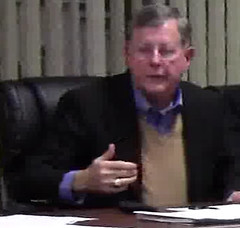
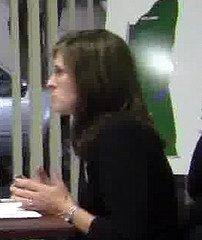
$30,000 saved by library furloughs, $millions for building construction —Idelle Dear @ LCC 2013-01-08


Idelle Dear noted we’re up to 12 library furlough days,
and reported a flaw in that picture to

the 8 January 2013 Lowndes County Commission Regular Session.

I looked across the street
and there are millions of dollars being spent on the construction of the
hospital, construction of the VSU Health Sciences building.
And yet what is happening, because
this is a mandatory furlough for all employees,
is that people who are employed by the South Georgia Regional Library,
most of whom are minimum wage, work part time,
rely on the income: they are going to lose out….

We’d heard about these

state-mandated furlough closings
at a library board meeting.
Idelle Dear spelled out some of the consequences, and made
some telling comparisons.

Something is wrong with this picture,
and I realize there are different kinds of money,
but something is wrong with this picture if we can spend
millions and millions of dollars on construction of these buildings
and yet shut down the library and the employees who are in low income
are going to be affected.

She said she wasn’t sure most people even knew about all this.
And she heard somebody had said most people have Internet at home, but

Continue reading

Bird supper tickets on sale

Once a year busloads of people go to Atlanta from Lowndes County and Valdosta
to lobby their legislators with small birds.
It’s curious we only hear about this from Valdosta, not Lowndes County.
-jsq

Bird Supper 2013 Tickets on Sale Now

Posted Date: 1/3/2013


Sementha Mathews
, Public Information Officer

Phone: (229) 259-3548

E-mail:

smathews@valdostacity.com

Tickets are on sale for the 2013 Bird Supper, scheduled for
Wednesday, Feb. 27, 2013, at the historic Georgia Railroad Depot, in
Atlanta, beginning at 5 p.m. The tradition—over 50 years
old—brings together hundreds of state officials and local
business, professional and government personnel for a dinner of
quail and important conversation.

The event, sponsored by the City of Valdosta and the Lowndes County
Board of Commissioners, allows local professionals the opportunity
to have an impact on the current legislative agenda through
face-to-face conversations with those who will make some very
important decisions impacting our local area and entire state.

Tickets may be purchased

Continue reading

Nukes economically hard to justify —GE CEO Immelt

The CEO of General Electric,
the company that designed the reactors

at Fukushima and Hatch 1 and 2,

said nukes are economically hard to justify.
And that was back in July, before
the first new nukes permitted in 30 years,
at Plant Vogtle on the Savannah River,

slipped 15 months.

What’s winning? Shale gas, temporarily, but that’s just a bump
in the road on the way to wind and solar power.

Pilita Clark wrote for Financial Times 30 July 2012,

Nuclear ‘hard to justify’, says GE chief
,


Nuclear power is so expensive compared with other forms of energy
that it has become “really hard” to justify, according
to the chief executive of General Electric, one of the world’s
largest suppliers of atomic equipment.

“It’s really a gas and wind world today,” said Jeff
Immelt, referring to two sources of electricity he said most
countries are shifting towards as natural gas becomes
“permanently cheap”.

“When I talk to the guys who run the oil companies they say
look, they’re finding more gas all the time. It’s just hard to
justify nuclear, really hard. Gas is so cheap and at some point,
really, economics rule,” Mr Immelt told the Financial Times in
an interview in London at the weekend. “So I think some
combination of gas, and either wind or solar … that’s where we see
most countries around the world going.”


GE CEO Immelt may also want to talk to GE’s own research director

Continue reading

Putting conservation into conservatives —John S. Quarterman

My op-ed in the VDT today. -jsq

Gov. Deal
(WABE, 14 Nov 2012)
temporarily forgot that “conservative”
includes conserving something,


like

Theodore Roosevelt and national parks
,
or when

Franklin D. Roosevelt established the Okefenokee National Wildlife
Refuge
which also

administers Banks Lake,
when

Richard Nixon started the EPA,

and when

Jimmy Carter signed the Soil and Water Conservation Act.

If Gov. Deal wants to call conservation “liberal”, I’m happy to
be a liberal working for water for our state!


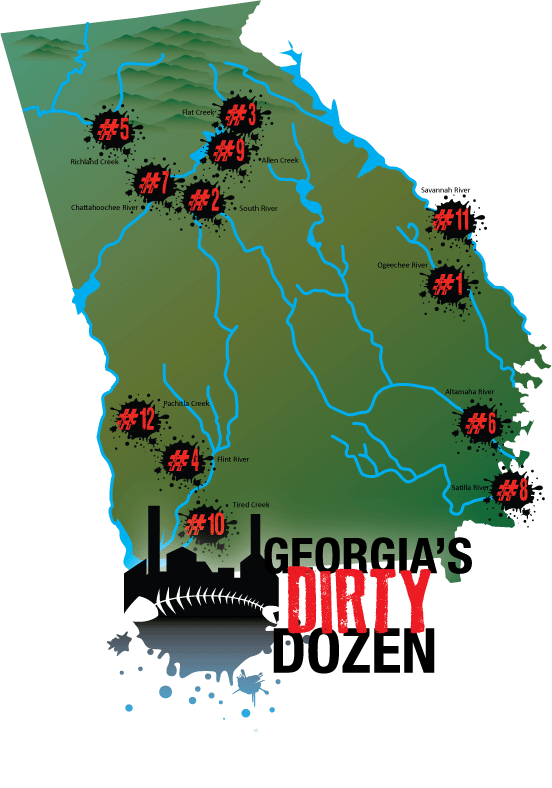
Georgia Water Coalition’s Dirty Dozen


listed the biggest boondoggle
of all as

#11: the nuclear reactors at Plant Vogtle

suck up more water from the Savannah River than all local agriculture and almost
as much as the city of Savannah.

If the new Plant Vogtle nukes

are ever completed,
all four will use more water than Savannah. In

2009 the legislature approved and Gov. Deal signed a law

letting Georgia
Power charge its customers in advance for building that boondoggle,
to the tune of

about $1.5 billion so far!

Let’s not forget

Continue reading

New Clayton County Commissioners fire County Manager, fund forensic audit

A few new Commissioners on a five-member board is producing significant
changes in Clayton County.
What changes will the new Lowndes County Commissioners make?

Tammy Joyner write for the AJC

Election results usher in period of change for Clayton
,


The new County Commission set the tone this week by ushering in a
raft of changes aimed at creating better accountability in Clayton’s
finances while putting greater control in the hands of the new
chairman. The board removed County Manager Wade Starr, a long-time
kingmaker in Clayton politics, and will bring in a chief financial
officer to manage county finances.


The balance of power clearly has swung to newly elected
Commissioners Jeff Turner and Shana Rooks. Turner, who replaces
Eldrin Bell as chairman, and Rooks, who defeated Wole Ralph, teamed
with returning Commissioner Michael Edmondson to create a new voting
bloc on the five-member board, and they appear intent on taking
swift action.

“They hit the ground running,” said Carl Swensson,
chairman of the Clayton County Citizens Oversight Committee.
“The former power triumvirate has been absolutely shattered.
We’re going to have good people in position where they can do the
most good for this county. You’re going to find a more receptive ear
in the new structure.”

Naturally the remaining old guard took issue:

Continue reading

Carbon bubble? Solar and wind erode coal, gas, and biomass credit quality —Moody’s


In Europe it’s already happening: solar and wind are causing
bond-rater Moody’s to warn of downgrades of energy companies
that depend on heat from burning coal, gas, or biomass.
Moody’s earlier even warned the Bank of England
of a potential carbon bubble developing.
If combustion energy plants are affected like this,
the credit effects will be even bigger on even-more-expensive
nuclear plants, which Moody’s called a

bet-the-farm risk
way back in 2009.

James Murray wrote for businessGreen 6 Nov 2012,

Moody’s: Renewables boom poses credit risk for coal and gas power plants:
Credit ratings agency warns increases in renewable power have had ‘a
profound negative impact’ on the competitiveness of thermal
generation companies
,

“Large increases in renewables have had a profound negative impact
on power prices and the competitiveness of thermal generation
companies in Europe,” said Scott Phillips, an assistant vice
president and analyst at Moody’s Infrastructure Finance Group, in a
statement.

“What were once considered stable companies have seen their business
models severely disrupted and we expect steadily rising levels of
renewable energy output to further affect European utilities’
creditworthiness.”

And not just rising, rising increasingly

Continue reading

Solar cars and charging stations: who wouldn’t?

Tired of Southern Company CEO Fanning’s

maybe “next decade”
for solar power?


Tired of Georgia Power’s Bowers

trying to push solar off for fifty years?

Let’s hear from somebody who takes on big tasks and gets them done:
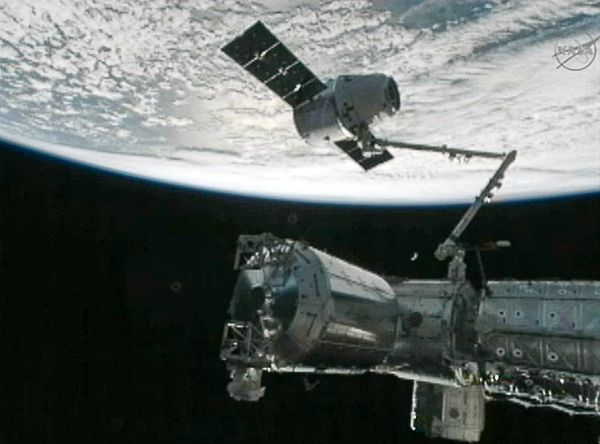
Elon Musk, who’s already built a rocket that is resupplying the International
Space Station, and who is also building all-electric cars.

Carl Hoffman wrote for Smithsonian magazine December 2012,

Elon Musk, the Rocket Man With a Sweet Ride

When he’s not launching rockets, Musk is disrupting the notoriously
obdurate automobile industry (see National Treasure, p. 42). While
industry giants like Chevrolet and Nissan and Toyota were dithering
with electric-gasoline hybrids, this upstart kid said he would
design and manufacture an all-electric car that would travel
hundreds of miles on a single charge. The Tesla Roadster hit the
streets in 2008 with a range of 200 miles, and the far more


functional Model S, starting at $57,000, was introduced in June.
It’s the world’s first all-electric car that does everything my old
gasoline version does, only better. The high-end model travels 300
miles on a single charge, leaps from zero to 60 in 5.5 seconds,
slows from 60 to a dead stop in 105 feet, can seat up to five, has
room for mulch bags and golf clubs, handles like a race car and its
battery comes with an eight-year, 100,000-mile warranty. If you
charged it via solar panels, it would run off the sun. One hundred a
week are being produced in a former Toyota factory in Fremont,
California, and nearly 13,000 people have put deposits on them….

And since that story:

Continue reading

2012 solar deployments driven by Moore’s Law price reductions


Moore's Law in solar Watts/$100


Moore’s Law for solar
is about decreasing price per Watt,
or more Watts per dollar.
Here’s an example of a common confusion, to think it’s about efficiency:

“The curve will obviously become asymptotic at some point, ie,. the rate
of improvement will flatten out, so we end up with a sort of squashed
“S” shape curve, because you can’t get more than 100% efficiency —
36 watts/m2 or so.”

And indeed efficiency probably will flatten out soon.
But it’s not solar
efficiency that’s improving by Moore’s Law: it’s price per watt.
That can keep improving for a long time.

Here’s an example of decreasing price.
Scott Detrow wrote for NPR 23 December 2012,

Forget Fracking: 2012 Was A Powerful Year For Renewables
,


Rhone Resch

“Just to give you perspective,” Resh said, “in Washington, D.C.,
where I live, when I installed solar on my house six years ago, the
average install cost was about $14 a watt. Today it’s about $4 a
watt.”

Here’s another comparison, this one just for solar panels.

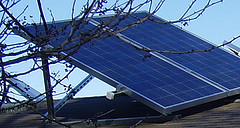
KC 170 solar panels, purchased 2005

In 2005 the first set of solar panels we got cost $670 each
and produced 170 Watts DC each, or $4.94/Watt.
In 2011 our second set of solar panels cost $562 each
for 235 Watts DC each, or $2.39/Watt.
That’s more than 50% price decrease for solar panels in six years.
(I can’t compare inverters or support structures directly,
because those were sized so differently, but those have also
come down in price, helping lower the overall install cost).

Year price /Watt price /panel Watts /panel Dimens. square inches Watts /100 sq in. Model
2005 $4.94 $670 170W 50×39″ 1950 8.7 KC 170
2011 $2.39 $562 235W 39.1×64.6″ 2525 9.3 Sharp ND 235 QCJ
2012 $1.32 $310 235W 39.1×64.6″ 2525 9.3 Sharp ND 235 QCJ

Meanwhile, the Watts per surface area hardly changed, from about

Continue reading

Waste offer letter: take it or….

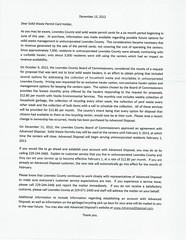
Unsigned trash letter from Lowndes County
I received the appended unsigned letter from Lowndes County
recently,
which says the
5,000 residents of the unincorporated parts that currently use the
county’s waste disposal sites can sign up with Advanced Disposal
(of New York City) for curbside pickup or…. There is no or. So
look forward to trash dumping long roadsides, in parking lots in
town, and on your property. And neither outgoing County Chairman
Ashley Paulk nor County Manager Joe Pritchard even had the courtesy
to sign the letter.

After noting that back in June the county changed waste permit
cards from 12 months to 6 months, the letter says:

At purchase, information was made available regarding
possible future options for solid waste management in
unincorporated Lowndes County.

So the county is backing off from claiming card buyers got a
letter spelling out options. I got no such letter with card
purchase.

This consideration became necessary due to revenue
generated by the sale of the permit cards, not covering the cost of
operating the centers.

And that’s all the accounting we get. Where is the summary of
expenses for the centers compared to revenue? The VDT reported from
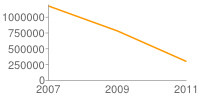
the Commissioners’ stealth retreat back in April:

“In total, the county is currently spending $782,058.34
each year for solid waste disposal, a reduction from $1,176,207.75
in 2007.”

As I pointed out then, “So that’s a rapid reduction in cost to
less than a third of what it used to be, and less than half of what
it was only a year ago.” Later Joe Pritchard said those numbers
didn’t include everything being spent. So what was actually being
spent? We the taxpayers and we the card payers don’t know. After

a long series of meetings to which the public was either not
invited at all or was not invited to provide input
, at its last
meeting of the year (exactly as I predicted),

Commissioners approved changes to the solid waste ordinance
eliminating the collection sites
and

granted a monopoly to Advanced Disposal Services
of

New York City.

Former Chairman Ashley Paulk

recently complained Moody AFB had become “privatized”.
Yet at
his last Commission meeting he presided over privatizing the
county’s public service of solid waste collection.

Three new Commissioners were just sworn in yesterday, including
a new chair. The new Commission in the new year is not, so far as I
know, bound by the decisions of any previous Commission. It could
undo the damage the old one just did. Or it could, like the old
one, ignore concerns of

public health, safety, and the environment
that

the state requires them to implement,
plus concerns of

local waste collection businesses,
of local residents

about recycling
and

about the lack of any other option than curbside;
will the new
Commission continue to kick 5,000 county residents towards curbside
collection or tossing their trash in the your yard?

Unsigned trash letter from Lowndes County:

Continue reading

Industrial Authority working for solar in south Georgia @ VLCIA 2012-12-18

The

Industrial Authority

is working to find locations for some of the
210 MW Georgia Power got the PSC to shift
from biomass to solar
back in September.
That’s a good next step.

Jason Schaefer wrote for the VDT 23 Dec 2012,

Solar power push has Authority working to establish connections
,

Since the Georgia Public Service Commission (PSC) approved Georgia

Allan Ricketts, Projects and Existing Industry Manager, VLCIA, 2012-12-18

Power Company’s plan Nov. 20 to add 210 megawatts of solar power to
its electrical grid, the Valdosta-Lowndes County Industrial
Authority has been devising strategies to draw solar energy
producers to South Georgia.

Georgia Power will issue a Request for Proposals (RFP) from solar
energy collection and production companies in early 2013, according
to the PSC, and the company will contract with the lowest bidders to
purchase their energy and place it on the Georgia Power electrical
grid for public consumption.

Georgia Power plans to add 90 megawatts to its grid from distributed
generation (small companies producing between 100 kilowatts and 1
megawatt), and 120 megawatts of large utility-scale projects
producing up to 20 megawatts each. The company plans to price the
solar energy at $0.13 per kWh for distributed generation and up to
$0.12 per kWh for utility-scale projects, according to the PSC.

This government-approved commercial push for solar energy could be a
boon to sunny South Georgia as well as the greater Valdosta area
specifically, and the Authority is prepared to accommodate the solar
energy producers they expect.


Andrew Schruijer, Executive Director, VLCIA, 2012-12-18

“I think there’s a very good possibility of solar energy
coming to South Georgia,” Executive Director Andrea Schruijer
said. “Possibly in the near future.”

There’s more in the VDT story.
It’s pretty much what
Col. Ricketts also told me after the VLCIA meeting Tuesday a week ago.
He asked me if I knew what “distributed” meant.
I pointed out Georgia Power’s version of distributed was actually not
very distributed, compared to

Continue reading