Category Archives: History

Green from the Grassroots —Elinor Ostrom

On the day she died, Nobel Prize-winning economist Elinor Ostrom published her last article, in Project Syndicate, 12 June 2012, Green from the Grassroots,

This grassroots diversity in “green policymaking” makes economic sense. “Sustainable cities” attract the creative, educated people who want to live in a pollution-free, modern urban environment that suits their lifestyles. This is where future growth lies. Like upgrading a mobile phone, when people see the benefits, they will discard old models in a flash.

Of course, true sustainability goes further than pollution control. City planners must look beyond municipal limits and analyze flows of resources — energy, food, water, and people into and out of their cities.

Worldwide, we are seeing a heterogeneous collection of cities interacting in a way that could have far-reaching influence on how Earth's entire life-support system evolves. These cities are learning from one another, building on good ideas and jettisoning poorer ones. Los Angeles took decades to implement pollution controls, but other cities, like Beijing, converted rapidly when they saw the benefits. In the coming decades, we may see a global system of interconnected sustainable cities emerging. If successful, everyone will want to join the club.
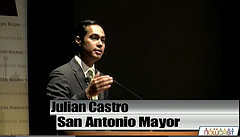
And counties, and regions, and watersheds, of course. As Mayor Julian Castro of San Antonio said, there is a "nexus between sustainability and job creation." We don't have to wait for San Antonio or Los Angeles or Beijing or Atlanta to lead the way: we can get on with it right here where we are.

-jsq

Industrial Authority has to be congratulated —Michael G. Noll

Received yesterday on WCTV on biomass site VLCIA v. Sterling Planet. -jsq

Wiregrass Activists for Clean Energy (WACE) have made it clear from the start that biomass plants have a number of issues: 1) biomass plants bear significant health risks; 2) biomass plants waste enormous amounts of water; 3) biomass plants are risky investments in an increasingly competitive energy sector; and 4) biomass plants contribute to global warming.

In the light of rising global temperatures, worsening drought conditions, and dropping prices for solar panels, an increasing number of people are understanding these simple truths.

The Industrial Authority has to be congratulated for the courage to admit that energy from biomass plants is indeed more expensive than energy from solar plants, and we have not even figured in the costs associated with the consequences of air pollution coming from biomass plants.

(For more information on biomass plants, here a testimony I recently gave: http://www.bredl.org/pdf3/120828_WACE-Comments-Docket_NO-E-100_SUB113.pdf)

Although this point has already been made earlier, note again that solar plants are much better alternatives, economically and environmentally: they do not pollute our air, they do not need any water, and a huge spill of solar energy is simply called a sunny day … of which we have plenty here in the south.

-Michael G. Noll

-jsq


WCTV on biomass site VLCIA v. Sterling Planet

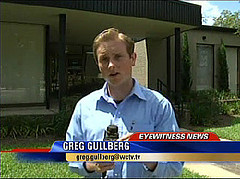
Greg Gullberg WCTV does what VDT dares not: Greg Gullberg mentioned last year’s biomass protests in the first sentence of this story about the Industrial Authority threatening to sue Sterling Planet to get clear title to the former proposed biomass plant site.

Greg Gullberg reported for WCTV yesterday, Dispute Over Land For Proposed Biomass Plant,

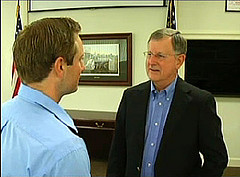
Gullberg and Ricketts

The vocal protests in Valdosta are long gone, but the controversy over the proposed Biomass plant lingers. This time not for concerns of health safety, but over the land.

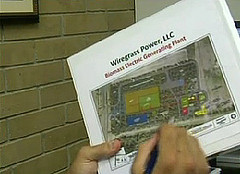
The Valdosta-Lowndes County Industrial Authority plans to sue Wiregrass Power LLC to end its contract.

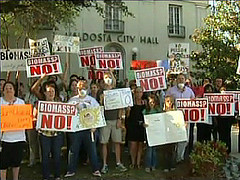
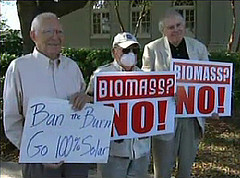
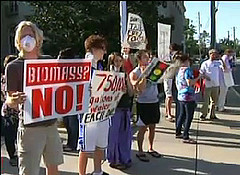
Protesters at City Hall Ban the Burn Go 100% Solar
Ban the Burn Go 100% Solar.

The proposed Biomass Plant was supposed to be a low-cost source of efficient energy. Supporters say it would have created hundreds of jobs. But opponents say the health risks include cancer, lung disease and respiratory disease.

750,000 gallons of water each day Biomass site plan
750,000 gallons of water each day

Tell me, Col. Ricketts, doesn’t it feel better to be visibly on the side of the people, instead of having to defend a bad business deal?

Continue reading

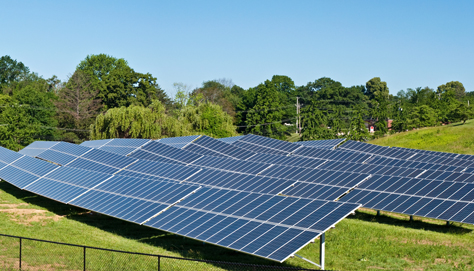
1.5MW solar field near Philadelphia

Far to the north of here, a botanical garden installed more than a megawatt of solar power a year ago. Maybe Georgia Power should ask them how it’s done.

PR of 16 June 2011, LONGWOOD GARDENS COMMISSIONS 10-ACRE SOLAR FIELD: Installation first step of goal to achieve 3 MW of solar energy by 2018

June 16, 2011, Kennett Square, PA — Longwood Gardens today commissioned a new, ground-mounted solar field spanning more than 10 acres at the horticultural showplace in Kennett Square, Pennsylvania.

One of the largest examples of clean emission-free energy in the region, the solar field produces 1.2 MW (megawatts) of power and will produce 1.5 MW when the final panels are installed in the coming weeks. The fixed-tilt, 1.5 MW solar installation will produce enough electricity to offset the usage of approximately 138 average Pennsylvania homes and reduce Longwood’s annual carbon dioxide emissions by 1,367 tons.

“We are always looking for ways to advance our sustainable practices,” said Paul Redman, Longwood Gardens Director. “It is integral to Longwood’s mission to decrease our dependence on fossil fuels.” We want to establish best practices and lead the way in showing communities how to live responsibly,” said Redman.

Imagine if Georgia Power and Southern Company acted responsibly and led the way in solar power!

Continue reading

ALEC, private prisons, fossil fuels, and charter schools

It’s good to see someone trying a coordinated strategy for something good in multiple states, as Our Children’s Trust is doing for air as a public trust. We already knew going to multiple states at once works, because ALEC, the American Legislative Exchange, gets reactionary results that way.

How does ALEC do it? By

So once again, it’s refreshing to see somebody successfully try multiple states for something worthwhile!

The above ALEC projects are just some I’ve run across while researching local topics. It often seems as if every rock I turn over has the ALEC millipede scurrying around under it. Far more about ALEC is available through ALEC Exposed.

ALEC Exposed has a list of companies that have dumped ALEC recently. Georgia Power’s parent The Southern Company and UPS are still not on that list. You can help. Let them know you want them to dump ALEC!

-jsq


There are no private schools in Finland: the opposite of Atlanta-imposed charter schools

Privatizing isn’t the answer, rote tests are irrelevant, and competition doesn’t help win. Those are a few of the lessons Finland learned that made its schools world leaders in education. So why would we consider letting Atlanta force privatized charter schools on us?

Anu Partanen wrote for the Atlantic 29 December 2011, What Americans Keep Ignoring About Finland’s School Success

“Oh,” he mentioned at one point, “and there are no private schools in Finland.”

Pasi Sahlberg, director of the Finnish Ministry of Education’s Center for International Mobility and author of the new book Finnish Lessons: What Can the World Learn from Educational Change in Finland, said that offhand while talking at a private school in New York. Nobody seemed to pay much attention. Maybe we should.

He also noted Finland has no standardized tests until the equivalent of high school graduation, and they don’t have any particular system for accountability for teachers or administrators.

“Accountability is something that is left when responsibility has been subtracted.”

So why do teachers and administrators in Finland so successfully take that responsibility?

Continue reading

The sun came up on a different world —Julian Assange

Julian Assange of Wikileaks spoke from the Ecuadorean Embassy in London today (video, text):

The next time somebody tells you that it is pointless to defend the rights we hold dear, remind them of your vigil in the dark outside the Embassy of Ecuador, and how, in the morning, the sun came up on a different world, and a courageous Latin American nation took a stand for justice.

The British government made a stunning mistake in throwing away the worldwide goodwill just gained through the London Olympic Games, by actually beginning to storm a sovereign embassy in violation of the Vienna Convention on Diplomatic Relations that was observed throughout the Cold War. How could they be so foolish? This man, this reporter and publisher, they think is somehow more dangerous to them than the armed might of the Soviet Union was? This is as if JFK arrested MLK after John Glenn’s first orbital flight (a step which JFK fortunately did not take).

There is something you can do, even when the world is turned upside down:

Continue reading

New research shows Natural Gas far more dangerous for climate stability —Seth Gunning

Received yesterday on U.S. CO2 emissions lowest in 20 years: that's good and bad: natural gas is methane, after all. -jsq

Yet another comprehensive article. I might also add that one of the major down-falls (if not the most significant) of large-scale conversions to natural gas is the resources lifecycle methane emissions.

As your readers likely know, Methane is about twenty times as 'potent' a greenhouse gas as Carbon Dioxide. That is to say, it is far more efficient at trapping heat then Co2. So, less methane has a far greater impact on climate disruption then more Co2.

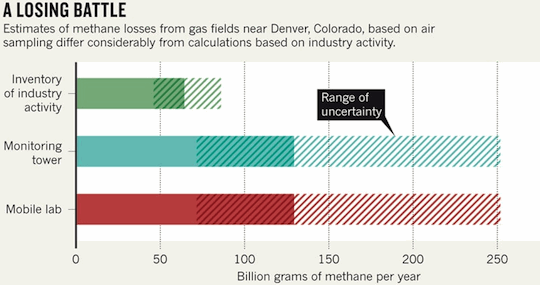
Natural Gas, from the point of combustion, releases about half the amount of Co2 released from burning coal, and about 30% of what's released in burning oil. To keep the benefits of reduced Co2 levels when switching from coal to natural gas, natural gas wells and transport lines must leak less then 2% of methane into the atmosphere. Recent research from Cornell is showing that Fracking wells are regularly releasing more then 4%, and often as much as 8% —far exceeding the 2% threshold— and thus making Natural Gas a far more dangerous resource for climate stability.

Tom Zeller Jr. wrote for the NYTimes 11 April 2011, Studies Say Natural Gas Has Its Own Problems

-Seth Gunning

-jsq

Another sewage overflow after FEMA finally decides about Valdosta wastewater plant

Since the floods of 2009 Valdosta had been waiting on FEMA to say whether it would grant some funding for improving the wastewater treatment plant that flooded then. Finally, FEMA gave a decision, no, which allowed the Valdosta City Council to choose another path. But not in time for improvements before the same plant had another wastewater overflow.

WCTV posted PR from the City of Valdosta of 17 August 2012, Major Sewage Overflow from Withlacoochee Water Pollution Control Plant,

At approximately 1 a.m. on Aug. 16, 2012, the pumps in the Influent Pump Station of the Withlacoochee Water Pollution Control Plant (WPCP) stopped working.

An emergency bypass pump system was placed into service at 12:45 a.m., on Aug. 17; and as a result, the sewer spills are no longer occurring. Contractors are currently on site investigating the cause of the failure, which has not yet been determined, while also making necessary repairs to the damaged equipment.

Sewer overflows were recorded at the following locations within the sewer collection system:

Continue reading

U.S. CO2 emissions lowest in 20 years: that’s good and bad

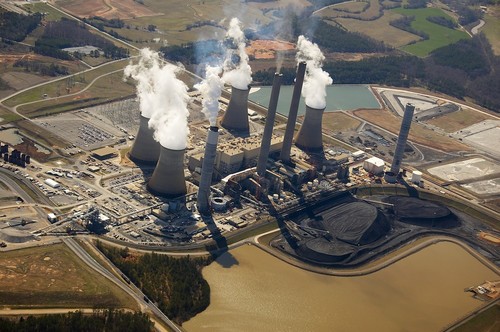
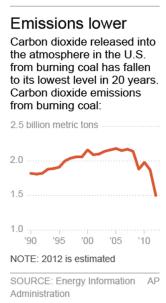
The good news: because utilities such as Southern Company are switching away from coal U.S. emissions of CO2 are the lowest they’ve been in 20 years. The bad news: they’re switching to natural gas, which not only still emits carbon dioxide, it pollutes groundwater through fracking, requires a lot of groundwater to do the fracking in the first place, and then uses more groundwater for cooling. But the further good news is cheaper energy sources drive out expensive ones, and wind and solar are already cheaper than nuclear and coal, and solar is already cheaper than natural gas. Oh, and solar and wind emit no CO2.

Kevin Begos write for AP yesterday, AP IMPACT: CO2 emissions in US drop to 20-year low

“There’s a very clear lesson here. What it shows is that if you make a cleaner energy source cheaper, you will displace dirtier sources,” said Roger Pielke Jr., a climate expert at the University of Colorado.

While conservation efforts, the lagging economy and greater use of renewable energy are factors in the CO2 decline, the drop-off is due mainly to low-priced natural gas, the agency said.

A frenzy of shale gas drilling in the Northeast’s Marcellus Shale and in Texas, Arkansas and Louisiana has caused the wholesale price of natural gas to plummet from $7 or $8 per unit to about $3 over the past four years, making it cheaper to burn than coal for a given amount of energy produced. As a result, utilities are relying more than ever on gas-fired generating plants.

Both government and industry experts said the biggest surprise is how quickly the electric industry turned away from coal. In 2005, coal was used to produce about half of all the electricity generated in the U.S. The Energy Information Agency said that fell to 34 percent in March, the lowest level since it began keeping records nearly 40 years ago.

And that’s why Southern Company (SO) turned towards natural gas: it’s cheaper! SO still prefers nuclear and coal before gas, as SO CEO Thomas A. Fanning keeps reminding us. But even SO couldn’t ignore “the revolution in shale gas”, which is cheaper prices through fracking. Solar PV costs dropped 50% last year alone. How long can SO ignore that?

“Natural gas is not a long-term solution to the CO2 problem,” Pielke warned….

Continue reading