Tag Archives: Planning

How to implement trash, health, and safety?

Disposal of solid waste (trash/garbage) is a matter of

community public health and safety

and providing such service

is the responsibilty of the local governing bodies.

How should trash health and safety responsibly be implemented?



We cannot be left in a situation where residents are either “forced
to buy” service from a provider, or have no option but to burn
their trash. The government can levy a tax, but they cannot say that
residents are forbidden to buy a service from an independent provider.

Such a ruling is

  • unfriendly to those who currently own, or want to
    start

    a waste collection business in our county
    ,
  • unfriendly to the
    residents who are counting on the government to follow
    the state-legislated goals to

    “protect the health
    safety, and well-being of its citizens and to protect
    and enhance the quality of its environment” ,

  • unfriendly to the environment as trash ends up on the side of the
    road or polluting the air by being burned and leaves us to
    face a new problem on a different day.

Residents in the unincorporated areas of the county who want curb side
collection, for the most part, already purchase it. Those of us using

the collection centers
do so because it is our preference.

The county
should (in my opinion) create a special tax district for waste disposal
(it already makes special lighting districts) and tax the residents
for the maintenance of the collection centers.

-gretchen

Who implements trash, health, and safety?

As we’ve seen, solid waste is a matter of public health, safety,
well-being, and the environment,

according to Georgia state law.

Whose responsibility is it to protect the environment
and the public health, safety, and well-being from solid waste?

Many health and safety issues are handled through the health department,

Diagram of the waste hierarchy


including the Georgia Department of Public Health,

and the

South Health District

(Ben Hill, Berrien, Brooks, Cook, Echols, Irwin, Lanier, Lowndes, Tift and Turner Counties).
Particularly, water quality (septic tanks, well water), food safety,
cleanliness of hotels, motels, restaurants, swimming pools and so on
are the responsibility of the local health department,
such as the

Lowndes County Health Department.

However, disposal of solid waste (trash/garbage) is handled by
the local municipality or governmental body (county).

The EPA has a variety of documents available about solid waste.

So does the state EPD, as enabled through Georgia Legislation:

Existing Rules and Corresponding Laws
.

So, where does this leave us?
See next post.

-gretchen

Trash, health, and safety

Solid waste is a health and safety issue,
according to Georgia law.

According to the
Georgia Department of Natural Resources
copy of the

GEORGIA COMPREHENSIVE SOLID WASTE MANAGEMENT ACT OF 1990
AS AMENDED THROUGH 2004
,

O.C.G.A. § 12-8-21. Declaration of policy; legislative intent


a) It is declared to be the policy of the State of Georgia, in
furtherance of

its responsibility to protect the

public health, safety, and well-being

of its citizens and to protect and enhance
the

quality of its environment,
to institute and maintain a
comprehensive state-wide program for solid waste management and

to prevent and abate litter,
so as to assure that solid waste does not
adversely affect the

health, safety, and well-being
of the public
and that solid waste facilities, whether publicly or privately
owned, do not degrade the quality of the environment

by reason of
their location, design, method of operation, or other means and
which, to the extent feasible and practical, makes maximum utilization
of the resources contained in solid waste.


Emphasis added on the parts about
health, safety, well-being, and the environment.
Those are the goals of this legislation, stated twice in the first paragraph.
Georgia being a home rule state, the implementation of these goals
is now left to the local governing bodies.
More on that next.

-gretchen

Savannah and Jacksonville most vulnerable to rising sea level

Savannah and Jacksonville are among the east coast cities most vulnerable
to rising sea levels due to climate change, a study finds.
Savannah, Georgia’s main seaport, with storm surges, hurricanes,
and waves on top:
what will that look like?

Suzanne Goldenberg wrote for the Guardian today,

US coastal cities in danger as sea levels rise faster than expected, study warns:
Satellite measurements show flooding from storms like Sandy will put low-lying population centres at risk sooner than projected
,

A

study published last March by Climate Central
found sea-level rise
due to global warming had already doubled the risk of extreme flood
events — so-called once in a century floods — for dozens
of locations up and down the Atlantic and Pacific coasts.

It singled out the California cities of Los Angeles and San Diego on
the Pacific coast and Jacksonville, Florida, and Savannah, Georgia,
on the Atlantic, as the most vulnerable to historic flooding due to
sea-level rise.

Sandy, which produced a 9ft storm surge at Battery Park in New York
City, produced one example of the dangerous combination of storm
surges and rising sea level. In New York, each additional foot of
water puts up to 100,000 additional people at risk, according to a
map published with the study.

That study projected 6 inches rise at Fort Pulaski by 2030 (minimum 3 inches)
and 13 inches by 2050 (maximum 24 inches).
But projections have gotten worse since then:


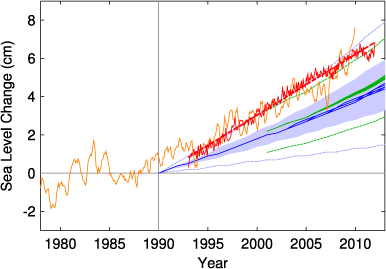
Sea level changes measured and projected

The latest research,

published on Wednesday in Environmental Research Letters,

found global sea-levels rising at a rate of 3.2mm a year, compared to the best estimates by the IPCC of 2mm a year, or 60% faster.

So that would be more like 9 inches by 2030 and 20 inches by 2050.

Add to a higher base sea level bigger storms like Hurricane Sandy,
and Savannah and Jacksonville have a problem.
Sure, Savannah is

Continue reading

Grant funding opportunities: deadlines very soon

Received today from Bryan Zulko of USDA. -jsq


Community Food Projects Competitive Grants Program
– Application deadline:
Nov 28, 2012
Grants to plan or implement food projects designed to meet the needs of low-income individuals and increase community self-reliance concerning food and nutrition.

Great American Main Street Awards (GAMSA) – Application deadline: Dec 3, 2012
Grants to recognize exemplary and innovative revitalization achievements in revitalization of historic and older neighborhood commercial districts using a community-driven, historic-preservation based approach.

Continue reading

How to stop climate change: divest from fossil fuel companies

In response to a very downbeat

diatribe by Bill McKibben in Rolling Stone on the occasion
of the U.N.’s Rio+20 conference
being some sound and less fury accomplishing
not much about stopping climate change,
[Bill McKibben, Rolling Stone, 19 July 2012, “Global Warming’s Terrifying New Math: Three simple numbers that add up to global catastrophe – and that make clear who the real enemy is”]


Chloe Maxmin, Divest Harvard

Harvard student Chloe Maxmin

followed up McKibben’s problem statement with a plan for what to do:

divest from fossil fuel companies. [“In Honor of Kalamazoo: An Open Letter to Bill McKibben,” NextGenJournal, 25 July 2012, no longer online, referred to in a post the same day by Chloe Maxmin on First Here, Then Everywhere.]

Maxmin didn’t just wish, either,
she joined up with McKibben’s 350.org and helped organize
Harvard students to do something about it:
persuade Harvard to divest its shares of fossil fuel companies.
Students at the University of Georgia, or at Valdosta State University,
for that matter, could do the same.

Alli Welton wrote for 350.org 18 November 2012,

72% of Harvard Students Vote to Divest from Fossil Fuels
,

Last Friday night, the Harvard College Undergraduate Council
announced that the student body had voted 72% in favor of Harvard
University divesting its $30.7 billion endowment from fossil fuels.

Members of the Harvard chapter of Students for a Just and Stable
Future have been campaigning since September to divest Harvard’s
endowment from the top 200 publicly-traded fossil fuel corporations
that own the majority of the world’s oil, coal, and gas reserves.

Harvard actually already has divested its shares of one fossil fuel company
due to public pressure.

Continue reading

SPLOST, media, southside library: videos @ SGLB 2012-11-20

Here’s
a video playlist of the 20 November 2012 South Georgia Regional Library Board meeting.


And here’s

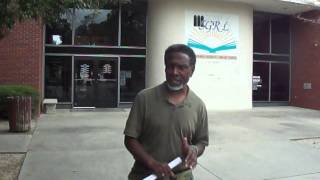
George Rhynes’ editorial
on what he saw, heard, and was asked at that meeting.
He’d prefer SPLOST being spent first on sidewalks
than on moving the library where people would have
to go farther to get to it.
Also, like many of us, he’s tired of a few people controlling
the purse-strings without input from the rest of us.
He gave an example:

Continue reading

SPLOST VII @ SGLB 2012-11-20


SPLOST on the ballot again? --Willis Miller @SGLB 2012-11-20

At

Tuesday’s South Georgia Library Board meeting.

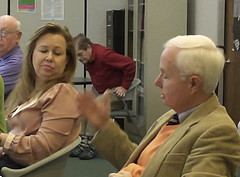
a board member (his nameplate said Willis Miller)

wanted to know about SPLOST
:

How we know it’s going to come up next November or at another time?

Good question.


Here’s video of the discussion as

it resumed later in the meeting:


SPLOST VII discussion at Monthly Meeting, South Georgia Library Board (SGLB),

Video by George Boston Rhynes for K.V.C.I. and bostongbr on YouTube,

Valdosta, Lowndes County, Georgia, 20 November 2012.

Kay Harris said there had to be a
minimum of twelve months, so November 2013 would be the next possible time.
She said County Commissioner Richard Raines had expressed full support for the new library,
and she was talking to the other commissioners.
She was asked whether the SPLOST lists would be the same,
and said there might be some changes,
but she hadn’t heard anyone suggest that the Five Points property might be deleted.
That’s curious, because

she quoted Valdosta Mayor Gayle in the VDT 7 November 2012
as saying:

Continue reading

ALEC and the anti-sustainability astroturf talking points (aka “Agenda 21”)

Why do I keep associating the anti-sustainability astroturf talking points
with ALEC?
Because ALEC's "our state legislators" were promoting them at Georgia's Capitol.


ALEC logo


Chip Rogers

Two out of three of
the Georgia legislators Jim Galloway named in

Georgia's own 52-minute video on the ‘Agenda 21’ conspiracy
,
namely

Chip Rogers and Barry Loudermilk,
are associated with ALEC.

Senate Majority Leader (now former) Chip Rogers (R-21)
has been ALEC's State Chaimran for Georgia and received ALEC's
2011 State Chair of the year Award.
Surely you remember him!
Rogers

sponsored both misleading amendment 1 ("charter schools") and
misleading amendment 2 ("multi-year contracts")
on this year's ballot.


Barry Loudermilk

Rep. Barry D. Loudermilk (R-14) is on ALEC's
Telecommunications and Information Technology Task Force.
How convenient that Loudermilk is the

Secretary of the Georgia
Energy, Utilities & Telecommunications Committee
!

So there is at least a convergence of ALEC's "our state legislators"
and those pushing this anti-sustainability agenda.
This is not surprising, since ALEC is opposed to clean, sustainable energy,
as confirmed by

ALEC's own attempt to rebut that point.

A rebuttal that brought to light ALEC's phrase "our state legislators".

I see Loudermilk is a sponsor of a bill called the

Georgia Government Accountability Act
,

Continue reading

GaSU wins at GA PSC, but will GaSU help all of us win in the legislature?

GA PSC Stan Wise’s 2009 nuclear CWIP lobbying points eerily matched Southern Company’s,
but suddenly he’s got separation-of-powers religion about Georgia Solar Utilities (GaSU).
The PSC recommended GaSU’s utility bid anyway.
When the legislature takes that up in a month or so, will GaSU CEO Robert Green,
unlike SO or Georgia Power or Stan Wise, help the rest of us little people
fix the 1973 Territoriality law so we can sell our solar electricity
on a free market?

Dave Williams wrote for the Atlanta Business Chronicle yesterday,

Georgia Public Service Commission moves ahead on solar energy
,


Georgia Power logo

The Georgia Public Service Commission approved a plan by Georgia
Power Co. Tuesday to acquire an additional 210 megawatts of solar
generating capacity, more than tripling its investment in solar
energy.


GA PSC PR about 20 November 2012 decisions

But a sharply divided PSC also gave a potential competitor to
Georgia Power its blessing to appeal to the General Assembly to
amend a 39-year-old law that gives the Atlanta-based utility the
exclusive right to continue serving existing customers.

Under Georgia Power’s Advanced Solar Initiative, the company will
buy solar power produced by both large “utility-scale”
solar farms and from smaller projects operated by residential and
commercial property owners.

Right, that’s actually

only 10 Megawatts from “smaller projects”,

maintaining Georgia Power’s monopoly while throwing throwing
a bone to the rest of us.

While the PSC supported Georgia Power’s plan unanimously, a
subsequent motion by McDonald encouraging other solar utilities
interested in serving Georgia to pursue their plans with the
legislature passed by the narrow margin of 3-2.

Georgia Solar Utilities Inc., a company launched in Macon, Ga.,
earlier this year, filed an application with the PSC in September
for authority to generate solar energy in Georgia on a utility
scale.

The two Nay votes were from the two recently-reelected PSC members,
apparently now thoroughly in the pocket of the incumbent utilities.
Here’s one of them now:

Continue reading