Tag Archives: Economy

Nukes economically hard to justify —GE CEO Immelt

The CEO of General Electric,
the company that designed the reactors

at Fukushima and Hatch 1 and 2,

said nukes are economically hard to justify.
And that was back in July, before
the first new nukes permitted in 30 years,
at Plant Vogtle on the Savannah River,

slipped 15 months.

What’s winning? Shale gas, temporarily, but that’s just a bump
in the road on the way to wind and solar power.

Pilita Clark wrote for Financial Times 30 July 2012,

Nuclear ‘hard to justify’, says GE chief
,


Nuclear power is so expensive compared with other forms of energy
that it has become “really hard” to justify, according
to the chief executive of General Electric, one of the world’s
largest suppliers of atomic equipment.

“It’s really a gas and wind world today,” said Jeff
Immelt, referring to two sources of electricity he said most
countries are shifting towards as natural gas becomes
“permanently cheap”.

“When I talk to the guys who run the oil companies they say
look, they’re finding more gas all the time. It’s just hard to
justify nuclear, really hard. Gas is so cheap and at some point,
really, economics rule,” Mr Immelt told the Financial Times in
an interview in London at the weekend. “So I think some
combination of gas, and either wind or solar … that’s where we see
most countries around the world going.”



GE CEO Immelt may also want to talk to GE’s own research director

Continue reading

Putting conservation into conservatives —John S. Quarterman

My op-ed in the VDT today. -jsq

Gov. Deal
(WABE, 14 Nov 2012)
temporarily forgot that “conservative”
includes conserving something,


like

Theodore Roosevelt and national parks
,
or when

Franklin D. Roosevelt established the Okefenokee National Wildlife
Refuge
which also

administers Banks Lake,
when

Richard Nixon started the EPA,

and when

Jimmy Carter signed the Soil and Water Conservation Act.

If Gov. Deal wants to call conservation “liberal”, I’m happy to
be a liberal working for water for our state!


Georgia Water Coalition’s Dirty Dozen


listed the biggest boondoggle
of all as

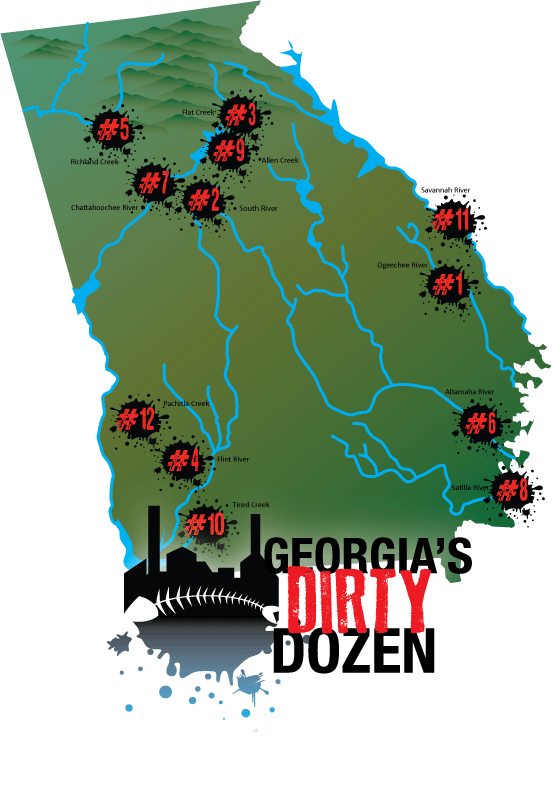
#11: the nuclear reactors at Plant Vogtle

suck up more water from the Savannah River than all local agriculture and almost
as much as the city of Savannah.

If the new Plant Vogtle nukes

are ever completed,
all four will use more water than Savannah. In

2009 the legislature approved and Gov. Deal signed a law

letting Georgia
Power charge its customers in advance for building that boondoggle,
to the tune of

about $1.5 billion so far!

Let’s not forget

Continue reading

New Clayton County Commissioners fire County Manager, fund forensic audit

A few new Commissioners on a five-member board is producing significant
changes in Clayton County.
What changes will the new Lowndes County Commissioners make?

Tammy Joyner write for the AJC

Election results usher in period of change for Clayton
,


The new County Commission set the tone this week by ushering in a
raft of changes aimed at creating better accountability in Clayton’s
finances while putting greater control in the hands of the new
chairman. The board removed County Manager Wade Starr, a long-time
kingmaker in Clayton politics, and will bring in a chief financial
officer to manage county finances.


The balance of power clearly has swung to newly elected
Commissioners Jeff Turner and Shana Rooks. Turner, who replaces
Eldrin Bell as chairman, and Rooks, who defeated Wole Ralph, teamed
with returning Commissioner Michael Edmondson to create a new voting
bloc on the five-member board, and they appear intent on taking
swift action.

“They hit the ground running,” said Carl Swensson,
chairman of the Clayton County Citizens Oversight Committee.
“The former power triumvirate has been absolutely shattered.
We’re going to have good people in position where they can do the
most good for this county. You’re going to find a more receptive ear
in the new structure.”

Naturally the remaining old guard took issue:

Continue reading

Substandard fire protection at nuclear Plant Hatch?

Does Hatch nuclear Unit 1 have substandard fire protection, like
many reactors built before 1975?
Protection against fires that the NRC says cause about half
the core damage risk, such as at Fukushima, which is the same
design as Hatch?

According to Simplyfy.org 2 Jan 2012,

Fire Risk At Older Japan Reactors Shows Potential Worldwide Problem
,


The [Japanese Nuclear Regulatory Authority] NRA announced recently that
reactors built before 1975 likely have sub standard fire protection
designs. This includes having important cables coated in fire resistant
insulation, isolating and protecting cables and creating barriers to
prevent fires from spreading to other areas of critical equipment.


Source:
The Mainichi, 1 Jan 2013,

Over 10 nuclear plants in Japan have flawed fire-prevention equipment: sources
.


What else was built before 1975?
Plant Hatch Unit 1

“Operating License: Issued – 10/13/1974”
,
according to the U.S. NRC.

100 miles from here,

and the same design as Fukushima.

DOE also instituted upgrades and changes to their reactor facilities
which included facility modifications as a result of Browns Ferry
fire. Private sector nuclear power reactors in the US are not all
fully up to the newer rules. The NRC has issued a number of
exemptions that watchdog groups have criticized as being unsafe.
Browns Ferry still does not meet the NRC fire rules for cables. 47
of 52 reactors in the US still do not comply with the 1980 fire
regulations.

Plant Hatch is privately owned and operated.
Has it been upgraded?

Continue reading

Carbon bubble? Solar and wind erode coal, gas, and biomass credit quality —Moody’s


In Europe it’s already happening: solar and wind are causing
bond-rater Moody’s to warn of downgrades of energy companies
that depend on heat from burning coal, gas, or biomass.
Moody’s earlier even warned the Bank of England
of a potential carbon bubble developing.
If combustion energy plants are affected like this,
the credit effects will be even bigger on even-more-expensive
nuclear plants, which Moody’s called a

bet-the-farm risk
way back in 2009.

James Murray wrote for businessGreen 6 Nov 2012,

Moody’s: Renewables boom poses credit risk for coal and gas power plants:
Credit ratings agency warns increases in renewable power have had ‘a
profound negative impact’ on the competitiveness of thermal
generation companies
,

“Large increases in renewables have had a profound negative impact
on power prices and the competitiveness of thermal generation
companies in Europe,” said Scott Phillips, an assistant vice
president and analyst at Moody’s Infrastructure Finance Group, in a
statement.

“What were once considered stable companies have seen their business
models severely disrupted and we expect steadily rising levels of
renewable energy output to further affect European utilities’
creditworthiness.”

And not just rising, rising increasingly

Continue reading

Net zero school in Bowling Green KY


Why stop with
solar Lowndes High or VHS?
Why not have all our elementary and middle schools
generate more solar electricity than they use, and
change their power bills into profits to help pay for education?
A school in Bowling Green, Kentucky is already doing that.

Chuck Mason wrote for bgdailynews.com 22 December 2012,

‘Net-zero’ school pays off
,

The district received a check for $37,227.31 this year. The
Tennessee Valley Authority paid the school district for electricity
it generated. The school district doesn’t have a power plant, per
se, like the utility company. But it does have an energy producer,


the first “net-zero” school in the nation: Richardsville
Elementary School.

The check is tangible evidence that net-zero pays for itself and
then some.

“It has exceeded expectations. We’re seeing a savings of
millions of dollars in energy costs,” state Rep. Jim DeCesare,
R-Bowling Green, said of the net-zero schools concept developing
across the nation.

This is the same Bowling Green, Kentucky that has fast Internet access.
Maybe that’s another reason

the Chamber might want to consider comparing Bowling Green and Warren County
to here.

-jsq

Florida Crystal River nuke down $5 billion?


Only
160 miles from here,
the Crystal River nuclear reactor continues to run up a bad bill,
maybe as much as $5 billion,
and even other nuclear operators are reportedly starting to turn against it.
Should we wait for the new nukes on the Savannah River to run up a bill
that high before we cancel them?

Remember

back in May?

Florida is already experiencing a likely future for the new Plant
Vogtle nukes in Georgia: completion date pushed back, and customer
charges raised.

Yep, that’s the one.
And the bill keeps going up, as
Ivan Penn wrote for the Tampa Bay Times 30 December 2012,

Utilities nationwide could share the financial pain of the idled Crystal River nuclear plant
,

The crippled Crystal River nuclear plant is now America’s headache.

The bill to fix it and pay for replacement power may top $5 billion.
The problem?

The company that insures all 104 U.S. nuclear power plants has just
$3.6 billion on hand to pay for claims.

Broken nuclear plants in California, Texas and Michigan will vie for
some of that money. But Crystal River alone represents such a
financial threat that the insurance company, Nuclear Electric
Insurance Ltd., may demand that its member utilities pony up more
money.

Is NEIL the guarantor on the bonds for the new nukes at Plant Vogtle?
I think Southern Company was smarter (for SO, not for us)
and

got Congress to guarantee those.

If so,

Continue reading

Plant the seeds for viable water future

This AJC op-ed is about coastal wetlands, but
much of it applies to wetlands such as cypress swamps and streams
in Lowndes County and the rest of central south Georgia,
especially since

our state water plan for the Suwannee-Satilla Region

points us at

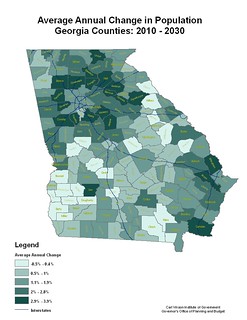
County-Level Population Projections from the Governor’s Office of Planning and Budget

that project 45% growth in Lowndes County population in 20 years to 156,650 people by 2030,
which means near doubling in 30 years to 2050. -jsq

David Kyler wrote for the AJC 29 December 2006,
“Plant the seeds for viable coastal future”,

Recent population projections for the Georgia coast issued by

2010-2030 Change in Population of Georgia Counties

Georgia Tech say nothing new. We’re growing at almost 20 percent a
decade, meaning a near doubling every 35 years.

The Center for a Sustainable Coast projected a population of about 1
million by 2030 for the 11 counties in the coastal region as defined
by the Department of Natural Resources, somewhat higher than the
844,000 predicted by Georgia Tech. This compares with a population
of 538,469 reported in the 2000 Census report.

But the accuracy of projections is not the point. Increased
population will result in more land clearing and environmental
disturbance than in the past—there will be larger homes,
bigger lots and fewer people per household.

National studies show up to twice as much land is

Continue reading

Solar cars and charging stations: who wouldn’t?

Tired of Southern Company CEO Fanning’s

maybe “next decade”
for solar power?


Tired of Georgia Power’s Bowers

trying to push solar off for fifty years?

Let’s hear from somebody who takes on big tasks and gets them done:
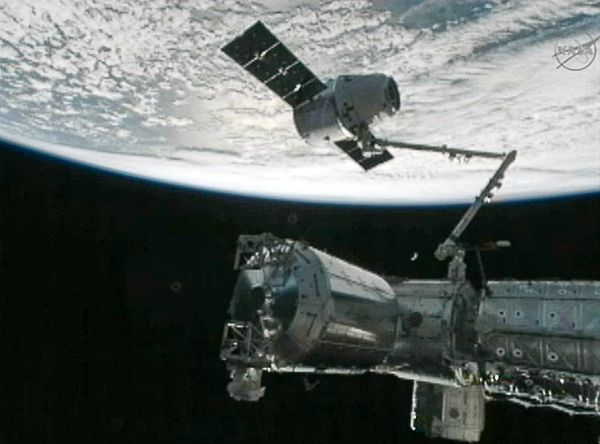
Elon Musk, who’s already built a rocket that is resupplying the International
Space Station, and who is also building all-electric cars.

Carl Hoffman wrote for Smithsonian magazine December 2012,

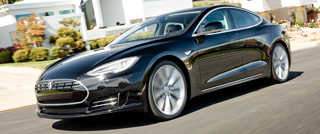
Elon Musk, the Rocket Man With a Sweet Ride

When he’s not launching rockets, Musk is disrupting the notoriously
obdurate automobile industry (see National Treasure, p. 42). While
industry giants like Chevrolet and Nissan and Toyota were dithering
with electric-gasoline hybrids, this upstart kid said he would
design and manufacture an all-electric car that would travel
hundreds of miles on a single charge. The Tesla Roadster hit the
streets in 2008 with a range of 200 miles, and the far more


functional Model S, starting at $57,000, was introduced in June.
It’s the world’s first all-electric car that does everything my old
gasoline version does, only better. The high-end model travels 300
miles on a single charge, leaps from zero to 60 in 5.5 seconds,
slows from 60 to a dead stop in 105 feet, can seat up to five, has
room for mulch bags and golf clubs, handles like a race car and its
battery comes with an eight-year, 100,000-mile warranty. If you
charged it via solar panels, it would run off the sun. One hundred a
week are being produced in a former Toyota factory in Fremont,
California, and nearly 13,000 people have put deposits on them….

And since that story:

Continue reading

2012 solar deployments driven by Moore’s Law price reductions


Moore's Law in solar Watts/$100


Moore’s Law for solar
is about decreasing price per Watt,
or more Watts per dollar.
Here’s an example of a common confusion, to think it’s about efficiency:

“The curve will obviously become asymptotic at some point, ie,. the rate
of improvement will flatten out, so we end up with a sort of squashed
“S” shape curve, because you can’t get more than 100% efficiency —
36 watts/m2 or so.”

And indeed efficiency probably will flatten out soon.
But it’s not solar
efficiency that’s improving by Moore’s Law: it’s price per watt.
That can keep improving for a long time.

Here’s an example of decreasing price.
Scott Detrow wrote for NPR 23 December 2012,

Forget Fracking: 2012 Was A Powerful Year For Renewables
,


Rhone Resch

“Just to give you perspective,” Resh said, “in Washington, D.C.,
where I live, when I installed solar on my house six years ago, the
average install cost was about $14 a watt. Today it’s about $4 a
watt.”

Here’s another comparison, this one just for solar panels.

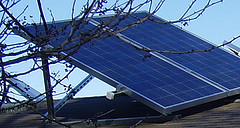
KC 170 solar panels, purchased 2005

In 2005 the first set of solar panels we got cost $670 each
and produced 170 Watts DC each, or $4.94/Watt.
In 2011 our second set of solar panels cost $562 each
for 235 Watts DC each, or $2.39/Watt.
That’s more than 50% price decrease for solar panels in six years.
(I can’t compare inverters or support structures directly,
because those were sized so differently, but those have also
come down in price, helping lower the overall install cost).

Year price /Watt price /panel Watts /panel Dimens. square inches Watts /100 sq in. Model
2005 $4.94 $670 170W 50×39″ 1950 8.7 KC 170
2011 $2.39 $562 235W 39.1×64.6″ 2525 9.3 Sharp ND 235 QCJ
2012 $1.32 $310 235W 39.1×64.6″ 2525 9.3 Sharp ND 235 QCJ

Meanwhile, the Watts per surface area hardly changed, from about

Continue reading