Tag Archives: Planning

National attention on GA HB 282 against muni broadband: needs GA leg. to vote it down

Another bad idea from ALEC already passed in SC and NC and is now in the GA
legislature, getting coverage in several national technical
and political blogs:

HB 282
, which would effectively forbid
municipal broadband if any commercial carrier offers 1.5Mbps.
It's up for a hearing this week: time to call your state rep.

Timothy B. Lee wrote for ArsTechnica 14 Feb 2013,

Bill would ban muni broadband if one home in census tract gets 1.5Mbps:
Approach could leave some Georgia residents without a viable broadband option.


Incumbent broadband providers are pushing legislation that would
restrict Georgia towns from building municipal broadband networks.
Under the proposal, if a single home in a census tract has Internet
access at speeds of 1.5Mbps or above, the town would be prohibited
from offering broadband service to anyone in that tract.

State-level restrictions on municipal broadband networks are

Continue reading

Why cant we keep and restore something that is very important to a community of people? —April Huntley

Received Friday. April Huntley also sent it to the Lowndes County Commissioners.
I have added a few links and pictures. -jsq

Dear Editor,


I’m not sure if people know or care that there is

another Dollar
General about to pop-up
in Lowndes County. This time it will be in
Naylor. I’m not sure if this will be an improvement or not.

Something I am also aware of and hold an opinion about is the

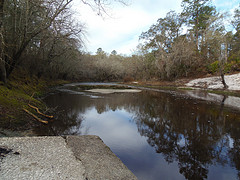
proposal to abandon a road in Naylor that leads to the Alapaha
River
. This is

the only public access to the Alapaha in Lowndes
County
. It is a place of history, recreation and fun for many
people.

The spot where County Road 16, Old State Rd., dead ends at the
Alapaha River is an area of rich history for Naylor and

Continue reading

Internet speeds into jobs

Something good out of Chattanooga?
The city with the fastest metropolitan Internet access
plans to turn that into jobs.

Elizabeth Prann wrote for Fox 26 January 2013,

City turns Internet speeds into jobs
, that Chattanooga


is home to most advanced smart grid in the nation, customers are
enjoying Internet speeds that are almost 100 times faster than the
national average. Most Internet users in the U.S. have access to
about 4.5 megabits of Internet speed.

We wish!
OK, you can get spees that fast here:

with Verizon 4G LTE
,
not too many places via land access.

So what’s Chattanooga got that’s better?

Continue reading

Thank you for helping the community —April Huntley

Received Wednesday from April Huntley to Joyce Evans. -jsq

Good morning, Commissioner Evans!

Thank you very much for helping the community get the public hearing


for the closure of Old State Rd. tabled until next meeting! I hope
we will all be able to work together to find a lasting solution that
will enable the residents of Lowndes County and surrounding areas to
continue to enjoy this beautiful spot on the Alapaha River. I hope
you agree that this is not a standard road abandonment since it
affects a body of water. I hope you have a great day, and I look
forward to speaking with you soon!

Thank you again!

April Huntley

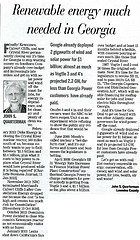
Renewable energy much needed in Georgia —John S. Quarterman

My op-ed in the VDT today; I’ve added links, plus some more after the op-ed.


Finally! Kewaunee, Calvert Cliffs, and now Crystal River
permanently closing say it’s time for Georgia to stop wasting money
on Southern Company’s already over-budget and increasingly-late
nukes and get on with solar power and wind off the coast: for
jobs, for energy independence, and for clean air and plenty of
clean water.

February 2013:

Duke Energy is closing
the Crystal River nuclear
reactor

(Tampa Bay Times, 6 Feb 2013)
,
160 miles south of us, because

nobody wants to pay to fix it
:
between “$1.5 billion and $3.4 billion,
plus what it costs to buy power to replace
what Crystal River would have produced while it is
being repaired”

[Charlotte Business Journal, 11 Jan 2013]
.
November 2012:

NRC terminated
Maryland’s Calvert Cliffs 3

(NRC 1 Nov 2012)

after

Constellation Energy dropped out
because the cost “is too high
and creates too much risk for Constellation”

[Bloomberg 10 Oct 2010]
.

Continue reading

As went Maine Yankee, so goes San Onofre: another reactor will close


San Onofre 4 will stay down
,
if opponents can stop the hidden experiment shell game.
Maine Yankee was down for about a year, and never started up again.

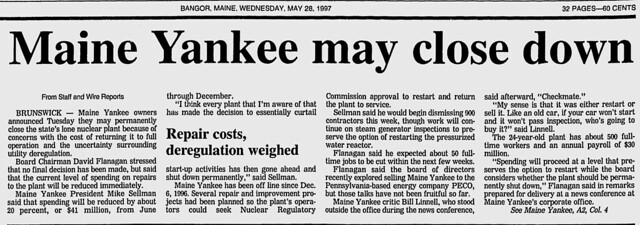
Front page of the Bangor Daily News 28 May 1997,

Maine Yankee plant may be closed down: Owners weigh repair costs, deregulation
,


Page 1A Bangor Daily News 28 May 1997

Maine Yankee President Mike Sellman said that spending
will be reduced by about 20 percent, or $41 million, from
June through December.

“I think every plant that I’m aware of that has made the decision
to essentially curtail start-up activities has then gone ahead
shut down permanently,” said Sellman.

Maine Yankee has been off line since Dec. 6, 1966.
Several repair and improvement projects had been planned so the plant’s
operators could seek Nuclear Regulatory Commission approval to
restart and return the plant to service.

See also
“It has to close because of the pocketbook.” —Kyle Jones on Maine Yankee nuclear power plant
.

-jsq

“It has to close because of the pocketbook.” —Kyle Jones on Maine Yankee nuclear power plant

Instead of demonstrating to influence legislators, sometimes it's better
to get elected and legislate: that's what Kyle Jones did in Maine,
and he closed the Maine Yankee nuke,
de-monopolized the state's electrical utilities,
and instituted a 30% renewable energy goal.
All this was helped by the nuclear industry's own incompetence.

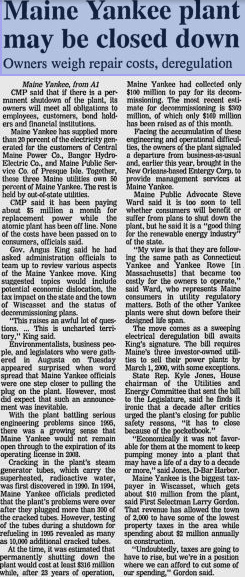
Bangor Daily News, Page A2, 28 May 1997,

Maine Yankee plant may be closed down: Owners weigh repair costs, deregulation
,


Page 2A Bangor Daily News 28 May 1997

Cracking in the plant's steam generator tubes, which carry the superheated,
radioactive water, was first discovered in 1990.
In 1994, Main Yankee officials predicted that the plant's problems
were over after they plugged more than 300 of the cracked tubes.
However, testing of the tubes during a shutdown for refueling in 1995
revealed as many as 10,000 additional cracked tubes.

Sounds a lot like

San Onofre.

At the time, it was estimated that permanently shutting down
the plant would cost at least $316 million while,
after 23 years of operation, Maine Yankee had collected only
$100 million to pay for its decommissioning. The most recent
estimate for decommissioning is $369 million, of which
only $169 million has been raised as of this month.

Facing the accumulation of these engineering and operational difficulties,
the owners of the plant signaled a departure from business-as-usual
and, earlier this year, brought in the New Orleans-based Entergy Corp.
to provide management services at Maine Yankee.

Oh, my!
The same Entergy that's now

likely to close Vermont Yankee.

And Vermont Yankee wasn’t the first to follow this financial path to closure:

Continue reading

No list of who bought waste collection center cards? @ LCC 2013-02-12

How can Lowndes County not have a list of who it
sold waste collection center cards to?
How can it not provide it in response to an open records request?

In the

9 October 2012 Regular Session,
Lowndes County Manager Joe Pritchard
said:


Just under 5,000 residents who have purchased the cards

That was in his curiously redacted summary of the history of
solid waste handling in the county, and he was referring to the
access cards to the waste collection centers.


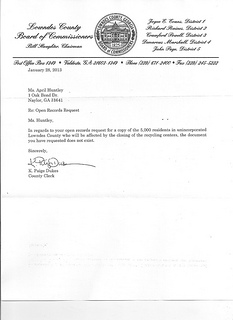
Paige Dukes to April Huntley 2013-01-28

Yet when April Huntley submitted an open records request asking
for the names of the 5,000 people who would be affected by the
waste collection centers, this is what County Clerk Paige Dukes
replied:

In regards to your open records requst for a copy of the 5,000 residents
in unincorporated Lowndes County who will be affected by the closing of
the recycling centers, the document you have requested does not exist.

Maybe this explains part of why

Veolia, excuse me, ADS, seemed so confused yesterday morning.

Come tonight to see if any Commissioners ask about this.

-jsq

Ways to fix the trash problem

I commend Commissioner John Page for
his op-ed in the VDT today,


attempting to do what no other Commissioner has tried:
to explain the trash issue.
Indeed, like him, most of the people I talked
to while campaigning for Gretchen were for keeping
the waste collection centers open, and of those
the vast majority were willing to pay more,
which is the main reason the previous Commission
made a big mistake in closing those centers.
Unfortunately his letter seems to indicate nothing can be done.
Well, here are some things that can be done.

Let the contract lapse.

Commissioner Joyce Evans insisted on the contract
with the sole provider being only for one year.
Let it lapse after that year!

Publish the contract.

What’s in the contract?
How do we even know it’s for only one year?
The new Commission already had to

do over a decision of the previous Commission
(remove license fee from Sunday alcohol sales)

because the ordinance written up afterwards wasn’t what
they thought they passed.
Publish the contract and let everyone see!

Publish an accounting for the waste collection sites.

Commissioner Page wrote:

The county was losing hundreds of thousands
of dollars each year because the fees for the permits
were not bringing in enough money to fully fund
the sites.

How do we know that?

Continue reading

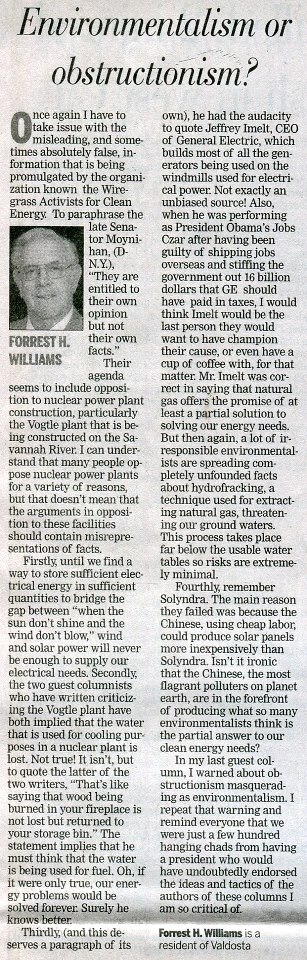
Return of water misinformation by Forrest H. Williams in the VDT

Seen today on the
WACE facebook page
is an image of an op-ed in the VDT, and alongside it I include here
Michael Noll’s initial comments, plus a few links.


There is good reason why Stephen Hawkins once said “the greatest
enemy of knowledge is not ignorance, it is the illusion of
knowledge.” When entities like Fox News can claim that “solar won’t
work in America because it’s not as sunny as Germany”, we shouldn’t
be surprised by the results of such “educational” efforts. The fact
is that we have a number of clean and renewable forms of energy
(e.g. wind, solar, geothermal) that already work. Just go to

Spain
,

Germany
,

Denmark
, Iceland, or simply stay in the US and visit places
like from

New Jersey

and

New York

to

California

and

Arizona
. Combine
these pieces of a larger energy puzzle with meaningful initiatives
of

energy conservation and energy efficiency
, and we find a way out
of our current predicament (i.e. continuing dependence on finite and
dirty sources of energy), while saving money (see

solar vs. nuclear
),
preserving our natural resources (e.g. water, forests),
and providing clean, healthy and safe environments to live in (e.g.
wind and solar do not produce radioactive waste, pollute our air and
groundwater).

The guest columnist appearing above is the same individual who
thought

Continue reading