Tag Archives: Economy

Arkansas tar sands oil spill


Will Exxon clean all these tar sands oil spills like BP “cleaned up” the Gulf?
Meanwhile, a solar spill is called a nice day.


June 2013, pipeline ruptured in
Alberta:
250,000 gallons spilled into the Red Deer River.

27 March 2013, train derailment in

Minnesota
: 15,000 gallons spilled.

“Only about 1,000 gallons has been recovered,” said Dan Olson, spokesman for the Minnesota Pollution Control Agency. “The remaining oil on the ground has thickened into a heavy tar-like consistency.”

30 March 2013, pipleline rupture,

Mayflower, Arkansas
: “thousands of gallons” spilled.

Kimberly Brasington, an Exxon spokeswoman, confirmed the oil from
the ruptured Pegasus pipeline originated in Canada. The oil is
“Wabasca Heavy Crude from Western Canada,” she said in
an e-mail Sunday. Canadian group CrudeMonitor describes Wabasca as a
blend of heavy oil production from the Athabasca region.


Aerial footage
of the Arkansas crude seeping through woods, waterways, streets, and yards:

Continue reading

Utilities levy an absurd tax upon the rest of their fellow-citizens –Adam Smith

What’s next door to Georgia Power, also a Southern Company,
and raising rates on customers who are using less electricity?
Alabama Power.

Rebecca Smith wrote for WSJ 21 March 2013,

Return Rates for Utilities Get Harder Look


Households getting electricity from Alabama Power Co. are using 6%
less than five years ago. But their monthly power bills still have
increased by an average of 8%, partly because of a lucrative rate
agreement that the utility brokered with state regulators 30 years
ago.

“an absurd tax upon the rest of their fellow-citizens”

—Adam Smith

The deal allows Alabama Power, the state’s largest electric utility,
to adjust its rates annually to maintain a return on equity, a
measure of profit, of 13% to 14.5%. Now it is coming under fire from
consumer advocates and one state utility commissioner, who argue
that the utility’s profit levels are too high.

Continue reading

NJ 1 GW Solar: GA #22

While Georgia

failed to reform its antique Territorial Electric Service Act

and

toyed with a solar monopoly
,


New Jersey, far to the north with far less sun,
finished installing a gigawatt (1,000 megawatts) of solar power.
The rest of the

U.S. installed 3.3 MW total
, slightly higher
than projections of 3.2 MW, but Georgia lagged behind.
When will the legislature and the Public Service Commission,
and perhaps more importantly, Georgia Power and Southern Company,
stop

stop wasting our money on that three-legged nuclear regulatory-capture boondoggle
at Plant Vogtle

and get on with solar in Georgia for jobs, for profit, and for clean air and water?

Pete Danko wrote for

Earth Techling
and Huffpo 20 March 2013,

New Jersey Solar Capacity Hits 1 Gigawatt
,

Continue reading

U.S. installed 3.3 Gigawatts of solar in 2012, on target

Moore’s law continues to drive solar costs down and installations up.
According to SEIA,

U.S. Market Installs 3,300 Megawatts in 2012; Driven by Record Fourth Quarter
,

2012 was a historic year for the U.S. solar industry. There were
3,313 megawatts (MW) of photovoltaic (PV) capacity installed
throughout the year, which represents 76% growth over 2011’s record
deployment totals. The fourth quarter of 2012 was also the largest
quarter on record as 1,300 MW came online, driven in part by
unprecedented installation levels in the residential and utility
markets. SEIA and GTM Research forecast that the market will
continue to grow at a steady clip with over 4,200 MW of PV and 940
MW of concentrating solar power (CSP) expected to come online in
2013. (All data from SEIA/GTM Research “U.S. Solar Market
Insight 2012 Year-In-Review” unless otherwise noted.)


And those new installations are driven by solar PV prices continually falling in

Moore’s Law for solar
:

Continue reading

Billions for Cape Wind

Wind, wind, blow away the NIMBYs.

David Richardson
wrote for Grist today,

Cape Wind wins billions in backing, launches offshore wind in the U.S.


What do you do when local opposition to an offshore wind farm
project dries up, when the NIMBY crowd runs out of steam, when the
federal government gives the green light and extends every permit
and courtesy the law will allow, when the technology is tested and
proven, and there’s nothing left to do but build it? Well, then you
go looking for money — lots of it. After more than a decade of
preparation, the Massachusetts wind energy company Cape Wind has
done just that — and the results are looking promising.

A $2 billion agreement with Bank of Tokyo-Mitsubishi UFJ penned last
week catapults Cape Wind to a commanding lead in the race to be the
first offshore wind project in the U.S. When complete, 130 turbines
in Nantucket Sound will generate 468 megawatts of electricity,
enough to power 100,000 to 200,000 households in the Cape Cod
region, depending on the season. If the company can get construction
started this year, Cape Wind’s clean power could begin turning on
lights from Buzzards Bay to Provincetown by 2015.

There’s more in
the article.

-jsq

Rural hospitals closing

A state that forces hospital closings by refusing Medicare expansion
while spending a billion dollars a year on locking up too many
prisoners has its priorities wrong.

Tom Baxter wrote for SaportaReport yesterday,

Ominous signs for rural Georgia as hospitals shut their doors,


Lewis forecast at the beginning of the year that five to six rural
hospitals might be forced to close in 2013, and already there have
been two.

Calhoun Memorial
Hospital in Arlington closed in February,
and

Stewart-Webster
Hospital in Richland shut its doors last week.

That’s only a foretaste, Lewis says, of what’s going to happen when
the Affordable Care Act next year eliminates the

subsidies
which
have been key to the survival of many of these hospitals, and
imposes new standards — for instances, penalizing hospitals
for readmitting patients in less than 30 days — which will
directly impact their bottom line.

“We will probably get hurt worse than any state in the
nation,” Lewis said last week. “It’s not like we will be
friendly faces to the feds, and they’re going to come in and do
major damage to us. ” He’s certainly not an enthusiastic fan
of Obamacare, but thinks the state has no choice but to accept the
Medicaid expansion which was intended as compensation for what the
new law takes away.

“With Obamacare coming down the pike, if we don’t get some
kind of relief in (Medicaid) expansion, we will face certain
death,” Lewis said last week.

Ah, so the problem isn’t ObamaCare: it’s Gov. Deal’s refusal to
accept Medicaid expansion!
The AJC warned us about that back in August:

Continue reading

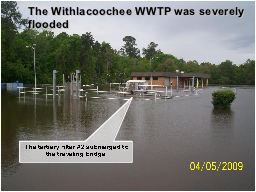
Valdosta PR about wastewater issues

The city of Valdosta responds. I have decorated this PR with a few
images with links, and a few comments after it. -jsq


Mayor and Council Address Recent Wastewater Issues
,

The Valdosta Mayor and City Council are committed to providing quality
municipal services that meet the expectations of our citizens. In addition
to providing fire and police protection and other beneficial quality of
life services, the city leadership is equally committed to providing
adequate water and wastewater treatment services to its citizens,
maintaining a functioning sewer collection system and discharging treated
water in an environmentally responsible manner.


Recently, citizens have been inundated with information about
the current state of the city’s wastewater treatment plant and sewer
collection system, as well as the decisions made during the recent flood
event. The following information is provided to explain the recent event
and to help citizens better understand these important issues and the
dedicated work of their elected officials and municipal staff.

THE SITUATION

Continue reading

Prison gang violence

This is what eventually happens in

a country with 5% of the world’s population yet 25% of the world’s
prisoners
,
in a state that has
1 in 13 adults in the prison system (jail, prison, probation, or parole): prison violence the prisons can’t deal with,
possibly including

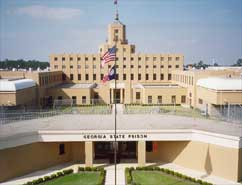
the mysterious violence at Valdosta State Prison
.
When we stop locking up so many people by ending the war on drugs,
we’ll have plenty of money to adequately secure the few remaining
real violent offenders.

Rhonda Cook wrote for the AJC Saturday,

Gang violence in prison is increasingly deadly
,


In a little more than 10 months, 12 inmates and a guard have been
stabbed to death in Georgia prisons, a dramatic uptick in violence
that law enforcement officials and human rights advocates agree
points to increased gang activity.

“We cannot remember a time like this when we were getting this
volume and severity of violence,” said Sara Totonchi,
executive director of the Southern Center for Human Rights, which
monitors prison violence.

People who go into such prisons, if they aren’t already violent,
are likely to be taught to be violent, and some just don’t come back out.
Yet those that do get out can be bad for the rest of us:

Continue reading

Spilling Sewage Pictures by Gabe Fisher 3:30 PM 24 March 2013

Received yesterday. -jsq

Date: Sun, 24 Mar 2013 15:43:47 -0400


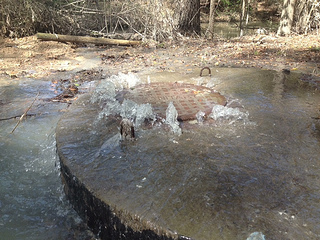
Manhole

All, just so everyone is on the same page- the sewer line is currently
spilling sewage. It just started at mu house but has been going strong
at sugar creek for awhile by the looks of it. Here are some current
pictures as of 3:30 today. It will get worse until the river crests..

Gabe

Continue reading

HB 657, the Rural Georgia Economic Recovery and Solar Resource Act of 2014

The solar bill that’s been talked about for weeks has finally appeared in the
Georgia legislature:

HB 657
.
It’s better than I expected, because it’s about rural solar generation and distribution.
However, there is a catch: a “community solar provider” must be certified
by the Public Service Commission, instead of just setting up in business
as in most states, and the PSC could certify only one state-wide monopoly;
note the summary at the front says “an independent community solar
provider” as in only one.
But the body of the bill is more circumspect and says “any”.
Perhaps if we get enough installations
the benefits of solar will become obvious enough that
the PSC will certify a lot of community solar providers,
and we can get on with solar in Georgia,
including house and business rooftop solar.
Many thanks to Representatives Kidd of the 145th, Kirby of the 114th, Rogers of the 10th, Brockway of
the 102nd, Fullerton of the 153rd, and others.
And special credit to Robert E. Green, Shane Owl-Greason, and Ted Terry
of Georgia Solar Utilities (GaSU) for shepherding this bill
into the legislature.


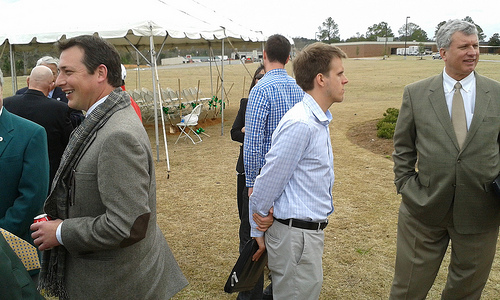
Shane Owl-Greason, Ted Terry, Robert E. Green


Shane Owl-Greason, Ted Terry, Robert E. Green
at the

Dublin High School solar groundbreaking
.

The bill requires the PSC to study changes in retail
rates
because of this bill.
Too bad it doesn’t go the rest of the way to

what North Carolina did
,
and require timely public posting of who buys and sells which types
of energy at which prices, but at least it’s a start.

Maybe HB 657 will help get

HB 503
passed for Renewable Portfolio Standards.
However, HB 657 is cleaner than either HB 503 or SB 51 because it does not mess around
with biomass or for that matter any other energy source:
HB 657 is about solar energy and nothing else.

The main part of HB 657 is in Section 1, but first here’s how it
shoehorns

Continue reading