Tag Archives: Economy

BP: the beaches are open for everyone to enjoy!


BP must be getting desperate about people catching onto what they did to the Gulf.
A BP video ad has been replaying itself every few minutes beside various
news stories since yesterday, claiming two years after the oil disaster
(“spill” doesn’t describe it) “the beaches are open for everyone to enjoy!”

BP’s website

says “We are helping economic and environmental restoration efforts in the Gulf Coast as part of our ongoing commitment to the region following the Deepwater Horizon accident in 2010”.
Neither the ad nor the website says BP actually cleaned up the oil.
Because they didn’t.
It’s still there, as is the even more toxic “dispersant” Corexit BP
dumped on top of the oil to make it sink.
Both are busily poisoning dolphins, fish, birds, and humans.

Antonia Juhasz wrote for The Nation 7 May 2012,

Investigation: Two Years After the BP Spill, A Hidden Health Crisis Festers
,

Continue reading

Southern Company Stockholder Meeting @ SO 2013-05-22


Spring means soon time for the Southern Company Stockholder meeting!
See what one of the biggest electric utilities in the world is up to,
and maybe make a few suggestions.

Here are
videos of what you missed last year,
and here is the official SO notice for this year
(I got a link to it because I’m a shareholder):

Notice of Annual Meeting of Stockholders of The Southern Company

DATE: Wednesday, May 22, 2013
TIME: 10:00 a.m., ET
PLACE: The Lodge Conference Center at Callaway Gardens

Highway 18

Pine Mountain, Georgia 3182


It includes a list of Items of Business, which doesn’t mention that
stockholders are usually allowed to ask questions.
Those questions are usually answered by Thomas A. fanning,
Chairman, President, and Chief Executive Officer,
who included a letter (text below) in which he recites

his usual list
of energy sources, in his usual order: Continue reading

Agenda, Industrial Authority @ VLCIA 2013-04-16


The agenda is different for today’s Industrial Authority meeting!
It has even less information than usual:
no reports about PR or marketing or existing or new projects;
nothing about business parks, and no executive director’s report.
It does list an attorney report and an audit update.

Here’s
the agenda.


Valdosta-Lowndes County Industrial Authority

Agenda

Tuesday, April 16, 2013 5:30 p.m.

Industrial Authority Conference Room

2110 N. Patterson Street

General Business

  • Call to Order
  • Invocation
  • Welcome Guests

Minutes

  • Regular Meeting, March 8, 2013

Financial

  • Review Compiled Balance Sheet and Income Statements for March 2013
  • Audit Update

Attorney Report


Citzens Wishing To Be Heard


Adjourn General Meeting

Mission of the Valdosta Lowndes County Industrial Authority is to

lead economic development in our community by supporting existing industries

recruiting industries through capitalizing on opportunities for collaboration.

-jsq

Electric utiltiies know about Moore’s Law for solar power

And they know compound annual growth, even at a low 22% rate,
is going to cause them a heap of trouble.


More from the

Edison Electric Institute
January 2013 report,

Disruptive Challenges: Financial Implications and Strategic Responses to a Changing Retail Electric Business
(rehosted on the LAKE web server, since it disappered from the EEI server),


The decline in the price of PV panels from $3.80/watt in 2008 to
$0.86/watt in mid-20121. While some will
question the sustainability of cost-curve trends experienced, it
is expected that PV panel costs will not increase (or not increase
meaningfully) even as the current supply glut is resolved. As a result,
the all-in cost of PV solar installation approximates $5/watt, with
expectations of the cost declining further as scale is realized;

Sure, costs won’t continue to drop forever, but Continue reading

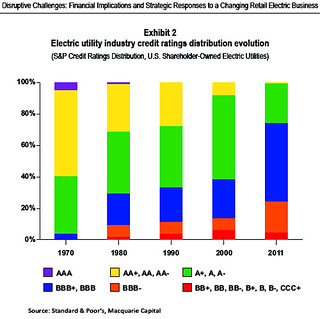
Solar could burn utility business model


Exhibit 2

Utilities say that like it’s a bad thing.
The same utilities that

left millions without power
in the U.S.

repeatedly
last

year
, and that

gouge ratepayers for 10% or more profits
.
Moore’s Law continues

to drive solar costs down and installations up
,
with increasingly more each like compound interest.
Utilties need to adapt or get out of the way.

Last November Moody’s reported that solar and wind were eroding
credit for coal and gas power plants, and were already having

‘a profound negative impact’ on the competitiveness of thermal generation companies
.
That was in Europe.
David Roberts wrote for Grist yesterday,

Solar panels could destroy U.S. utilities, according to U.S. utilities
,

The thing to remember is that it is in a utility’s financial
interest to generate (or buy) and deliver as much power as possible.
The higher the demand, the higher the investments, the higher the
utility shareholder profits. In short, all things being equal,
utilities want to sell more power. (All things are occasionally not
equal, but we’ll leave those complications aside for now.)

And they want to produce that power

from big baseload power stations

for their economy of scale while the monopoly power utilities
get guaranteed profits, not to mention huge ratepayer and loan-guaranteed

boondoggles like the new nukes at Plant Vogtle
.
(Electric Member Cooperatives are somewhat different.)

Now, into this cozy business model enters cheap distributed solar
PV, which eats away at it like acid.

Continue reading

Lancaster, CA solar capital?

What does it take to turn a city into a solar power powerhouse of jobs
and clean energy profit?
Mostly the will to do it, plus some public relations and business relations.

Felicity Barringer wrote for NYTimes 8 April 2013,

With Help From Nature, a Town Aims to Be a Solar Capital
,
the mayor of Lancaster, California,
R. Rex Parris,
said,


“We want to be the first city that produces more electricity
from solar energy than we consume on a daily basis,”

And then the city of Lancaster took action, requiring

that almost all new homes either come equipped with solar panels or
be in subdivisions that produce one kilowatt of solar energy per
house. He also was able to recruit the home building giant KB Home
to implement his vision, despite the industry’s overall resistance
to solar power.

Result, according to one solar tracker?

Continue reading

Fossil fuels get five times the subsidies of renewable solar and wind


Fossil fuels get more than $70 billion dollars a year in
U.S. government subsidies (tax breaks and direct spending),
while solar and wind get only about $12 billion,
so fossil fuels got more than five times as much,
while

nuclear got ten times as much
(especially
in Georgia
).
Even corn ethanol, that sounded-like-a-good-idea-at-the-time
boondoggle, gets more subsidies than solar and wind put together.

That’s without even going into the
externalities

such as healthcare costs due to polution, environmental destruction
through mountaintop removal for coal, tar sands oil drilling,
and fracking for natural gas, and wars for oil and uranium.

Continue reading

IKEA biggest solar in Georgia


The biggest solar rooftop installation in Georgia?
Not by mighty Georgia Power, not by an EMC, not even by GaSU:
it’s IKEA’s distribution center in Chatham County.
Chatham is also trailing only Atlanta in solar installations in general.

Mary Landers wrote for Savannahnow.com 7 January 2013,

New solar adds to Chatham’s growing inventory
,

Just in time for the new year, and for a tax break for the old one,
Consolidated Utilities began producing electricity from solar panels
at its water treatment plant in west Chatham County on the afternoon
of New Year’s Eve.

“When I left on Monday the meter was receiving power,”
said Tony Abbott, president of Consolidated Utilities, a private
local water company.

The 416-panel, 100-kilowatt system is big enough to power about 10
average homes for 25 years, said Julian Smith, of SolarSmith, which
installed the system. At the water treatment site, however, solar
will instead power the blowers that keep the sewage ponds aerated.
The panels occupy previously useless property in a flood zone, Smith
noted.

OK, the
Wiregrass Solar installation at Valdosta’s Mud Creek Wastewater
Treatment Plant
is larger, and the Valdosta City Council recently
voted to expand it further.
Go Valdosta!

But what about IKEA?

It’s not the largest solar installation in the county. That honor
still goes to the IKEA distribution center, which in October plugged
in its 1,460-kilowatt solar array on the roof of its distribution
center. That IKEA installation is in fact the largest in the state.

Back in July I mentioned that

IKEA was going to build that array
,
and IKEA was building almost as much solar as all of Georgia Power’s
parent Southern Company.
BusinessWire reported 9 Oct 2012

IKEA Plugs-In Georgia’s Largest Private Solar Rooftop Array on Savannah Distribution Center: Surpasses 75% U.S. Solar Presence
.

This installation represents the 34th
completed solar project for IKEA in the U.S., with five more
locations underway, making the eventual U.S. solar presence of IKEA
nearly 89% of its U.S. locations, generating with a total 38 MW.
IKEA owns and operates each of its solar PV energy systems atop its
buildings — as opposed to a solar lease or PPA (power purchase
agreement) — and globally has allocated €590 million to
invest in renewable energy, focusing on solar and wind during the
coming three years. This investment reinforces the long-term
commitment of IKEA to sustainability and confidence in photovoltaic
(PV) technology. More than 250,000 solar panels have been installed
on IKEA stores and buildings across the world. The company also owns
and/or operates approximately 110 wind turbines in Europe.

The Savannahnow article mentions something
happening in Chatham County but not so much yet in Lowndes County:

“What’s really going on in Chatham is that lots of homeowners
put solar on their rooftops,” Arora said. “The
excitement exists in Chatham for solar.”

-jsq

Banks as slumlord renters reducing property values

Lou Raguse write for WIVB.com 4 April 2013,

Cheektowaga picks fight with big banks
,


CHEEKTOWAGA, N.Y. (WIVB)—Neighbors in Cheektowaga say empty
houses are ruining the value of their neighborhoods and bringing in
unwanted guests.

Residents want to know why these properties, seized by banking
giants, have been left to crumble. The town board says they have
serious issues with the homeowners.

“In normal life, you would call them slumlords,” says Town Board
Member Charlie Markel.

Those so-called “slumlords” are big banks like Bank of America and
Chase. Markel says in too many cases, a homeowner falls behind on a
mortgage and the bank begins to foreclose. But then, it stops short.
He says the bank continues paying property tax but allows the homes
to fall into disrepair, never allowing them back on the market for
sale, or to be auctioned.

Let’s remember what

last year’s study of America’s richest and poorest cities
found
about the Valdosta MSA:


Despite these positives, 14.4 percent of housing units were vacant
last year [2011], higher than the national vacancy rate of 13.1
percent.

I wonder how big national and multinational banks are serving our area?
And with a vacancy rate that high, and
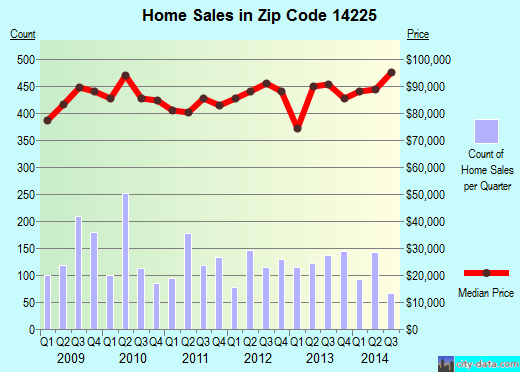
housing prices still dropping,
why are we building more houses?

-jsq

Who’s inaccurate: VDT, Valdosta, GEFA, Chamber, County?

Both Chamber of Commerce Chair Myrna Ballard and Lowndes County Manager
Joe Pritchard say the VDT is inaccurate.
The VDT took offense at Ballard’s assertion.
Which do you believe?


I believe I’d like to see the evidence, not just the VDT’s assertions.
And this junior high school cat fight the VDT insists on is not
helping fix the real problem with water and wastewater in Valdosta
and Lowndes County: the widespread and longterm damage to our watersheds
that turned a normal rain in 2009 into a 700 year flood, and caused
another flooding of the Withlacoochee Wasterwater Treatment Plant this year.
I’m all for investigative reporting, but I have not yet once seen
the VDT investigate the real underlying issues of longtime clearcutting
and building of roads subdivisions, and parking lots without adequate
consideration of water flows.

The VDT front page today has yet another story attacking the City of Valdosta,

Loan info from GEFA contradicts City:
$11 million awaits disbursement, loan amounts don’t match
.
I can’t make much sense out of it, because while Jason Shaefer has
dug up a lot of interesting information, he doesn’t include dates
for much of the financial detail he attributes to GEFA.
Let’s see the VDT publish the documents they are referring to.
The city does publish its

Comprehensive Annual Financial Reports
.
The VDT has a website, and could publish whatever records
it got from GEFA, which after all were produced using our tax dollars,
and are therefore public records.
Or if the documents are somewhere on

GEFA’s website
, the VDT could publish links to the specific documents.
The VDT did publish

a timeline of correspondence with the City about loans
,
so it could just as easily publish the GEFA documents and its
own page-by-page and chart-by-chart comparison so we could all see
for ourselves.

The VDT prepended this blurb to its timeline:

It has come to the attention of the Times that the Chamber of
Commerce has called a special meeting on Tuesday to address what COC
Pres. Myrna Ballard terms as “damage to our community’s
reputation” due to the stories that have appeared in the
newspaper. The invitation for the 9 a.m. meeting at the Chamber
office was extended to only a select group of Chamber members, no
media, and states that Mayor John Gayle and City Manager Larry
Hanson will explain the city’s financial status. The Times takes
very seriously the implication that the newspaper has written
anything that is “inaccurate,” as stated by the Chamber.
As such, the Times has chosen to show the public the information
provided to the newspaper in response to questions posed to the
City, with no editing, to allow citizens the opportunity to see for
themselves if what the Times has written is an
“inaccurate” portrayal of the city’s financial status.

What was that again?

The Times takes
very seriously the implication that the newspaper has written
anything that is “inaccurate,”
as stated by the Chamber.

How about as stated by Lowndes County Manager Joe Pritchard?
In

a letter from him to me of 29 January 2013
Pritchard stated:

Continue reading