Category Archives: Renewable Energy

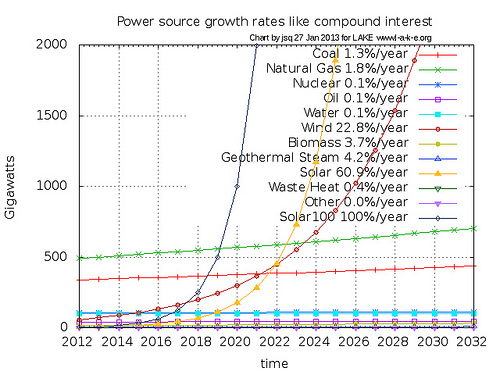
Power source growth rates like compound interest

What if instead of
projecting percentages
, we project gigawatts from
FERC’s December 2012 Installed Operating Generating Capacity table?
Solar and wind still win in less than a decade.


FERC 2012 power source gigawatts and growth rates projected 20 years

Ignore the fastest-growing curve for a moment; I added that.
All the other curves start with the December 2012 gigawatts
for each power source in the FERC table, and an annual compound
growth rate computed by comparing that installed operating capacity
to the capacity added in 2012 for that power source.
That compound annual growth rate for solar is 60.9% and for wind is 22.8%.
Nothing else comes close.

Solar passes coal in about 8 years, wind in about 9, and natural gas in
about

Continue reading

Georgia Power to announce 20-year plan Thursday

What will Georgia Power announce for a 20 year energy plan Thursday?
Will they (1) just double down on their rate-hike boondoggles for

nuclear
and

gas
,
or (2) they could flip like

Austin Energy in 2003
and

Cobb EMC in 2012

and suddenly go solar?
The wording here looks like it’s going to be the former.
That they even feel compelled to announce some sort of formal plan instead of just

shovelling disinformation out another 50 years

indicates they’re feeling

the pressure to change direction

to real sustainable energy: wind and solar power.

Matt Shedd wrote for WUGATV today,

Georgia Power To Release Energy Plan
,

Georgia Power is set to release a 20-year energy plan on Thursday


which will outline a way for the company and the state to be less
reliant on coal power. The AJC reports that just 5 years ago, the
company’s reliance on coal was at 70 percent.

That number has now dropped to 47 percent. These changes are coming
in the wake of Georgia Power’s parent, the Southern Co., being
pushed by environmental rules to rely less on coal. Georgia Power
won approval to buy electricity produced by natural gas from its
sister company Southern Power, which may be part of the company’s
future plans.

Thomas A. Fanning, CEO of Georgia Power’s parent The Southern Company (SO),
has been touting 70% to 35% reduction in coal since at least

May 2012 at the SO shareholder meeting.

Fanning continues to

emphasize nuclear, gas, and “clean coal”

instead of real sustainable energy, namely wind and solar power.
He also continues to assert electricity demand will increase,
while

ignoring conservation and efficiency,
which for Georgia
could remove all need for new energy,
enabling solar and wind to shut down more coal and gas plants,
as well as nukes.

So, get out the popcorn and take your bets.
Will it be (1) or will it be (2)?
I’m betting this time it will be (1), but sooner or later it will be (2),
and even Georgia Power, and yes, even Southern Company,
will stop digging in their heels and get on the solar
train to profits, jobs, energy independence, and oh, by the way, clean
air and plenty of clean water.

-jsq

Rooftop solar: the most direct route to clean energy industries


Austin vs. San Antonio in solar power

Around here I hear local leaders say “we’ll never be Austin.”
Well, Austin may be letting San Antonio pass Austin as far as rooftop solar
and the jobs that generates.
It’s not a matter of size or pre-existing advantages.
It’s a matter of political will.
Do we have that will here?

TexasVox
wrote a white paper in February 2012,

Solar Austin: Rooftop Solar & Job Creation,

…the most direct route to attracting and encouraging the
development of clean energy industries is through the


the scale of future development will be orders of
magnitude greater than what has occurred to date.

mass deployment of local rooftop solar, which is probably why solar has
by far the most significant presence of any clean energy generation
technology in Austin.

But the paper’s point is that Austin is falling short.
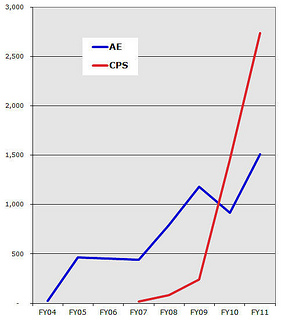
Look at the graph:
Austin seems to have settled for linear growth in solar power,
while San Antonio gets it about
compound growth.

As San Antonio Mayor Julian Castro
said in 2011, solar power is in

Continue reading

GA SB 51, The Georgia Cogeneration and Distributed Generation Act


Georgia Senator Buddy Carter
has introduced a Senate bill for the current
session of the legislature,

SB 51,
“The Georgia Cogeneration and Distributed Generation Act of 2001”.

It attempts to fix
Georgia’s special solar financing problem,
the antique 1973 Territorial Electric Service Act.

Why 2001?
Apparently Buddy Carter has been introducing it every year since then.
Last year

Georgia Power’s disinformation campaign

nuked it when it was

SB 401.

Has the legislature gotten tired of Georgia Power and its parent the Southern
Company being
way late and overbudget on those new nukes?

Does the legislature want Georgia citizens to get the savings and job
benefits of

the fastest growing energy source in the country?

Will
GaSU help
with SB 51, or only with GaSU’s attempt to become a solar
monopoly utility?
You can contact your legislators and tell them what you think.
Every one of them who

voted for Georgia Power’s stealth-tax rate hike for that nuke boondoggle

should vote for SB 51 to start getting Georgia on a clean path to jobs
and energy independence.

This bill is not perfect:
it counts

“generator fueled by biomass”

as

Continue reading

Solar energy growth like compound interest

Some nuclear backers only want to look at the
next table in that FERC report,

Office of Energy Projects
Energy Infrastructure Update
For December 2012
,
which shows solar energy as 0.34% of total U.S. energy production,
and then they stop thinking.
But what about

that 30% increase in solar power deployed
between 2011 and 2012?

Think of it like compound interest.

Total Installed Operating Generating Capacity
Installed Capacity (GW) % of Total Capacity % Growth 2011-2012
Coal 337.71 29.17% 1.3%
Natural Gas 491.82 42.48% 1.8%
Nuclear 107.01 9.24% 0.1%
Oil 41.32 3.57% 0.1%
Water 98.12 8.47% 0.1%
Wind 57.53 4.97% 22.8%
Biomass 15.00 1.30% 3.7%
Geothermal Steam 3.70 0.32% 4.2%
Solar 3.90 0.34% 60.9%
Waste Heat 0.69 0.06% 0.4%
Other 1.04 0.09% 0.0%
Total 1,157.86 100.00% 23.3%

Source: Data derived from Ventyx Global LLC, Velocity Suite.

Growth rates computed by jsq for LAKE www.l-a-k-e.org 24 January 2013.

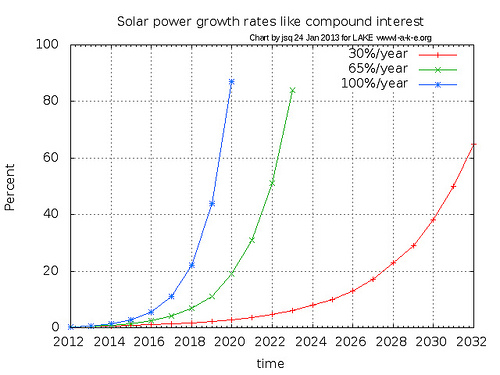
Let’s look what happens if we assume 30% growth in solar power deployed per year:


Solar power growth rates like compound interest

At 30% annual growth,
we’re up to solar as 50% of all generation
within

Continue reading

New U.S. energy in 2012 —FERC


What new energy sources are being deployed the fastest in the U.S.?
According to FERC, the Federal Energy Regulatory Commission,
it’s not what you may think.
The big winners are coal, wind, and solar.

According to the report

Office of Energy Projects
Energy Infrastructure Update
For December 2012
,
Coal, while accounting for only 17% of new capacity in 2012,
unfortunately increased by 133% over new capacity installed in 2011.
Natural gas did account for the second most new installed capacity in 2012,
33%, but the amount in megawatts installed actually decreased by 20%
from 2011.

The most new capacity installed in 2012?
Wind, at 40%, with a 56% increase over new installations in 2011.
That’s right, wind beat natural gas 40% to 33% in total new capacity in 2012,
and whomped gas in increase in new capacity in 2011, by 56% to -20%.

While solar only accounted for 5.59% of new capacity in 2012,
that was an increase of 30% over new capacity in 2011,
which is way more than gas and after only coal and wind.

New Generation In-Service (New Build and Expansion)
December 2012 January – December 2012 Cumulative January – December 2011 Cumulative Percent of Total New 2012 Percent Increase 2011- 2012
Primary Fuel Type No. of Units Installed Capacity (MW) No. of Units Installed Capacity (MW) No. of Units Installed Capacity (MW)
Coal 4 1,434 8 4,510 15 1,932 17.1% 133%
Natural Gas 6 2,306 94 8,746 108 11,020 33.1% -20.6%
Nuclear 0 0 1 125 0 0 0.474% -%
Oil 0 0 19 49 66 136 0.186% -64%
Water 2 4 13 99 41 94 0.375% 5.32%
Wind 45 3,095 164 10,689 146 6,844 40.5% 56.2%
Biomass 5 91 100 543 131 446 2.06% 21.7%
Geo- thermal Steam 2 9 13 149 9 56 0.565% 166%
Solar 16 77 240 1,476 354 1,131 5.59% 30.5%
Waste Heat 0 0 1 3 2 136 0.0114% -97.8%
Other 2 0 5 0 11 0 0% -%
Total 82 7,016 658 26,387 883 21,795 100% 21.1%

Source: Data derived from Ventyx Global LLC, Velocity Suite.

Last two columns added by jsq for LAKE www.l-a-k-e.org 24 January 2013.

Biomass unfortunately accounted for

Continue reading

Rural AIDS: poverty the cause, solar power part of the solution


Director Lisa Biagiotti
spent two years travelling around the South
interviewing people about AIDS to make a film,
deepsouth.
She found rural AIDS is a bigger and faster-growing problem
than AIDS in center cities,
yet most health and prevention funding goes to urban areas.
The root cause seemed clear to her: poverty.
Here’s some deeper dirt (literally) on rural poverty in the U.S.,
and one thing we know can help with that: distributed solar power,
for jobs, for reduced electrical bills, and for energy independence.
What politician wouldn’t want jobs for their constituents?

The director said the screening at

VSU at the end of November
drew more people than the
day before in Little Rock.
There were clearly more than 150 in the audience in Valdosta.
It’s a topic very relevant to here, as

Dean Poling wrote in the VDT 26 November 2012,

Organizers note that Georgia is ranked sixth highest nationally for
its cumulative number of AIDS cases reported through December 2009.
More than 40,000 known HIV/AIDS cases were reported in Georgia as of
2010.

The South Health District’s 10 counties, which include Lowndes and


surrounding counties, report 950 confirmed cases of HIV/AIDS, while
many more are likely infected and risk becoming sick because they
are not being treated. More specifically, there are about 460
reported cases in Lowndes County.

In reporting these numbers, HIV is the virus (HIV disease) and AIDS
is the medical diagnosis made by a doctor of the symptoms, according
to South Health District.

It’s a great movie and I highly recommend it.
Director Biagiotti spent a substantial amount of her own money and two years to make
this film, yet there are aspects she could only note in passing,
such as incarceration.
She can’t be expected to have researched every aspect;
maybe somebody else can step up and help follow more threads.

The movie starts with some maps about poverty and AIDS in the South.
It did not, however, look outside the South for poverty.
Here are better
poverty maps, from the CDC:
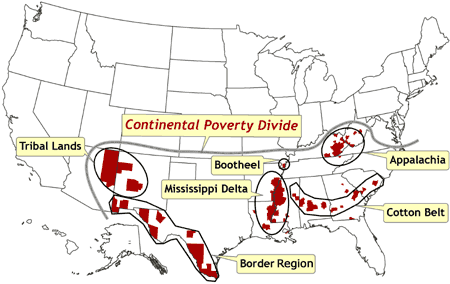

Continue reading

Shutdown at San Onofre: permanent this time?

California only has a couple of nuclear reactor locations (unlike the
32 reactors within 500 miles of here),
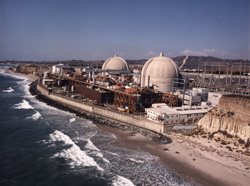
and one is in even worse shape than the other: San Onofre,
almost as bad as
Crystal River.
I’m sure Southern Company would never cut corners or have
design or

construction problems
at Plant Vogtle, right?

Harvey Wasserman wrote for AlterNet 7 January 2013,

Showdown at San Onofre: Why the Nuclear Industry May Be Dealt a Big Blow
,

Perched on an ocean cliff between Los Angeles and San Diego, the


reactors’ owners cut unconscionable corners in replacing their
multi-million-dollar steam generators. According to Russell Hoffman,
one of California’s leading experts on San Onofre, inferior metals
and major design failures turned what was meant to be an upgrade
into an utter fiasco.

Installed by Mitsubishi, the generators simply did not work. When
they were shut nearly a year ago, tubes were leaking, banging
together and overall rendering further operations impossible.

Southern California Edison and San Diego Gas & Electric have
unofficially thrown in the towel on Unit 3. But they’re lobbying
hard to get at least Unit 2 back up and running. Their technical
problems are so serious that they’ve asked the Nuclear Regulatory
Commission to let them run Unit 2 at 70% capacity. In essence, they
want to “see what happens” without daring to take the
reactor to full power.

The NRC has expressed serious doubts. On December 26 it demanded
answers to more than 30 questions about the plant’s technical realities.
There have been assertions that unless San Onofre can be shown as operable
at full power, its license should be negated.

It’s good the NRC got around to doing something, after

Continue reading

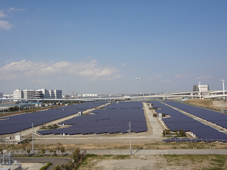
2 gigawatts of Wind Power off Fukushima, plus solar


Southern Company didn’t

do the renewable energy study for Georgia

when Mark Z. Jacobson’s study showed

All U.S. east coast electricity could come from offshore wind 3 seasons out of 4
.
Now somebody else has, including how to build offshore wind turbines
to withstand hurricanes.

Rob Gilhooly wrote for New Scientist 16 January 2013,

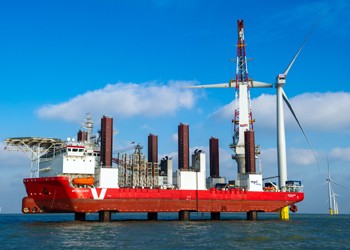
Japan to build world’s largest offshore wind farm
,

The wind farm, which will generate 1 gigawatt of power once
completed, is part of a national plan to increase renewable energy


resources following the post-tsunami shutdown of the nation’s 54
nuclear reactors. Only two have since come back online.

The project is part of Fukushima’s plan to become completely energy
self-sufficient by 2040, using renewable sources alone. The
prefecture is also set to build the country’s biggest

solar park.


The wind farm will surpass the 504 megawatts generated by the 140
turbines at the Greater Gabbard farm off the coast of Suffolk, UK
— currently the world’s largest farm. This accolade will soon
pass to the London Array in the Thames Estuary, where 175 turbines
will produce 630 megawatts of power when it comes online later this
year. The Fukushima farm will beat this, too.

How will these wind turbines work?

Continue reading

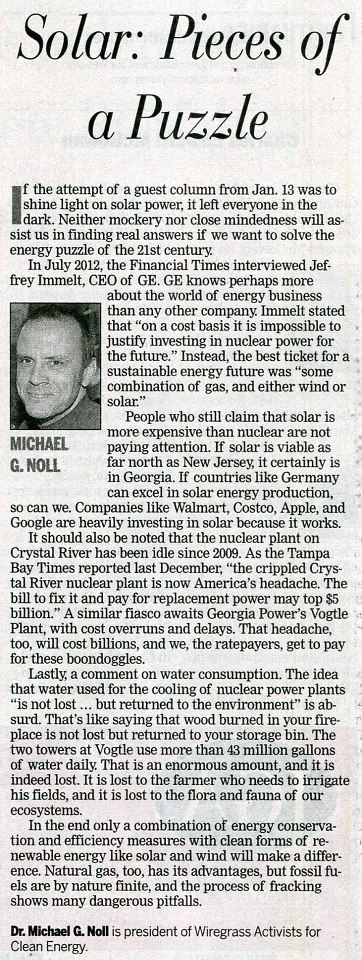
Solar: Pieces of a Puzzle —Dr. Michael G. Noll

Op-ed in the VDT today, responding to

a response

to

my op-ed.
-jsq


If the attempt of

a guest column from Jan 13
was to shine light on solar power,
it left everyone in the dark.
Neither mockery nor close mindedness will assist us in finding real answers
if we want to solve

the energy puzzle of the 21st century.


In July 2012, the Financial Times interviewed Jeffrey Immelt, CEO of GE.

GE knows perhaps more about the world of energy business than any other company.
Immelt stated that

“on a cost basis it is impossible to justfy investing in nuclar power for the future.”

People who sitll claim that solar is more expensive
than nuclear are not paying attention.
If solar is viable as far north as

New Jersey
, it certainly is in Georgia.
If countries like

Germany
can excel in solar energy production,
so can we.
Companies like Walmart, Costco, Apple, and

Google

are havily investing in solar because it works.

It should also be noted that the nuclear plant on

Crystal River has been idle since 2009.

As

the Tampa Bay Times reported last December,

Continue reading