Category Archives: Community

Community Calendar —Jane F. Osborn 22 November 2011


The latest update (22 November 2011) is online for the

community calendar

produced by

Jane F. Osborn

who organizes the

Valdosta Civic Roundtable
.
She wrote:

…the calendar is not
produced for civic roundtable, it is just a project of mine for the many
counties that lost a source of information when 2-1-1 was discontinued.

LAKE will attempt to remember to update new ones in

this web page

as Miss Jane sends them.
We hope you, dear readers, will remind us if we don’t.

-jsq

CUNY’s idea of a public meeting

City University of New York’s trustees were holding a public meeting,
and some of the public, namely CUNY students, attempted to attend.
CUNY police and NYPD staged a welcome for them:


Carlos Pazmino, 21, a City College student who helped organize
the protest, said that after students began opening doors to the
auditorium where the CUNY trustees were to hold a public hearing at 5
p.m., CUNY police officers surrounded the entrances and pushed back,
using their batons, and that when students formed a line to push past,
the officers began hitting the students with the batons.

“I saw two people knocked down by cops,” Mr. Pazmino said.
“They were arrested and one guy’s head was bleeding.”

That’s in a NYTimes story by Alice Speri and Anna M. Phillips,

CUNY Students Protesting Tuition Increase Clash With Police
.
Interesting title considering that the content says that the public
went to a public meeting and were violently attacked by police.

And that’s the cleaned up version:

Continue reading

Baltimore’s place-based model

Growth isn’t everything, and vacant lots can be leveraged to deal with
food disparity and obesity, Baltimore is demonstrating.

Vanessa Barrington wrote for Grist 21 November 2011,

Baltimore’s can-do approach to food justice


…43 percent of the
residents in the city’s predominantly black neighborhoods had little
access to healthy foods, compared to 4 percent in predominantly white
neighborhoods. Meanwhile, more than two-thirds of the city’s adults and
almost 40 percent of high school students are overweight or obese.

That’s the problem.

There are solutions:

Speaking on a panel at the recent Community Food Security Coalition
Conference in Oakland, Calif., Abby Cocke, of Baltimore’s Office of
Sustainability, and Laura Fox, of the city health department’s Virtual
Supermarket Program, outlined two approaches to address the city’s food
deserts. Both were presenting programs that have launched since Grist
last reported on Baltimore’s efforts to address food justice. And both
programs come under the auspices of The Baltimore Food Policy Initiative,
a rare intergovernmental collaboration between the city’s Department of
Planning, Office of Sustainability, and Health Department. They also
show how an active, involved city government and a willingness to try
new ideas can change the urban food landscape for the better.

According to Cocke, Baltimore’s Planning Department has a new mindset. She
calls it a “place-based” model. “In the past,” she says, “growth was seen
as the only way to improve the city, but we’re starting to look at ways
to make our neighborhoods stronger, healthier, and more vibrant places
at the low density that they’re at now.”

The article outlines the specific solutions,
such as:

Continue reading

Militarization of Police and Private Prison Profiteering: the Connection

Occupy UC Davis and the UC Davis Police have suddenly turned militarization
of police from an obscure topic to a huge story with more than 3,000
stories found by google news.
But what’s the connection between
Mic check stops a police riot at UC Davis

and

CCA charges inmates five days’ pay for one telephone minute
?
The main cause of the militarization of police
is also the main cause of the huge U.S. prison population (5% of the world’s
population,
25% of the world’s prisoners:
USA #1!).
That cause is the failed War on Drugs.

Norm Stanager wrote for YES! Magazine (via AlterNet) 17 November 2011,

Police Chief Who Oversaw 1999 WTO Crackdown Says Paramilitary Policing Is a Disaster


Then came day two. Early in the morning, large contingents of
demonstrators began to converge at a key downtown intersection. They sat
down and refused to budge. Their numbers grew. A labor march would soon
add additional thousands to the mix.

“We have to clear the intersection,” said the field commander. “We
have to clear the intersection,” the operations commander agreed,
from his bunker in the Public Safety Building. Standing alone on the
edge of the crowd, I, the chief of police, said to myself, “We have
to clear the intersection.”

Why?

Because of all the what-ifs. What if a fire breaks out in the Sheraton
across the street? What if a woman goes into labor on the seventeenth
floor of the hotel? What if a heart patient goes into cardiac arrest in
the high-rise on the corner? What if there’s a stabbing, a shooting,
a serious-injury traffic accident? How would an aid car, fire engine or
police cruiser get through that sea of people? The cop in me supported
the decision to clear the intersection. But the chief in me should have
vetoed it. And he certainly should have forbidden the indiscriminate
use of tear gas to accomplish it, no matter how many warnings we barked
through the bullhorn.

My support for a militaristic solution caused all hell to break
loose. Rocks, bottles and newspaper racks went flying. Windows were
smashed, stores were looted, fires lighted; and more gas filled the
streets, with some cops clearly overreacting, escalating and prolonging
the conflict. The “Battle in Seattle,” as the WTO protests and their
aftermath came to be known, was a huge setback—for the protesters,
my cops, the community.

Did anybody consider informing the protesters of the issues and asking
for cooperation,
or checking to see if there were alternate routes for emergency vehicles,
or….
Hey, I’m not a professional emergency responder, but surely there
must be a plan B in case some major intersection is out of commission
due to a water main blowout, natural gas leak, earthquake, or whatever.

This article was published a few days before the UC Davis pepper spray events,
but the author explicitly cites what happened to Scott Olsen in Oakland
and the arrests in Atlanta, saying those are continuations of the same
problems he experience in Seattle in 1999.

Then he gets into why:

Continue reading

Plymouth Rock n Ride, Sunday 20 November —Matt Portwood

Received today. -jsq


John,

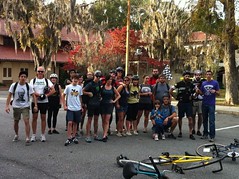
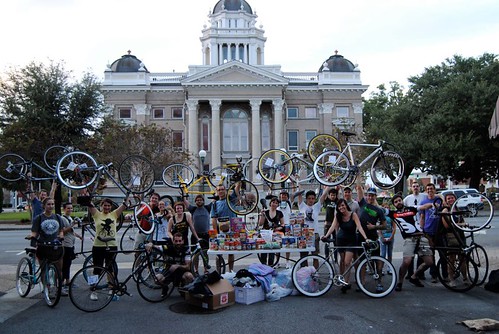
A group of local cyclists collected over 60 food items and over 200
clothing items while riding in the Plymouth Rock-n-Ride Charity Bicycle
Ride on Sunday November 20th. The cyclists rode to various checkpoints
throughout Valdosta featuring different challenges to be completed. The
group also visited grocery store checkpoints to buy a variety of food


items for a local charity. The riders then delivered the food and
clothing donations to the Saint Francis Center Ministry Outreach
program on Mary Street. Prizes from local sponsors (Red Door Records,
Western Auto, Valdosta Bike Center and Salem Records) were awarded to
the 1st, 2nd,
9th, and 13th
place finishers in the ride.


Matt


Mic check stops a police riot at UC Davis


By now you’ve probably seen the video of UC Davis police pepper spraying peaceful protesters who were simply sitting on the gorund.
But have you seen what happened next?
Police were forming up with weapons raised surrounded on three sides by protesters, when someone yelled “Mic check!”
Follow

this link
.
Or, if you want to see it starting with the pepper spraying:

The one with the two pepper spray cans appears to be the same police
lieutenant who pepper sprayed the protesters.
As the protesters say through the human microphone that they are
willing to let the police just walk away, even after the police
had assaulted them with pepper spray,
that same lieutenant motions to the police, who lower their weapons
and back away.

Here’s

the police version of the incident:

Continue reading

Occupy Valdosta General Assembly today


Noon until 3PM today, in Drexel Park, Valdosta, Lowndes County, Georgia,
Occupy Valdosta will be having a General Assembly.
This is the slow, messy, talkative, oddly organized, flashy-fingered
decision-making forum descended from the direct democracy of ancient Athens.
The General Assembly method is

why Occupy Wall Street is two months old

instead of being a one-shot one-day march.

Occupy Atlanta has published a

General Assembly Guide
which includes this
Occupy Atlanta Pledge and Guidelines
derived from Occupy Wall Street:

Continue reading

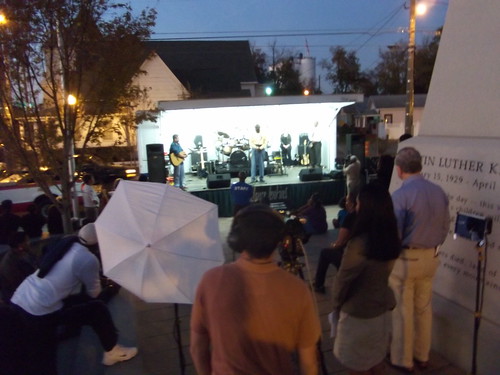
FVCS Final Meeting 15 November 2011

Former electoral opponents met Tuesday as FVCS held

its final meeting,

with Rusty Griffin, Vice-Chair of CUEE,
watching at the MLK Monument as
Sam Allen, President of Friends of
Valdosta Schools (FVCS) announced the dissolution of FVCS.


Sam Allen,

as he has before,

called for

reconciliation of opponents
on the recent school consolidation referendum,


and support of the two school systems,
financially and otherwise.

In addition to FVCS regulars such as JC Cunningham,
Chamber Chair Tom Gooding was there,
as were current Valdosta Mayor Sonny Vickers and
Mayor-Elect John Gayle, plus re-elected Valdosta City Council At-Large Ben Norton.
Valdosta School Superintendent Cason was there.
I didn’t see Lowndes Superintendent Smith,
although various members of

Continue reading

No Private Prison Petition

Most people I talk to about the proposed private prison in Lowndes County Georgia


have never heard of it,
and many of them want to know where they can find out more.
Linked from

the front page of the LAKE website

is

the letter to the Industrial Authority
people are signing,
which in turn has links to

an online petition

and

a large amount of background material.

Feel free to use any of this as pointers to research for writing your own
letter, of course.

We don’t need a private prison in Lowndes County, Georgia.
Spend those tax dollars on rehabilitation and education instead.

-jsq

57 year overdue house cleaning —Barbara Stratton

Received today on

Repealing the 1928 GA School Consolidation Law
. -jsq

The 1926 statute that needs to be removed is

OCGA 20-2-370.
The


1983 constitutional law

had priority of law precedence over the older statute &
CUEE was advised before they asked for signatures it could be protested
on those grounds before or after the vote. Thankfully we did not have to
go that route. I remember in high school I did a project on outdated laws
still in the GA Constitution including mandatory hanging for horse theft
(which I liked). There was also a law if you hit & killed a cow or pig
on the road you were required to get out & slit the throat so the owner
could salvage the meat & many others that were outdated & no longer
enforced. I trust these have now been removed. The general assembly
should be thankful that we are addressing this 57 year overdue need for
house cleaning & remedy this in January. Rule of Law should never remain
questionable when it is the duty of our lawmakers to provide clarity.

-Barbara Stratton

According to Justia.com:


2010 Georgia Code

TITLE 20 – EDUCATION

CHAPTER 2 – ELEMENTARY AND SECONDARY EDUCATION

ARTICLE 8 – CONSOLIDATION OF INDEPENDENT AND COUNTY SCHOOL SYSTEMS

ยง 20-2-370 – Referendum on repeal of special school law and consolidation of systems


O.C.G.A. 20-2-370 (2010)

20-2-370. Referendum on repeal of special school law and consolidation of systems

Whenever the citizens of a municipality or independent school district
authorized by law to establish and maintain a system of schools by local
taxation in whole or in part are operating a system of public schools
independent of the county school system and wish to annul their special
school law and become a part of the county school system, they shall
present and file with the governing authority of the city a petition
signed by one-fourth of the qualified voters of their territory; and the
governing authority shall then submit the question at an election to
be held in accordance with Chapter 2 of Title 21. A majority of those
voting shall be necessary to carry the election. Only qualified voters
residing within the municipality or district for six months prior to
the election shall vote. An election shall not be held for the same
purpose more often than every 12 months.

Disclaimer: These codes may not be the most recent version. Georgia
may have more current or accurate information. We make no warranties
or guarantees about the accuracy, completeness, or adequacy of the
information contained on this site or the information linked to on the
state site. Please check official sources.