At
yesterday’s wind rally on Tybee Island,
one spoke about
passing the Production Tax Credit
for
wind jobs in Georgia.
More pictures and videos in the
GA Sierra Club flickr set.
-jsq
PS: Owed to Seth Gunning.
At
yesterday’s wind rally on Tybee Island,
one spoke about
passing the Production Tax Credit
for
wind jobs in Georgia.
More pictures and videos in the
GA Sierra Club flickr set.
-jsq
PS: Owed to Seth Gunning.
What to do if you can’t interest Georgia Power in building solar?
Do it yourself, and do enough so you can be a utility yourself.
That’s the loophole in the 1973
Electric Territorial Act
that FPL and JEA use to burn coal at Plant Scherer in Georgia and export the power to Florida.
Now Georgia Solar Utilities Inc. is using the loophole for a better purpose:
building almost twice as much solar generation
as Georgia Power’s meager 50 MW.

Dave Williams wrote for the Atlanta Business Chronicle yesterday
New Georgia utility pitches solar plant:
A new utility is planning to build a $320 million solar power plant on 2,200 acres adjacent to Georgia Power Co’s coal-burning Plant Branch near Milledgeville, Ga.
Georgia Solar Utilities Inc. initially approached Georgia Power, a
unit of Southern Co. (NYSE: SO), with a proposal to build the plant
and sell it to Georgia Power through a power-purchasing agreement.Georgia Power is retiring two coal-fired units at Plant Branch, part
of a move to reduce the Atlanta-based utility’s reliance on coal.But when Georgia Power officials declined to take part in the
project last May, Georgia Solar Utilities executives decided to
build the plant on their own and operate it as a new utility
independent of Georgia Power.Once cost prohibitive, solar energy has become competitive with
fossil fuels because of the rising costs of coal and tighter
government regulation of coal emissions, said Robert Green, founder
of Georgia Solar Utilities.“When you don’t have to buy coal or worry about environmental
hangovers, it overwhelms the costs of fossil fuels, Green said
Thursday after presenting the proposal to the Georgia Public Service
Commission’s Energy Committee.
Some say the PSC can’t approve such a utility because of that 1973 law.
I suspect that if they don’t approve this proposal, the next one
will be even harder to turn down, and the next one,
as they become even more competitive.
How competitive?
This morning WTOC interviewed Paul Wolff, Tybee City Council, and
Karen Grainey, Coastal Chapter, Georgia Sierra Club,
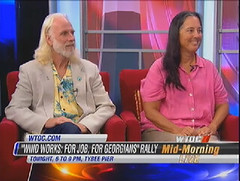
about
Wind Works: for Jobs, for Georgians, 6-9 PM tonight 31 August 2012 Tybee Pier.
Paul Wolff said we have a potential for 14.5 gigawatts off the Georgia coast,
without interfering with shipping lanes or the ocean ecology.
He noted big wind turbines need everything down to ball bearings,
much of which can be (and some already is) produced in Georgia.
LAKE blog readers know Paul Wolff
as somebody who has put his money where his mouth is, with
solar on his roof.
Here’s
the video.
Also
PR from SACE
and
a facebook event.
WTOC-TV: Savannah, Beaufort, SC, News, Weather
-jsq
PS: Owed to Seth Gunning.
-jsq
Phase 2 after
South GA Solar Power, LLC remediated the historic Wisenbaker Building
is solar generation, according to Ron Jackson.
We wanted to … remediate some of the problems first to reduce the load,
to reduce the energy consumption.
Once we’ve done that, phase 2 kicks in, which is the solar power application.
If we’d done that first, we probably would have put on a 20KW system
to handle this load.
But because we’ve done the phase 1 project and reduced the energy load,
now we only need an 8-10 KW system,
so the prices have been reduced.
Next year hopefully it will be a fully green, fully functioned
solar power application.Right in downtown Valdosta!
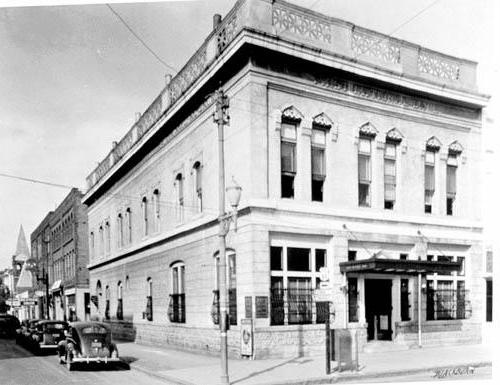
The
historic Wisenbaker Building,
100 North Patterson Street, is at the corner of West Hill Avenue.
It was
purchased by Gino Fina in 2006,
and is now used as
Valdosta Shared Office Space.
Here’s
the video.
Phase 2 Solar Power for the Wisenbaker Building –Ron Jackson
Pictures and video by John S. Quarterman for Lowndes Area Knowledge Exchange (LAKE), Valdosta, Lowndes County, Georgia, 5 May 2012.
-jsq
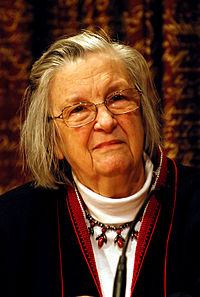
On the day she died, Nobel Prize-winning economist Elinor
Ostrom published
her last article, in Project Syndicate, 12 June 2012,
Green from the Grassroots,
This grassroots diversity in “green policymaking” makes
economic sense. “Sustainable cities” attract the
creative, educated people who want to live in a pollution-free,
modern urban environment that suits their lifestyles. This is where
future growth lies. Like upgrading a mobile phone, when people see
the benefits, they will discard old models in a flash.Of course, true sustainability goes further than pollution control.
City planners must look beyond municipal limits and analyze flows of
resources —
energy,
food,
water, and
people —
into and
out of their cities.Worldwide, we are seeing a heterogeneous collection of cities
interacting in a way that could have far-reaching influence on how
Earth's entire life-support system evolves. These cities are
learning from one another, building on good ideas and jettisoning
poorer ones. Los Angeles took decades to implement pollution
controls, but other cities, like Beijing, converted rapidly when
they saw the benefits. In the coming decades, we may see a global
system of interconnected sustainable cities emerging. If successful,
everyone will want to join the club.

And counties, and regions, and watersheds, of course.
As Mayor Julian Castro of San Antonio said, there is a
"nexus between sustainability and job creation."
We don't have to wait for San Antonio or Los Angeles or Beijing or
Atlanta to lead the way:
we can get on with it right here where we are.
-jsq
The sinkholes are not just in
Michael McCormick’s garage.
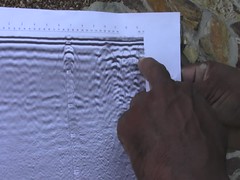
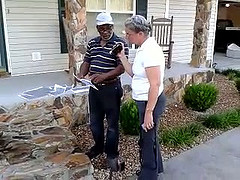
According to groundscan radar by a VSU professor and students,
the sinkholes are also
spreading
under his
front steps and
his house.
The steps are sinking and there’s
a crack on the wall inside the house.
Received yesterday on
WCTV on biomass site VLCIA v. Sterling Planet. -jsq
Wiregrass Activists for Clean Energy (WACE) have made it clear from
the start that biomass plants have a number of issues: 1) biomass
plants bear significant health risks; 2) biomass plants waste
enormous amounts of water; 3) biomass plants are risky investments
in an increasingly competitive energy sector; and 4) biomass plants
contribute to global warming.In the light of rising global temperatures, worsening drought
conditions, and dropping prices for solar panels, an increasing
number of people are understanding these simple truths.The Industrial Authority has to be congratulated for the courage to
admit that energy from biomass plants is indeed more expensive than
energy from solar plants, and we have not even figured in the costs
associated with the consequences of air pollution coming from
biomass plants.(For more information on biomass plants, here a testimony I recently
gave:
http://www.bredl.org/pdf3/120828_WACE-Comments-Docket_NO-E-100_SUB113.pdf)Although this point has already been made earlier, note again that
solar plants are much better alternatives, economically and
environmentally: they do not pollute our air, they do not need any
water, and a huge spill of solar energy is simply called a sunny day
… of which we have plenty here in the south.-Michael G. Noll
-jsq
Ron Jackson told LAKE about
how South GA Solar Power, LLC remediated the historic Wisenbaker Building
in downtown Valdosta for
increased air flow and reduced energy consumption.
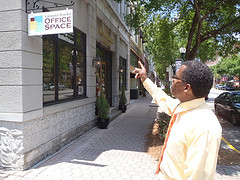
Valdosta Shared Office Space, Downtown Valdosta,
is in the Wisenbaker Building, built in 1884:
the owner hired South GA Solar Power, LLC as an engineer consultant
to bring down the energy this building was using.
Ron Jackson says they examined air flow, average load,
and other factors,
bringing $12,000/year electric bill down to $3,000,
120 amps/day down to 17 amps/day.
“Consider us as your next consultant for your green energy product.”
Here’s
the video.
Picture and video by John S. Quarterman for Lowndes Area Knowledge Exchange (LAKE), Valdosta, Lowndes County, Georgia, 5 May 2012.
Tomorrow: Phase 2.
-jsq
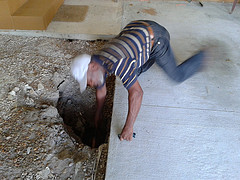
In what the County Planner calls “central Lowndes County” there’s
a sinkhole in a garage,
deeper than a hoe handle.
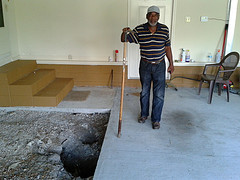
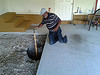
Michael McCormick called me up yesterday and told me about this
sinkhole in his garage at 4326 Norman Hall Road.
Naturally he’s a bit concerned about this problem.
He thinks his insurance may cover it, but he’s looking for other
options in case.
So far, nobody seems to know what to do.
Which can’t be the case:
this isn’t the first sinkhole in Lowndes County.
We’re helping get the word out to help find whoever does know more about
sinkholes and what resources are available to deal with them.
It’s not only straight down and under the carport concrete.
At Cinco de Mayo,
Ron Jackson explained a self-contained solar attic fan
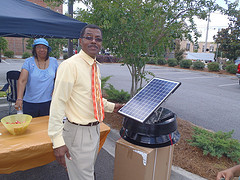
sold by
South GA Solar Power, LLC.
He was assisted by mechanical engineer Danielle, and isn’t that Business Manager Sharon Jackson?
It’s actually an exhaust fan powered by the sun.
What it does is it simply takes the hot air,
125-150° heat, exhausts it out
down to 90°, which
makes the house cooler, which makes the air conditioner stop running.
Which makes the electric bill reduce, go down, 50%.
My bill was $345 a month now it’s $120 a month.
By a simple application!
If you need any more information, call
Ron Jackson at South GA Solar Power, LLC.
Self-contained solar attic fan
Pictures and video by John S. Quarterman for Lowndes Area Knowledge Exchange (LAKE), Valdosta, Lowndes County, Georgia, 5 May 2012.
-jsq