Tag Archives: History

Solar cars and charging stations: who wouldn’t?

Tired of Southern Company CEO Fanning’s

maybe “next decade”
for solar power?


Tired of Georgia Power’s Bowers

trying to push solar off for fifty years?

Let’s hear from somebody who takes on big tasks and gets them done:
Elon Musk, who’s already built a rocket that is resupplying the International
Space Station, and who is also building all-electric cars.

Carl Hoffman wrote for Smithsonian magazine December 2012,

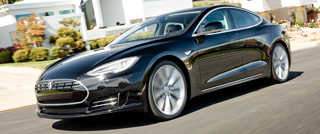
Elon Musk, the Rocket Man With a Sweet Ride

When he’s not launching rockets, Musk is disrupting the notoriously
obdurate automobile industry (see National Treasure, p. 42). While
industry giants like Chevrolet and Nissan and Toyota were dithering
with electric-gasoline hybrids, this upstart kid said he would
design and manufacture an all-electric car that would travel
hundreds of miles on a single charge. The Tesla Roadster hit the
streets in 2008 with a range of 200 miles, and the far more


functional Model S, starting at $57,000, was introduced in June.
It’s the world’s first all-electric car that does everything my old
gasoline version does, only better. The high-end model travels 300
miles on a single charge, leaps from zero to 60 in 5.5 seconds,
slows from 60 to a dead stop in 105 feet, can seat up to five, has
room for mulch bags and golf clubs, handles like a race car and its
battery comes with an eight-year, 100,000-mile warranty. If you
charged it via solar panels, it would run off the sun. One hundred a
week are being produced in a former Toyota factory in Fremont,
California, and nearly 13,000 people have put deposits on them….
And since that story:


Continue reading

2012 solar deployments driven by Moore’s Law price reductions


Moore's Law in solar Watts/$100


Moore’s Law for solar
is about decreasing price per Watt,
or more Watts per dollar.
Here’s an example of a common confusion, to think it’s about efficiency:

“The curve will obviously become asymptotic at some point, ie,. the rate
of improvement will flatten out, so we end up with a sort of squashed
“S” shape curve, because you can’t get more than 100% efficiency —
36 watts/m2 or so.”

And indeed efficiency probably will flatten out soon.
But it’s not solar
efficiency that’s improving by Moore’s Law: it’s price per watt.
That can keep improving for a long time.

Here’s an example of decreasing price.
Scott Detrow wrote for NPR 23 December 2012,

Forget Fracking: 2012 Was A Powerful Year For Renewables
,


Rhone Resch

“Just to give you perspective,” Resh said, “in Washington, D.C.,
where I live, when I installed solar on my house six years ago, the
average install cost was about $14 a watt. Today it’s about $4 a
watt.”

Here’s another comparison, this one just for solar panels.

KC 170 solar panels, purchased 2005

In 2005 the first set of solar panels we got cost $670 each
and produced 170 Watts DC each, or $4.94/Watt.
In 2011 our second set of solar panels cost $562 each
for 235 Watts DC each, or $2.39/Watt.
That’s more than 50% price decrease for solar panels in six years.
(I can’t compare inverters or support structures directly,
because those were sized so differently, but those have also
come down in price, helping lower the overall install cost).

Year price /Watt price /panel Watts /panel Dimens. square inches Watts /100 sq in. Model
2005 $4.94 $670 170W 50×39″ 1950 8.7 KC 170
2011 $2.39 $562 235W 39.1×64.6″ 2525 9.3 Sharp ND 235 QCJ
2012 $1.32 $310 235W 39.1×64.6″ 2525 9.3 Sharp ND 235 QCJ

Meanwhile, the Watts per surface area hardly changed, from about

Continue reading

Waste offer letter: take it or….

Unsigned trash letter from Lowndes County
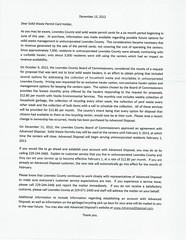
I received the appended unsigned letter from Lowndes County
recently,
which says the
5,000 residents of the unincorporated parts that currently use the
county’s waste disposal sites can sign up with Advanced Disposal
(of New York City) for curbside pickup or…. There is no or. So
look forward to trash dumping long roadsides, in parking lots in
town, and on your property. And neither outgoing County Chairman
Ashley Paulk nor County Manager Joe Pritchard even had the courtesy
to sign the letter.

After noting that back in June the county changed waste permit
cards from 12 months to 6 months, the letter says:

At purchase, information was made available regarding
possible future options for solid waste management in
unincorporated Lowndes County.

So the county is backing off from claiming card buyers got a
letter spelling out options. I got no such letter with card
purchase.

This consideration became necessary due to revenue
generated by the sale of the permit cards, not covering the cost of
operating the centers.


And that’s all the accounting we get. Where is the summary of
expenses for the centers compared to revenue? The VDT reported from
the Commissioners’ stealth retreat back in April:

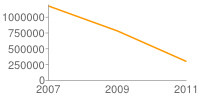
“In total, the county is currently spending $782,058.34
each year for solid waste disposal, a reduction from $1,176,207.75
in 2007.”

As I pointed out then, “So that’s a rapid reduction in cost to
less than a third of what it used to be, and less than half of what
it was only a year ago.” Later Joe Pritchard said those numbers
didn’t include everything being spent. So what was actually being
spent? We the taxpayers and we the card payers don’t know. After

a long series of meetings to which the public was either not
invited at all or was not invited to provide input
, at its last
meeting of the year (exactly as I predicted),

Commissioners approved changes to the solid waste ordinance
eliminating the collection sites
and

granted a monopoly to Advanced Disposal Services
of

New York City.

Former Chairman Ashley Paulk

recently complained Moody AFB had become “privatized”.
Yet at
his last Commission meeting he presided over privatizing the
county’s public service of solid waste collection.

Three new Commissioners were just sworn in yesterday, including
a new chair. The new Commission in the new year is not, so far as I
know, bound by the decisions of any previous Commission. It could
undo the damage the old one just did. Or it could, like the old
one, ignore concerns of

public health, safety, and the environment
that

the state requires them to implement,
plus concerns of

local waste collection businesses,
of local residents

about recycling
and

about the lack of any other option than curbside;
will the new
Commission continue to kick 5,000 county residents towards curbside
collection or tossing their trash in the your yard?

Unsigned trash letter from Lowndes County:

Continue reading

Industrial Authority working for solar in south Georgia @ VLCIA 2012-12-18

The

Industrial Authority

is working to find locations for some of the
210 MW Georgia Power got the PSC to shift
from biomass to solar
back in September.
That’s a good next step.

Jason Schaefer wrote for the VDT 23 Dec 2012,

Solar power push has Authority working to establish connections
,

Since the Georgia Public Service Commission (PSC) approved Georgia

Allan Ricketts, Projects and Existing Industry Manager, VLCIA, 2012-12-18

Power Company’s plan Nov. 20 to add 210 megawatts of solar power to
its electrical grid, the Valdosta-Lowndes County Industrial
Authority has been devising strategies to draw solar energy
producers to South Georgia.

Georgia Power will issue a Request for Proposals (RFP) from solar
energy collection and production companies in early 2013, according
to the PSC, and the company will contract with the lowest bidders to
purchase their energy and place it on the Georgia Power electrical
grid for public consumption.

Georgia Power plans to add 90 megawatts to its grid from distributed
generation (small companies producing between 100 kilowatts and 1
megawatt), and 120 megawatts of large utility-scale projects
producing up to 20 megawatts each. The company plans to price the
solar energy at $0.13 per kWh for distributed generation and up to
$0.12 per kWh for utility-scale projects, according to the PSC.

This government-approved commercial push for solar energy could be a
boon to sunny South Georgia as well as the greater Valdosta area
specifically, and the Authority is prepared to accommodate the solar
energy producers they expect.


Andrew Schruijer, Executive Director, VLCIA, 2012-12-18

“I think there’s a very good possibility of solar energy
coming to South Georgia,” Executive Director Andrea Schruijer
said. “Possibly in the near future.”

There’s more in the VDT story.
It’s pretty much what
Col. Ricketts also told me after the VLCIA meeting Tuesday a week ago.
He asked me if I knew what “distributed” meant.
I pointed out Georgia Power’s version of distributed was actually not
very distributed, compared to

Continue reading

What is Moore’s Law for solar power?

Many people are unfamiliar with Moore’s Law, and

how it affects solar power.

Moore’s Law doesn’t occur
in many technologies or industries,
but it’s there in solar photovoltaic (PV).
For those of us whose whole working lives have been
affected by Moore’s Law, seeing it turn up in another field
is like a flashing neon sign pointing to the future.
A future of distributed solar power sunrise
over the crumbling industrial relics of coal, nuclear, and natural gas plants.
A future with much less control by monopoly utilities,
which is why they fight it.
If they even see it coming; Bill Gates didn’t, back in the day,
but Jeff Bezos of Amazon did.
They both surfed that tide,
and Moore’s Law made both of them among the richest humans on the planet
while changing the world for all of us.
Steve Jobs even used it to put a computer in your pocket
more powerful than big companies could buy a few decades ago.
What does Moore’s Law for solar power mean for electric power?

This chart shows the telltale symptom of Moore’s Law in solar electricity:
65% compound annual growth rate in solar power plants
deployed for the past 5 years:


Source:
Solar Power Graphs to Make You Smile

by Zachary Shahan for CleanTechnica 10 June 2011.

As SunPower’s Dinwoodie puts it:

That 17 GW installed in 2010 is the equivalent of 17 nuclear power
plants — manufactured, shipped and installed in one year. It
can take decades just to install a nuclear plant. Think about that.
I heard Bill Gates recently call solar “cute.” Well,
that’s 17 GW of “cute” adding up at an astonishing pace.


Bill Gates should recall that Moore’s Law made formerly “cute” PCs with his
“cute” operating system Windows expand into every company in the world
and made him the second richest human on the planet.
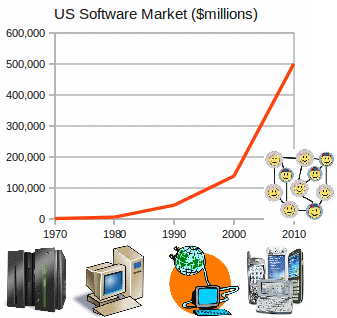
Growth of computer software markets,

like for the U.S. as shown in the graph on the right,

is a symptom of the original Moore’s Law.
Software runs on hardware, and these hardware market curves
are driven more directly by Moore’s Law:

Continue reading

Bainbridge beats Valdosta!


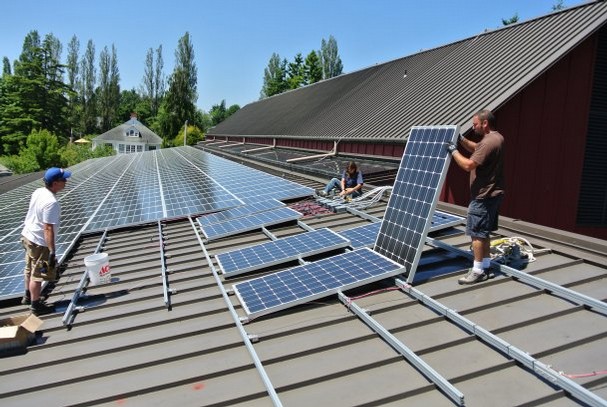
Bainbridge City Hall now hums with solar energy
,
Tristan Baurick wrote for Kitsap Sun 2 August 2012:


City Hall’s array of 297 rooftop solar panels is expected to produce
the equivalent of 20 percent of the building’s energy needs,
according to Joe Deets, executive director of Community Energy
Solutions, the Bainbridge nonprofit group that spearheaded the
privately-funded project.

“This is a great day for Bainbridge,” Deets said.

How many solar panels do you see on Valdosta City Hall?
Well, that’s a historic building.
But how about City Hall Annex?
The parking lot?
The

formerly “100% Paid by SPLOST” Lowndes County palace that
we’re now paying almost $9 million in bonds for?

Nope, not a solar panel in sight.

Oh, sorry, that’s

Continue reading

First ALEC, now Heartland Institute: losing sponsors

Heartland Institute, one of only two organizations to field a speaker

for
continuing Plant Vogtle delays and cost overruns

at this week's GA PSC hearing,
has been dropped by every pharmaceutical company.
When you're down to Heartland Institute and

renewable-energy-opposing

and

astroturf-funding
super-lobby group ALEC,
itself
rapidly losing members
(so bad
even Bank of America has dumped ALEC);
and when your public hearing speakers are 40 to 1 against continuing
with Southern Company and Georgia Power's nuclear boondoggle,
maybe it's time to end it.

Brad Johnson wrote for thinkprogress 19 December 2012,

Heeding Public Outrage, Pfizer Drops Climate Denial And Tobacco Front Group Heartland Institute
,

The pharmaceutical giant Pfizer (PFE) has confirmed that it will no
longer support the Heartland Institute, a political advocacy group
that questions the science of climate change and tobacco smoking.


Forecast the Facts, which is leading the

campaign calling on
corporations to drop Heartland,
was informed of the decision by
Pfizer's Corporate Secretary Matthew Lepore. Pfizer was a major
donor to Heartland, giving $45,000 in 2012 alone.

Pfizer's decision means that there are no longer any pharmaceutical
companies known to support the Heartland Institute.

Pfizer's last contribution to Heartland was in 2012. Pfizer's
decision follows a groundswell of public outrage over the corporate
support for the Heartland Institute's toxic behavior, including a
billboard campaign that equated believers in climate change with
serial killers such as the Unabomber. Over 150,000 people have
signed petitions to corporate leaders to drop Heartland. Pfizer is
the 21st company to end its support for Joseph Bast's organization,
joining its competitors Amgen (AMGN), Eli Lilly (LLY), Bayer
(BAYRY), and GlaxoSmithKline (GSK), as well as major companies like
General Motors (GM), State Farm, and PepsiCo (PEP).

That’s the best you’ve got for support, PSC, and you’re pretending continuing
to let Southern Company and Georgia Power run up a bill of $billions is in the
best interests of the people of Georgia?

-jsq

Fake fracking reports: professor and institute head quit, other institute disbanded

From Austin to Buffalo, fake science for fracking is increasingly being exposed,

Frack U

with academic consequences: lead professor resigns,
institute head quits, another institute disbanded.
The image on the right (Frack U) is not a reputation any university wants to see.
At least academia takes conflicts of interest seriously;
now if government and the voters would do the same….
Or energy companies.
Remember, shale gas (plus nuclear) is what Georgia Power and
Southern Company are shifting to from coal,
while shading us from the finances that would enable solar power
for jobs and energy independence in south Georgia.

Terrence Henry
wrote for NPR 6 December 2012,

Review of UT Fracking Study Finds Failure to Disclose Conflict of Interest (Updated)

The original report by UT Austin’s Energy Institute,


‘Fact-Based Regulation for Environmental Protection in the Shale Gas
Development,’
was released early this year, and claimed that there
was no link between fracking and water contamination. But this
summer, the

Public Accountability Initiative
, a watchdog group,
reported that the head of the study, UT professor Chip Groat, had
been sitting on the board of a drilling company the entire time. His
compensation totaled over $1.5 million over the last five years.
That prompted the University to announce an independent review of
the study a month later, which was released today.

The review finds many problems with the original study, chief among
them that Groat did not disclose what it calls a “clear
conflict of interest,” which “severely diminished”
the study. The study was originally commissioned as a way to correct
what it called “controversies” over fracking because of
media reports, but ironically ended up as a lightning rod itself for
failing to disclose conflicts of interest and for lacking scientific
rigor.

Unrepentant
as recently as July,
Professor Groat resigned in November.
Plus this:

Raymond Orbach of UT’s Energy Institute has resigned after the group
became engulfed in controversy over a study of fracking.

And elsewhere even more drastic results have ensued:

Continue reading

15 month delay for new Plant Vogtle nukes —state inspector at PSC


Southern Company's new nukes are delayed at least fifteen months,
at least a billion over budget and rising,
and not organized to meet safety filing requirements,
yet the Georgia PSC yesterday
let SO pass the buck to contractors and Georgia Power
continue charging customers for that boondoggle,
despite 40 to 1 opposition from attendees.

Ellen Reinhardt wrote for GPB News yesterday,

Plant Vogtle Construction Costs Rising
,

An independent auditor told utility regulators Plant Vogtle
construction will be delayed at least 15 months and go millions of
dollars over budget.

Nuclear engineer William Jacobs said poor construction material,
contractor mistakes and oversight delays will mean the Unit 3
reactor won't be ready until July of 2017.

That's 15 months later than planned.

Surprise!

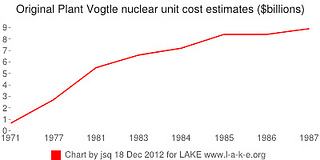
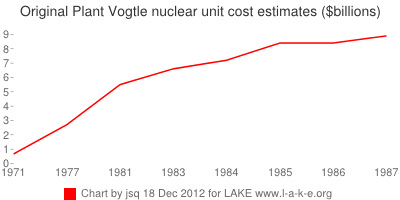
From $0.66 to $8.87 billion: original Plant Vogtle nuclear costs

Who could have expected that, given that back in the 1970s and
1980s

costs blew up 26 times the original estimate.

Back then SO complained about paperwork after Three Mile Island.
They're trying that same excuse now,
but even a former Commissioner-turned-lobbyist is incredulous,
as Kristi Swartz reported for the AJC yesterday,

Monitor: Paperwork problems a drag on Vogtle schedule
,

“It's taken eight months to handle paperwork
deficiencies?” asked Bobby Baker, a former PSC commissioner
who now represents Resource Supply Management, an energy consultant
that works with large commercial, institutional and industrial
electric customers.

A current Commissioner was almost as incredulous:

Continue reading

Original nuclear Plant Vogtle cost overruns

Why should we expect Southern Company to be any better at controlling
costs now than back in the 1970s and 1980s when its original
nukes on the Savannah River went massively over budget?
Massively as in 26 times as much per unit as originally projected.

Kristi Swartz wrote for the AJC 30 Jan 2012,

A financial look at Plant Vogtle nuclear projects
,


From $0.66 to $8.87 billion: original Plant Vogtle nuclear costs

When the two original nuclear units at Plant Vogtle were planned,
the total cost estimate was $660 million.

Yet, as

Jon Gertner reported for NYTimes 16 July 2006
,

The plant took almost 15 years to move from blueprints to being
operational. And by the time it began producing electricity in the
late 1980’s, its total cost, $8.87 billion, was so far overbudget
that Vogtle became yet another notorious example of the evils of
nuclear energy….

The grand plan was to have four reactors. Instead, it was scaled
back to two, Vogtle Unit 1 (finished in 1987) and Vogtle Unit 2
(1989).

That’s right, 4 nuclear units were planned for $660,000,000
fifteen (15) years later only 2 units were built,
for $8,870,000,000.
That’s more than $8 billion in cost overruns,
or more than 13 times the original cost estimate.
So per unit, that’s more than 26 times the original estimate,
or more than $4 billion per unit.

Swartz provided a handy table of cost estimates by year:

Continue reading