Tag Archives: History

The water is not lost. —Forrest H. Williams


Valdosta resident Forrest H. Williams replied in the VDT today to

my op-ed of 6 January.

His information seems a bit out of date.
For example, he cites

Progress Energy’s Crystal River nuke

as a good example, when it’s been

down since 2009

and is still

producing zero percent power
,
both according to the NRC.
Readers of this blog know that

the blog version of my op-ed

already links to sources for everything I said.
I may respond more later, but no doubt there are other people
who want to get involved in this discussion.
And I do thank Forrest H. Williams for airing the sort of disinformation
that is out there, so others can dispel it.

Oh, and saying water that is evaporated is not lost is like saying trees that are burned are not lost. Evaporated water is not available for agricultural or wildlife or drinking water use, and thus is indeed lost.

Continue reading

Crystal River nuke still can’t get insurance payoff


Nobody wants to pay to fix

Progress Energy's Crystal River nuke
:
not PGN, not its new owner Duke Energy, not
Nuclear Electric Insurance Ltd. (NEIL).
So maybe this nuke, only

160 miles from here
,
will be staying shut permanently?
What say we do the same for the new nukes at Plant Vogtle,
only

200 miles from here
,
before they even open?

John Downey
wrote for the Charlotte Business Journal,

Crystal River nuke plant stymies Duke Energy

Utility facing penalties, high costs for repairs,

After two mediation sessions, Progress Energy Florida and its
insurer haven't agreed how much of the potential repair costs for
the utility's crippled Crystal River nuclear unit are covered.

It appears all but certain that Progress — a Duke Energy Corp.
subsidiary — will have to pay millions of dollars as a penalty
for failing to make a timely decision on whether to repair the
plant.

Repair expenses have been calculated at between $1.5 billion and
$3.4 billion, plus what it costs to buy power to replace what
Crystal River would have produced while it is being repaired.

What kept shut Crystal River down from 2009 on was

a concrete containment separation.

Maybe those

errors in pouring concrete at Plant Vogtle

are

Continue reading

Fire in Texas nuclear reactor

Do

fires at nuclear plants like Plant Hatch
actually still occur?
Yep, at the South Texas Nuclear Project, just this week.
And that STP Unit 2 is

a different design and newer (1989)
than Hatch 1 or 2.
Austin has been trying to sell its share in that lemon since 1981.
Even TEPCO cancelled plans for new reactors there in 2011,
due to cost overruns and the Fukushima disaster.
What say we cancel our new nuclear lemons at Plant Vogtle?

According to the

NRC event report for 9 January 2013:

UNUSUAL EVENT DECLARED DUE TO MAIN TRANSFORMER FIRE


“Fire in Unit 2 main transformer 2A. Reactor trip. Two train of
offsite power lost to Unit 2.”

“An Unusual Event was declared based on EAL HU-2—Fire or
explosion in protected area or switchyard which affects normal plant
operations.”

At 1655 CST, South Texas Unit 2 declared an Unusual Event due to a
main transformer fire. Unit 2 tripped from 100% power and is
currently at 0% power in Mode 3. The transformer fire is out.


In
addition to the loss of the main transformer, several safety related
electrical busses and non-safety electrical busses lost offsite
power. The appropriate emergency diesel generators started and
powered the safety related busses. Unit 2 is currently stable and on
natural circulation due to the loss of power to the reactor coolant
pumps. Auxiliary feedwater is functioning as required and decay heat
is being removed through the steam generator atmospheric relief
valves. Unit 1 was unaffected by the event.

The licensee notified the NRC Resident Inspector.

Notified DHS SWO, FEMA, DHS NICC and NuclearSSA via email.

According to the NRC,

they still don’t know

Continue reading

Stripe some roads! —Former Commissioner Richard Lee @ LCC 2013-01-08


The ghost of Commissions Past, in the form of former Commissioner
Richard Lee, pointed his finger at the Commission and staff
at

the 8 January 2013 Lowndes County Commission Regular Session.

Richard Lee congratulated the current Commissioners
on being willing to serve.
He pointed at Commissioner Joyce Evans as having been to this rodeo before.
He said they could trust County Manager Joe Pritchard.
And he asked them to find money to stripe roads.

So if y’all can find some coins, and
Mr. Prichard has a real knack for doing that,
we’d appreciate it up in my end of the county.

That’s curious, since Mr. Pritchard can’t seem to

to keep the solid waste collection stations open
,
or for

to keep libraries open
,
or even for
a bus for 4-H
without children doing much of the heavy lifting.

But Mr. Lee is confident Mr. Pritchard can find funds to stripe roads
in Mr. Lee’s neighborhood!

Here’s

the video:

Continue reading

Vogtle nuclear reactor train wreck

Ever wondered what a nuclear reactor vessel looks like?
Here’s one that’s literally a train wreck,
on its way to Plant Vogtle on the Savannah River.

Rob Pavey wrote for the Augusta Chronicle 10 January 2013,

Vogtle reactor vessel slips between Savannah, Burke County
,


A 300-ton reactor vessel bound for Plant Vogtle was stranded briefly
in south Georgia this week after a malfunction with the specially
designed rail car moving the nuclear component from Savannah to
Burke County. Workers examine a rail car that was transporting a
300-ton reactor vessel from the Port of Savannah to the Plant Vogtle
nuclear site in Burke County. A misalignment between the cargo
platform and the rail car caused the component to be returned to
Savannah.

“The platform that contained the RV (reactor vessel) during
transport became misaligned with the Schnabel railcar, so the
railcar stopped immediately,” said Georgia Power Co. spokesman
Mark Williams. “The platform and car were re-aligned the same
day and safely returned to the port.”

The Schnabel railcar, which features extra axles that help
distribute and support the weight of heavy objects, did not break,
he said. Georgia Power would not divulge the location of the
incident.

I wonder what the locals think.
We’d ask them, if we knew where they were.

Well, that’s the only mishap so far, right?

Continue reading

Putting conservation into conservatives —John S. Quarterman

My op-ed in the VDT today. -jsq

Gov. Deal
(WABE, 14 Nov 2012)
temporarily forgot that “conservative”
includes conserving something,


like

Theodore Roosevelt and national parks
,
or when

Franklin D. Roosevelt established the Okefenokee National Wildlife
Refuge
which also

administers Banks Lake,
when

Richard Nixon started the EPA,

and when

Jimmy Carter signed the Soil and Water Conservation Act.

If Gov. Deal wants to call conservation “liberal”, I’m happy to
be a liberal working for water for our state!


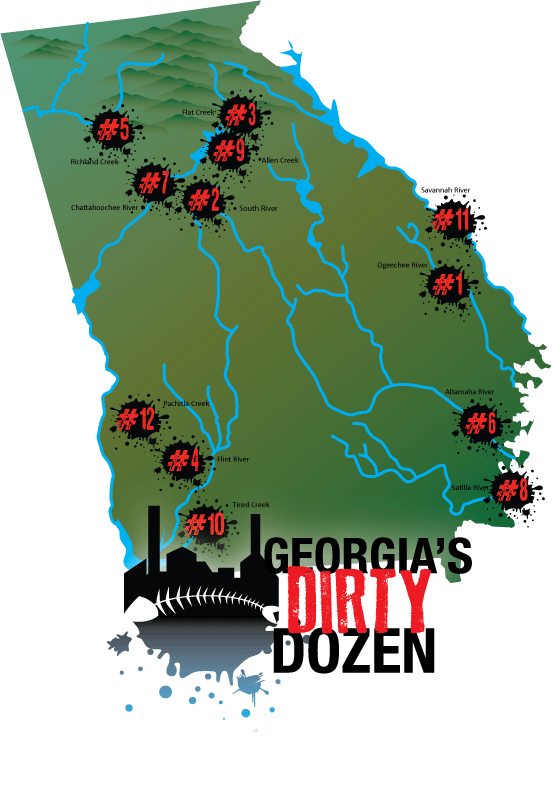
Georgia Water Coalition’s Dirty Dozen


listed the biggest boondoggle
of all as

#11: the nuclear reactors at Plant Vogtle

suck up more water from the Savannah River than all local agriculture and almost
as much as the city of Savannah.

If the new Plant Vogtle nukes

are ever completed,
all four will use more water than Savannah. In

2009 the legislature approved and Gov. Deal signed a law

letting Georgia
Power charge its customers in advance for building that boondoggle,
to the tune of

about $1.5 billion so far!

Let’s not forget

Continue reading

Substandard fire protection at nuclear Plant Hatch?

Does Hatch nuclear Unit 1 have substandard fire protection, like
many reactors built before 1975?
Protection against fires that the NRC says cause about half
the core damage risk, such as at Fukushima, which is the same
design as Hatch?

According to Simplyfy.org 2 Jan 2012,

Fire Risk At Older Japan Reactors Shows Potential Worldwide Problem
,


The [Japanese Nuclear Regulatory Authority] NRA announced recently that
reactors built before 1975 likely have sub standard fire protection
designs. This includes having important cables coated in fire resistant
insulation, isolating and protecting cables and creating barriers to
prevent fires from spreading to other areas of critical equipment.


Source:
The Mainichi, 1 Jan 2013,

Over 10 nuclear plants in Japan have flawed fire-prevention equipment: sources
.


What else was built before 1975?
Plant Hatch Unit 1

“Operating License: Issued – 10/13/1974”
,
according to the U.S. NRC.

100 miles from here,

and the same design as Fukushima.

DOE also instituted upgrades and changes to their reactor facilities
which included facility modifications as a result of Browns Ferry
fire. Private sector nuclear power reactors in the US are not all
fully up to the newer rules. The NRC has issued a number of
exemptions that watchdog groups have criticized as being unsafe.
Browns Ferry still does not meet the NRC fire rules for cables. 47
of 52 reactors in the US still do not comply with the 1980 fire
regulations.

Plant Hatch is privately owned and operated.
Has it been upgraded?

Continue reading

Carbon bubble? Solar and wind erode coal, gas, and biomass credit quality —Moody’s


In Europe it’s already happening: solar and wind are causing
bond-rater Moody’s to warn of downgrades of energy companies
that depend on heat from burning coal, gas, or biomass.
Moody’s earlier even warned the Bank of England
of a potential carbon bubble developing.
If combustion energy plants are affected like this,
the credit effects will be even bigger on even-more-expensive
nuclear plants, which Moody’s called a

bet-the-farm risk
way back in 2009.

James Murray wrote for businessGreen 6 Nov 2012,

Moody’s: Renewables boom poses credit risk for coal and gas power plants:
Credit ratings agency warns increases in renewable power have had ‘a
profound negative impact’ on the competitiveness of thermal
generation companies
,

“Large increases in renewables have had a profound negative impact
on power prices and the competitiveness of thermal generation
companies in Europe,” said Scott Phillips, an assistant vice
president and analyst at Moody’s Infrastructure Finance Group, in a
statement.

“What were once considered stable companies have seen their business
models severely disrupted and we expect steadily rising levels of
renewable energy output to further affect European utilities’
creditworthiness.”

And not just rising, rising increasingly

Continue reading

Florida Crystal River nuke down $5 billion?


Only
160 miles from here,
the Crystal River nuclear reactor continues to run up a bad bill,
maybe as much as $5 billion,
and even other nuclear operators are reportedly starting to turn against it.
Should we wait for the new nukes on the Savannah River to run up a bill
that high before we cancel them?

Remember

back in May?

Florida is already experiencing a likely future for the new Plant
Vogtle nukes in Georgia: completion date pushed back, and customer
charges raised.

Yep, that’s the one.
And the bill keeps going up, as
Ivan Penn wrote for the Tampa Bay Times 30 December 2012,

Utilities nationwide could share the financial pain of the idled Crystal River nuclear plant
,

The crippled Crystal River nuclear plant is now America’s headache.

The bill to fix it and pay for replacement power may top $5 billion.
The problem?

The company that insures all 104 U.S. nuclear power plants has just
$3.6 billion on hand to pay for claims.

Broken nuclear plants in California, Texas and Michigan will vie for
some of that money. But Crystal River alone represents such a
financial threat that the insurance company, Nuclear Electric
Insurance Ltd., may demand that its member utilities pony up more
money.

Is NEIL the guarantor on the bonds for the new nukes at Plant Vogtle?
I think Southern Company was smarter (for SO, not for us)
and

got Congress to guarantee those.

If so,

Continue reading

Plant the seeds for viable water future

This AJC op-ed is about coastal wetlands, but
much of it applies to wetlands such as cypress swamps and streams
in Lowndes County and the rest of central south Georgia,
especially since

our state water plan for the Suwannee-Satilla Region

points us at

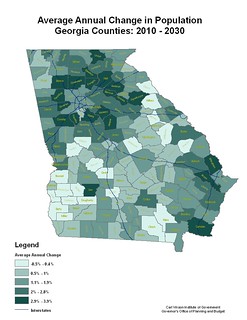
County-Level Population Projections from the Governor’s Office of Planning and Budget

that project 45% growth in Lowndes County population in 20 years to 156,650 people by 2030,
which means near doubling in 30 years to 2050. -jsq

David Kyler wrote for the AJC 29 December 2006,
“Plant the seeds for viable coastal future”,

Recent population projections for the Georgia coast issued by

2010-2030 Change in Population of Georgia Counties

Georgia Tech say nothing new. We’re growing at almost 20 percent a
decade, meaning a near doubling every 35 years.

The Center for a Sustainable Coast projected a population of about 1
million by 2030 for the 11 counties in the coastal region as defined
by the Department of Natural Resources, somewhat higher than the
844,000 predicted by Georgia Tech. This compares with a population
of 538,469 reported in the 2000 Census report.

But the accuracy of projections is not the point. Increased
population will result in more land clearing and environmental
disturbance than in the past—there will be larger homes,
bigger lots and fewer people per household.

National studies show up to twice as much land is

Continue reading