Tag Archives: History

No choice on trash —”representatives from Lowndes County”


The VDT went deep under the Lowndes County government’s anonymous cover
for an interview with “representatives” who
confirmed that unincorporated residents have no choice
for trash collection other than

the monopoly the Commission granted

to a company from New York City.

Jason Schaefer wrote on the front page of the VDT today,

County trash ordinance goes into effect Friday:
VDT has Q&A with county leadership about new law, burning
,

VDT:
Lowndes County has said residents aren’t required to sign a
service contract with Advanced Disposal. What other services are
there in the area, and do they include Deep South Sanitation in
Valdosta?

LC:
“According to the solid waste ordinance, Advanced Disposal
will be the only residential hauler licensed to serve unincorporated
Lowndes County. There’s been some confusion about trash collection
service in the city. This ordinance is just for unincorporated
Lowndes County, not for any of the cities.”

Maybe these were the same “representatives” who sent

an unsigned letter

saying there were 5,000 residents of unincorporated parts of
Lowndes County who didn’t already have curbside service, and they
have one choice now: the one-and-only
county-appointed purveyor of waste bins.
What could possibly go wrong?

Continue reading

Get a job —Lowndes County to waste site workers

Continuing to ignore its responsibilities to protect public health, safety,
and well-being,
the Lowndes County government proceeded with its plan
to trash rural residents’ waste collection sites,
and told part time workers there to get a job.

Jason Schaefer wrote for the VDT today,

Trash centers dumped:
Final week to make trips to county recycling centers
,

The Lowndes County Board of Commissioners near the end of 2012 voted


to approve a contract with Advanced Disposal to serve as the sole
waste company to conduct curbside trash pick-up in unincorporated
Lowndes County. Some citizens remain critical of the change in
service, which will cost $12.80 per month, and many are trying to
get their last loads to the collection/recycling centers before they
close….


Full-time employees at the recycling stations, which are already
employees of Public Works, said County Clerk Paige Dukes, will be
moved to different positions within the department. Part-time
employees will need to find new jobs.

Why might citizens be critical?

Continue reading

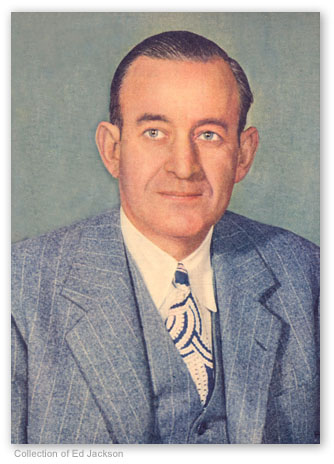
I-75 as the Governor Melvin Ernest Thompson Memorial Highway?

Did you know the legislature is likely to rename much of Interstate 75
through Lowndes County in honor of a former governor,
and spend $4,500 for signs to do so?

The Valdosta Daily Times, Lowndes County


NOTICE OF ROAD FACILITY DEDICATION


Notice is given that there will be introduced at the regular 2013
session of the General Assembly of Georgia a resolution sponsored by
Senator Tim Golden, 121 State Capitol, Atlanta, Georgia 30334, (404)
656-7580, to dedicate the portion of Interstate 75 in Lowndes County
from the West Hill Avenue exit to the North Valdosta Road exit as
the Governor Melvin Ernest Thompson Memorial Highway in honor of his
achievements, accomplishments, and contributions to Lowndes County
and to the State of Georgia; and for other purposes. The estimated
cost of such dedication is $4,500.00.

00046038

1/19/13

And such a bill has been introduced in the Georgia House (not the Senate) as

HR 47, Governor Melvin Ernest Thompson Memorial Highway; Lowndes County; dedicate
,
sponsored by
(1) Shaw, Jason 176th, (2) Carter, Amy 175th, (3) Black, Ellis 174th,
(4) Sharper, Dexter 177th, (5) Houston, Penny 170th.

Here's the part that ties Gov. Thompson to here:

WHEREAS, Governor Thompson was instrumental in the success of the City of


Valdosta and Lowndes County, where his leadership as a founding member of
the Valdosta-Lowndes County Industrial Authority spearheaded much of the
urban development and planning for Valdosta and the surrounding areas,
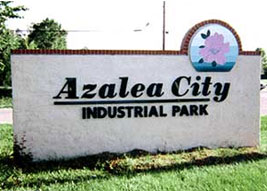
including the Azalea City Industrial Park; and

And establishing Industrial Parks was a cutting-edge idea: in the 1950s.

The bill adds:

Continue reading

Rural AIDS: poverty the cause, solar power part of the solution


Director Lisa Biagiotti
spent two years travelling around the South
interviewing people about AIDS to make a film,
deepsouth.
She found rural AIDS is a bigger and faster-growing problem
than AIDS in center cities,
yet most health and prevention funding goes to urban areas.
The root cause seemed clear to her: poverty.
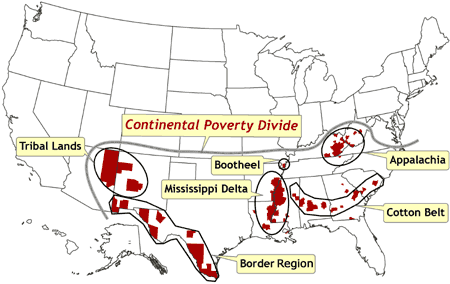
Here’s some deeper dirt (literally) on rural poverty in the U.S.,
and one thing we know can help with that: distributed solar power,
for jobs, for reduced electrical bills, and for energy independence.
What politician wouldn’t want jobs for their constituents?

The director said the screening at

VSU at the end of November
drew more people than the
day before in Little Rock.
There were clearly more than 150 in the audience in Valdosta.
It’s a topic very relevant to here, as

Dean Poling wrote in the VDT 26 November 2012,

Organizers note that Georgia is ranked sixth highest nationally for
its cumulative number of AIDS cases reported through December 2009.
More than 40,000 known HIV/AIDS cases were reported in Georgia as of
2010.

The South Health District’s 10 counties, which include Lowndes and


surrounding counties, report 950 confirmed cases of HIV/AIDS, while
many more are likely infected and risk becoming sick because they
are not being treated. More specifically, there are about 460
reported cases in Lowndes County.

In reporting these numbers, HIV is the virus (HIV disease) and AIDS
is the medical diagnosis made by a doctor of the symptoms, according
to South Health District.

It’s a great movie and I highly recommend it.
Director Biagiotti spent a substantial amount of her own money and two years to make
this film, yet there are aspects she could only note in passing,
such as incarceration.
She can’t be expected to have researched every aspect;
maybe somebody else can step up and help follow more threads.

The movie starts with some maps about poverty and AIDS in the South.
It did not, however, look outside the South for poverty.
Here are better
poverty maps, from the CDC:


Continue reading

How to get fast Internet service —Susan Crawford

Susan Crawford has a plan

for getting us fast Internet access
for jobs, community, education,
and health care.


Susan Crawford wrote for Wired 2 October 2012,

We Can’t All Be in Google’s Kansas: A Plan for Winning the Bandwidth
Race
,
about how the incumbent telephone and cable companies that provide
our Internet access aren’t going to help:

They have no incentive to do so. Because they never enter one
another’s territories, they don’t face the competition that might
spur such expansion.

Instead, incumbent internet access providers such as Comcast and
Time Warner (for wired access) and AT&T and Verizon (for
complementary wireless access) are in “harvesting” mode.
They’re raising average revenue per user through special pricing for
planned “specialized services” and usage-based billing,
which allows the incumbents to constrain demand. The ecosystem these
companies have built is never under stress, because consumers do
their best to avoid heavy charges for using more data than they’re
supposed to. Where users have no expectation of abundance, there’s
no need to build fiber on the wired side of the business or build
small cells fed by fiber on the wireless side.

If the current internet access providers that dominate the American
telecommunications landscape could get away with it, they’d sell
nothing but specialized services and turn internet access into a
dirt road.

So what is her plan?

Continue reading

Captive cable audience —Susan Crawford


Affordable high-speed Internet access would bring us
jobs, community, “online commerce and services, the ability to reach world
markets, to invent and innovate, to learn and communicate” and
“a wealth of economic activity and information”
writes Susan Crawford, a very savvy and experienced communications law professor
who has been recommended by many as a potential chair of the FCC,
who also explains why we aren’t currently getting it.

The Diane Rehm Show 10 January 2013,

Susan Crawford: “Captive Audience”
,
and that’s the title of her book,

Captive Audience: The Telecom Industry and Monopoly Power in the New Gilded Age
,
excerpted here:

The sea change in policy that led to the current situation has
been coordinated over the past twenty years by legions of lobbyists,
hired-guneconomists, and credulous regulators. The cable companies
have no incentive to upgrade their core network hardware to ensure
that advanced fiberconnections are available to every home
throughout the country. Communications companies describe globally
competitive high-speed access as aluxury, just as the private
electricity companies did a century ago.

Yet communications services are now as important as electricity.

Today if you asked American mayors what technology they most want
for their city, the majority would say, “affordable high-speed
Internet access.”
And they want these networks not simply for
the jobs created to construct them but because the Internet brings
the world to their community.

High-speed Internet access gives towns
and cities online commerce and services, the ability to reach world
markets, to invent and innovate, to learn and communicate. It brings
a wealth of economic activity and information.

But despite these
manifold benefits, Americans continue to treat such services as the
exclusive domain of private monopolies and as luxuries
obtainable only by the wealthy.

Not coincidentally, the United States has fallen from the forefront

Continue reading

Failed concrete: the bane of nuclear reactors

Let’s not forget the failed concrete on which

Plant Vogtle’s unprotected stranded reactor vessel
is supposed to sit.

A week before

the reactor vessel train wreck,
news stories
said concrete pouring was delayed due to “noncompliant rebar”.
Thomas Clements elaborated for the Aiken Leader 14 January 2013,

Vogtle AP1000 Nuclear Reactor Vessel Discovered Unprotected, Stranded in Savannah Port since December 15 Shipment Failure
,


Due to chronic delays in the pouring of “nuclear
concrete” for the basemat of the AP1000 units at Vogtle and VC
Summer, it remains unknown when or if any reactor vessels can
actually be placed into the excavated holes at the sites. A January
10 meeting of the NRC confirmed that another basemat-related
“license amendment request” (LAR) was soon to be filed
by SCE&G for its AP1000 project and that the target date for
granting of the LAR was March 18. It appears that the Vogtle project
has fallen behind the V.C. Summer project and no strategy for the
filing of a similar and necessary LAR by Southern Company is known.


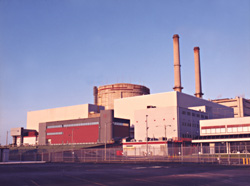
Concrete, the long-time bane of

Seabrook Station

and also what’s keeping

Crystal River
shut down because nobody wants to pay the
billions of dollars it would take to fix it.


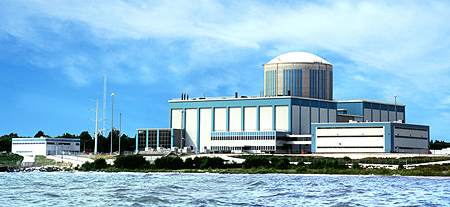
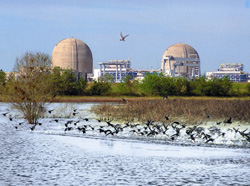
What say we call the whole thing off, like
Dominion Power did with its existing

Kewaunee nuke
,
and
TEPCO and NRG did

with their plans for new South Texas nukes
.


Maybe it’s a sign that meanwhile

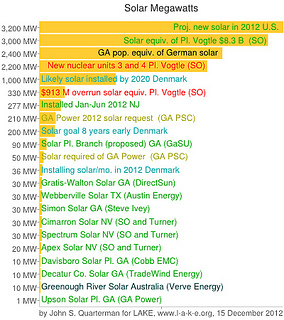
Google has invested a billion dollars in wind and solar
and gotten
2 gigawatts of power, almost as much as the 2.2 GW the two new Vogtle nukes
were supposed to produce, except Google’s solar and wind projects
are online on time, and for less than just the cost overruns at Vogtle.

The Georgia legislature is in session.
You can contact

your legislator or the PSC
today
about

toppling Southern Company’s three-legged nuclear regulatory-capture stool

and

fixing that 1973 Territoriality Law

so we can get on with solar and wind in Georgia,
for jobs and energy independence, and oh by the way clean air and
plenty of clean

water
.

-jsq

Centralized Nuclear Bad Investment?

A writer for Forbes spells out the question of nuclear investment:
how can something that expensive, over-budget, late, and phenomenally
risky be a good investment, especially when cheaper and faster energy
sources are readily available?

Peter Kelly-Detwiler wrote for Forbes today,

New Centralized Nuclear Plants: Still an Investment Worth Making?


Just a few years ago, the US nuclear renaissance seemed at hand. It
probably shouldn’t have been. Cost overruns from Finland to France
to the US were already becoming manifest, government guarantees were
in doubt, and shale gas drillers were beginning to punch holes into
the ground with abandon.

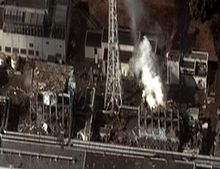
Then came Fukushima. The latter proved a somewhat astonishing
reminder of forgotten lessons about nuclear power risks, unique to
that technology: A failure of one power plant in an isolated


location can create a contagion in countries far away, and even
where somewhat different variants of that technology are in use.
Just as Three Mile Island put the kaibosh on nuclear power in the US
for decades, Fukushima appears to have done the same for Japan and
Germany, at a minimum. It certainly did not help public opinion, and
at a minimum, the effect of Fukushima will likely be to increase
permitting and associated regulatory costs.

He goes into detail: they take too long (while gas and solar got cheaper),
they’re extremely expensive to build and run, and they’re all-or-nothing
investments.

I was going to compile this list of recent nuclear financial failures,
but he saves us all the trouble:

Continue reading

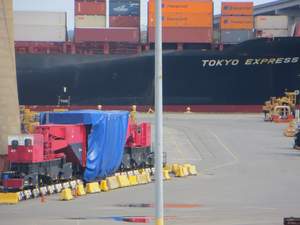
Vogtle reactor vessel sitting unprotected at Savannah port

What happened to Plant Vogtle’s new reactor vessel after

it was in a train wreck
a week ago?
It went back to Savannah port and sits there unprotected and unguarded.

Thomas Clements wrote for the Aiken Leader 14 January 2013,

Vogtle AP1000 Nuclear Reactor Vessel Discovered Unprotected, Stranded in Savannah Port since December 15 Shipment Failure
,


Tom Clements, Alliance for Nuclear Accountability

The reactor pressure vessel (RPV) for the chronically delayed Vogtle
AP1000 reactor construction project near Waynesboro, Georgia sits
stranded and seemingly unprotected in the port of Savannah. The
special railroad car carrying the 300-ton vessel had unknown
mechanical problems on December 15 on exiting the port. The NRC has
said that the vessel only got one-quarter mile before a sound was
heard and the car stopped. Plans by Westinghouse and Southern
Company to move the vessel are unknown. It is also unknown if the
railroad car can be repaired and used or if the railroad company
which owns the line is concerned that the rail car might break down
again on its line in an in accessible place. Meanwhile, the
apparently unguarded reactor might be subject to sabotage and sits
in apparent violation of NRC quality assurance and “administrative
control” regulations.

The article includes links to several more pictures
taken 13 January 2013 by Tom Clements of

Alliance for Nuclear Accountability,

such as this one with the bridge clearly visible:

Continue reading

Georgia legislature still trying to suck up Tennessee River water

Because Atlanta can’t get a grip on its water usage, the Georgia legislature
is still trying to suck up Tennessee River water.
If the legislature is willing to try that, how long before they
try sucking up our Floridan Aquifer water for Atlanta?


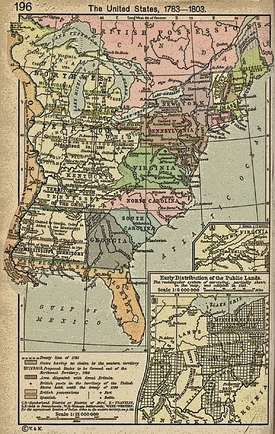
Prefiled in December to be up early as the Georgia legisture starts meeting
today, is a bill to try to move the northern border of Georgia to match
an eighteenth century boundary that just happens to include a bit of the
Tennessee River in Georgia.
HR 4,

Georgia and Tennessee; boundary dispute; propose settlement
,
was filed by

Rep. Harry Geisinger, R – Roswell, District 48,

and says in part:

WHEREAS, the State of Georgia proposes to the State of Tennessee
that the dispute be resolved by the states agreeing that the current
boundary between the two states reflecting the flawed 1818 survey be
adopted as the legal boundary between the states except for an area
described as follows which shall be made a part of the State of
Georgia by which Georgia shall be able to exercise its riparian
water rights to the Tennessee River at Nickajack:

Georgia is already in a

three-decade-long dispute with Alabama and
Florida over the Chattahoochee River.

Does adding a dispute over the Tennessee River
seem like a good idea to you?

And how can we best stop Atlanta from coming for our Floridan Aquifer?

-jsq