Tag Archives: energy conservation

Bill Moyers on ALEC

Bill Moyers takes on ALEC.

Posted yesterday On Bill Moyers’ website,

‘United States of ALEC’ Video Previews

This week, Moyers & Company (check local listings) presents


“United States of ALEC,” a report on the most
influential corporate-funded political force most of America has
never heard of — ALEC, the American Legislative Exchange
Council. A national consortium of state politicians and powerful
corporations, ALEC presents itself as a “nonpartisan
public-private partnership”. But behind that mantra lies a
vast network of corporate lobbying and political action aimed to
increase corporate profits at public expense without public
knowledge.

He said more

on Huffington Post Wednesday,

Continue reading

Southern Company: let’s do the renewable energy study for Georgia

Mark Z. Jacobson's study shows

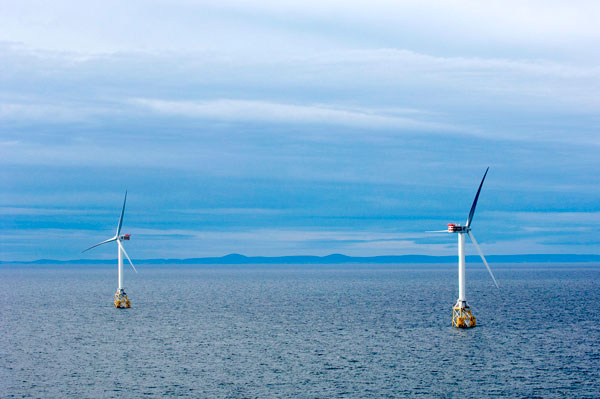
offshore wind is plentiful from Virginia to Maine

Let's

do the study for Georgia!

Southern Company

brags about its private R&D:

Research & Development (since the 1960s)


  • Awarded more than $1.3 billion to conduct more than $3.8 billion of research and development.
  • Qualified for $412 million of investment tax credits for a 21st century coal plant being built in Mississippi.

OK, SO, let's see you do the study to show what we can really do with


conservation, efficiency,
wind, sun, and less natural gas than we have now.
Sure, in the Georgia Bight we do have to contend with hurricanes.
But a

"great, big company"

like SO should be able to focus its vaunted private R&D on that problem and solve it.

Maybe SO doesn't want to do that because the result might show there is no need for
any coal plants, nor new natural gas plants, nor any nuclear plants, which would mean
Georgia Power would have to give up its nuclear-funding rate-hike stealth tax
and SO would have to give up its $8.3 billion loan guarantee.
Hey, we might even need to

change the 1973 Georgia Electric Territorial Act
,
and that might damage Georgia Power's guaranteed profit!
Nevermind that Georgia Power and SO might make more profit if they got out
in front on solar and wind power and a smart grid.

If SO won't do it, how about we elect some Public Service Commissioners and legislators who will?
For

jobs, energy independence, and profit, oh, and clean air and plenty of water!

-jsq

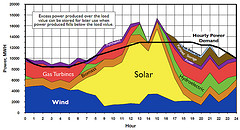
All U.S. east coast electricity could come from offshore wind 3 seasons out of 4

Why build nukes when wind can provide 3/4 of our power?
While Southern Company claims to be

“a company that is engaged in offering solutions, not just rhetoric”
,
yet

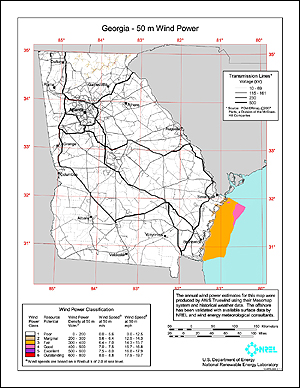
does nothing about wind off the Georgia coast,


researchers in far California have demonstrated we can get
3/4 of all needed east coast electricity from offshore wind.

Bjorn Carey wrote for Stanford Report 14 September 2012,

Offshore wind energy could power entire U.S. East Coast, Stanford scientists say

A new analysis by Stanford researchers reveals that there is enough
offshore wind along the U.S. East Coast to meet the electricity
demands of at least one-third of the country.


The scientists paid special attention to the Maine-to-Virginia
corridor; the historical lack of strong hurricanes in the region
makes it a favorable site for offshore wind turbines. They found
that turbines placed there could satisfy the peak-time power needs
of these states for three seasons of the year (summer is the
exception).

“We knew there was a lot of wind out there, but this is the first
actual quantification of the total resource and the time of day that
the resource peaks,” said Mark Z. Jacobson, a professor of civil and
environmental engineering at Stanford who directed the research.
“This provides practical information to wind farm developers about
the best areas to place turbines.”


Mark Z. Jacobson already worked out a framework for

powering the entire world from wind, water, and sun alone.

The late
John Blackburn, Ph.D., showed us how

to power North Carolina with sun, wind, and hydro,

plus less natural gas than NC uses now.
Now Jacobson is working out the details of implementation.

-jsq


PS: Owed to Seth Gunning.

Industrial Authority goes solar, broadband, and conversational!

The Industrial Authority apparently listened to its focus groups,
and discovered that broadband and solar energy are important
to attract industry.
Andrea Schruijer even recommends conversation,
which has been sorely lacking in recent years.
Congratulations, Industrial Authority!

Jason Schaefer wrote for the VDT today,

Authority analyzes Valdosta business:
Broadband, solar power, professional services targeted for growth,



The Authority also plans to work toward the availability of more
broadband Internet service and solar power in Valdosta and
surrounding communities. These amenities would help support local
industries as well as draw new ones to the greater Valdosta area for
the creation of new jobs.

That’s a good start. Although it’s not clear from the writeup that VLCIA quite got it about
Internet access.

As part of presenting Valdosta as an attractive package for


prospective industries, the Authority attempts to ready the land set
aside for development before beginning the recruitment process. This
means investing in infrastructure, including broadband internet.

“It’s not that we don’t have broadband,” Schruijer said.
“What we’re looking at is the technology behind the broadband.
We have it in certain areas, but in order for us to grow some of
these core targets, such as professional services, we need that
infrastructure.”

Well, actually, no,


we don’t have broadband.

6Mbps is the fastest most people can get around here,
and 30Mbps is the slowest you can even buy in many countries.
Plus, it’s not just fast Internet to industrial sites that’s needed:

it’s fast Internet access everywhere knowledge-based employees
may want to live.

But they’re on the right track:

Because the Authority can’t “buy” industries into coming
to Valdosta—though it can offer tax abatements—it is
necessary to make sure that new businesses have what they will need
before ground is even broken, Schruijer said. To this effect, the
Authority will “stimulate the conversation” to actively
attract more broadband companies to the area.

A conversation!
Now there’s something we’ve been needing around here.
And it’s a refreshing change from only
a year ago when all we heard was



“Debate is not allowed.”

Maybe the Industrial Authority will be the organization that will show the
rest of us how to hold civil discussions about things that affect all of us!

The VDT’s writeup skips quickly over another big change:

Continue reading

Energy experts making excuses for fracking

Numerous eminent current and former regulators, governors,
and legislators’ best advice for how to keep fracking from
polluting our aquifers and drinking water: “strict regulation”.
As Gandhi reputedly said about western civilization: that would be a good idea.
But in Georgia and many other places, where the regulatory agency
(GA PSC) and the legislature are pretty much captured by the utilities
they pretend to regulate, how will we get that “strict regulation”?

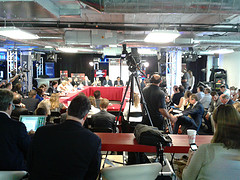
This was at a Politico event, sponsored by American Wind Power,
called Energy & the Presidency.

Join POLITICO for a lunch conversation with energy experts and
policy leaders

Energy & the Presidency panel

as they discuss current energy legislation, the
energy debates facing the nation, policy options and what’s ahead in
the year to come. Speakers include: ClearView Energy Partners’ Kevin
Book; former Administrator of the EPA and former Director of the
White House Office on Climate Change, Carol Browner; Rep. Ed Markey
(Mass.); former Gov. Bill Richardson (NM) and former Gov. Bill
Ritter (Colo.).

When: Wednesday, September 5, 2012 at 12:00 pm ET


This event was in North Carolina, where the late John Blackburn, Ph.D.
already reported two years ago that

the whole state could be powered by wind, sun, existing hydro, landfill gas, and less natural gas than is already in use,

why do we need fracking at all?

Georgia has similar real renewable energy potential,
plus studies by

Georgia Tech

and Duke
indicate that Georgia doesn’t need any additional total electric power
anyway, if it gets on with energy efficiency.
Add

solar
and

wind
instead of natural gas, and we can retire a lot of
coal plants.
With no need for fracking.

I have an idea:
let’s elect Public Service Commissioners and legislators who are not
beholden to the utilities they will regulate!

-jsq

Phase 2 Solar Power for the Wisenbaker Building —Ron Jackson

Phase 2 after
South GA Solar Power, LLC remediated the historic Wisenbaker Building
is solar generation, according to Ron Jackson.

We wanted to … remediate some of the problems first to reduce the load,
to reduce the energy consumption.


Phase 2 Solar Power for the Wisenbaker Building --Ron Jackson

Once we’ve done that, phase 2 kicks in, which is the solar power application.
If we’d done that first, we probably would have put on a 20KW system
to handle this load.
But because we’ve done the phase 1 project and reduced the energy load,
now we only need an 8-10 KW system,
so the prices have been reduced.
Next year hopefully it will be a fully green, fully functioned
solar power application.

Right in downtown Valdosta!


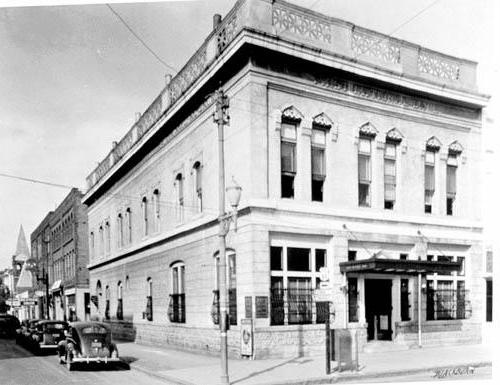
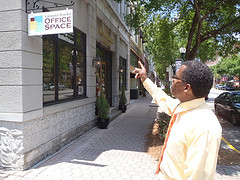
The

historic Wisenbaker Building
,
100 North Patterson Street, is at the corner of West Hill Avenue.
It was

purchased by Gino Fina in 2006,

and is now used as

Valdosta Shared Office Space.

Here’s

the video.


Phase 2 Solar Power for the Wisenbaker Building –Ron Jackson

Pictures and video by John S. Quarterman for Lowndes Area Knowledge Exchange (LAKE), Valdosta, Lowndes County, Georgia, 5 May 2012.

-jsq

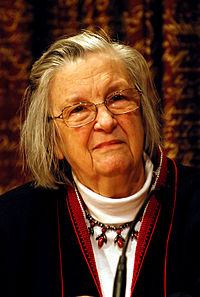
Green from the Grassroots —Elinor Ostrom


On the day she died, Nobel Prize-winning economist Elinor
Ostrom published
her last article, in Project Syndicate, 12 June 2012,

Green from the Grassroots
,

This grassroots diversity in “green policymaking” makes
economic sense. “Sustainable cities” attract the
creative, educated people who want to live in a pollution-free,
modern urban environment that suits their lifestyles. This is where
future growth lies. Like upgrading a mobile phone, when people see
the benefits, they will discard old models in a flash.

Of course, true sustainability goes further than pollution control.
City planners must look beyond municipal limits and analyze flows of
resources —

energy
,

food
,

water
, and

people


into
and

out of
their cities.

Worldwide, we are seeing a heterogeneous collection of cities
interacting in a way that could have far-reaching influence on how
Earth's entire life-support system evolves. These cities are
learning from one another, building on good ideas and jettisoning
poorer ones. Los Angeles took decades to implement pollution
controls, but other cities, like Beijing, converted rapidly when
they saw the benefits. In the coming decades, we may see a global
system of interconnected sustainable cities emerging. If successful,
everyone will want to join the club.


And counties, and regions, and watersheds, of course.
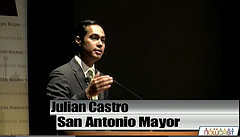
As Mayor Julian Castro of San Antonio said, there is a

"nexus between sustainability and job creation."

We don't have to wait for San Antonio or Los Angeles or Beijing or
Atlanta to lead the way:

we can get on with it right here where we are.

-jsq

Remediating a building in downtown Valdosta –Ron Jackson of South GA Solar Power, LLC

Ron Jackson told LAKE about
how South GA Solar Power, LLC remediated the historic Wisenbaker Building
in downtown Valdosta for
increased air flow and reduced energy consumption.


Ron Jackson at the Wisenbaker Building

Valdosta Shared Office Space, Downtown Valdosta,
is in the Wisenbaker Building, built in 1884:
the owner hired South GA Solar Power, LLC as an engineer consultant
to bring down the energy this building was using.
Ron Jackson says they examined air flow, average load,
and other factors,
bringing $12,000/year electric bill down to $3,000,
120 amps/day down to 17 amps/day.


“Consider us as your next consultant for your green energy product.”

Here’s
the video.


Picture and video by John S. Quarterman for Lowndes Area Knowledge Exchange (LAKE), Valdosta, Lowndes County, Georgia, 5 May 2012.

Tomorrow: Phase 2.

-jsq

Self-contained solar attic fan –Ron Jackson of South GA Solar Power, LLC

At Cinco de Mayo,

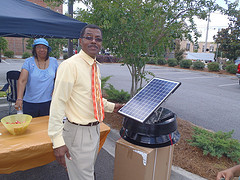
Ron Jackson explained
a self-contained solar attic fan

Self-contained solar attic fan

sold by
South GA Solar Power, LLC.
He was assisted by mechanical engineer Danielle, and isn’t that Business Manager Sharon Jackson?

It’s actually an exhaust fan powered by the sun.
What it does is it simply takes the hot air,
125-150° heat, exhausts it out
down to 90°, which
makes the house cooler, which makes the air conditioner stop running.
Which makes the electric bill reduce, go down, 50%.
My bill was $345 a month now it’s $120 a month.
By a simple application!
If you need any more information, call

Ron Jackson at South GA Solar Power, LLC.


Self-contained solar attic fan

Pictures and video by John S. Quarterman for Lowndes Area Knowledge Exchange (LAKE), Valdosta, Lowndes County, Georgia, 5 May 2012.

-jsq

New research shows Natural Gas far more dangerous for climate stability —Seth Gunning

Received yesterday on U.S. CO2 emissions lowest in 20 years: that's good and bad: natural gas is methane, after all. -jsq

Yet another comprehensive article. I might also add that one of the major down-falls (if not the most significant) of large-scale conversions to natural gas is the resources lifecycle methane emissions.

As your readers likely know, Methane is about twenty times as 'potent' a greenhouse gas as Carbon Dioxide. That is to say, it is far more efficient at trapping heat then Co2. So, less methane has a far greater impact on climate disruption then more Co2.

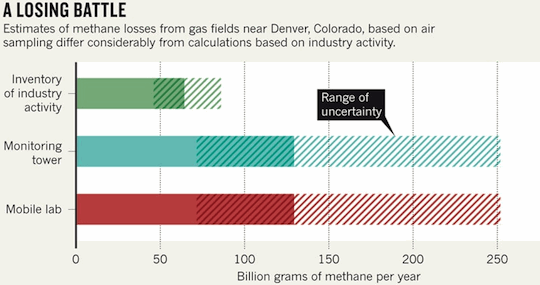
Natural Gas, from the point of combustion, releases about half the amount of Co2 released from burning coal, and about 30% of what's released in burning oil. To keep the benefits of reduced Co2 levels when switching from coal to natural gas, natural gas wells and transport lines must leak less then 2% of methane into the atmosphere. Recent research from Cornell is showing that Fracking wells are regularly releasing more then 4%, and often as much as 8% —far exceeding the 2% threshold— and thus making Natural Gas a far more dangerous resource for climate stability.

Tom Zeller Jr. wrote for the NYTimes 11 April 2011, Studies Say Natural Gas Has Its Own Problems

-Seth Gunning

-jsq