Tag Archives: Wind

Georgia Power raising rates


Georgia Power is raising rates
in January, despite its recent announcement that it would lower
rates because of lower fuel bills.
Why raising?
Mostly the new nukes and for a new natural gas plant.
And 16% of the rise is for energy efficiency.
Does that seem like the right proportion to you?

Kristi Swartz wrote for the AJC 1 Nov 2012,

Georgia Power bills to increase
,

The average Georgia Power bill will increase about 44 cents a month
starting in January, not decrease as many might have expected when
the company announced last month its fuel costs had dropped.

The utility, which serves 2.4 million customers, notified state
regulators in October that it would be applying for a residential
rate reduction because the amount it pays for fuel has fallen 7
percent, saving $122 million. The utility cannot profit from lower
fuel costs and must pass those savings on to customers.

So why are customer rates going up?

About $1.05 of the typical residential bill will go toward paying
for a new natural gas unit at Plant McDonough-Atkinson in Smyrna.
That increase already was approved as part of a three-tiered rate
hike set in 2010.

Yep, that’s that

set-in-2010 and keep-rising-’till-2013 natural gas
rate hike

that Georgia Power got away with while complaining about
any potential solar subsidies.
The one
AJC complained would be “on autopilot”:

Continue reading

Nuclear reactors near here

If you think of nuclear reactors as something far away,
or as much safer than Fukushima,
you’re in for a surprise.
The most notorious reactors are the ones not yet built,
units 3 and 4 at Plant Vogtle near Augusta and their

famous financial boondoggle.

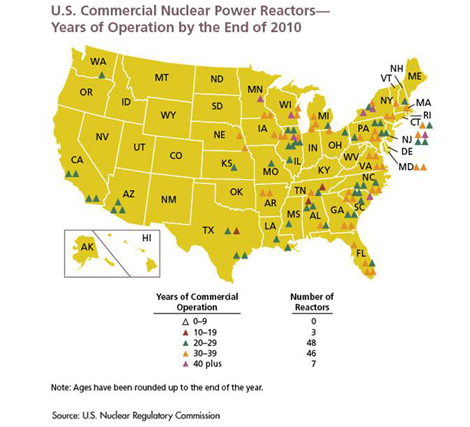
But others are closer, older, and more numerous than you may know.

Here’s a map by the Nuclear Regulatory Commission (NRC).


That map’s not clickable, so here’s a table,
selected from an

NRC table

by distance from Valdosta:

Name Owner Where Distance
from
Valdosta
Hatch 1 & 2* SNOC 11 miles N of Baxley, GA 100 miles
Farley 1 & 2 SNOC 18 miles SE of Dothan, AL 125 miles
Crystal River 3 PGN 80 miles N of Tampa, FL 160 miles
Vogtle 1 & 2 SNOC 26 miles SE of Augusta, GA 200 miles
Summer SCEG 26 miles NW of Columbia, SC 300 miles
Saint Lucie 1 & 2 FPL 10 miles SE of Ft. Pierce, FL 325 miles
Oconee 1,2,3 Duke 30 miles W of Greenville, SC 330 miles
Robinson 2 PGN 26 miles NW of Florence, SC 350 miles
Sequoya 1 & 2 TVA 16 miles NE of Chattanooga, TN 360 miles
Catawba 1 & 2 Duke 18 miles S of Charlotte, NC 390 miles
McGuire 1 & 2 Duke 17 miles N of Charlotte, NC 410 miles
Browns Ferry 1,2,3* TVA 32 miles W of Huntsville, AL 410 miles
Turkey Point 3 & 4 FPL 20 miles S of Miami, FL 440 miles
Brunswick 1 & 2* PGN 40 miles S of Wilmington, NC 480 miles
Waterford 3 Entergy 25 miles W of New Orleans, LA 495 miles
Shearon Harris 1 PGN 20 miles SW of Raleigh, NC 498 miles
* GE Mark I;
Duke: Duke Energy Power Company, LLC;
Entergy: Entergy Nuclear Operations, Inc.;
FPL: Florida Power & Light Co.;
PGN: Progress Energy;
SCEG: South Carolina Electric & Gas Co.;
SNOC: Southern Nuclear Operating Company;
TVA: Tennessee Valley Authority

Five operating nuclear power reactors are closer to us

Continue reading

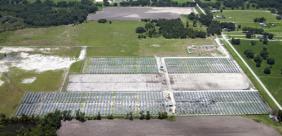
New solar in New Jersey, Massachusetts, Florida: where’s Georgia?

What are these

new solar projects?

Here are a few FERC lists,
in New Jersey, Massachusetts, and Florida,
and there are more in Texas.
Not so many in Georgia.


  • Zongyi Solar America’s 20 MW Tinton Falls Solar in Monmouth County,
    New Jersey, is online. Tinton Falls Solar is the largest
    photovoltaic project in New Jersey.
  • Southern Sky Renewable Energy LLC’s 5.6 MW Canton Landfill Solar
    Project in Canton County, Massachusetts is online. This photovoltaic
    project is built on the closed and capped Canton Landfill. It is the
    largest solar facility in New England. The electricity generated is
    sold to the Town of Canton under a long-term agreement.

New Jersey again!
20 Megawatts is even larger than the

6.1 MW at Lawrenceville School.

And Massachusetts, even farther north.
Let’s also look just south of us:


  • SunEdison’s 3.6 MW Phase 2 Lakeland Regional Airport Solar Project
    expansion in Polk County, Florida is online. The Lakeland Regional
    Airport Solar has a total capacity of 6.3 MW. It is the largest
    photovoltaic project in Florida. The electricity generated is sold
    under long-term contract to Lakeland Department of Electric Water
    Utilities.

Ah, but

that’s illegal in Georgia!

Here you can sell electricity only to your one and only monopoly utility,
predetermined for you by the 1973 Territorial Electric Service Act.
Maybe we should change that?

The Lakeland Chamber of Commerce

helped promote that solar project.

Maybe better PR than

feuding with the newspaper?

Also only slightly farther south of us,

Continue reading

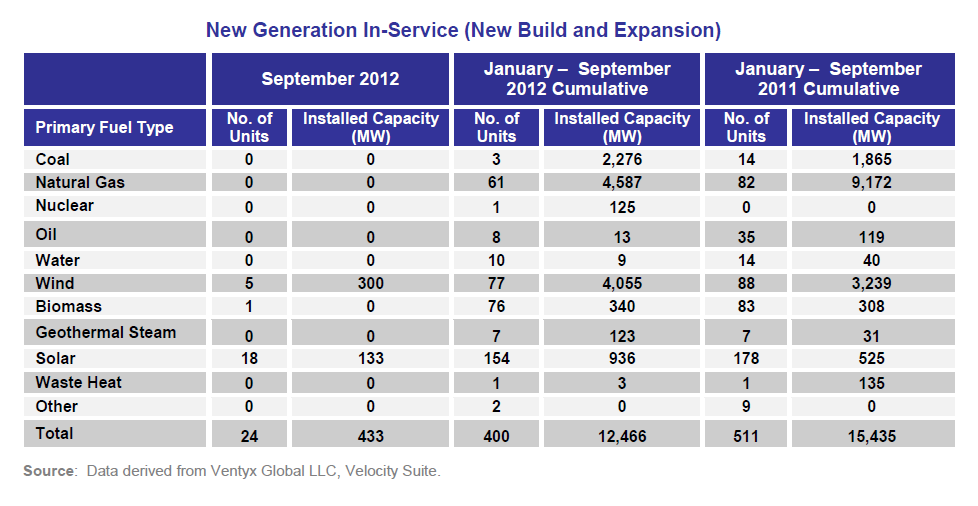
Wind and solar were all the new U.S. electric generation in September 2012

Wind and sun provided all the new electric power generation
deployed in September 2012.
As Moore’s Law continues to decrease solar prices, solar
power gets deployed still more rapidly,
and wind also gets installed on time and on budget.
Meanwhile, nuclear takes a

three-legged nuclear regulatory-capture stool

and hardly any new reactors get finished anyway.


Stephen Lacey wrote for TP Climate Progress 24 October 2012,

Wind And Solar Make Up 100% Of New U.S. Electricity Capacity In September
,

September was tied for the

hottest of any September
on record
globally. It was also a very hot month for renewable energy in the
U.S. According

to figures
from the Federal Energy Regulatory
Commission, wind and solar accounted for all new electricity
capacity added to America’s grid in September.

New wind is up 25% Jan-Sep 2012 over the same period last year,
and new solar is up 78%.
For comparison, new coal is

Continue reading

Solar and broadband are good for the economy and for PR

When

the Industrial Authority came out for solar and broadband

WCTV noticed.
It seems solar and broadband are good not only in themselves,
but also for good PR for the community.
PR that might attract the kinds of businesses the Industrial Authority
is looking for.


WCTV wrote 9 September 2012,

Solar Power and Broadband Internet Could Boost Local Job Growth
,

The Valdosta-Lowndes County Industrial Authority has put a spot
light on solar power and broadband internet. That’s according to a
new analysis of regional businesses and employment. They say it will
be a way to generate job growth going forward. Many in the community
agree.

Valdosta Resident Mark Yates said “if they could bring those all in,
it would be great for the economy and bring a lot of jobs for a lot
of people in town here.”

That’s how Saginaw, Michigan, attracted that second Suniva plant
away from Georgia:


it has a plan for solar industry and it gets it in the news.

Way better than

worrying what Albany thinks,
don’t you think?

By the way, Saginaw also goes for wind manufacturing jobs,
and we already have one wind manufacturing business right here; more on that
later.

It sure would be good if the Industrial Authority,
with its 1 mil tax rate or almost $3 million a year,
could succeed in attracting some jobs here:

Continue reading

What Georgia Power is afraid of: GaSU and Dr. Smith; and you

So what is Georgia Power afraid of

that made their CEO Paul Bowers double down on old-style baseload?

Competition, that’s what!
What could be more scary in the power-monopoly state of the

1973 Territorial Electric Service Act?


GaSU sun

On one side, Georgia Power faces

GaSU and its 80 or 90 MW solar plant proposal.

Walter C. Jones wrote for OnlineAthens 24 September 2012,

Proposed solar company could stir up Georgia’s utility structure
,

A proposal from a start-up business promises to lower electricity
rates by rebating profits to customers if given a chance to compete
as Georgia Power Co.’s “mirror image.”


GaSU fb profile image

To proceed with its long-range plan of developing 2 gigawatts of
solar power, the start-up, Georgia Solar Utilities Inc., wants to
start by building an 80-megawatt “solar farm” near
Milledgeville as soon as it gets a green light from the Georgia
Public Service Commission. GaSU filed its request last week, and as
of Monday, it’s still too fresh for public evaluation.

So radical is the proposal that spokespersons for Georgia Power and
the Georgia Solar Energy Association said they still were evaluating
it and could not comment.

Groups that normally advocate for customers also are staying quiet.

GaSU executives recognize such a big change won’t come easily.

Continue reading

San Onofre nuke might restart: why not solar and wind instead?

Southern California Edison bet on big baseload nuclear, and
has been out two units for eight months and counting.
Big baseload turns quickly from 24/7 to 0/7.
Tentative plans are forming for a restart, which will take
many more months, if ever.
Wouldn’t distributed solar and wind be quicker and smarter?
In Georgia, as well as California?

Michael R. Blood wrote for AP yesterday,

Troubled Calif. nuke plant aims to restart reactor,

The company announced plans to repair and restart one of two damaged


reactors, Unit 2, at reduced power to hopefully halt vibration that
has caused excessive wear to scores of tubes that carry radioactive
water. The outlook for its heavily damaged sister, Unit 3, appears
grim and no decision on its future is expected until at least next
summer.

The Nuclear Regulatory Commission is expected to take months to
review the plan, and there is no timetable to restart the plant.

There are a few signs that the eventual outcome is dawning on some utility people.

Plans are already taking shape that envision lower output from San
Onofre at least into 2013.

“Whenever you lose generation, it has implications,” said San Diego
Gas & Electric spokeswoman Jennifer Ramp.

Well, yeah, and losing big blocks of power is one of the implications
of depending on a few big baseload plants in the first place.
Distributed

solar

and

wind
wouldn’t have this problem.

-jsq

Georgia Power’s Bowers pushes solar misinformation out the next fifty years

Paul Bowers, CEO of Georgia Power, doubled down on baseload nuclear,
coal, and natural gas for the next fifty years.
What’s he scared of?

Nick Coltrain wrote for OnlineAthens yesterday,

Renewable push not in the cards for Ga. Power
,


Georgia Power CEO Paul Bowers in Georgia Trend, November 2011

“Renewable (energy sources are) going to have a sliver,”
Bowers said of fuels to create electricity. “Is it going to be
2 or 4 percent? That’s yet to be determined. Economics will drive
that. But you always remember (that renewable energy is) an
intermittent resource. It’s not one you can depend on 100 percent of
the time.”

One time you can depend on it is hot summer days when everybody is
air conditioning, which is why

Roger Duncan of Austin Energy in 2003


Austin Energy flipped in one year

from spouting such nonsense to deploying the most aggressive solar rooftop
rebate program in the country.
Austin Energy did the math and found those rebates would cost
about the same as a coal plant and would generate as much energy.
And when it is needed most, unlike the fossilized baseload grid,
which
left millions without power in the U.S. in June

and

hundreds of millions without power in India in July.

Bowers knows better than the nonsense he just spouted;
as recently as

November 2011 he told Georgia Trend,

Continue reading

Southern Company’s three-legged nuclear regulatory-capture stool


The

failed EDF nuke project at Calvert Cliffs in Maryland

makes it clearer why Southern Company (SO) was the first company
to get a nuclear permit in 30 years:
it was the only one big enough and monopolistic enough to pull it off.
Even then it’s such a

bet-the-farm risk

that even

“great, big company”

SO only dared
to deploy its

great big huge scale
equipment
with the regulatory capture triple-whammy
of
a stealth tax on Georgia Power bills,
PSC approval of cost overruns,
and
an $8.33 billion federal loan guarantee:


  1. a legislated

    stealth tax in the form of

    a rate hike on Georgia Power customers
    for
    power they won’t get for years if ever.
    If you’re a Georgia Power customer,
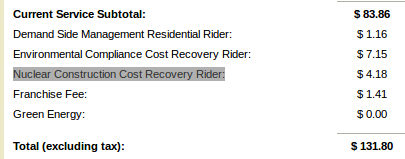
    look on your bill for Nuclear Construct Cost Recovery Rider.
    You’ll find it adds about 5% on top of your Current Service Subtotal.
    Georgia is one of only a handful of states where such a
    Construction Work in Progress (CWIP) charge is legal

    thanks to our regulatory-captured legislature.

    Doubling down on bad energy bets,
    Southern Company is also

    trying to use CWIP to build a coal plant in Mississippi.


  2. A captive Public Service Commission that

    rubber-stamps costs
    for Plant Vogtle.
    In case there was any doubt as to the PSC’s role in legitimizing those new nukes,
    the very next day Fitch reaffirmed Southern Company’s bond ratings.

    Southern Company’s regulated utility subsidiaries derive predictable
    cash flows from low-risk utility businesses, enjoy relatively
    favorable regulatory framework in their service territories, and
    exhibit limited commodity price risks due to the ability to recover
    fuel and purchased power through separate cost trackers.

    Translation: Georgia Power customers subsidize SO’s bonds
    and SO shareholders’ stock dividends.
    The PSC also approved
    cost overruns being
    passed on to Georgia Power customers,
    and those nukes are already over

    $400 or $900 million
    , depending on who you ask.
    What do you expect when

    4 out of 5 Public Service Commissioners
    apparently took 70% of their campaign contributions from utilities
    they regulate or their employees or their law firms,

    and the fifth commissioner took about 20% from such sources?
    Hm, there’s an election going on right now!


  3. An

    $8.33 billion federal loan guarantee.

    Even that’s not good enough for SO and Georgia Power: SO is
    asking for less down payment.

And what if even one of that three-legged regulatory capture stool’s legs
went away?

Continue reading

Bill Moyers on ALEC

Bill Moyers takes on ALEC.

Posted yesterday On Bill Moyers’ website,

‘United States of ALEC’ Video Previews

This week, Moyers & Company (check local listings) presents


“United States of ALEC,” a report on the most
influential corporate-funded political force most of America has
never heard of — ALEC, the American Legislative Exchange
Council. A national consortium of state politicians and powerful
corporations, ALEC presents itself as a “nonpartisan
public-private partnership”. But behind that mantra lies a
vast network of corporate lobbying and political action aimed to
increase corporate profits at public expense without public
knowledge.

He said more

on Huffington Post Wednesday,

Continue reading