Tag Archives: Wind

Georgia Power inches towards more solar, trailing New Jersey

If you’re quick, you may be able to sell solar from your roof
to Georgia Power.
If the PSC approves a pending request.
If you get in before that new quota gets filled.
And if you’re a Georgia Power customer.
The rest of us?
Not until the
1973 Georgia Electric Territorial Act
is changed.
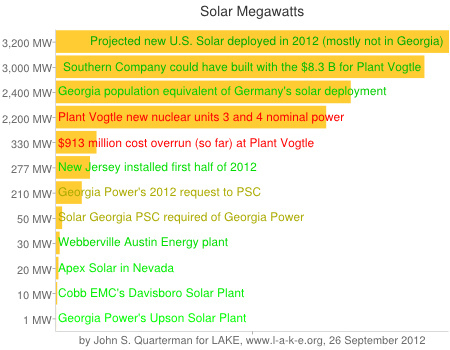
Until then, Georgia will continue to lag way behind New Jersey in solar power.


210 MW is more than 50 MW but way less than 3,000 MW

Walter C. Jones wrote for the Augusta Chronicle today,

Georgia Power plans to triple solar power use
,

Georgia Power filed Wednesday seeking permission from state
regulators to more than triple the amount of solar power it uses to
generate electricity for its 2.4 million customers by swapping it
for what was already planned from other renewable sources.

What “other renewable sources”?

The Georgia Power plan won’t affect rates because it is based on
paying the solar providers what it would have paid the biomass
provider, 13 cents per kilowatt hour, which is already figured into
customer’s rates.

OK, that’s good, because it means biomass is well and truly
dead in Georgia.
But it also means Georgia Power isn’t very serious about solar,
if all it’s doing is fiddling with accounting for the small amount
of power biomass might have produced and not going for the real
numbers solar can produce.
OK, how many solar megawatts?

Continue reading

Southern Company: let’s do the renewable energy study for Georgia

Mark Z. Jacobson's study shows

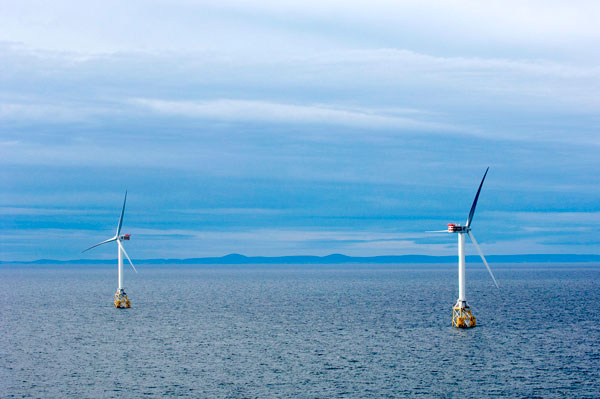
offshore wind is plentiful from Virginia to Maine

Let's

do the study for Georgia!

Southern Company

brags about its private R&D:

Research & Development (since the 1960s)


  • Awarded more than $1.3 billion to conduct more than $3.8 billion of research and development.
  • Qualified for $412 million of investment tax credits for a 21st century coal plant being built in Mississippi.

OK, SO, let's see you do the study to show what we can really do with


conservation, efficiency,
wind, sun, and less natural gas than we have now.
Sure, in the Georgia Bight we do have to contend with hurricanes.
But a

"great, big company"

like SO should be able to focus its vaunted private R&D on that problem and solve it.

Maybe SO doesn't want to do that because the result might show there is no need for
any coal plants, nor new natural gas plants, nor any nuclear plants, which would mean
Georgia Power would have to give up its nuclear-funding rate-hike stealth tax
and SO would have to give up its $8.3 billion loan guarantee.
Hey, we might even need to

change the 1973 Georgia Electric Territorial Act
,
and that might damage Georgia Power's guaranteed profit!
Nevermind that Georgia Power and SO might make more profit if they got out
in front on solar and wind power and a smart grid.

If SO won't do it, how about we elect some Public Service Commissioners and legislators who will?
For

jobs, energy independence, and profit, oh, and clean air and plenty of water!

-jsq

All U.S. east coast electricity could come from offshore wind 3 seasons out of 4

Why build nukes when wind can provide 3/4 of our power?
While Southern Company claims to be

“a company that is engaged in offering solutions, not just rhetoric”
,
yet

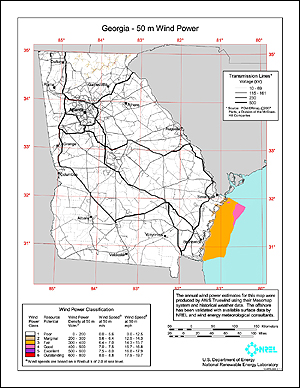
does nothing about wind off the Georgia coast,


researchers in far California have demonstrated we can get
3/4 of all needed east coast electricity from offshore wind.

Bjorn Carey wrote for Stanford Report 14 September 2012,

Offshore wind energy could power entire U.S. East Coast, Stanford scientists say

A new analysis by Stanford researchers reveals that there is enough
offshore wind along the U.S. East Coast to meet the electricity
demands of at least one-third of the country.


The scientists paid special attention to the Maine-to-Virginia
corridor; the historical lack of strong hurricanes in the region
makes it a favorable site for offshore wind turbines. They found
that turbines placed there could satisfy the peak-time power needs
of these states for three seasons of the year (summer is the
exception).

“We knew there was a lot of wind out there, but this is the first
actual quantification of the total resource and the time of day that
the resource peaks,” said Mark Z. Jacobson, a professor of civil and
environmental engineering at Stanford who directed the research.
“This provides practical information to wind farm developers about
the best areas to place turbines.”


Mark Z. Jacobson already worked out a framework for

powering the entire world from wind, water, and sun alone.

The late
John Blackburn, Ph.D., showed us how

to power North Carolina with sun, wind, and hydro,

plus less natural gas than NC uses now.
Now Jacobson is working out the details of implementation.

-jsq


PS: Owed to Seth Gunning.

Europe: no shale gas, more renewables

Europe has no shale gas, so, unlike the U.S., natural gas will
not be getting in the way of quickly moving to renewable wind and solar energy.

Barbara Lewis and Henning Gloystein wrote for Reuters 23 August 2012,

EU Green Energy Drive Says No To Shale Gas, Looks Towards More Renewable Power Sources
,

In the medium term, the value of conventional gas is in providing
reliable baseload power to supplement unpredictable renewables,
which depend on the sun shining or the wind blowing.

Danish state-owned utility

DONG Energy
, which has relied heavily on
coal-fired power generation, sees a combination of gas and
renewables as the way to go.


“We see gas-to-power and wind energy as the ideal mix, together
comprising clean and stable energy. Wind energy as the clean energy
source, and gas-to-power as the balancing power,” Carsten Krogsgaard
Thomsen, DONG Energy’s acting CEO, said.

Meanwhile, Windpower Monthly reported 13 August 2012,

Dong issues 2012 profit warning
,

Continue reading

Change the Atomic Energy Act? How about change the Georgia Electric Territorial Act?

In reaction to

the NRC denying a nuclear permit for Calvert Cliffs,


some nuclear backers suggest

changing the
Atomic Energy Act of 1954 to permit majority foreign ownership
of nuclear reactors.

What will they suggest next?
Asking Iran to invest in U.S. nukes?

Steve Skutnik wrote for http://theenergycollective.com 5 September 2012,

A cost-free way to open up nuclear investment
,

If this seems entirely backward in a world of global production and
investment, that’s because it is. The current regulation is an


artifact of the Atomic Energy Act of 1954, which first authorized
private ownership of nuclear facilities. (Prior to this—per
the Atomic Energy Act of 1946, all nuclear technology was considered
a state secret, during the short time in which the U.S. enjoyed a
monopoly on the technology.)

Is there any real compelling reason for restrictions on foreign
ownership and investment in nuclear facilities to exist at a time
when the U.S. holding a monopoly on the technology has long since
passed? Issues of safety here of course are irrelevant—the
facilities would be licensed and regulated by the NRC, just as any
other nuclear facility is now. About the only salient objection is
the political one—i.e., the implications of a foreign entity
maintaining controlling ownership in key infrastructure. (Although
it’s hard to see anyone getting particularly upset about the
reverse—U.S. entities owning a controlling stake in
infrastructure in other nations.)

Yeah, sure, strict regulation
will deal with that, just like it prevents fracking from setting
drinking water on fire, or BP from poisoning the Gulf.
The new NRC head is

maybe well-meaning
,
but it’s the same NRC

that gave Vogtle 1 a clean bill just before it had to shut down

and the same NRC that’s ignoring

cancer in Shell Bluff.

Oh, by the way, the article gets to the main point eventually:

Continue reading

NRC rejects nuke permit for EDF in Maryland

French nuclear operator Électricité de France (EDF)
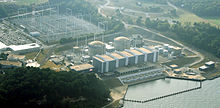


was denied a license last week for the proposed Calvert Cliffs

nuclear reactor in Maryland, because the
Atomic Energy Act of 1954 prohibits majority foreign ownership
of nuclear plants.
EDF now has 60 days to find a U.S. partner, or give up the project.
Who could the possible suitors be?
Hint: think southeast.

The handwriting was on the wall two years ago when
Constellation Energy pulled out of the project.
Jim Polson and Alan Katz wrote for Bloomberg 10 October 2010,

Constellation Drops Nuclear Plant, Denting EDF’s U.S. Plans
,

Constellation Energy Group Inc. pulled out of negotiations on a $7.5


billion loan guarantee to build a nuclear reactor in Maryland with
Electricite de France SA, potentially damaging the French utility’s
U.S. expansion plans and the companies’ partnership.

The cost of the U.S. government loan guarantee that the companies’
joint venture, UniStar Nuclear Energy, would need to build the
Calvert Cliffs 3 reactor is too high and creates too much risk for
Constellation, the Baltimore-based utility said in a statement
yesterday. The statement said the next step is up to EDF. Enlarge
image U.S. Deputy Energy Secretary Daniel Poneman

In a letter Oct. 8 to Daniel Poneman, deputy secretary of the U.S.
Department of Energy, Constellation said it received a government
estimate that the venture would have to pay about $880 million to
the U.S. Treasury for the loan guarantee, “dramatically out of
line with both our own independent assessments and of what the
figure should reasonably be.”

Constellation’s decision may make it more likely that the U.S.
utility will exercise a put option forcing EDF to buy as much as $2
billion of Constellation’s non-nuclear power plants, said Ingo
Becker, head of utilities sector research at Kepler Capital Markets.

“EDF very clearly said if they exercise the put, this thing is
over,” Becker said. “Constellation may have just turned
around the calendar and pulled out of the new build before
exercising the put, anticipating EDF’s reaction.”

In a letter Oct. 8 to Daniel Poneman, deputy secretary of the U.S.
Department of Energy, Constellation said it received a government
estimate that the venture would have to pay about $880 million to
the U.S. Treasury for the loan guarantee, “dramatically out of
line with both our own independent assessments and of what the
figure should reasonably be.”

Meanwhile, Southern Company

is still trying to reduce what it has to pay for its
$8.3 billion federal loan guarantee
.

Back in Maryland, the news got worse for the nuke last year.
EDF

asked for the state’s help
,
but didn’t get the answer it wanted.
Scott Dance wrote for Baltimore Business Journal 16 December 2011,

EDF: Constellation-Exelon settlement hurts Maryland nuclear industry
,

Continue reading

Energy experts making excuses for fracking

Numerous eminent current and former regulators, governors,
and legislators’ best advice for how to keep fracking from
polluting our aquifers and drinking water: “strict regulation”.
As Gandhi reputedly said about western civilization: that would be a good idea.
But in Georgia and many other places, where the regulatory agency
(GA PSC) and the legislature are pretty much captured by the utilities
they pretend to regulate, how will we get that “strict regulation”?

This was at a Politico event, sponsored by American Wind Power,
called Energy & the Presidency.

Join POLITICO for a lunch conversation with energy experts and
policy leaders

Energy & the Presidency panel

as they discuss current energy legislation, the
energy debates facing the nation, policy options and what’s ahead in
the year to come. Speakers include: ClearView Energy Partners’ Kevin
Book; former Administrator of the EPA and former Director of the
White House Office on Climate Change, Carol Browner; Rep. Ed Markey
(Mass.); former Gov. Bill Richardson (NM) and former Gov. Bill
Ritter (Colo.).

When: Wednesday, September 5, 2012 at 12:00 pm ET


This event was in North Carolina, where the late John Blackburn, Ph.D.
already reported two years ago that

the whole state could be powered by wind, sun, existing hydro, landfill gas, and less natural gas than is already in use,

why do we need fracking at all?

Georgia has similar real renewable energy potential,
plus studies by

Georgia Tech

and Duke
indicate that Georgia doesn’t need any additional total electric power
anyway, if it gets on with energy efficiency.
Add

solar
and

wind
instead of natural gas, and we can retire a lot of
coal plants.
With no need for fracking.

I have an idea:
let’s elect Public Service Commissioners and legislators who are not
beholden to the utilities they will regulate!

-jsq

New NRC head says agency is standing up for public health and safety

Sounds to me like the NRC is not telling its new chief everything.
For example, what about

Vogtle unit 1 shutting down right after it passed
an NRC review?

What about

cancer in Shell Bluff, Georgia,
near the reactors?


Mike M. Ahlers wrote for CNN 14 August 2012,

New NRC chair vouches for agency’s independence, states goals

Allison Macfarlane said Tuesday she has confidence in the agency and
its independence from the nation’s 104 commercial nuclear power
plants.

“I have some strong initial impressions of the agency, and one is
that I’ve been very impressed with the staff and their dedication to
safety, and their willingness to stand up to industry when they
believe a situation is not safe,” Macfarlane said in a wide-ranging
discussion with reporters.


“So I’m actually quite assured that the agency is completing its
mission of protecting public health and safety,” she said. “They
take safety issues very seriously. They take their role as
regulators very seriously and the public should be assure that they
have the public’s best interests in mind.”


Macfarlane said she hopes to build public confidence in the agency
by improving communication, increasing transparency and making NRC
documents understandable. “Some of them are rather opaque,” she
allowed.

She has said some slightly more impressive things back before
she was appointed.

Continue reading

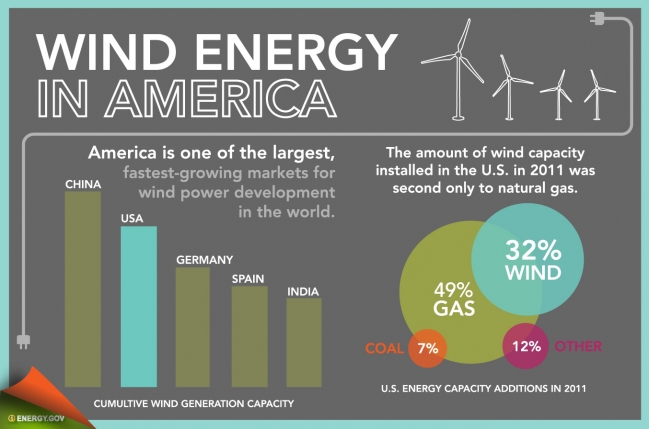
Wind second only to natural gas in 2011 added capacity

Looks like Southern Company (SO) bet on the wrong horse.

David Danielson wrote for DoE 14 August 2012,

A Banner Year for the U.S. Wind Industry
,

The report finds total U.S. wind power capacity grew to 47,000
megawatts by the end of 2011 and has since grown to 50,000
megawatts, enough to power 12 million homes annually — as many
homes as in the entire state of California. And as wind energy
capacity has grown, more and more wind turbines and components like
towers, blades, gears, and generators are “Made in
America.” Nearly 70 percent of all of the equipment installed
at U.S. wind farms last year came from domestic manufacturers,
doubling from 35 percent in 2005.


Why should SO worry? Wind only came in second in added capacity.
Because of this:

In addition to strong gains in domestic wind manufacturing and
capacity, the report finds that as wind technology improves, costs
are coming down. Technological innovations are helping make longer
and lighter wind turbine blades, while improving turbine performance
and increasing the efficiency of power generation. At the same time,
wind project capital and maintenance costs have continued to
decline.

And wind doesn't even have Moore's Law going for it as much as solar does,
plus solar is usable in more areas than wind.
Add wind and solar and why do we need much natural gas?
(Or any coal or nuclear?)

-jsq

Pass the Production Tax Credit for Georgia Jobs


At

yesterday’s wind rally on Tybee Island,

one spoke about

passing the Production Tax Credit

for

wind jobs in Georgia.

More pictures and videos in the
GA Sierra Club flickr set.

-jsq

PS: Owed to Seth Gunning.