Category Archives: Coal

Plant Scherer country’s dirtiest again!


Southern Company #1 and #2!
We get most of our electricity from #1 coal Plant Scherer
near Macon, and 1/4 of its power goes to Florida, dirtying our air.
SO says it’s worst only because it’s one of the biggest.
But it still emits more greenhouse gases than any other power plant
in the country.
#2 is only about twice as far away, and it’s also Southern Company.

Kate Sheppard wrote for Huffpost 10 September 2013,

Biggest Polluters In U.S. Ranked By Greenhouse Gas Emissions In New Report
,

The top five individual plants were:

  1. Georgia Power Company’s Plant Scherer

  2. Alabama Power Company’s James H. Miller Jr. Plant

  3. Luminant Generation Company’s Martin Lake Plant in Texas

  4. Union Electric Company’s Labadie Plant in Missouri

  5. NRG Texas Power’s W.A. Parish Plant

These power plants, said Julian Boggs, Environment America’s global warming program director, “are the elephant in the room when it comes to global warming.”

The report,

America’s Dirtiest Power Plants
,
by Environment America,
says (page 5) Plant Scherer alone produces 0.4% of all U.S. CO2 emissions
and 0.1% of all the world’s. Plant Miller emits almost as much, so that’s 0.8% of U.S. and 0.2% of world CO2
emissions from just the top 2 Southern Company coal plants.

How about we insist Georgia Power and Southern Company get on with solar
power inland and wind off the coast to replace all those coal plants and
the water-sucking nukes, too?

-jsq
Landfill is in aquifer recharge zone

In a recharge zone for

our drinking water supply, the Floridan Aquifer
,
is the Pecan Row Landfill


with its

PCBs
and

coal ash
.
That proposed

landfill pipeline
requiring cutting through the vegetative buffer
along an unnamed tributary to Spring Branch?
Also at least partly in the recharge zone. Continue reading

Landfill pipeline


Apparently

ADS’s landfill gas project

wants to take in methane from the closed old landfill, as well,
according to a public notice today that proposes
a pipeline from the old

Evergreen Landfill

to the

Pecan Row Landfill
that has the natural gas turbine.

Nevermind
the

$27,500 fine for PCBs
or
that

coal ash in the landfill
that nobody on the Lowndes County Commission
or Valdosta City Council or Deep South Solid Waste Authority (SWA) can be bothered to check on.
Nevermind the

unaccounted for
tipping fees
or
host fees.
I wonder if cutting through that vegetative buffer will let the coal ash and PCBs reach the Withlacoochee River more easily?


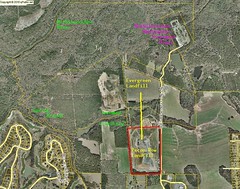
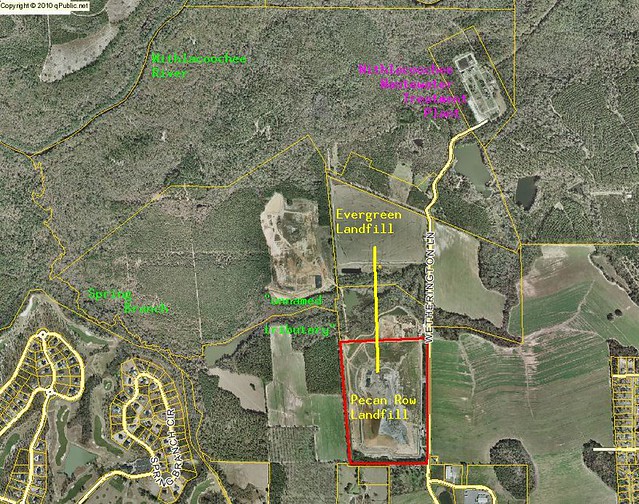
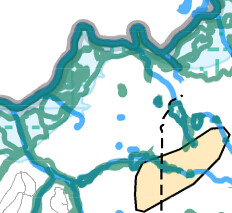
Location of proposed pipeline from Evergreen Landfill to Pecan Row Landfill


The yellow path indicated for the pipeline is just a guess.

In the VDT today,

PUBLIC ADVISORY NOTICE
,

The proposed project located west of Valdosta, in Lowndes County, GA
along Wetherington Lane near the Pecan Row Landfill facility (2995
Wetherington Lane, Valdosta, GA, 31601) involves buffer
encroachments necessary to install a 30-inch gas pipeline. This
pipeline will Continue reading

Bloomberg illustrates 63% solar growth in 2012

A graph Bloomberg New Energy Finance posted illustrates
the recent 60%+ growth deployed solar capacity, but
BNEF fails to project solar’s compound interest growth forward.


Look at the solar numbers in that graph:

2008 2009 2010 2011 2012
1.6 2.0 2.9 4.9 8.0
Change 25% 45% 69% 63%


Then look at that last row I added, which is each year’s
percentage increase over the previous year, as in
8.0 for 2012 divided by 4.9 for 2011 = 1.63 or 63%.
Slightly more for the previous year, and less in years before that.
In other words, the annual compound growth rate for solar is
around the 65% rate reported

by the solar industry
.

And slightly higher than the 60.9% FERC rate I used Continue reading

Pull out your phone, MacGyver, and take a picture of cars powered by rooftop solar


MacGyver needs to show an imprint on a floorboard to someone. Pull
out your phone and take a picture! No, in 1986

he MacGyvers a chisel
and hammer
and pries the floorboard up.


Even in 1996 the telcos and most of the public thought

dedicated copper and fiber connections were needed for reliable communications
.
(“Allison, can you explain what the Internet is?”)


But now you can pull out your phone and take a picture and post it over the packet-switched Internet to facebook for all the world to see.


In 2023 baseload nukes and coal plants and oil pipelines will be like
phone booths connected by dedicated copper, while rooftop solar charging
cars will be as common as phones in your pockets.
Solar power will win like the Internet did,
beating all other sources of power within a decade.


Meanwhile, Continue reading

Solar power will win like the Internet did

Remember BITNET, FidoNet, or UUCP?
Nope, the Internet overtook all of those.
And in 20 years that’s how young people will remember coal and natural gas plants,
although the waste-disposal costs of nukes will be with us for ten thousand years.
Solar power is going to overtake all other power sources within a decade.
Here’s why I think that.

Jerry Grillo quoted me in Georgia Trend July 2013,

Sun Dancing: As Georgia’s solar capacity shoots skyward, a new state utility is proposed
,


“Solar power is the fastest-growing industry in the world, and
it’s growing along in the same way the Internet did,” says
John S. Quarterman, a Harvard-educated author and Internet pioneer
who launched the first commercial online newsletter, among other
things, and who lives in rural Lowndes County.

“Think back 20 years to 1993. How many people had heard of the
Internet? And look at how far we’ve come. What I’m seeing with solar
energy is the same kind of exponential growth. It’s clean energy
that works, and it generates jobs.”

Here are 1992 ten-year graphs of Internet
growth from that newsletter, Matrix News,
using Continue reading

Solar will overtake everything –FERC Chair Jon Wellinghof

“Everybody’s roof is out there,” for solar power,
so natural gas or oil pipelines are a waste of time.


Solar prices dropping exponentially drive solar deployment up like compound interest, eventually onto everybody’s rooftops,
where eventually means in about a decade,
after which we’ll be ramping down natural gas like we’re already ramping down coal.
It’s time for Georgia Power and Southern Company and all of Georgia’s EMCs
to get on with solar and stop wasting resources on dead ends,
especially that bad idea of fifty years ago, nuclear power.

Herman K. Trabish wrote for Green Tech Media yesterday,

FERC Chair Jon Wellinghoff: Solar ‘Is Going to Overtake Everything’:
One of the country’s top regulators explains why he is so bullish on solar.

“Solar is growing so fast it is going to overtake
everything,” Wellinghoff told GTM last week in a sideline
conversation at the National Clean Energy Summit in Las Vegas.

If a single drop of water on the pitcher’s mound at Dodger Stadium
is doubled every minute, Wellinghoff said, a person chained to the
highest seat would be in danger of drowning in an hour.

“That’s what is happening in solar. It could double every two
years,” he said.

Indeed, as GTM Research’s MJ Shiao recently pointed out, in the next
2 1/2 years the U.S. will Continue reading

Climate change adversely affecting U.S. power grid

Yes, and moving away from baseload coal, nukes, and natural gas
and towards distributed solar and wind power will help with that,
both directly by making the grid more resilient, and indirectly
by slowing climate change.

Clare Foran wrote for NationalJournal 12 August 2013,
Climate Change Is Threatening the Power Grid:

So says the White House, in a new report that recommends strengthening the grid.


Just days away from the 10-year anniversary of the worst power
outage in U.S. history, the White House and the Energy Department
released a report on Monday evaluating the resiliency of the
nation’s electric grid and recommending steps to prevent future
blackouts.

The report called storms and severe weather “the leading cause of
power outages in the United States,” and warned against the steep
cost of weather-related damage to the electric grid. It put the
price tag for electrical failures caused by inclement weather at
between $18 billion and $33 billion annually, and noted that costs
have increased in recent years, jumping from a range of $14 billion
to $26 billion in 2003 to $27 billion to $52 billion in 2012. Storms
exceeding a billion dollars in damages (electrical and otherwise)
have also become more frequent in the past decade, as the chart
below shows.

Well,
Entergy’s Arkansas Nuclear 1 (ANO1) is still down

more than four months after a fatal accident

(hey,

look at that
; Continue reading

VDT links Plant Vogtle nuke cost overruns to Kemper Coal

Even the VDT has caught on to cost overruns for Kemper Coal and the
new nukes at Plant Vogtle.

VDT posted an AP article 29 July 2013,

Miss. deal may figure into Georgia nuclear plant
,
and
Charlotte Observer posted it the day before, including

Ray Henry

as the author,


In Mississippi, the Southern Co. utility took financial losses when
the cost of building a new power plant went over budget. In Georgia,
another of the company’s projects is going over budget, but it has
not yet taken a financial hit.

Southern Company subsidiary Mississippi Power promised utility
regulators that it would charge its customers only for $2.4 billion
in costs for building a coal-fired power plant in Kemper Country.
Those customers will also have to pay off another $1 billion in
bonds for the project, though the utility cannot make a profit off
that borrowed money.

The utility’s deal in Mississippi has become a point of debate as
Georgia regulators consider who should pay for the increased cost of
building two more nuclear reactors at Plant Vogtle (VOH’-gohl),
southeast of Augusta. Public Service Commissioner Tim Echols said he
wants Southern Co. subsidiary Georgia Power to consider a
Mississippi-style deal here, and Georgia regulators are carefully
tracking financial developments in Mississippi.


Echols said he was interested in the idea of a project spending cap.

“I’m sure when they made that deal they didn’t think they were going
to over the cap, but they did,” Echols said.

Oh, come now,

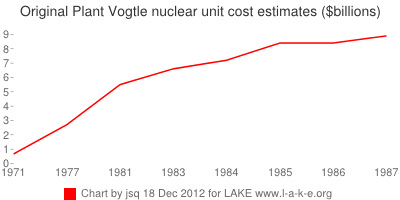
they went 26 times over budget last time
.
Why would anyone believe Continue reading

Southern Company missed earnings on Kemper Coal but Plant Vogtle is dominant

The dominant financial consideration
is “what’s going to happen with Georgia”,
meaning with nuclear Plant Vogtle,


said SO CEO Tom Fanning, referring to

the GA PSC CWIP monitoring hearings currently in progress
.
Meanwhile, that
$160 million estimate 2 July 2013 of more Kemper Coal cost overruns

by 30 July turned into
$278 million after taxes (AP)
.

This is on top of

$333 million after taxes in May
.
SO earnings fell 52% (WSJ), missing projections, and SO stock dropped 2% yesterday.


Remember GA PSC Tim Echols

already suggested a Plant Vogtle cost overrun cap

similar to the one Mississippi PSC applied to Kemper Coal that caused
SO to have to eat all those costs.
If that happens, SO’s got financial problems.

Has SO seen the solar light yet, as in reliable, dependable, and deployable
on time and on budget?
Nope.
Solar was tacked onto the end of

Tom Fanning’s summary of interesting stuff
in the 31 July 2013 earnings call
: Continue reading