Category Archives: Coal

Fossil Free Valdosta


Fossil Free Valdosta
, a facebook page just launched by
members of

S.A.V.E. (Students Against Violating the Environment)
,
under VSU’s new solar canopy:

A student campaign calling on Valdosta State University to freeze
any new investments in the fossil fuel industry immediately and
divest within the next five years.


You can help divestment by

signing their petition
.
That will help

VSU stop wasting investments on fossil fuels while solar stocks skyrocket
.
And that will help

undermine the political power of the fossil fuel industry
.
After all,
all our investments are political, and

there’s nothing neutral about investing in climate wreckage
.

-jsq

European utilities scared of renewable energy

Another reason

Southern Company needs to get on with
a smart grid,
using its

biggest private R&D outfit in the U.S.

Now that

solar has reached grid parity
with everything
including

natural gas

(and years since

it passed nuclear
), if the utilities
don’t get out in front, they’re going to be left behind.

Derek Mead wrote for Motherboard yesterday,

European Utilities Say They Can’t Make Money Because There’s Too Much Renewable Energy
,


Renewable energy has been on a tear the past few years, with growth in many countries spurred by subsidies for
wind and solar power. Now the heads of 10 European utility companies
say EU subsidies should end, because they've got more renewable
energy than they know what to do with.

The 10 CEOs in question, who refer to themselves as the Magritte
group because they first met in an art gallery, represent companies
that control about half the power capacity of Europe. The group gave
a press conference today—

Reuters says
that 10 such executives
giving a joint public statement is “unprecedented”—to hammer
home a message they’ve been trumpeting ahead of an EU energy summit
in 2014: There’s too much energy capacity, which has driven prices
down so far that they can’t make any money.


As long as there are nukes or coal plants, there’s too much capacity.
European utilities need to get on with things like Continue reading

Solar vs. fossil fuel stocks


Should Harvard President Drew Faust

worry that

“Significantly constraining investment options risks significantly constraining investment returns”?
Actually, if Harvard has been wasting investments in oil and gas for the
past year, its endowment has lost a bundle.
Ditto VSU.

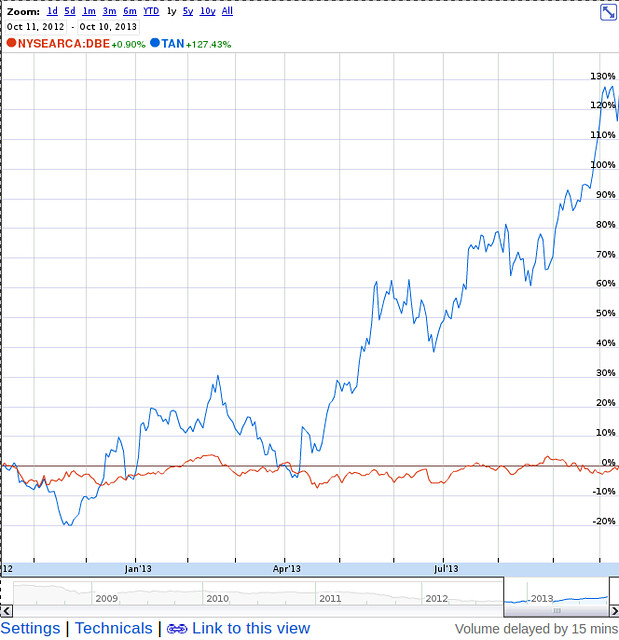
Let’s compare stock performance of

Guggenheim Solar ETF (NYSE:TAN)

which invests in solar stocks with the

PowerShares DB Energy Fund (NYSEARCA:DBE)
,
which invests in oil and natural gas companies.
Yep, that’s

120% for TAN and 0% for DBE
:


TAN solar v DBE oil and gas 1 year

Sure, if you go back farther, solar stocks continued to drop after 2009
until this year: Continue reading

Our investments are political –Divest Harvard to Drew Faust


Divest Harvard


summed it up
:

Our investments ARE political.

And that’s just as true at VSU.

Not even

Tim DeChristopher
put it more pithily than that.
Samantha Caravello wrote in the Harvard Law Record 7 October 2013,

Pres. Faust, There’s Nothing Neutral About Investing in Climate Wreckage
,
noting that

Pres. Faust’s excuses

were actually in response to
“an invitation from undergraduates to participate in an open forum
on divesting Harvard’s $32 billion endowment from the top 200 fossil
fuel companies.”

President Faust warned against using the endowment in ways that
would position the university as a political actor, claiming Continue reading

Divestment is about undermining the political power of the fossil fuel industry –Tim DeChristopher

Answering

Harvard President Drew Faust’s excuses
,

Tim DeChristopher, who

went to jail for directly opposing gas and oil drilling

and is now

a student at Harvard Divinity School
,

To seriously suggest that any research will solve the climate crisis
while we continue to allow the fossil fuel industry to maintain a
stranglehold on our democracy is profoundly naive.

Wen Stephenson
wrote for the Nation 4 October 2013,

Tim DeChristopher: There Is No ‘Neutral’ in the Climate Fight
,
including DeChristopher’s statement:


Drew Faust seeks a position of neutrality in a struggle where the
powerful only ask that people like her remain neutral. She says that
Harvard’s endowment shouldn’t take a political position, and yet it
invests in an industry that spends countless millions on corrupting
our political system. In a world of corporate personhood, if she
doesn’t want that money to be political, she should put it under her
mattress. She has clearly forgotten the words of Paolo Freire:
“Washing one’s hands of the conflict between the powerful and
powerless means to side with the powerful, not to remain
neutral.”
Or as Howard Zinn put succinctly, “You can’t
be neutral on a moving train.”

She touts Continue reading

Harvard excuses for not divesting from fossil fuels

Drew Faust wants us to believe Harvard can’t figure out how to power its
own campus and vehicles on renewable solar, wind, wave, and tidal energy?


Come on, pull the other one!

President Faust wrote that
divestment would make Harvard appear “as a political actor rather than an academic institution”,
that Harvard might not make enough money,
that “Universities own a very small fraction of the market capitalization of fossil fuel companies”, and that
“I also find a troubling inconsistency in the notion that, as an
investor, we should boycott a whole class of companies at the same
time that, as individuals and as a community, we are extensively
relying on those companies’ products and services for so much of
what we do every day.”
The first three excuses would have applied just as much back in the 1980s
when

Harvard finally divested from companies dealing in apartheid in South Africa
, a symbolic, and yes, political action that contributed markedly to the
release of Nelson Mandela, the downfall of the apartheid regime, and later
the election of Nelson Mandela as president of South Africa.

Harvard President Derek Bok, 18 May 1990,

in a letter to students

explaining the Unversity’s September 1989 decision
to divest from tobacco companies, since completed:


In reaching its decision, the corporation was motivated by a desire
not to be associated as a shareholder with companies engaged in
significant sales of products that create a substantial and
unjustified risk of harm to other human beings.

Harvard divestment was good enough for apartheid and tobacco.


In veritas, Harvard can have just as much or more influence by divesting
from fossil fuels, and that cause is even more important for the whole world.
In south Georgia truth, so can

Valdosta State University in its own region
.


Office of the President, Harvard,
3 October 2013,

Fossil Fuel Divestment Statement
;
I added the links and images, all directly related to Harvard.

Dear Members of the Harvard Community,

Continue reading

Divest VSU of fossil fuels –petition

The

divestment movement
has come to VSU,
thanks to
Danielle Jordan and
SAVE!
-jsq


Petition:

Divest Valdosta State From Fossil Fuels


To: VSU Administration and VSU Board of Trustees

We are asking Valdosta State University to:

  1. Disclose information on its investments

  2. To divest its holdings from fossil fuels within 5 years

  3. Freeze any new investments in the fossil fuel industry immediately


Why is this important?

As climate change progresses, we become more aware of the hazardous
consequences that manifest in relation to a warming planet. We
understand that in order to combat the issue, we have to alter our
daily practices. However. the lobbying power of the major fuel
companies has diminished the voices and power of individuals within
our political system. Subsequently, policy has been written to favor
the interests of the companies benefiting from the exploitation of
our environment.

We are asking Valdosta State to distance itself from this industry
and pursue alternatives, knowing that if we wish to address climate
change, a collaborative effort must be made. By joining this
movement, we can create a more ethical campus and move in the
direction of sustainability.

Which first to get more solar: fight big money or new technology?

In Georgia we’re still below 1% electric power generation from solar,
and we can get to 20-30% with no new technology whatever.


Georgia Power’s nuke overruns are

already causing a reaction of still more distributed solar
.
Yet even that good news gets the usual reaction:
“This is necessary but not sufficient: a breakthrough in energy storage technology is required.”
Which just ain’t so;
distributed rooftop solar alone is plenty to move Georgia way ahead.
That’s why

Edison Electric Institute calls distributed solar

a massively disruptive influence on the utilities’
century-old cozy baseload model.
What’s holding solar back is those same big utilities, who understandably
don’t want to change their long-time cash cow.
But they’re going to change, and pretty quickly.

People unfamiliar with the sunny south (which is most of the world
south of, oh, Germany), still say things like this: Continue reading

Nuke overruns already causing distributed solar in south Georgia

People are tired of

irresponsible trash government
at the state level
colluding with monopoly utilities to hold Georgia back in distributed
solar power, and some of us are doing something about it;
you can, too.


Jigar Shah
wrote for SaportReport 15 September 2013

Solar more viable as Georgia’s new nuclear power plants face overruns
,

I am seeing Georgia’s nuclear financial woes starting to prompt a
boon for distributed energy including solar, wind, biomass,
geothermal, low-impact hydro, high efficiency cogeneration, and
other sources of electricity.

Biomass?

Let’s not go back to that carbon-polluting forest-destroying factory-exploding waste of time and resources
.
Solar, wind, efficiency, and conservation are the main events, with solar increasingly leading the pack.
And those nuke cost overruns are already driving solar up even faster: Continue reading

Japan or south Georgia?

How is our local landfill like Fukushima?
No, not radiation: nobody seems to be responsible.

Colin P. A. Jones wrote for The Japan Times 16 September 2013,

Fukushima and the right to responsible government
,


Rather, the means of holding a member responsible for bad judgments
are internalized as part of the rules and discipline governing the
hierarchy to which they belong, with mechanisms for outsiders to
assert responsibility — to assert rights — being
minimized and neutralized whenever possible.

Sure, it’s not exactly the same.
Our local governments live in fear they’ll get sued (or so they claim),
and even sheriffs and judges occasionally get convicted around here.
But it’s quite difficult to get local elected officials to take their responsibility to the
people as seriously as “we’ve invested too much in that to stop now”
where “we” means the local government or more frequently a developer.

And privatizing the landfills and

now trash collection
is not that
dissimilar to the Japanese government keeping TEPCO afloat so they
have an unaccountable scapegoat for Fukushima.
Locally, nobody seems to even know, much less care, that the landfill
is Continue reading