Category Archives: Renewable Energy

Climate change adversely affecting U.S. power grid

Yes, and moving away from baseload coal, nukes, and natural gas
and towards distributed solar and wind power will help with that,
both directly by making the grid more resilient, and indirectly
by slowing climate change.

Clare Foran wrote for NationalJournal 12 August 2013,
Climate Change Is Threatening the Power Grid:

So says the White House, in a new report that recommends strengthening the grid.


Just days away from the 10-year anniversary of the worst power
outage in U.S. history, the White House and the Energy Department
released a report on Monday evaluating the resiliency of the
nation’s electric grid and recommending steps to prevent future
blackouts.

The report called storms and severe weather “the leading cause of
power outages in the United States,” and warned against the steep
cost of weather-related damage to the electric grid. It put the
price tag for electrical failures caused by inclement weather at
between $18 billion and $33 billion annually, and noted that costs
have increased in recent years, jumping from a range of $14 billion
to $26 billion in 2003 to $27 billion to $52 billion in 2012. Storms
exceeding a billion dollars in damages (electrical and otherwise)
have also become more frequent in the past decade, as the chart
below shows.

Well,
Entergy’s Arkansas Nuclear 1 (ANO1) is still down

more than four months after a fatal accident

(hey,

look at that
; Continue reading

New nukes make no financial sense –financial expert to GA PSC

If new nukes make no sense because of natural gas prices,
they make even less sense with continually-dropping solar power prices.

Ray Henry wrote for AP yesterday,

Regulator: New nuke plant now wouldn’t make sense
,

If Georgia was starting from scratch, it would not build a nuclear
power plant….


An analyst working for state regulators, Philip Hayet, said in
written testimony that the total costs of building two more nuclear
reactors at Plant Vogtle (VOH’-gohl) is more expensive than the
next-best option, constructing natural gas plants.

Still, Hayet said it is cheaper in most scenarios to finish the
nuclear plant rather than halt the project and instead build natural
gas plants.

But it’s not cheaper to finish a nuke than to halt it and
get on with wind offshore and distributed solar power throughout Georgia.

GA PSC didn’t publish Hayet’s calculations, using the old excuse of
“they involve proprietary financial information from Southern Co. subsidiary Georgia Power”.
But Edison Electric Institute didn’t need any proprietary financial
information to compute that Continue reading

EDF exits nuclear, focuses on solar and wind

EDF is moving to solar and wind, despite its excuse of shale gas for leaving
the U.S. nuclear market.
EDF already has almost twice as much solar and wind in the U.S., 2.3 gigawatts, as

the 1.2 gigawatts Southern Company plans by 2016
.


Maybe this means

Calvert Cliffs is finally dead

maybe along with

NRC’s attempt to change foreign ownership rules to accomodate EDF
.
EDF is the operator of France’s fleet of nuclear reactors,
including
caught-on-fire Cattenom
and many others

that drain over-hot water into French rivers in the summer
.

Reuters in Climate Spectator 31 July 2013

EDF exits US nuclear, focuses on renewables
,

French utility EDF, the world’s biggest operator of nuclear plants,
is pulling out of nuclear energy in the United States, bowing to the
realities of a market that has been transformed by cheap shale gas.

Several nuclear reactors in the US have been closed or are being
shuttered as utilities baulk at the big investments needed to extend
their lifetimes Continue reading

Southern Company missed earnings on Kemper Coal but Plant Vogtle is dominant

The dominant financial consideration
is “what’s going to happen with Georgia”,
meaning with nuclear Plant Vogtle,


said SO CEO Tom Fanning, referring to

the GA PSC CWIP monitoring hearings currently in progress
.
Meanwhile, that
$160 million estimate 2 July 2013 of more Kemper Coal cost overruns

by 30 July turned into
$278 million after taxes (AP)
.

This is on top of

$333 million after taxes in May
.
SO earnings fell 52% (WSJ), missing projections, and SO stock dropped 2% yesterday.


Remember GA PSC Tim Echols

already suggested a Plant Vogtle cost overrun cap

similar to the one Mississippi PSC applied to Kemper Coal that caused
SO to have to eat all those costs.
If that happens, SO’s got financial problems.

Has SO seen the solar light yet, as in reliable, dependable, and deployable
on time and on budget?
Nope.
Solar was tacked onto the end of

Tom Fanning’s summary of interesting stuff
in the 31 July 2013 earnings call
: Continue reading

The Economist answers Paul Bowers about carbon tax

Back in May someone asked Georgia Power CEO Paul Bowers what
he thought about a carbon tax,


and he answered
, “Why would anyone
want that?”
The Economist answered his question,
29 June 2013,

Tepid, timid:
The world will one day adopt a carbon tax—but only after exhausting all the alternatives
,

Winston Churchill famously said America would always do the right
thing after exhausting the alternatives. The right thing in climate


You can always count on Americans to do the right thing, after they ve tried everything else. --Winston Churchill

policy for all the big countries is a carbon tax, which is simpler
and less vulnerable to fluctuations in emissions than cap-and-trade
schemes. For years, such a tax has been a non-starter politically.
But as the alternatives are tested to destruction, it deserves to be
looked at again. Current environmental policies will not keep the
rise in global temperatures to below 2°C—the maximum that
most climate scientists think safe. A carbon tax, if stiff enough,
could. Big polluters should assume that such a tax will one day
arrive, and start planning for it now.

Dear Paul Bowers,


Stop being tepid and timid.
Go beyond Continue reading

German wind overpowering?

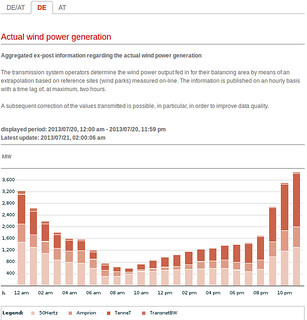
The biggest wind problem in Germany is it produces too much power?
Fortunately there are two well-known simple solutions to
this problem raised by GA Public Service Commissioner Tim Echols in
a comment yesterday.
I do want to thank him for engaging in dialog with the public.

Tim Echols

wrote
:


eeX DE wind 2013-07-20

We need nuclear, coal and gas as our baseload power. Germany is
doing the opposite and they are in trouble. Their people pay triple
what we pay for power, and when the wind is blowing at night or on
the weekend, the Germans have to pay Poland to take their excess
power. All of that primarily because the German people hate nuclear
power. In Georgia, we are leading the nation, and I am fine with
that. I just want to make sure our ratepayers are protected and not
paying for the learning curve of new nuclear.

As FERC Chairman Jon Wellinghof has been pointing out for years,

baseload is the problem
.
The baseload ideology stands in the way of

the distributed solar power the vast majority of the American people want
, and in the way of wind power.

Regarding German power costs to customers, Germany is far north of here,
with far less sun, and Germany has depended heavily on Feed-In Tariffs,
which may or may not be what we need in Georgia.
Meanwhile, what’s been hiking power rates in Georgia is not solar or wind
power, it’s

nuclear and natural gas
.
And not for Feed-In Tariffs, either, which are only charged on actual
energy production.
The Georgia legislature approved

Construction Work in Progress (CWIP) for nuclear
,
and GA PSC has raised rates to pay for natural
gas plant construction, which amounts to the same thing.
If we want to save ratepayers money,
we should get on with solar and wind power.

Now to the problem with two well-known solutions: Continue reading

Moody’s confirms excellent bond rating for Lowndes County School District

Lowndes Schools’ decrease of $4.1 million in annual bond payments after 2013
is more than the total

$3.6 million in bonds Dublin Schools issued

to pay for their

megawatt of solar power
.
So Lowndes Schools could float bonds for

solar panels at Lowndes High School

like Dublin Schools did for

Dubin High School
.
Or on the new Pine Grove Middle School,
which already has some

energy efficiency features
.
Either would decrease outgo in the future, thus evening up the financial structural balance and increasing reserve levels.

The SPLOST mentioned by Moody’s is the educational ESPLOST,
which
passed by more than 4 to 1 in March 2011
.


Moody’s PR 17 July 2013,

Moody’s confirms Lowndes County School District, GA’s Aa3 GO rating
,

$34.9 million in GO debt affected

New York, July 17, 2013 — Moody’s Investors Service has confirmed the Aa3 general obligation
rating of Lowndes County School District, GA. The Aa3 rating
affects $34.9 million in outstanding general obligation
bonds. The bonds are secured by the district’s general obligation,
unlimited tax pledge but are expected to be paid from proceeds of a one
percent Special Purpose Local Option Sales Tax (SPLOST). The district
has an additional $10 million in general obligation bonds not rated
by Moody’s.

SUMMARY RATING RATIONALE

The confirmation of the Aa3 rating reflects the district’s sizeable
and growing tax base, SPLOST support of debt service, modest
debt burden, and rapid payout. The rating also incorporates
the district’s below average socioeconomic indicators and recent
trend of General Fund operating deficits. Excluding a slight 1.7%
decline in fiscal year 2011, Lowndes County School District has
consistently experienced growth in the $3.87 million tax
base, which is expected to continue going forward. The base
benefits from the institutional presence offered by Moody Air Force Base,
Valdosta State University (A1/stable), and South Georgia Medical


Center (A2/stable). The current SPLOST is authorized through September
2017 and should provide sufficient revenues to make debt service payments.
In fiscal year 2012, SPLOST revenues were $12.4 million
compared to debt service payments of $12.2 million.
Following fiscal year 2013’s payment of $12.1 million,
the district’s payments will decline to just under $8 million
annually. Amortization is rapid with all debt fully matured by
fiscal year 2018. The district does not have any plans to issue
additional debt.

Continue reading

Solar power to Peru’s poorest

While we’ve been fighting over solar for 1% of Georgia Power’s production
(we won, yay!), Peru is busily providing solar power for almost all of its
poorest citizens.

Don Lieber wrote for PlanetSave 15 July 2013,

Peru To Power 2 Million Of Its Poorest — By Solar Energy

The first phase of the program, called “The National
Photovoltaic Household Electrification Program” was initiated
on Monday (July 8) in the Contumaza province, where 1,601 solar
panels were installed. These installations will power 126
impoverished communities in the districts of Cupisnique, San Benito,
Tantarica, Chilete, Yonan, San Luis, and Contai.


As MEM says,

PR 066-11 14 February 2011
,

The availability of solar power makes its use attractive throughout the whole country.

MEM remarked about a 20 MW solar plant in Moquegua,

PR 197-11 11 May 2011
,

Project will produce clean energy and generate local employment Continue reading

China ends a nuclear treatment plant after demonstrations

“In order to respect the popular will, the government of” the city of Heshan
refused to proceed with a $9 billion uranium processing plant.
That happened after this, yesterday:


The cancellation, unusually fast, demonstrates the increasingly important attention
given by the authorities to environmental concerns that are often expressed at the local level.
Several projects of petrochemical plants and metal processing have recently been postponed or relocated.

Yes, I know the plant may just be relocated somewhere else.
But with enough such demonstrations it won’t be built.
How about some of this respect for the popular will about,
for example, the natural gas pipeline through Georgia from Alabama to Florida,
or the new nukes at Plant Vogtle?

Le Monde, today, Continue reading

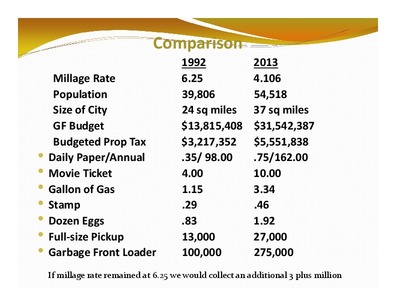
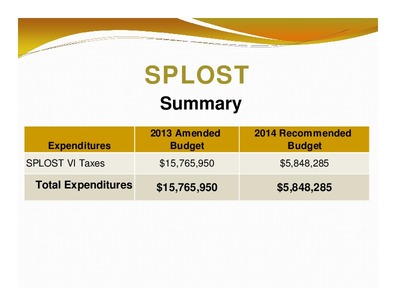
Valdosta budget with goals and accomplishments for each department

It’s too bad nobody came to Valdosta’s two public budget hearings,
because the city prepared
183 slides with details for each
department, including goals and accomplishments.


On

the LAKE website is that presentation
sent on request by City Clerk Teresa Bolden,
and
converted to HTML by LAKE.
Plus the actual budget.
No open records requests were required.
Oh, and Valdosta runs garbage collection on a balanced budget
without any exclusive franchises.

Valdosta News PR 20 June 2013,

City Delivers a Balanced Budget:
No property tax increase proposed for citizens
,


The Valdosta City Council approved the fiscal year 2014 budget for
the City of Valdosta at the June 20 City Council meeting, after
having the opportunity to hear the proposed budget at the hearings
on June 11 and 12. City staff presented the council with a balanced
budget, as required by the City Charter, possibly one of the most
challenging and difficult budgets prepared in years.


City leaders decreased the overall city budget from $86.2 million to
$77.3 million, a result of Continue reading