Tag Archives: Coal

Solar will overtake everything –FERC Chair Jon Wellinghof

“Everybody’s roof is out there,” for solar power,
so natural gas or oil pipelines are a waste of time.


Solar prices dropping exponentially drive solar deployment up like compound interest, eventually onto everybody’s rooftops,
where eventually means in about a decade,
after which we’ll be ramping down natural gas like we’re already ramping down coal.
It’s time for Georgia Power and Southern Company and all of Georgia’s EMCs
to get on with solar and stop wasting resources on dead ends,
especially that bad idea of fifty years ago, nuclear power.

Herman K. Trabish wrote for Green Tech Media yesterday,

FERC Chair Jon Wellinghoff: Solar ‘Is Going to Overtake Everything’:
One of the country’s top regulators explains why he is so bullish on solar.

“Solar is growing so fast it is going to overtake
everything,” Wellinghoff told GTM last week in a sideline
conversation at the National Clean Energy Summit in Las Vegas.

If a single drop of water on the pitcher’s mound at Dodger Stadium
is doubled every minute, Wellinghoff said, a person chained to the
highest seat would be in danger of drowning in an hour.

“That’s what is happening in solar. It could double every two
years,” he said.

Indeed, as GTM Research’s MJ Shiao recently pointed out, in the next
2 1/2 years the U.S. will Continue reading

Climate change adversely affecting U.S. power grid

Yes, and moving away from baseload coal, nukes, and natural gas
and towards distributed solar and wind power will help with that,
both directly by making the grid more resilient, and indirectly
by slowing climate change.

Clare Foran wrote for NationalJournal 12 August 2013,
Climate Change Is Threatening the Power Grid:

So says the White House, in a new report that recommends strengthening the grid.


Just days away from the 10-year anniversary of the worst power
outage in U.S. history, the White House and the Energy Department
released a report on Monday evaluating the resiliency of the
nation’s electric grid and recommending steps to prevent future
blackouts.

The report called storms and severe weather “the leading cause of
power outages in the United States,” and warned against the steep
cost of weather-related damage to the electric grid. It put the
price tag for electrical failures caused by inclement weather at
between $18 billion and $33 billion annually, and noted that costs
have increased in recent years, jumping from a range of $14 billion
to $26 billion in 2003 to $27 billion to $52 billion in 2012. Storms
exceeding a billion dollars in damages (electrical and otherwise)
have also become more frequent in the past decade, as the chart
below shows.

Well,
Entergy’s Arkansas Nuclear 1 (ANO1) is still down

more than four months after a fatal accident

(hey,

look at that
; Continue reading

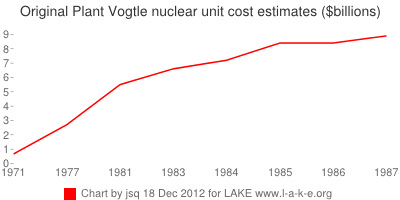
VDT links Plant Vogtle nuke cost overruns to Kemper Coal

Even the VDT has caught on to cost overruns for Kemper Coal and the
new nukes at Plant Vogtle.

VDT posted an AP article 29 July 2013,

Miss. deal may figure into Georgia nuclear plant
,
and
Charlotte Observer posted it the day before, including

Ray Henry

as the author,


In Mississippi, the Southern Co. utility took financial losses when
the cost of building a new power plant went over budget. In Georgia,
another of the company’s projects is going over budget, but it has
not yet taken a financial hit.

Southern Company subsidiary Mississippi Power promised utility
regulators that it would charge its customers only for $2.4 billion
in costs for building a coal-fired power plant in Kemper Country.
Those customers will also have to pay off another $1 billion in
bonds for the project, though the utility cannot make a profit off
that borrowed money.

The utility’s deal in Mississippi has become a point of debate as
Georgia regulators consider who should pay for the increased cost of
building two more nuclear reactors at Plant Vogtle (VOH’-gohl),
southeast of Augusta. Public Service Commissioner Tim Echols said he
wants Southern Co. subsidiary Georgia Power to consider a
Mississippi-style deal here, and Georgia regulators are carefully
tracking financial developments in Mississippi.


Echols said he was interested in the idea of a project spending cap.

“I’m sure when they made that deal they didn’t think they were going
to over the cap, but they did,” Echols said.

Oh, come now,

they went 26 times over budget last time
.
Why would anyone believe Continue reading

Southern Company missed earnings on Kemper Coal but Plant Vogtle is dominant

The dominant financial consideration
is “what’s going to happen with Georgia”,
meaning with nuclear Plant Vogtle,


said SO CEO Tom Fanning, referring to

the GA PSC CWIP monitoring hearings currently in progress
.
Meanwhile, that
$160 million estimate 2 July 2013 of more Kemper Coal cost overruns

by 30 July turned into
$278 million after taxes (AP)
.

This is on top of

$333 million after taxes in May
.
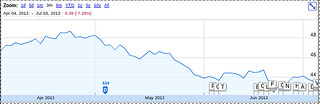
SO earnings fell 52% (WSJ), missing projections, and SO stock dropped 2% yesterday.


Remember GA PSC Tim Echols

already suggested a Plant Vogtle cost overrun cap

similar to the one Mississippi PSC applied to Kemper Coal that caused
SO to have to eat all those costs.
If that happens, SO’s got financial problems.

Has SO seen the solar light yet, as in reliable, dependable, and deployable
on time and on budget?
Nope.
Solar was tacked onto the end of

Tom Fanning’s summary of interesting stuff
in the 31 July 2013 earnings call
: Continue reading

The Economist answers Paul Bowers about carbon tax

Back in May someone asked Georgia Power CEO Paul Bowers what
he thought about a carbon tax,


and he answered
, “Why would anyone
want that?”
The Economist answered his question,
29 June 2013,

Tepid, timid:
The world will one day adopt a carbon tax—but only after exhausting all the alternatives
,

Winston Churchill famously said America would always do the right
thing after exhausting the alternatives. The right thing in climate


You can always count on Americans to do the right thing, after they ve tried everything else. --Winston Churchill

policy for all the big countries is a carbon tax, which is simpler
and less vulnerable to fluctuations in emissions than cap-and-trade
schemes. For years, such a tax has been a non-starter politically.
But as the alternatives are tested to destruction, it deserves to be
looked at again. Current environmental policies will not keep the
rise in global temperatures to below 2°C—the maximum that
most climate scientists think safe. A carbon tax, if stiff enough,
could. Big polluters should assume that such a tax will one day
arrive, and start planning for it now.

Dear Paul Bowers,


Stop being tepid and timid.
Go beyond Continue reading

German wind overpowering?

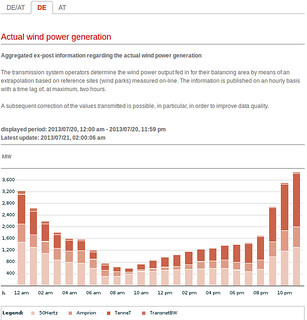
The biggest wind problem in Germany is it produces too much power?
Fortunately there are two well-known simple solutions to
this problem raised by GA Public Service Commissioner Tim Echols in
a comment yesterday.
I do want to thank him for engaging in dialog with the public.

Tim Echols

wrote
:


eeX DE wind 2013-07-20

We need nuclear, coal and gas as our baseload power. Germany is
doing the opposite and they are in trouble. Their people pay triple
what we pay for power, and when the wind is blowing at night or on
the weekend, the Germans have to pay Poland to take their excess
power. All of that primarily because the German people hate nuclear
power. In Georgia, we are leading the nation, and I am fine with
that. I just want to make sure our ratepayers are protected and not
paying for the learning curve of new nuclear.

As FERC Chairman Jon Wellinghof has been pointing out for years,

baseload is the problem
.
The baseload ideology stands in the way of

the distributed solar power the vast majority of the American people want
, and in the way of wind power.

Regarding German power costs to customers, Germany is far north of here,
with far less sun, and Germany has depended heavily on Feed-In Tariffs,
which may or may not be what we need in Georgia.
Meanwhile, what’s been hiking power rates in Georgia is not solar or wind
power, it’s

nuclear and natural gas
.
And not for Feed-In Tariffs, either, which are only charged on actual
energy production.
The Georgia legislature approved

Construction Work in Progress (CWIP) for nuclear
,
and GA PSC has raised rates to pay for natural
gas plant construction, which amounts to the same thing.
If we want to save ratepayers money,
we should get on with solar and wind power.

Now to the problem with two well-known solutions: Continue reading

GA PSC member ties Plant Vogtle nuke cost overruns to Kemper Coal in Mississippi

If Georgia Power stonewalls on cost overruns, will it lose
at least one Commissioner this time?


Long-time nuclear supporter Tim Echols suggested at

the hearings this morning

that cost overruns at nuclear Plant Vogtle should be capped like Southern Company
was forced to do for Kemper Coal by the Mississippi PSC.
Standard & Poor’s already

downgraded SO because of Kemper Coal

and two analysts have

downgraded SO for sticking to coal and nukes instead of doing more solar and wind
.
If SO’s majority part Georgia Power loses the GA PSC, it could be curtains
for Plant Vogtle’s new nukes.

Ray Henry wrote for AP this morning,

Southern Co. challenged on nuclear plant costs
,

Southern Co. subsidiary Georgia Power has asked to raise the budget
for its share of massive project by $737 million to roughly $6.85
billion.

Public Service Commission Tim Echols asked whether the firm has
considered offering a deal like one it reached in Mississippi over a
separate plant that also proved expensive to build. The company has
absorbed $540 million in losses in Mississippi and could face more.

Remember, Tim Echols has for two years now been Continue reading

More solar by Georgia Power –GA PSC

It’s a win for jobs and clean air and plenty of water in Georgia!
Doubled requirements on solar power, and a dozen coal plants shut down.


2, 4, 6, 8, solar power can’t wait!

The

astroturf resistance fizzled
, while the pro-solar grassroots
coalition won.
(Pictures of the two demonstrations by Ted Terry.)

525 megawatts more solar power required, on top of

last year’s 210 megawatts
, for more than 735 MW total.
That’s still

trailing New Jersey’s already-installed 1,000 MW
,
but it’s a big step forward.

The vote was either 4 to 1 (
Ray Henry of AP
)
or 3 to 2 (Georgia Sierra Club tweeting from the Commission chamber).
As

Ray Henry tweeted
:

“All opposed, say aye.” Wait, what? #gapsc


I’m guessing at least one nay vote was Stan Wise, judging by these
@gasierraclub tweets: Continue reading

Koch astroturf vs. solar jobs for Georgians

More solar for Georgia must be a good thing if AFP is organizing
astroturf against it.
GA PSC decides Thursday.
Like another speaker
at

GA PSC last month
,
I don’t think even

Bubba McDonald’s proposal to double solar requirements on Georgia Power

goes

nearly far enough
,
but at least it’s a start, which is more than Georgia Power will do
unless nudged by GA PSC.


Ray Henry wrote for AP yesterday,

Critics’ numbers misleading in Georgia solar fight:
Georgia panel will vote soon on power plan
,

A political group founded by billionaire brothers Charles and David
Koch wants Georgia’s utility regulators to reject a plan requiring
Southern Co. to buy more solar energy, but an Associated Press
review finds it has used misleading figures to build its case.

The Georgia chapter of Americans For Prosperity, founded by
billionaire brothers Charles and David Koch, wants Georgia’s utility
regulators to reject a solar energy plan in Georgia. But an
Associated Press review ahead of a vote on the issue finds that it
has used misleading figures to build its case.

The Georgia chapter of Americans For Prosperity has said in mass
e-mails that Continue reading

SO’s plan to make the Southeast a net exporter of the energy from solar and wind? –John S. Quarterman @ SO 2013-05-22

SO CEO Tom Fanning didn’t budge from nuclear and coal,
but he did announce a tiger team to get on top of
distributed solar and wind through a smart grid,
headed by SO’s COO,
at the

22 May 2013 Southern Company Stockholder Meeting
.


Next question --Tom Fanning

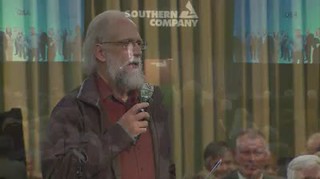
Mr. John S. Quarterman from Lowndes County, Georgia, and he holds
220 shares of Southern Company.

TF: Hello, John. Good to see you again this year.


jsq with SO fade

jsq: Hi. I’ve come to compliment Tom Fanning and Paul Bowers. Last
year, Tom Fanning was so persuasive I ran out and bought $10,000
worth of stock.

TF: Bless you.
[Applause]

However,
apparently because of

SO’s admission a few minutes before in that same meeting

that it was going to have to eat Kemper Coal cost overruns,


SO stock tanked that same day
,
causing my stock to stop out,
and Standard & Poor’s downgraded SO the following day
because of Kemper Coal, noting that if the same thing happened
with SO’s nuclear project at Plant Vogtle, S&P’s would probably Continue reading