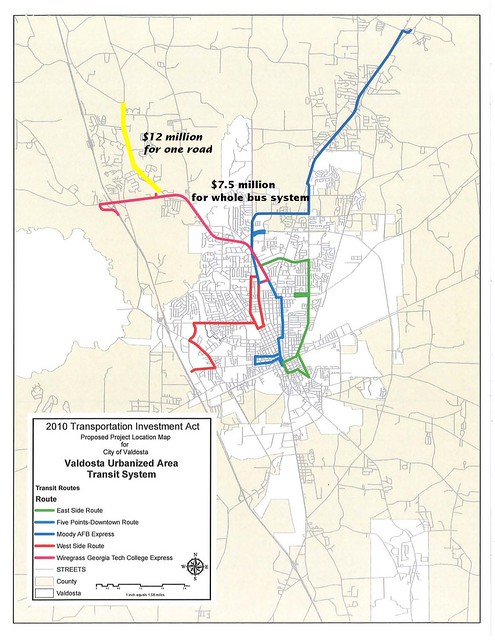
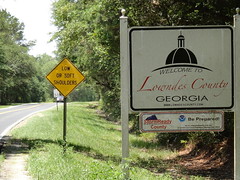
Many T-SPLOST projects submitted by Lowndes County would make traffic safety
worse.
More from Professor Ellen Dunham-Jones of Georgia Tech:
Even Buford Highway, she says, could be transformed with medians,
trees and buildings set closer to the road. Changes that are known
to slow traffic. But outside of the ivory tower, change does not come
easily. Or quickly.
Last year Georgia spent more than two billion dollars on transportation,
but only a tiny fraction, less than 1 percent, went specifically to
pedestrian safety.
And what Lowndes County has sent in for T-SPLOST funding includes:
Traffic on Old Pine will be regulated by the amount of people who
use the highway;
traffic on Bemiss since you and I moved out there forty years ago.
…
I’m not going to argue Bemiss Highway, it’s not a pertinent fact.
That’s right, traffic and traffic safety are considered not pertinent
to building subdivisions, according to the Chairman of the Lowndes County
Commission, and the actions of the Commissioners and staff.
The developer gets to consider only their one property and
the neighbors get to deal with all the effects on all the related roads.
Privatization of profits and socialization of problems
such as traffic accidents.
Does that seem right to you?
If not, it’s going to go on until more people argue and
debate.
In fact, many of Lowndes County’s T-SPLOST tax request would make the problem worse.
See
next post.
Maybe people are starting to notice that far more people die in traffic
accidents in the U.S.A. than in foreign wars.
The projects submitted by Lowndes County for
TSPLOST funding
would make this problem even worse,
except the bus system, which wouldn’t require road widening.
In recent years a little noticed shift has been transforming suburbia:
the home of the middle class has become the home of the working poor. As
a result, roadways that were built for the car are now used by a growing
population that can’t afford to drive. The consequences can be deadly.
According to a recent report, by two national transportation groups,
about 43 thousand pedestrians were killed in the U.S. in the last decade;
“the equivalent of a jumbo jet going down roughly every month.”
Of course, the problem didn’t start with an increase in pedestrians.
Continue reading →
Schoolchildren, safety, and farmland: three topics that often seem forgotten in discussions of development.
Opposing the
proposed rezoning for Notthinghill,
neighbor Thomas E. Stalvey Jr. noted
that traffic on Cat Creek Road
is already a problem, and adding a subdivision would make it worse.
He noted that it’s traffic routed down Cat Creek to Moody that
accounts for a lot of it.
He said school children stood out on the road and they were already in danger.
“If we put 49 more houses out there, it’s just going to up the risk.”
“The very first
contract
for the first private prison in America
went to CCA, from INS.”
Hear her in this video
Private Prisons-Commerce in Souls by Grassroots Leadership
that explains the private prison trade of public safety for private profit:
A local leader once called private prisons “good clean industry”.
Does locking up people for private profit sound like “good clean industry” to you?
Remember, not only is the U.S. the worst in the world for locking people up
(more prisoners per capita and total than any other country in the world),
but Georgia is the worst in the country, with
1 in 13 adults in the prison system.
And private prisons
don’t save money and
they
don’t improve local employment.
As someone says in the video, who wants to live in a prison colony?
We don’t need a private prison in Lowndes County, Georgia.
Spend that tax money on rehabilitation and education.
Vince Schneider warned county homeowners that it could happen to them, too:
To permit
the establishment of the Foxborough Avenue McDonalds, the county has
irreversibly established a most terrible precedence. You too can wake
up one morning to find a Fast food store being built in your front
yard.
Like many of us, he wondered what the county government is thinking:
I cannot comprehend how the county can possibly
benefit from allowing such an establishment to be built in a quite
county residential neighborhood. Is it because it provides unskilled
low paying jobs? Will this McDonalds look good on a resume? It was my
understanding that Valdosta and Lowndes County wanted to attract a more
skilled, professional work force. The real estate on Foxborough Avenue
the county permitted McDonalds to build on would have been, and is prime
real estate for just such a professional enterprise….
Residential home owners of Lowndes County take notice —Vince Schneider @ LCC 14 June 2011
Regular Session, Lowndes County Commission (LCC),
Valdosta, Lowndes County, Georgia, 14 June 2011.
Videos by Gretchen Quarterman for LAKE, the Lowndes Area Knowledge Exchange.
After Vince Schneider finished reading his letter,
Chairman Ashley Paulk handed him a paper, which was apparently
a communication from County Engineer Mike Fletcher.
Appended is the text of the letter Vince Schneider read to the Commission.
Continue reading →
LAST week authorities
captured two fugitives who had been on the lam
for three weeks after escaping from an Arizona prison. The convicts and
an accomplice are accused of murdering a holiday-making married couple
and stealing their camping trailer during their run from justice. This
gruesome incident has raised questions about the wisdom and efficacy of
private prisons, such as the one from which the Arizona convicts escaped.
“Poorly fitted air conditioners cost New York City 130 to 180 million
dollars a year in extra energy consumption,” one of the strategists,
Capt. Wayne Porter of the Navy, said Tuesday. “They generate 370,525
extra tons of carbon dioxide.”
Suppose, he says, you fixed them. And then you got the 40 states
that waste the most electricity to match the 10 most efficient. The
likely benefits are no surprise — less foreign oil, cost savings,
job creation, decreased pollution.
Now follow that thread to
“A National Strategic Narrative,”
a paper
written by Captain Porter and Col. Mark Mykleby of the Marines, which
calls on the United States to see that it cannot continue to engage the
world primarily with military force, but must do so as a nation powered
by the strength of its educational system, social policies, international
development and diplomacy, and its commitment to sustainable practices
in energy and agriculture.
“We must recognize that security means more than defense,” they
write. After ending the 20th century as the world’s most powerful
country, “we failed to recognize that dominance, like fossil fuel,
is not a sustainable form of energy.”
How much does it cost to pave 3.5 miles of dirt road?
Apparently $1,413,097.92, or around a million dollars a mile,
when the county insists on paving it like a state highway
at the expense of safety:
How Much
To Whom
From
For What
$7,200.00
Lovell Engineering Associates
Valdosta
Design of Culvert
$48,010.00
Doyle Hancock & Sons Construc.
Doerun
Clearing and Grubbing
$1,357,887.92
The Scruggs Company
Valdosta
Paving
$1,413,097.92
All contractors
Total
This financial information comes from an open records request
filed by Carolyn Selby more than a year ago
and finally fulfilled 17 March 2011.
Copies of all the pages received are
in the flickr set.
How many other roads could have been paved for $1.4 million?
If this road had been paved like a local rural road,
instead of like a state highway (literally according to
state highway standards) it would not have cost nearly
as much and probably another shorter road could have been paved, too.
And if other roads were paved like local roads instead of state
highways, how many more of them could be paved?
They still wait while this one got paved to the tune of $1.4 million.
U.S. nuclear-power output remained near a 4½-year low for a fourth day
as the Vogtle 1 reactor in Georgia shut down unexpectedly, the Nuclear
Regulatory Commission said.
Power generation nationwide decreased 538 megawatts to 71,781 megawatts
from yesterday, or 71 percent of capacity, the smallest amount since
Oct. 22, 2006, according to an NRC report today and data compiled by
Bloomberg. Twenty-nine of the nation’s 104 reactors were offline.
Southern Co. (SO)’s 1,109-megawatt Vogtle 1 reactor automatically
tripped offline yesterday at 5:34 p.m. when it was at full power. The
cause is under investigation, the NRC said.