
Last month former U.S. Nuclear Regulatory Commission Chair Jaczko
said all 104 operating U.S. nuclear power reactors are unsafe.
This month former Indian
Atomic Energy Regulatory Board Chair Gopalakrishnan
says the reactors currently building in India, already three years
behind schedule and now found to incorporate numerous defects and
deficiencies amid gross lack of transparency, must be stopped.
When will the NRC stop the restart of the flawed and non-transparent San Onofre 2?
When will the NRC or GA PSC or the GA legislature or even Southern Company
coming to its senses stop the 19-month-late $1-billion-overbudget
flawed-concrete Plant Vogtle 3 and 4 before they waste any more
of our resources that could be going to solar and wind jobs and energy?
Tag Archives: Plant Vogtle
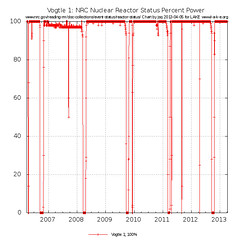
Fire at Plant Vogtle
Does a
Nuclear Operations Unusual Event (NOUE) give you a warm and fuzzy feeling?
When it’s a fire at a nuke on the Savannah River?
They didn’t shut Unit 1 down for that,
but Unit 2 has been down for almost a month.
NRC
Current Event Notification Report for April 4, 2013,
NOTIFICATION OF UNUSUAL EVENT BASED ON A FIRE IN THE PROTECTED AREA
LASTING GREATER THAN 15 MINUTES
“Vogtle Unit 1 has declared an NOUE based on a fire within the
protected area boundary not extinguished within 15 minutes of
detection.“At 0632 [EDT] Unit 1 received a fire alarm in the Unit 1 control
building. A systems operator was dispatched to investigate and
reported back that a small flame was visible inside 1ND3I1, computer
inverter. Fire brigade was dispatched in accordance with fire
response procedures. No other systems or parameters affected.
Even the smallest amount of tritium can have negative health impacts, and most nukes leak tritium.
Received yesterday on
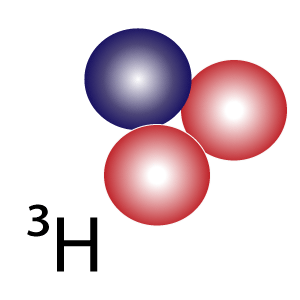
Nuclear Plant Hatch radioactive leaks. Tritium (3H, a radioactive isotope of hydrogen)
is the stuff nuclear Plant Hatch
is letting leak into our groundwater.
NRC lists 44 leaking sites
out of 65 active reactor locations.
No solar or wind plants leak tritium.
-jsq
In case you haven’t seen this yet:
TRITIUM: HEALTH CONSEQUENCES.
Excerpt:Most studies indicate that tritium in living creatures can produce
Apple: from 35% to 75% renewable energy in two years
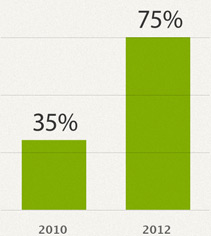
All it takes is the will to get it done, and Apple is doing it:
from 35% renewable energy in 2010 to 75% in 2012, and 100%
at all Apple data centers.
Cost? They’ll save more than they spent.
Time for Georgia Power and Southern Company to stop dragging their feet
and help us get on with it in Georgia.
Peter Burrows wrote for Bloomberg Thursday that
Apple got nudged:
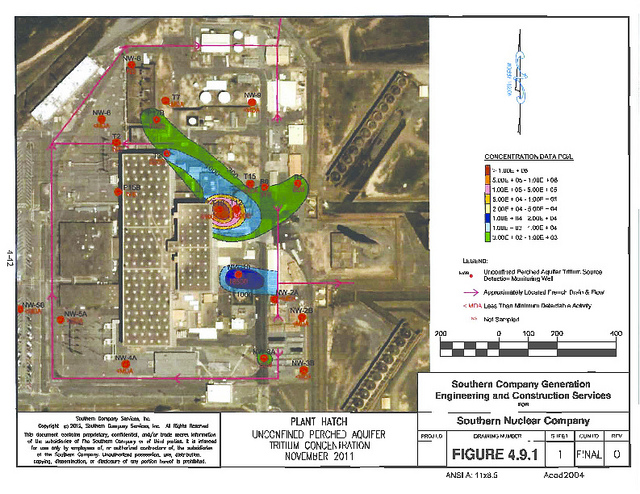
Nuclear Plant Hatch radioactive leaks
The NRC publishes annual
Radioactive Effluent and Environmental Reports for every operating nuclear power reactor.
The reports for
Plant Hatch 1 & 2 say
radioactive tritium has repeatedly leaked into the soil and groundwater,
but the internal swamp is getting less radioactive.
Reports like this are not needed for wind or solar plants.
Annual Radiological Environmental Operating Reports for 2011
According to a 2007
Industry Groundwater Protection Initiative Voluntary Data Collection Questionnaire,
Renewable Portfolio Standards: GA, NC, and ALEC
Renewable Energy Portfolio Standards (RPS) are being proposed
in Georgia and ALEC is trying to do away with them in North Carolina.
If ALEC doesn’t like them, there must be something good about RPS.
Let’s get on with real renewable energy in Georgia.

In Georgia,
HB 503,
sponsored by Karla Drenner, Carol Fullerton, Debbie Buckner, Scott
Holcomb, Spencer Frye, and Earnest Smith,
would create a Renewable Energy Credits Trading program as part of
renewable portfolio standards,
as Kyle wrote for Spencer Frye’s blog 10 March 2013,
Let the Sunshine In.
Unfortunately, HB 503 includes biomass as a renewable energy source.
Maybe they just mean landfill gas, which I consider a special case
since it’s being produced anyway, and since methane is worse as
a greenhouse gas than CO2, burning landfill gas makes some sense.
Nope, in
the actual bill, 46-3-71 (1):
‘Biomass material’ means organic matter, excluding fossil fuels and black liquor,
including agricultural crops, plants, trees, wood, wood wastes and residues, sawmill
waste, sawdust, wood chips, bark chips, and forest thinning, harvesting, or clearing
residues; wood waste from pallets or other wood demolition debris; peanut shells; cotton
plants; corn stalks; and plant matter, including aquatic plants, grasses, stalks, vegetation,
and residues, including hulls, shells, or cellulose containing fibers
The barn door in there is “harvesting”, which can mean whole trees,
but the rest isn’t much better.
We don’t need to be burning things that increase atmospheric CO2
and end up stripping our forests.
In
North Carolina they staretd with just tops and limbs and then tried to escalate
to whole trees.
We already
fought off the biomass boondoggle here in south Georgia;
let’s not have it encouraged statewide.
Especially when we have better solutions: solar and wind power.
HB 503 isn’t going to get passed this year, since it didn’t make
crossover day, so maybe its sponsors can clean up that biomass mess
before they submit it again.
Speaking of North Carolina,
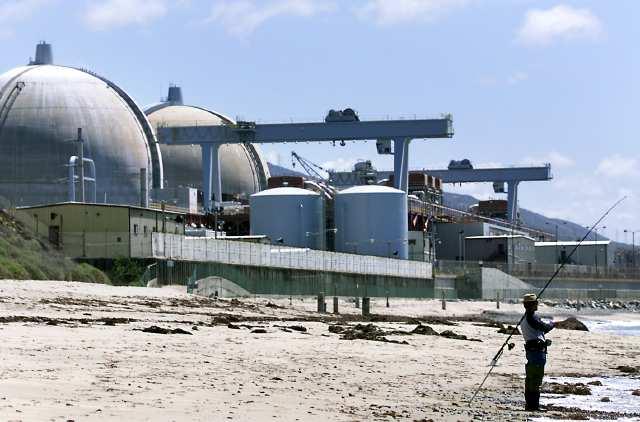
SC Edison knew San Onofre nuke steam generators were flawed before installation
Southern California Edison knew the new steam generators
were defective years before then even installed them in
the San Onofre nuclear reactors,
acccording to a report just released. These are the generators
that failed and caused both San Onofre reactors to shut down.
SD Edison wants to restart one of them,
and this document came out in that process.
Southern Company would never do this, right?
We shouldn’t worry about
failed concrete
or
15, no now 19, months delay
while the Georgia legislature
won’t even limit charges to Georgia Power customers for cost overruns.
Nope, no worries.
Friends of the Earth PR 8 March 2013,
San Onofre: Secret Report Confirms Edison Knew of Major Problems;
Friends of the Earth: ‘Bombshell’ for plans to restart crippled reactor
WASHINGTON—March 8—A secret Mitsubishi Heavy Industries
report released today confirms that Southern California Edison knew
about serious problems in the radically redesigned replacement steam
generators for the San Onofre nuclear reactors years before the
defective equipment was installed, yet failed to make changes to fix
the problems. The report was released today by the Nuclear
Regulatory Commission after Senator Barbara Boxer (D-Calif.) and
Representative Edward Markey (D-Mass.) revealed its existence and
demanded it be made public.The report documents that Edison knew
Already: Solar grid parity without subsidies in India and Italy
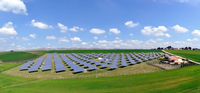
Solar power is going so well worldwide that Deutsche Bank has just
increased its projections for global demand,
noting that India and Italy have already in 2013 reached grid parity
without subsidies with other sources of energy,
and it expects the rest of the world to follow as early as 2014.
The big winner is rooftop solar.
Is Georgia paying attention?
Becky Beetz wrote for Global PV 26 February 2013,
Deutsche Bank: Sustainable solar market expected in 2014,
Buoyed by bullish demand forecasts, and increasing utilization rates
and pricing, Deutsche Bank forecasts a solar market transition from
subsidized to sustainable in 2014. Italy REC solar photovoltaic
plantThe German bank has raised its 2013 global solar demand forecast to
30 GW — representing a 20% year-on-year increase — on
the back of suggestions of strong demand in markets including India,
the U.S., China (around 7 to 10 GW), the U.K. (around 1 to 2 GW),
Germany and Italy (around 2 GW).Rooftop installations are, in particular, expected to be a main
focus, says Deutsche Bank. A trend for projects being planned with
either “minimal/no incentives” has also been observed, despite the
belief that solar policy outlooks are improving, particularly in the
U.S., China and India, and “other emerging markets”.
More analysis by
Jeff Spross in ThinkProgress 3 March 2013,
Solar Report Stunner: Unsubsidized ‘Grid Parity Has Been Reached In India’, Italy–With More Countries Coming in 2014.
As Renew Economy also
points out, this is the third report in the past month
Levy Co. FL nuke likely not to be built
Cost already sunk Kewaunee, Calvert Cliffs, Crystal River, and are gnawing
away at San Onofre: now it looks like new owner Duke is not
likely to build Progress Energy's Levy County, Florida reactor.
All that plus even in Georgia, even against all-powerful Georgia Power,
there's a reaction against the cost of the always-later always-more-expensive
new nukes at Plant Vogtle on the Savannah River.
A reaction that's getting written up in the Valdosta Daily Times.
In the VDT today from AP,
Some leaders souring on nuclear power costs.
I'm quoting from the abcNews version
because it includes the author's name, Ray Henry,
and the original date, 3 March 2013.
I added all the links and images.
As the cost of building a new nuclear plant soars, there are signs
of buyer's remorse.The second-guessing from officials in Georgia and Florida is a sign
that maybe the nation is not quite ready for a nuclear renaissance.
On top of construction costs running much higher than expected, the
price of natural gas has plummeted, making it tough for nuclear
plants to compete in the energy market.In Georgia last week, Southern Co. told regulators it needed to
raise its construction budget for Plant Vogtle in eastern Georgia by
$737 million to $6.85 billion. At about the same time, a Georgia
lawmaker sought to penalize the company for going over budget,
announcing a proposal to cut into Southern Co.'s profits by trimming
some of the money its subsidiary Georgia Power makes.
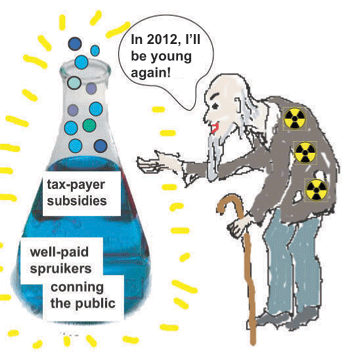
And Southern Company and Georgia Power slipped the Plant Vogtle schedule
still more,
from 15 to 19 months late.
The legislation has a coalition of tea party, conservative and
consumer advocacy groups behind it, but faces a tough sale in the
Republican-controlled General Assembly. GOP Rep. Jeff Chapman found
just a single co-sponsor, Democratic Rep. Karla Drenner.
That's
HB 267: Financing costs; construction of nuclear generating plant.
And AP failed to mention
Georgia Sierra Club's support for HB 267.
As a regulated monopoly, Georgia Power currently earns about 11
percent in profits when it invests its own money into power
projects. Chapman's legislation would reduce those profits if the
nuclear project is over budget, as is the current projection.
In Florida, there's a move to completely
eliminate Construction Work in Progress (CWIP)
such as is being used in Georgia to pre-fund the new Plant Vogtle nukes.
In Florida, lawmakers want to end the practice of utilities
collecting fees from customers before any electricity is produced.
Florida only recently got CWIP, but Progress Energy has been quick to profit by it:
HB 267 Would Limit Georgia Power’s Profits on Vogtle’s Cost Overruns —GA Sierra Club
There’s still time to contact your state legislators about stopping
Georgia Power profitting from cost overruns on the new nukes
at Plant Vogtle.
Georgia Sierra Club spells out why.
Georgia Power’s expansion at Plant Vogtle will bring us power that
is dangerous, expensive and unnecessary.You may remember a controversial bill the Georgia Legislature
approved in 2009,
SB 31, the Nuclear Construction Work in Progress
(CWIP) bill, which forces Georgia Power ratepayers to pay the
financing costs during construction, rather than over the life of
the plant. Large users of electricity are exempt from the charge,
but residential and mom and pop businesses have been paying for two
years.Even after that sweetheart deal, the Public Service Commissioners
scrapped their staff
proposal to stop the company from profiting on
cost overruns for the project after they top $300 million.The most recent reports from the independent monitor established by
the PSC says
that the project is months behind and as of December,
$88 million over budget. Georgia Power gets to earn 11.15% return on
all expenses approved by the PSC, so the more they have to spend,
the more they get to make and the more ratepayers get to pay!Putting the profit issue aside for the moment, if the Georgia PSC
ever decided to disapprove cost overruns, Georgia Power could take a
page from the Mississippi Power playbook and just get the
Legislature to let them issue bonds to pay for the work.
HB 267 by freshman Rep. Jeff Chapman excludes the collection of any
profits on cost overruns beyond the
$6.4 billion the Public Service Commission has approved.
The bill is co-sponsored by Avondale
Estates Democrat Karla Drenner, who is a member of the Utilities
Committee, to which the bill was assigned. Passage of this bill
would provide an incentive for Georgia Power to keep expenses down
at Vogtle, something that SB 31 failed to do.It isn’t fair for Georgia Power to profit to the tune of over 11% on
delays, overruns and mismanagement, so
ask your State Representative to support HB 267.
-jsq