It reads:
Climate Action.
Divest Now!
Nobody seems to know how it got there.
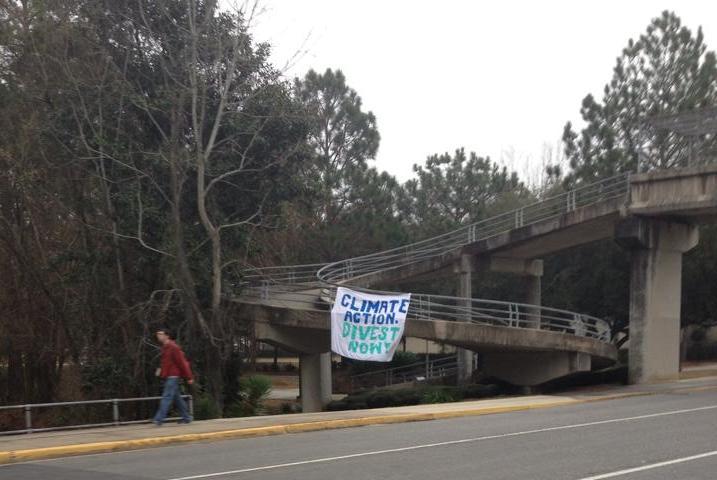
-jsq
It reads:
Climate Action.
Divest Now!
Nobody seems to know how it got there.
-jsq
Maybe that’s what the VSU Foundation wants to tell SAVE
when they dine Monday:
VSU gets it (even if Harvard doesn’t) that fossil fuels are a bad investment and solar is where the profits, students, and investors are.
Diane Cardwell
wrote for DealBook 30 January 2014,
Foundations Band Together to Get Rid of Fossil-Fuel Investments,
Seventeen foundations controlling nearly $1.8 billion in investments
have united to commit to pulling their money out of companies that
do business in fossil fuels, the group announced on Thursday.The move is a victory for a developing divestiture campaign that has
found success largely among small colleges and environmentally
conscious cities, but has not yet won over the wealthiest
institutions like Harvard, Brown and Swarthmore.But the participation of the foundations, including the Russell
Family Foundation, the Educational Foundation of America and the
John Merck Fund, is the largest commitment to the effort, and stems
in part from a push among philanthropies to bring their investing in
line with their missions.“At a minimum, our grants should not be undercut by our
investments,” Continue reading
The VSU Foundation has invited SAVE to dinner Monday.
No agenda is known, but the Foundation gets four attendees
and SAVE gets two.
Foundation attendees are to be:


William J. McKinney,
ninth president of VSU, and ex-officio VSU Foundation board member,
who at the solar canopy inauguration said

“I am committed to developing a culture of sustainability on this campus”.
The two attendees from
Students Against Violating the Environment (S.A.V.E.),
each apparently twice as heavyweight as a Foundation Trustee,
will be: Continue reading

If Europe can do it, the U.S. can do it.
And we know
Georgia can get a third of its power from wind,
and even Spain is north of Mississippi, Alabama, Georgia, and Florida,
which have a lot more sun for solar power than anywhere in Europe.
Solar power
is already winning, even in Georgia.
Let’s help it win even faster, plus wind.
PR from Potsdam Institute for Climate Impact Research (PIK) 16 January 2014,
EU could cut emissions by 40 percent at moderate cost,
The costs of achieving a more ambitious EU climate target are
estimated to be moderate. Upscaling greenhouse-gas emissions
reduction from the current 20 percent by 2020 to 40 percent by 2030
would be likely to cost less than an additional 0.7 percent of
economic activity.
And that apparently doesn’t count the additional economic activity
that would be produced by all those wind and solar deployments,
not to mention related activities like electric cars.
This is actually a pessimistic study, because it doesn’t account
for such likely positive corollaries.
Many options to choose from—wind power could expand sevenfold
An article that dismisses without investigation the fastest
growing industry in the world, solar power, after solar has become
cheaper than any other energy source, is not a serious article.

Richard Smith wrote for Truthout 9 January 2014,
Green Capitalism: The God That Failed.
Sure,
there are lots of good points in there (such as we need a carbon tax,
but it’s not enough), but given that
only 90 companies account for 2/3 of GHG emissions
saying we can’t change that without crashing the world’s economy is
like saying we can’t deal with horse manure in cities in 1900 without
crashing the world’s economy, and
people did say things like that back then.
Most of the world’s oil and gas is used to produce power,
so once we
convert to solar and wind,
we’ll have plenty of remaining petroleum for other uses
such as lubrication.

Saying in 2014 that solar and wind can’t power the world is like
saying in 1994 that Continue reading
300,000 people have their drinking water poisoned by
a coal chemical in a disaster declared by a state and the federal government.
Do we know what’s in that coal ash
coal ash
in the Lowndes County landfill?
Do we trust a pipeline company
with
a long list of safety violations
to dig into our aquifer?
David Jackson wrote for USA Today yesterday,
Obama sends disaster aid to West Virginia,
President Obama is sending federal assistance to West Virginia,
where schools and businesses are closed after a chemical spill
Thursday into a Charleston river.“The President today declared an emergency exists in the State of
West Virginia and ordered federal aid to supplement state and local
response efforts,” said an administration statement on Friday
morning.Under the order, the Department of Homeland Security and Federal
Emergency Management Agency will coordinate efforts with local
officials.
Kiley Kroh
wrote for Thinkprogress yesterday,
West Virginia Declares State Of Emergency After Coal Chemical Contaminates Drinking Water, Continue reading
And the same is true in Georgia, despite Georgia Power and Southern Company.
John Downey wrote for
Charlotte Business Journal 23 October 2013,
Study: Solar benefits outweigh costs in NC
An independent study published by a nationally known energy
consultant asserts that adding 500 megawatts of solar generation in
North Carolina would save utility ratepayers about $26 million
annually.It notes the gains from solar projects — such as lower
transmission and distribution costs, avoided emissions, lower losses
of electricity in transmission.
The study calculates that such benefits
outweigh the costs by 30 percent to 40 percent.
Update 2017-04-25:
Energy NC seems to have removed or moved its copy of that report,
but fortunately SEIA lists it
on
a backup website, and I’ve linked it into the quotation above, plus a copy on the LAKE website.
SEIA also lists many other studies for other states, such as
one for Virginia which is on the
MDV-SEIA website, and now also has
a copy on the LAKE website.
For Georgia SEIA lists the testimony of GSEIA before the Georgia Public Service Commission in 2013.
For Florida SEIA lists only a very old (2003) study with a broken link,
which can be found as a google book, but now would mostly be worthwhile as a museum piece.
Duke’s own actions in Florida in 2016 and 2017 indicate
Duke Energy knows the sun is rising even on the Sunshine State.
The study considered two intertwined solar methods: Continue reading

How to get Georgia Power and Southern Company off of
nuclear
and onto offshore wind and onshore solar power: stop approving
Construction Work in Progress (CWIP)
rate hikes for nukes that are already a billion dollars
over budget and more than a year late.
So far Mississippi is doing better about this than Georgia,
by
capping ratepayer and taxpayer costs for Kemper Coal.
Iowa did, and look what happened.
SimplyInfo wrote 23 December 2013,
What Power Companies Do When Nuclear Is No Longer An Easy Option, Continue reading

This was an op-ed submission to the VDT, which didn’t respond.
Today’s the GA PSC vote, so I’m blogging it now.
On Tuesday, the Georgia Public Service Commission (PSC) wants to do
for coal what
the Florida PSC already did for that gas pipeline
Sabal Trail wants to gash through here: raise utility customer
rates!

Who wants a Christmas present of higher electricity rates and
continued coal smoke, plus increased guaranteed profit for Georgia
Power of 11.5%? They
already raised rates each of the last three
years for gas and nuclear plants not yet even built; why should we
permit more rate hikes when the PSC votes December 17th? Last week’s
Public Policy poll
found 69% of Georgia voters oppose that rate hike.
Is a one-time payment enough to let a huge 36 inch fracked methane
pipeline gash through our communities while Spectra Energy of
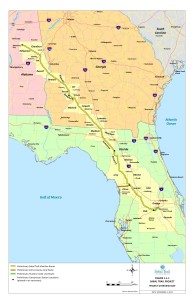
Houston and FPL of Juno Beach, Florida profit forever, and your
property values go down and your hazards go up?
Those FPL profits come from rate hikes on your cousins the Florida
ratepayers.
AARP opposes that, saying: Continue reading
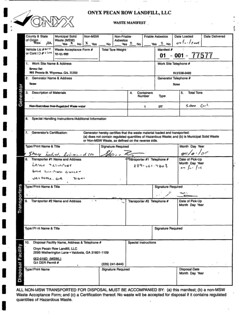
At the
EPA meeting in Waycross about the Seven Out Superfund site,
EPA, GA EPD, and state health officials also had information about
crossover contamination in Lowndes County.

Matthew J. Huyser, On-Scene Coordinator for U.S. EPA,
told me that before
EPA shipped those 196,500 gallons of wastewater from Seven Out to the Pecan Row Landfill in Lowndes County
they had applied procedures that were supposed to ensure those liquids
were no longer toxic and had tested them to be sure.
He said he would send me the specifics on that.
I didn’t ask him whether
CSX toxic wastes were shipped to Lowndes County.

Huyser also said EPA had checked the record of that receiving landfill
before sending anything there, and it had a good record.
He seemed surprised to learn Continue reading


