Tag Archives: prison

Biomass down for now: next?


Congratulations to all who worked against the biomass plant:
today was the deadline on its most recent extension,
so it’s gone for now.
Congratulations to WACE and SAVE and NAACP and New Life Ministries
and everyone else who was involved, especially Natasha Fast, Seth Gunning,
and Brad Bergstrom, who were working against it before almost anyone else.

Congratulations to those who were instrumental even though they were not
exactly or originally biomass opponents, especially

Ashley Paulk,

who came out and said what needed to be said,
and

George Bennett,
who
was willing to admit in public that he was one of the earliest
proponents of the biomass plant but new knowledge caused him to think differently.

A big shoutout to the
VSU Faculty Senate
,
the only traditional non-activist body that went on record as opposing
the biomass plant with an actual vote before the extension deadline.
The VSU Faculty Senate did what the Valdosta City Council, the Lowndes County Commission and the Industrial Authority Board would not.
Go Blazers!


A special strategic mention to Kay Harris and David Rodock of the
Valdosta Daily Times, who came to realize they were not being told the
whole truth by the Industrial Authority.
The VDT even

gave a civics lesson on how to stop the biomass plant.

And a very special mention to the people who did the most to make the
name of biomass mud in the public’s eye:


Brad Lofton, Col. Ricketts, and the VLCIA board.
Without their indoctrination sessions and paid “forum” and stonewalling,
people wouldn’t have been turned against that thing nearly as fast!

Yet it ain’t over until it’s over.

According to

David Rodock in the VDT today:

Continue reading

Farmers complain about labor shortage due to Georgia immigration law

Jeremy Redmon wrote in the AJC 26 May 2011,

Farmers tie labor shortage to state’s new immigration law, ask for help

Migrant farmworkers are bypassing Georgia because of the state’s tough
new immigration enforcement law, creating a severe labor shortage among
fruit and vegetable growers here and potentially putting hundreds of
millions of dollars in crops in jeopardy, agricultural industry leaders
said this week.

Who could have predicted such a thing?

Anyway, how is it going?

Continue reading

Who will pick Vidalia onions now that immigrants are scared away?

Could Georgia’s

anti-immigration law
already have ill effects?

AP wrote May 20, 2011,

Immigration crackdown worries Vidalia onion county
:


Signs point to an exodus in Vidalia onion country. Fliers on a
Mexican storefront advertise free transportation for workers willing
to pick jalapenos and banana peppers in Florida and blueberries in the
Carolinas. Buying an outbound bus ticket now requires reservations. While most states rejected immigration crackdowns this year, conservative
Georgia and Utah are the only states where comprehensive bills have
passed. With the ink barely dry on Georgia’s law, among the toughest
in the country, the divisions between suburban voters and those in
the countryside are once again laid bare when it comes to immigration,
even among people who line up on many other issues.

Guess who wanted this crackdown even though rural south Georgians didn’t:

The crackdown proved popular in suburban Atlanta, where Spanish-only
signs proliferate and the Latino population has risen dramatically over
the past few decades. Residents complain that illegal immigrants take
their jobs and strain public resources.

That’s right: Atlanta, not content with lusting after our water,
now scares off our workers.


Do immigrants really take jobs from locals?
Such claims never seem to have data to back them up.
I tend to agree with

Carlos Santana
:

“This is about fear, that people are going to steal my job,” Santana said
of the law. “No we ain’t. You don’t clean toilets and clean sheets,
stop shucking and jiving.”

In south Georgia local people won’t pick Vidalia onions for the wages
immigrants will, and the wages locals want the farmers can’t afford.


Remember who profits from this crackdown, at the expense of Georgia
farmers and taxpayers:

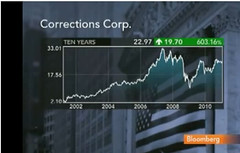
private prison companies and their investors.

We don’t need a private prison in Lowndes County.
Spend those tax dollars on education instead.

-jsq

PS: Vidalia onion story owed to Jane Osborn.

Another Sunday, another preacher against private prisons

Neal Peirce wrote:

And Sicilia had a stern judgment to make — as King did in his time —
about the U.S. government: “Since the war was unleashed as a means to
exterminate (drug trafficking), the United States, which is the grand
consumer of these toxic substances, has not done anything to support us.”

This was about Javier Sicilia and the war on drugs in Mexico.

MLK? Harsh? Maybe the writer is thinking about this speech,

Beyond Vietnam — A Time to Break Silence
:


My third reason moves to an even deeper level of awareness, for it grows
out of my experience in the ghettoes of the North over the last three
years — especially the last three summers. As I have walked among the
desperate, rejected, and angry young men, I have told them that Molotov
cocktails and rifles would not solve their problems. I have tried to
offer them my deepest compassion while maintaining my conviction that
social change comes most meaningfully through nonviolent action. But
they ask — and rightly so — what about Vietnam? They ask if our own
nation wasn’t using massive doses of violence to solve its problems,
to bring about the changes it wanted. Their questions hit home,
and I knew that I could never again raise my voice against the violence
of the oppressed in the ghettos without having first spoken clearly
to the greatest purveyor of violence in the world today — my own
government. For the sake of those boys, for the sake of this government,
for the sake of the hundreds of thousands trembling under our violence,
I cannot be silent.

One year later to the day Martin Luther King Jr. was shot dead.
This is what he died for:

Continue reading

Reduce prison population —Supreme Court to California

Will Georgia keep packing them into prisons until this happens?

Don Thompson wrote for AP 23 May 2011,

High court to Calif: Cut prison inmates by 33,000
:


The U.S. Supreme Court ruled Monday that California must drastically
reduce its prison population to relieve severe overcrowding that has
exposed inmates to increased violence, disease and death.

We don’t need a private prison in Lowndes County.
Spend that tax money on education instead.

-gretchen

States lock up less people, but Georgia increases —Pew

A Pew Center on the States report from 1 April 2010,

Prison Count 2010: State Population Declines for the First Time in 38 Years
:

For the first time in nearly 40 years, the number of state prisoners in
the United States has declined, according to “Prison Count 2010,” a new
survey by the Pew Center on the States. As of January 2010, there were
1,404,053* persons under the jurisdiction of state prison authorities,
4,777* fewer than on December 31, 2008.

This marks the first year-to-year drop in the nation’s state prison
population since 1972. While the study showed an overall decline, it
revealed great variation among jurisdictions. The prison population
declined in 26* states, while increasing in 24* states and in the
federal system.

*Numbers updated as of April 1, 2010. (Report originally released March 17, 2010.)

Guess which way Georgia went?
As you can see in the map,
Georgia increased by 1.6% while Texas,
already leading in not wasting tax dollars on new prisons,
decreased by 0.7%.

Continue reading

The Evils of For-Profit, “Private,” Prisons —Christians Against Prohibition

Another Sunday; another group of religious people against private prisons;
a group that points out Georgia is already number one in locking people up.

Christians Against Prohibition is a nondenominational organization and
website that welcomes everyone no matter what your perspective on God or
the War on Drugs. Here at the website you will find educational materials
— from an areligious as well as Christian perspective — as to why the
Drug War and drug prohibition exacerbates every ill the prohibitionists
decry, what can be done about it, and what you can do about it. (Hint:
Legalize and Regulate.)


CAP has

a three-point mission statement:

  1. Heal the Sick
  2. Free the Captives
  3. Shine Light in the Dark
  4. Deal with Dissent

They explain each point in practical and biblical terms.

And they spell out their position on the subject topic,

The Evils of For-Profit, “Private,” Prisons
:

Continue reading

The United Methodist Church declares its opposition to the privatization of prisons and jails

We already heard from the Episcopal, Presbyterian, and Catholic churches,

against private prisons.

Now let’s hear from the

United Methodist Church:


Our Lord began his ministry by declaring “release to the
captives…” (Luke 4:18 NRSV), and he distinguished those who would
receive a blessing at the last judgment by saying, “I was in prison and
you visited me.” (Matthew 25:36b NRSV) Jesus also declared that one
cannot serve two masters and condemned the idolatry of mammon, or wealth.
(Luke 16:13).

Christians, therefore, must have a special concern for those who
are captive in any way, especially for those who are imprisoned,
and for the human conditions under which persons are incarcerated.
Individual Christians and churches must also oppose those policies and
practices which reflect greater allegiance to the profit motive than to
public safety and to restorative justice for offenders, crime victims,
and local communities.

Therefore, The United Methodist Church declares its opposition to
the privatization of prisons and jails and to profit making from the
punishment of human beings.

ADOPTED 2000

The statement has further practical explanation of why this opposition:

Continue reading

Cheap prison labor used to build U.S. military weapons?


Destroy local labor while building weapons to destroy foreign enemies!

Mike Elk wrote for Alternet 28 April 2011,

Defense Contractors Using Prison Labor to Build High-Tech Weapons Systems

It is a little known fact of the attack on Libya that some of the
components of the cruise missiles being launched into the country
mayl have been made by prisoners in the United States. According to
its website, UNICOR, which is the organization that represents Federal
Prison Industries, “supplies numerous electronic components and service
for guided missiles, including the Patriot Advanced Capability Missile
(PAC-3)”.

In addition to constructing electronic components for missiles, prison
labor in the United States is used to make electronic cables for defense
items like “the McDonnell Douglas/Boeing (BA) F-15, the General
Dynamics/Lockheed Martin F-16, Bell/Textron’s (TXT) Cobra helicopter,
as well as electro-optical equipment for the BAE Systems”.

Traditionally these types of defense jobs would have gone to highly paid,
unionized workers. However the prison workers building parts for these
missiles earn a starting wage of 23 cents an hour and can only make a
maximum of $1.15 an hour.

Maybe you’re out of a job.
Can you compete with 23 cents an hour?

More detail in

Noah Schactman’s Danger Room story

And Justin Rohrich, who apparently broke the story,

says Lockheed Martin demanded a correction

because they claim:

Continue reading

Local businesses help the local economy

Here’s

a long list of studies
that show that:


Independent businesses have been found to generate between 60% and 300% more local economic activity that chain retail stores do.

Somebody remind me why VLCIA’s main efforts are on bringing in big chains?

Or why people are so fascinated with Olive Garden, for that matter?

Well, I suppose if you want lower wages,

big box retailers are good for that.

Hm, so the ultimate big box would be

a private prison:

a literally captive audience paid for by captive tax dollars
and hirable at the lowest possible wages.

-jsq