And Sicilia had a stern judgment to make — as King did in his time —
about the U.S. government: “Since the war was unleashed as a means to
exterminate (drug trafficking), the United States, which is the grand
consumer of these toxic substances, has not done anything to support us.”
This was about Javier Sicilia and the war on drugs in Mexico.
MLK? Harsh? Maybe the writer is thinking about this speech,
Beyond Vietnam — A Time to Break Silence:
My third reason moves to an even deeper level of awareness, for it grows
out of my experience in the ghettoes of the North over the last three
years — especially the last three summers. As I have walked among the
desperate, rejected, and angry young men, I have told them that Molotov
cocktails and rifles would not solve their problems. I have tried to
offer them my deepest compassion while maintaining my conviction that
social change comes most meaningfully through nonviolent action. But
they ask — and rightly so — what about Vietnam? They ask if our own
nation wasn’t using massive doses of violence to solve its problems,
to bring about the changes it wanted. Their questions hit home,
and I knew that I could never again raise my voice against the violence
of the oppressed in the ghettos without having first spoken clearly
to the greatest purveyor of violence in the world today — my own
government. For the sake of those boys, for the sake of this government,
for the sake of the hundreds of thousands trembling under our violence,
I cannot be silent.
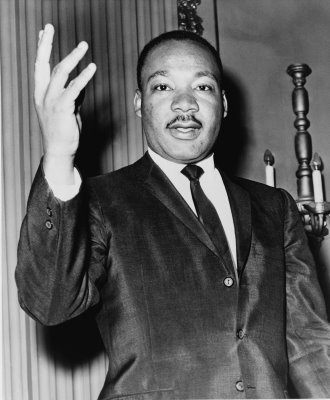
One year later to the day Martin Luther King Jr. was shot dead.
This is what he died for: