Category Archives: Renewable Energy

Georgia missing out on solar jobs behind New Jersey and Michigan


Other states, even New Jersey and far-north Michigan,
are beating Georgia to solar jobs.
Why isn’t sunny Georgia leading in one of the fastest-growing industries in the country that is deploying rural jobs everywhere else?
Hint: who’s

holding a shareholder meeting this month
?

Carin Hall wrote for energydigital 13 May 2013,

Solar Jobs Outnumber Texas Ranchers and US Coal Miners:
New statistics show that solar is one of the fastest growing industries in the US, creating thousands of jobs across the country

There are now more solar energy workers in the state of Texas than
there are ranchers, according to solar research group The Solar
Foundation.

The group’s data mapping out solar jobs across the nation also
showed that there are more solar jobs in California than actors, and
more solar workers than coal miners nationwide. Sunny states like
California and Arizona topped the list. Wyoming came in last, with
just 50 workers, while Utah showed a mere 290 solar workers despite
being one of the country’s sunniest states.

Even the states with less sunshine like New Jersey and Michigan
showed a high number of solar jobs—thanks to favorable tax and
regulatory policies that help attract developers to cope with high
electricity prices.


New Jersey is #9 and Michigan is #15 according to

The Solar Foundation’s map of State Solar Jobs
.
Where’s Georgia?
Number 41 in solar jobs per capita.
Yet Michigan is #47 by maximum solar resource and New Jersey is #36,
while Georgia is #18: much sunnier than those northern states.
Why is Georgia so far behind?

LEGAL STATUS OF THIRD-PARTY OWNERSHIP: NOT ALLOWED

Because of Continue reading

Dear SO: Time to move beyond coal –Sierra Club

You can to talk to Southern Company
even if you can’t come to SO’s

annual stockholder meeting 22 May at Callaway Gardens
.


Sierra Club helps you to ask SO CEO Thomas A. Fanning questions; maybe

about SO’s nuclear financial and safety performance
,
or

why SO is already losing on its “clean coal” bet in Mississippi
,
or

when SO might get serious about distributed solar power
,
or

when SO will help Georgia join the Atlantic Offshore Wind Energy Consortium
,
or….
So many possible questions, and you don’t even have to go to ask them!


Sierra Club message to Southern Company,

Tell Southern Company to Move Beyond Coal
,

On May 22, Southern Company will host its annual shareholder meeting
in Georgia, giving us a great opportunity to push them forward on
clean energy.


Southern Company has taken steps to grow clean energy in the
Southeast — Alabama Power and Georgia Power both invested in
wind energy and Georgia power increased solar energy investments
— but they can do a lot more.

Southern Company still provides some of the dirtiest, most
unreliable, dangerous, and expensive power in the country. And its
subsidiaries continue to place “Big Bets” on dirty coal electricity
that poisons the health of our communities’ water, air, and
families. Georgia is even home to the biggest emitter of carbon
pollution in the nation, Scherer Plant in Juliette.

Send a message to Southern Company’s CEO Tom Fanning to thanking him
for clean energy investments, and demand that Southern Company clean
up its act and invest in job creating clean energy.

Follow the link to send a message.

-jsq

110 MW solar financing: SolarCity and Goldman Sachs

When Goldman Sachs gets in, you know there’s money in solar.
They’re certainly not investing half a billion dollars for your health.
Of course, if you’re in Georgia, you won’t be getting any of this
110 MW of SolarCity solar on your roof, because of that

antique 1973 Territorial Electric Service Act

that

Georgia Power and Southern Company keep propping up
.
Maybe we should

do something about that
.
-jsq


PR today,

SolarCity and Goldman Sachs Create Largest U.S. Rooftop Solar Lease Financing Platform:
Collaboration Expected to Fund more than $500 Million in Solar Projects, 110 Megawatts of Solar Capacity


SAN MATEO, Calif., and NEW YORK, May 16, 2013—SolarCity
(Nasdaq: SCTY), a leading provider of clean energy, today announced
a lease financing agreement with Goldman Sachs (NYSE: GS) to fund
more than $500 million in solar power projects; an estimated 110
megawatts in generation capacity for homeowners and businesses.

The financing makes it possible for homeowners, businesses,
government and other non-profit organizations to install solar
panels with no upfront cost and pay less for clean electricity than
they currently pay for utility bills. The agreement was initiated in
2012 and expanded per

Continue reading

Solar Music City Center, Nashville, Tennessee

Valdosta has a larger solar installation than Nashville, Tennessee,
but Valdosta’s is hidden away at the Mud Creek Wastewater Treatment Plant
while Nashville’s biggest is on its new

Music City Center
.
Which do you think shows the most leadership,
and will attract the most business?


In Lightwave Solar’s May 2013 newsletter,

LightWave Completes Music City Center Solar Project
,

LightWave Solar recently completed the installation of a 211
kilo-watt (kW) solar system for the Music City Center, and it is the
largest solar installation in Nashville.

Installed within the guitar shaped structure on the roof, the system
consists of 845 solar panels and four inverters weighing 1,800
pounds each. The system will generate approx. 271,000 kilowatt-hours
per year, enough electricity to power the electric vehicle charging
stations and lighting for the building. Over 25 years, the clean
electricity will offset nearly 5,000 tons of carbon dioxide
emissions, the equivalent of taking 920 cars off the road.

“This project shows great leadership on behalf of the city,” said
Steve Johnson, President of LightWave Solar. “We applaud the mayor’s
vision in making Nashville a more sustainable city with a bright
future.”

And leadership can extend even beyond solar into water and habitat:

Continue reading

Solar Baxley City Hall


Baxley City Hall has solar panels, in Appling County, home to nuclear Plant Hatch.
Why?
The solar installation will
generate most during the most expensive electrical power times of the day;
it will pay for itself in ten years,
and it’s lower power bills from then on.
Baxley City Council approved the project unanimously in December,
to be paid for out of reserves with no financing,
and the solar system is already installed and working.
Any local city or county hereabouts could do the same thing.

Renee O’Quinn wrote for the Baxley News-Banner 19 December 2012,

City approves installation of solar panels at City Hall
,

Continue reading

The Super Bowl of disruptive distributed energy: Georgia Power and Southern Company are losing

It’s literally game-changing time with solar power at the electric utilities,
while Georgia Power and Southern Company are sticking with big baseload
nuclear, “clean coal”, and natural gas.
They cannot win if they don’t even try.


Steven Schultz wrote for Physorg 6 May 2013,

Growth of ‘distributed’ electricity generation could transform
utility systems
,

(Phys.org) —The U.S. electric utility industry faces a
critical juncture as new technology and declining prices allow a
more “distributed” system of small-scale generators, renewable
energy installations and energy-efficiency strategies, according to
a group of high-level energy industry executives and regulators who
met at Princeton University recently.

“We have a monumental challenge,” said Jon Wellinghoff, chairman of
the Federal Energy Regulatory Commission, who participated in the
all-day meeting Friday, April 26. Citing commentary by an analyst
who warned of a potential “train wreck” in the industry, Wellinghoff
outlined converging tends in which technological advances are
allowing consumers and companies to take matters of reliability,
security and efficiency into their own hands, while utility
companies are under pressure to maintain and upgrade a national
electricity system that is broadly accessible.

“Everybody saw the Super Bowl,” Wellinghoff said, referring to the
half-hour blackout that disrupted the 2013 football championship.

He didn’t mention that after blacking out the Super Bowl Continue reading

Harrisburg just keeps getting worse

After Harrisburg, PA

defaulted on its incinerator bonds
,
started

selling off pieces of itself
, and

threatened bankruptcy

(twice),
now the SEC is suing the city for fraud.


James O’Toole wrote for CNN Money 6 May 2013,

SEC sues financially troubled Harrisburg
,

The Securities and Exchange Commission has sued the city of
Harrisburg for fraud, alleging that officials in the Pennsylvania
capital misled the public about the city’s financial condition.

The SEC says the misleading statements came in the city’s 2009
budget report, its annual and mid-year financial statements and a
“State of the City” address. The case marks the first time the SEC
has charged a municipality with misleading investors in statements
made outside of securities documents.

Harrisburg has been mired in

Continue reading

How can we get Georgia to move ahead in solar power?


If we

can’t expect Georgia Power or Southern Company to change their tune about solar power
,
what can we do?
Legislate and raise public pressure, while getting on with installing what
solar power we can.


Maybe it’s time to pass something like

HB 267
that would limit Georgia Power’s profits on

that 19-month-late and $1 billion over budget nuclear boondoggle at Plant Vogtle
.
Instead of pouring more money down that broken concrete pit on the Savannah River,
we need something like

GA SB 51, The Georgia Cogeneration and Distributed Generation Act
,
to fix

Georgia’s special solar financing problem
,
the antique 1973 Territorial Electric Service Act.
That’s the 40-year-old antiquated law that SO CEO Thomas A. Fanning says
“we need to protect”.
Maybe SO does, for Fanning’s
huge raises in compensation
.
Georgia Power and SO are not only defending that antique law,
they’re preventing
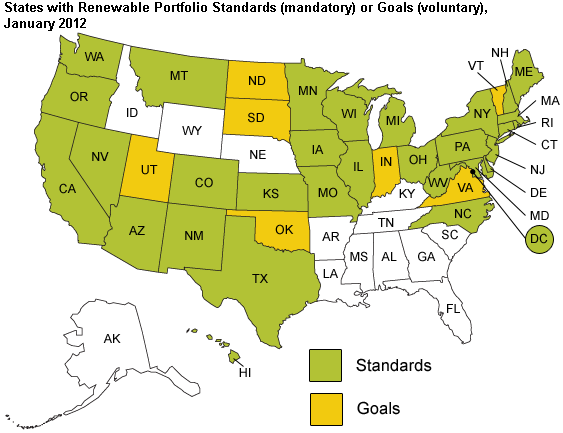
a Georgia Renewable Portfolio Standard (REPS) by stopping passage of bills like
HB 503
.
Georgia Power, SO, and super-lobby ALEC

systematically oppose renewable energy standards
.


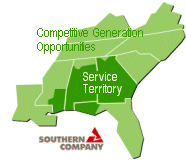
They do this so successfully there are no REPS in Southern Company (SO)’s
service territory, nor in most of SO’s surrounding
“Competitive Generation Opportunities” states.
One of the few exceptions is North Carolina, and

a bill was introduced there to eliminate NC’s REPS
.

Maybe it’s even time to do something about

Georgia Power’s 11% guaranteed profit
.
Isn’t Georgia Power supposed to be a utility operating for the good of
Georgians?
Why does it get a guaranteed profit to pass on to Southern Company
shareholder dividends and SO executive bonuses?


Georgia Power and even Southern Company could suddenly flip for solar power
like
Austin Energy did in 2003
and Cobb EMC did in 2012.
But that probably won’t happen without a lot of public pressure,
legal requirements by the Georgia legislature or PSC,
or a shareholder revolt.
So let’s start with

the public pressure
….

-jsq

Solar shakeout


Solar companies are shaking out just like car and computer companies before them.
Dozens of automobile manufacturers shook out to a handful of major ones;
Tesla is the first new one in decades.
So many computer hardware and software companies went under or were bought
by bigger ones that it would take a very long blog post to list them all;
I could name a dozen or two off the top of my head.
There’s a shakeout going on right now among mobile phone manufacturers:
even mighty Nokia is sinking.
The solar industry is going through that same normal shakeout phase.
Will electric utilities be next?

Stephen Lacey wrote for greentechsolar 23 April 2013,

Four Must-See Charts on the Future of the Global Solar Market:
Who will be left standing when the dust settles?

In 2009, after Spain’s market collapsed and the world faced a
crippling financial crisis, GTM Research predicted a shake-out in
the manufacturing sector. But unexpected growth in global demand,
particularly in European markets, helped keep many producers afloat.

Then, in 2010 and 2011, we saw a surge of new manufacturing capacity
— much of it driven by China — that created the
structural oversupply faced by the industry today. As illustrated by
the growing list of deceased solar companies and acquisitions, the
delayed shake-out in the industry is now well underway.

This morning at the GTM Solar Summit, Shayle Kann, vice president of
research, shared his outlook on consolidation, module prices, and
the shifting global demand through 2016. Here are four charts from
his presentation that provide a glimpse of what the world may look
like in the next three years.

In 2010, when the period of irrational growth began in solar
manufacturing, there were 357 active module producers.

By the end of this year, that number will be down to 145. And in
2016, it will drop below 100. (So if you’re at a conference talking
to a person involved in manufacturing, there’s a good chance he or
she might be out of a job or working for a different firm the next
time you see them.)


He then predicts that solar PV panel prices may actually rise
briefly due to fewer manufacturers.
However, as he notes, demand will keep going up.
And demand combined with economies of scale may make prices continue down
with

Moore’s Law
.
I think his installed capacity graph is way too conservative,
because he doesn’t go back far enough, which would reveal that
2010 growth is not an anomaly, it’s

a steady continuation
of the
previous decade (well, except in Georgia).
We shall see what happens in the next few years.

One thing’s for certain:
a few bankruptcies are not a problem for the world’s fastest-growing
industry.
They are merely a symptom of any industry growing that fast.
Solar panels will continue to spread, ever-faster,
and

electric utilities need to adapt

or soon their big utility shakeout will start, too.
The utility shakeout may look more like an increase
in companies, as many solar installers and vendors move in to
handle distributed solar power

if the incumbents won’t do it
.
That’s my speculation, and again we’ll see.

-jsq