Category Archives: Coal

Where’s the wood to come from and who will buy the electricity?


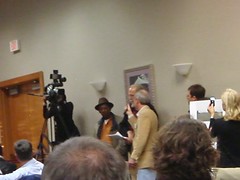
Here’s video of what I asked at the recent VLCIA biomass event
(6 Dec 2010) and the answers from the panel.

So there’s actually not any new study of wood sourcing
(Brad Lofton told me after the meeting that the study had been “completed”
after we met in June),
and the study that exists is not publicly available.
Someone from Sterling promised me after the meeting to redact the
private parts of the wood sourcing study and provide the rest
for public distribution. We’ll see.

Regarding my question about who will buy the electricity and
whether we’ll end up like Plant Scherer, selling electricity
to Florida while keeping the pollution here, the answer was:
Continue reading

Brad Lofton’s Selective Memory

I see by yesterday’s VDT story about the Lowndes County Board of Education (LCBOE)
meeting that Brad Lofton, executive directory of the Valdosta-Lowndes County Industrial Authority (VLCIA), is reported as saying:

The people … that are opposing the plant … have yet to agree
to sit down and talk with the authority directly about the plant.

He said somehing similar at the 29 Sep 2010 meeting of the
Valdosta Board of Education (VBOE).
Except then he at least admitted that I had gotten the VLCIA presentation.
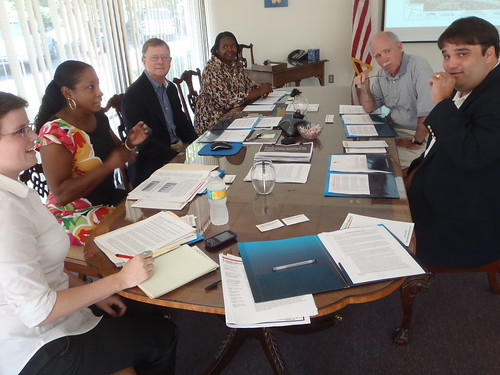
Yet even then he forgot about the other people in this picture
of that 10 June 2010 meeting at the VLCIA offices:


Pictured: Natasha Fast, Angela Manning, Allan Ricketts (Project Manager), Geraldine Fairell, Ken Klanicki, Brad Lofton (Executive Director)

Even earlier, Dr. Brad Bergstrom and Seth Gunning got a presentation from
the VLCIA.

I pointed all this out

a month ago,
after the VBOE incident.

Why does Brad Lofton, a public employee,
keep standing up before elected bodies and
saying something that is not true?

-jsq

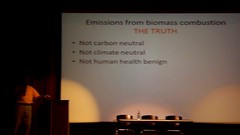
Video of Dr. Sammons’ talk at VSU


Here is

a video of most of Dr. William Sammons’ presentation

at the

SAVE Biomass Forum at VSU.

His slides from that talk
are available on the LAKE web pages, so you can follow along.

Instead of dirty biomass we could have clean efficiency and conservation (retrofitting produces twice as many jobs as biomass)
and solar power, which is booming nationwide,
burns no trees, and emits no pollutants.

You can also contact your
local elected or appointed officials.

-jsq

Due Diligence on Biomass Combustion, by Dr. William Sammons


Monday a week ago
Dr. William Sammons, a pediatrician
who has studied biomass plants nationwide, called them

“a medical atrocity.”

His

slides from that talk are now available on the LAKE web pages.

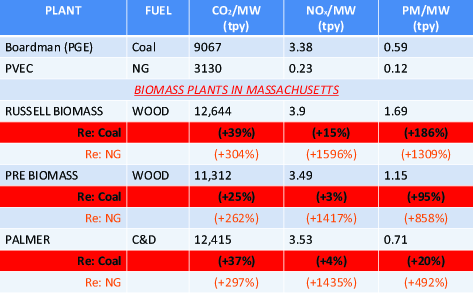
For example, he demonstrated that burning wood is dirtier than burning coal:


This slide shows data taken from biomass plant permits.
Also notice

Continue reading

“Proposed plant said to be ‘medical atrocity'”


Johnna Pinholster writes in the
the Valdosta Daily Times (paper 25 Oct,

online 27 Oct 2010)

about the

the SAVE Biomass Forum at VSU:

A medical atrocity.

That is the phrase Dr. William Sammons used to described biomass energy
plants at Monday night’s biomass forum at Valdosta State University’s
Student Union theater.

Dr. Sammons answered many of the unanswered concerns about the biomass
incinerator, and,

unlike the lack of peer-reviewed evidence from the plant proponents
:

Continue reading

Subsidize Solar, not Coal or Biomass


The
WSJ article about economic problems of biomass plants

goes on to suggest the government subsidize biomass more.
Clean Technica suggests

a better idea:

If solar got the
same subsidies as fossil fuels,
solar would be cheaper than current grid power everywhere in the U.S.
Each taxpayer has spent about $521 towards coal over the past five years
and only $7.24 towards solar.
How about we reverse that?

Solar needs no fuel, no truck deliveries, and no emissions.

-jsq

WSJ on Economic Problems of Biomass Plants


Jim Carlton points out in the Wall Street Journal

some of the problems of biomass plants.

With all the plants and trees in the world, biomass energy would appear
to have boundless potential.

Or as Georgia politicians are fond of saying,
“Georgia is the Saudi Arabia of forest energy.”

Yet in the U.S., biomass power—generated mainly by burning wood and
other plant debris—has run into roadblocks that have stymied its growth.

Here at the Northern Nevada Correctional Center, officials in 2007
built a $7.7 million biomass plant to meet all the power needs of the
medium-security prison. But last month, two years after the plant opened,
prison officials closed it, citing excessive costs.

“This was a project that was well intentioned, but not well implemented,”
says Jeff Mohlenkamp, deputy director of support services for the Nevada
Department of Corrections.

Even with a captive market (pun intended), biomass was not economically
feasible.

Maybe it was an isolated case?

Continue reading

Biomass: “a sub-prime carbon mortgage”


BirdLife International writes about

Bioenergy – a carbon accounting time bomb
:

The first study, carried out by Joanneum Research, identifies a major
flaw in the way carbon savings from forest-derived biomass are calculated
in EU law as well as under UNFCCC and Kyoto Protocol mechanisms. It
concludes that harvesting trees for energy creates a ‘carbon debt’:
the carbon contained in the trees is emitted upfront while trees grow
back over many years. The true climate impact of so-called woody biomass
in the short to medium term can, as a result, be worse than the fossil
fuels it is designed to replace.

“The EU is taking out a sub-prime carbon mortgage that it may never be
able to pay back. Biomass policy needs to be fixed before this regulatory
failure leads to an ecological crisis that no bail out will ever fix”,
commented Ariel Brunner, Head of EU Policy at BirdLife International.

Hm, this seems to contradict VLCIA’s assertion that
the document they gave me proves their proposed wood
incinerator would be carbon neutral.

That document openly admits that biomass produces more CO2 than
coal, and calls for national or regional studies, which didn’t exist.
Nonetheless,

when I pointed that out (again) to VLCIA Executive Director
Brad Lofton,

he asserted that

“Carbon is absolutely not an issue with our plant.”

Hm, well, now there is a study, and it shows that burning woody
biomass is not carbon neutral.

And this excess production of CO2 isn’t limited to

burning whole trees.

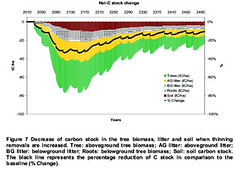
Looking at the actual

study
:

When residues are left on the forest floor, they gradually decompose. A
great deal of the carbon contained in their biomass is released over time
into the atmosphere and a small fraction of the carbon is transformed
into humus and soil carbon. When the residues are burnt as bioenergy,
the carbon that would have been oxidized over a longer time and carbon
that would have been stored in the soil is released immediately to the
atmosphere. This produces a short term decrease of the dead wood and
litter pools that is later translated into a decrease of soil carbon.

So it doesn’t really matter that VLCIA asserts that their proposed
plant will never burn whole trees.
The tops and limbs they want to burn produce the same problem.

The study also includes comparisons with CO2 saved by
biomass offsetting coal burning.
The catch for the proposed biomass incinerator in Lowndes County
is that it’s not offsetting anything: it’s in addition to the
coal burned at Plant Scherer.
We could offset some coal through efficiency and conservation,
plus solar power.
None of those things produce any emissions.

LBJ about Pollution


It’s a really great speech and still relevant 45 years later.
This is just a little excerpt:

In the last few decades entire new categories of waste have come to plague
and menace the American scene. These are the technological wastes–the
by-products of growth, industry, agriculture, and science. We cannot
wait for slow evolution over generations to deal with them.

Pollution is growing at a rapid rate. Some pollutants are known to be
harmful to health, while the effect of others is uncertain and unknown. In
some cases we can control pollution with a larger effort. For other
forms of pollution we still do not have effective means of control.

Pollution destroys beauty and menaces health. It cuts down on efficiency,
reduces property values and raises taxes.

The longer we wait to act, the greater the dangers and the larger the
problem.

Continue reading

Videos of pro and con biomass speakers at VBOE

Karen Noll took these videos at the

29 September 2010
meeting of the Valdosta Board of Education (VBOE).

Much more about that meeting here.

-jsq


Dr. Gretchen Bielmyer
speaking against the biomass plant.


Dr. Brad Bergstrom
speaking against the biomass plant.

Brad Lofton and Allan Ricketts
speaking for the Valdosta-Lowndes County Industrial Authority (VLCIA) and the biomass plant.