Tag Archives: jobs

Why the Chamber Supports Unification —Tom Gooding, Chairman, VLCoC

My opinion is appended. -jsq


Date: Wed, 2 Nov 2011 11:17:00 -0400 (EDT)

From: Tom Gooding <chamber@valdostachamber.com>

Subject: Why the Chamber Supports Unification

Dear Chamber Members:

Some ask why the Chamber supports school system unification, instead
of focusing
on poverty. The answer is very simple: The Chamber’s mission is to
build a strong
and healthy community, resulting in job opportunities for our citizens,
which addresses poverty. Improving public education is the single most
important thing we can do to build a strong community, grow jobs, and
reduce poverty.

Valdosta’s business community consistently ranks

Continue reading

To the people of Valdosta and South Georgia —Occupy Valdosta

Posted today in

Occupy Valdosta’s
facebook page:

To the people of Valdosta and South Georgia


We, the local citizens occupying Valdosta, urge you to assert your power.


Exercise your right to peaceably assemble;
to nonviolently occupy
public space;
to create an open process to address the problems we face, and to generate
solutions accessible to everyone.

Our issues are varied, yet related.

We seek

Continue reading

Neighborhoods matter more than schools?

Where you live makes more difference to your education than where you go to school,
says a news study, backed up by an older study.

Maureen Downey blogged for AJC 5 October 2011,

Forget school vouchers. The route to improving education may be housing vouchers.


School voucher proponents argue that kids need a way out of failing
schools, but research increasingly suggests that it would be more
effective to provide them a way out of failing neighborhoods.

Should we consider giving poor families in low-performing school zones
housing vouchers that they could use to relocate in the zone of a school
performing above the area median?

I’d say that’s a bad solution to the problem the study identifies,
and we already know better solutions.
But first,
from the abstract of the the study

Continue reading

Top 10 Reasons Why Solar Energy Will Win


Greentechsolar has an interesting article 28 Sep 2011 on

Top 10 Reasons Why Renewable Energy Wins
.
in which is a top 10 list for solar.
Here are some excerpts:

  1. A job is a job is a job.

    With all this talk about green jobs, clean jobs, and other kinds of jobs
    — how about we just call it a job? A job that puts food on the table,
    pays the bills, keeps the kids in clothes, and affords the occasional
    family night out. And, if you subscribe to the belief that all is lost due
    to the Chinese PV manufacturing juggernaut, keep in mind that you can’t
    export the thousands of business development, sales, design, engineering,
    installation, and service jobs we’re going to need every year.

Why not just say
jobs, jobs, jobs?

Because solar also doesn’t pollute the air and doesn’t suck up
ground water.
Not just jobs: clean jobs that don’t drain our resources.

But opinion only matters if the data supports it. Solar is one of the only
industries adding private sector jobs in our struggling economy — with
6.8 percent growth from August 2010 to August 2011, when overall U.S. job
growth was only 0.7 percent and when fossil fuel generators actually cut
jobs by 2 percent. It’s estimated the United States already has over
90,000 direct and indirect jobs in the manufacturing and installation
of solar panels. That’s more than in either steel production or coal
mining (not including transportation and power plant employment).

Yes, while road and bridge building projects may bring in a few temporary
construction jobs, solar brings construction jobs plus all sorts
of other jobs plus long-term jobs.
Long-term jobs in the fastest-growing industry in the world:

Continue reading

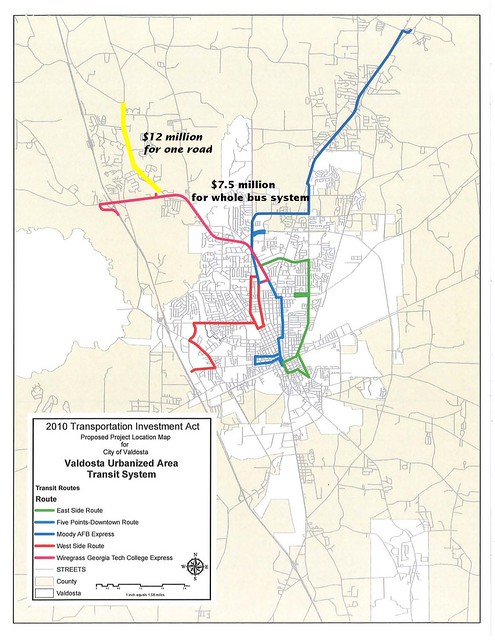
$12M to widen US 41 N is more than $7.5M for a bus system

There is no public transit in Lowndes County, except for the
tiny MIDS bus system (I like it, but it’s small).
Meanwhile,
the county proposes to spend more in a new sales tax to widen one road,

$12 million dollars for Old US 41 North
,
than

a bus system would cost, $7.5 million.


One short stretch of road vs. a three-line bus system to connect Wiregrass Tech, Five Points, Downtown,
Moody, East Side, South Side, West Side, and the Mall.

Road and bridge proponents usually mutter that a bus system won’t pay back
for years, if ever.
And that’s right: bus systems usually operate at a loss because local
governments subsidize them for the social and economic benefits they bring,

such as these:

This project will provide mobility options for all travelers; improve
access to employment; and help mitigate congestion and maximize the use
of existing infrastructure by promoting high-occupancy travel.

Employment, safety, and less sprawl, all from a bus system.

What road and bridge proponents don’t ever mention is:

Continue reading

NAACP calls for end to War on Drugs

Nafari Vanaski, wrote for Gateway newspapers 18 August 2011,

NAACP calling for truce in nation’s drug war


If you grew up at the same time that I did, you’ll remember the “Just
Say No” anti-drug campaign that became popular in the mid-1980s and
early 1990s.

It manifested itself in many ways, from the posters and talks in class
to the “very special episodes” of shows such as “Blossom” and “The
Facts of Life,” where a character encounters a kid from the wrong side
of the tracks who is pressuring him or her to try drugs. Inevitably,
good prevailed and the druggie turned out to be from a broken family
and needed only a good face-to-face with Nancy Reagan, the driving
force behind the campaign, to overcome his addiction. (She appeared on
“Diff’rent Strokes,” and considering the real-life histories of Gary
Coleman, Todd Bridges and Dana Plato, she probably should have stuck
around for a five-episode story arc.)

“Just Say No” was part of the larger war on drugs the Nixon administration
declared in 1971. For grown-ups, that war symbolized a lot more than
sappy primetime television. Especially for black adults. For them, it
meant stricter laws for those found buying, selling and distributing
illegal drugs.

To that end, the NAACP took an interesting step at its national convention
last month. It approved a resolution to end the war on drugs because of
its devastating effect on the black community.

Interesting how the headline writer watered that down:
NAACP called

Continue reading

Your children’s education at stake —Sam Allen, FVCS, 7 July 2011

Good question:


“Are you willing to put your children’s education at stake
because somebody has promised you something they can’t deliver?
I for one am not willing.”

Here’s

the video:


Your children’s education at stake —Sam Allen, FVCS, 7 July 2011

No school consolidation,

Press Conference, Friends of Valdosta City Schools (FVCS),

Valdosta, Lowndes County, Georgia, 7 July 2011.

Videos by John S. Quarterman for LAKE, the Lowndes Area Knowledge Exchange.

-jsq

Private prison operations have been rife with abuse —WV Council of Churches

Another Sunday, another church group against private prisons;
this time, a group of churches.

Dan Heyman wrote 12 January 2010 for Public News Service – WV,

Churches: No Private Prison For Immigrants In WV
,

CHARLESTON, WV – West Virginia’s largest church group has asked
U.S. Sen. Robert Byrd and the rest of the state’s congressional delegation
to oppose funding a private prison for undocumented immigrants in
Pendleton County near the Virginia border.


The Council of Churches is
one of several groups discussing immigration reform ahead of expected
congressional action on the issue. The Council has asked federal
lawmakers’ help in the effort, arguing private prison operations have
been rife with abuse. GSI Professional Corrections is seeking county
commission approval to build the detention center near Sugar Grove to
house 1,000 nonviolent immigrant detainees awaiting possible deportation.

Rev. Dennis Sparks, the Council’s executive director, complains private
prisons operate outside the mainstream legal

Continue reading

School consolidation report: can cause irreversible damage

People ask me: why do the NAACP and the SCLC oppose school consolidation?
Well, here’s some recent research that backs up their position, followed
by their positions.
My summary: because it caused great damage last time, and this time would be no different.


Craig Howley, Jerry Johnson, Jennifer Petrie wrote 1 February 2011,

Consolidation of Schools and Districts: What the Research Says and What it Means
:

…the review of research evidence detailed in this brief suggests that
a century of consolidation has already produced most of the efficiencies
obtainable. Research also suggests that impoverished regions in particular
often benefit from smaller schools and districts, and they can suffer
irreversible damage if consolidation occurs.

Isn’t such irreversible damage what

Rev. Floyd Rose got Mrs. Ruth Council to admit?


Rev. Rose: “…we were told about the world, where we came from, how we got here.”

Mrs. Council: “I think we did receive a better education.”

They are referring to black schools before desegregation in the 1960s.

Rev. Floyd Rose is president of the local SCLC,
and here is a statement by
Leigh Touchton, president of the local NAACP:

Continue reading