Category Archives: Incarceration

Prisoner call centers

Prisoners answering the telephone for your government? Yes, apparently.

M. Alex Johnson of msnbc.com and Bill Lambdin of WNYT-TV wrote yesterday for MSNBC, Inside the secret industry of inmate-staffed call centers,

When you call a company or government agency for help, there’s a good chance the person on the other end of the line is a prison inmate.

The federal government calls it “the best-kept secret in outsourcing” — providing inmates to staff call centers and other services in both the private and public sectors.

The U.S. government, through a 75-year-old program called Federal Prison Industries, makes about $750 million a year providing prison labor, federal records show. The great majority of those contracts are with other federal agencies for services as diverse as laundry, construction, data conversion and manufacture of emergency equipment.

We’ve heard of Prison Industries before. The Georgia prisoners who struck back in January 2011 work for Prison Industries, allegedly for no pay.
But the program also markets itself to businesses under a different name, Unicor, providing commercial market and product-related services. Unicor made about $10 million from “other agencies and customers” in the first six months of fiscal year 2011 (the most recent period for which official figures are available), according to an msnbc.com analysis of its sales records.

The Justice Department and the U.S. Bureau of Prisons don’t
Continue reading

CCA is a functional equivalent of a government agency —TN court

A government agency is subject to open records laws. Alex Friedman of Prison Legal News sued CCA for not satisfying an open records request. CCA lost in local court, then lost again on first appeal. On a second appeal, CCA lost even more abruptly.

Knoxville News editorial of 14 March 2010, Chalk two up for open government

CAA[sic] maintained it wasn’t the functional equivalent of a government agency, but the Appeals Court rejected that claim and the Supreme Court refused even to hear it.

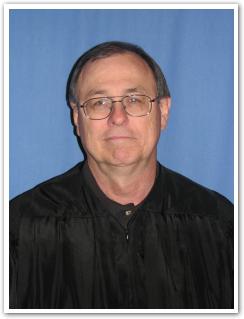
“With all due respect to CAA[sic],” Appeals Court Judge D. Michael Swiney wrote in his opinion on Friedman’s case, “this Court is at a loss as to how operating a state prison could be considered anything less than a governmental function.”

So eventually CCA will have to surrender at least some of the records, although there is still haggling in court over which exceptions CCA can use for which records. (And there’s always the old “we didn’t keep them that long” trick.)

The Tennessee Supreme Court had already ruled about government contractors:

“When a private entity’s relationship with the government is so extensive that the entity serves as the functional equivalent of a governmental agency, the accountability created by public oversight should be preserved.”
I wonder if Georgia will accept a Tennessee precedent?

-jsq

Ankle monitoring system budget adjustment: Lowndes County Commission 9-10 January 2012

Two more board appointments, several road and infrastructure items, and a budget adjustment to the ankle monitoring system, among many other items on the agenda for the Lowndes County Commission. The Commission will vote Tuesday on its meeting schedule and its budget calendar. This morning’s meeting is the Work Session; no voting during that, but maybe some information that won’t get mentioned Tuesday.

They can change their meeting schedule at any time. Did you know they had a special called meeting December 1st? They didn’t mention that during their 12-13 Dec meetings; there’s no agenda for it on their web pages; and this agenda doesn’t say what it was for.

Here’s the agenda.

LOWNDES COUNTY BOARD OF COMMISSIONERS
PROPOSED AGENDA
WORK SESSION, MONDAY, JANUARY 9, 2012, 8:30 a.m.
REGULAR SESSION, TUESDAY, JANUARY 10, 2012, 5:30 p.m.
327 N. Ashley Street – 2nd Floor
Continue reading

Map of prisons in Georgia

The Georgia Department of Corrections (GDOC) does not provide a map of prisons in Georgia; at least not that I’ve been able to find. CCA does not provide a map of its private prisons, either. This omission seems odd for an industry that brags about how good it is economically.

But someone has composed this google map that gives the big picture. I don’t know if this map is current or accurate, but the spot checks I’ve made show markers for real prisons. Did you know there were so many?

Apparently,

  • the reddish circles are county prisons;
  • the red arrows are state prisons for men like Valdosta State Prison;
  • the yellow arrows are state prisons for women (Pulaski) or juveniles (Arrendale), except Washington State Prison appears to be back to housing men;
  • the blue arrows are Regional Youth Detention Centers (RYDC);
  • and the green arrows are at least some of CCA’s private prisons,

Prisons are bad economics, producing no longterm improvement in employment, and risking closure, leaving communities with expensive white elephants. We don’t need a private prison in Lowndes County, Georgia. Spend those tax dollars on rehabilitation and education instead. Follow this link to petition the Valdosta-Lowndes County Industrial Authority.

-jsq

Rural prisons: economic bane or bust?

Some interesting points about prisons from a Georgia blogger.

Keith McCants posted Wednesday in Peanut Politics, Prisons as Economic Development: Boom or Bust for Rural Georgia? In Georgia today there are more prisoners than farmers. And while most prisoners in Georgia are from urban communities, most prisons are now in rural areas with high levels of poverty & a unskilled, uneducated workforce. During the last two decades, the large-scale use of incarceration to solve social problems has combined with the fall-out of globalization to produce an ominous trend: prisons have become a “growth industry” in rural Georgia, in fact Rural America.

Communities in isolated regions of the state began suffering from declines in farming, mining, timber-work and manufacturing are now begging for prisons to be built in their backyards. The economic restructuring that began in the troubled decade of the 1980s has had dramatic social and economic consequences for rural communities and small towns. Together the farm crises, factory closings, corporate downsizing, shift to service sector employment and the substitution of major regional and national chains for local, main-street businesses have triggered profound change in these areas. So, many rural areas have bought into prisons as a growth industry.

Some consequences are pretty obvious:

Many small rural towns have become dependent on an industry which itself is dependent on the continuation of crime-producing conditions.
Others may take more time to see: Continue reading

I really support … allowing non-violent offenders the opportunity to work and rehabilitate — Jessica B. Hughes

Received yesterday on Ankle monitoring for Lowndes County Jail. -jsq
I really support this idea. Initially, I was concerned about it, because I know that things like the SCRAM bracelet and the ignition interlock devices are very expensive to install and maintain, especially if you consider the costs involved with probation fees. $213.00/month may not sound like a lot of money to some people, but it is a king’s ransom to others (saying $7.00/day makes it seem more manageable). Still, allowing non-violent offenders the opportunity to work and rehabilitate themselves outside of a prison is a big step forward in the philosophy of crime and punishment in this county, in my opinion.

-Jessica B. Hughes

Ankle monitoring for Lowndes County Jail @ LCC 13 December 2011

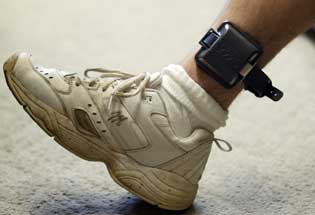
Tuesday the Lowndes County Commission approved ankle bracelet monitoring for nonviolent jail inmates so they can serve the rest of their time outside the jail, putting them in a better environment and decreasing expenses at the Sheriff’s office. This sounds like a good idea. I have not expressed an opinion because, as Barbara Stratton pointed out, the public doesn’t really know what was in the proposal County Commissioners got in their agenda packet. However, I would like to compliment Commissioner Joyce Evans about trying to do something about nonviolent prisoners.

Summarizing the ankle monitoring discussion of Monday morning, County Manager Joe Pritchard Tuesday evening asked the Lowndes County Commission to approve continued work by county staff with the Sheriff’s office in implementing an ankle monitoring system to move some inmates out of the county jail.

Commissioner Richard Raines gave the credit to Commissioner Joyce Evans for both proposing a drug court and for proposing ankle monitoring.

Commissioner Evans declined comment but did make the motion, seconded by Commissioner Powell, and approved unanimously.

The VDT had a little more information in David Rodock’s Wednesday story: Continue reading

8.a. Ankle Monitoring System —Joe Pritchard @ LCC 12 December 2011

County Manager Joe Pritchard briefly described agenda item
8.a. Ankle Monitoring System
He said it would permit jail inmates to serve some of their time outside the jail. He mentioned early discussions with Commissioners Joyce Evans and Richard Raines, and said it started related to drug court, but the idea had expanded. He recommended the board approve the County Manager working with the judges to organize the monitoring.

Chairman (and former Sheriff) Ashley Paulk remarked that this could lower the jail population. He seemed to be in favor of it.

Sheriff Chris Prine had some concerns that were hard to hear, but seemed to be related to budget.

Pritchard indicated that everybody realized the program was an experiment, and everyone would work with the Sheriff to avoid any unnecessary impact.

Commissioner Raines also reassured the Sheriff along the same lines.

They vote on it tonight, 5:30 PM.

Here’s the video:


8.a. Ankle Monitoring System –Joe Pritchard @ LCC 12 December 2011
Work Session, Lowndes County Commission (LCC),
Valdosta, Lowndes County, Georgia, 12 December 2011.
Videos by Gretchen Quarterman for LAKE, the Lowndes Area Knowledge Exchange.

-jsq

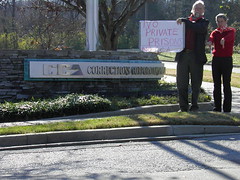
No Private Prisons at CCA headquarters, Nashville, TN, 10 December 1011

Visiting CCA HQ in Nashville, Tennessee the other day, Gretchen said:
Here we are at CCA, Corrections Corporation of America. They think that they’re patriotic; they have a U.S. flag. And they have a Corrections Corporation of America flag and it says Excellence in Corrections. We don’t think too much of private prisons.
No private prisons.
No CCA.
Here’s the video.

You can help stop CCA right here at home. We don’t need a private prison in Lowndes County, Georgia. Spend those tax dollars on rehabilitation and education instead. Follow this link to petition the Industrial Authority.

-jsq

Local state legislative delegation at the Country Club

At the State Legislative Luncheon at the Country Club yesterday, sponsored by the Rotary Club and the Chamber of Commerce, I found it more interesting what the legislators didn’t mention than what they did.

Frequent attendees told me the audience was much larger than in previous years, and one attributed that to the recent school consolidation referendum. Sitting side by side were Chamber Chair Tom Gooding and FVCS President Sam Allen.

Jeff Hanson introduced the legislators. He’s the Chair of the Chamber’s Government Affairs Council (GAC). He said they are seeking more participants. Hm, they have an Energy and Environment Policy Committee that’s chaired by someone from Georgia Power….

Tim Golden announced that the local delegation’s highest priority was to get $32 million for a Health Science Center for VSU. VSU Interim President Dr. Levy was there, as was former president “Dr. Z” as Tim Golden called him.

I was just talking to someone from SGMC in the food line about how it would be nice if the Industrial Authority would promote healthcare industries more. It’s good that the legislators are doing that, although it’s not clear that there are not other things that should be even higher priority.

Tim Golden also wants to remove a sales tax Continue reading