Category Archives: energy efficiency

After Fukushima: Fewer nukes most places; More in Georgia

Most countries are not building more nuclear power plants,
and some are shutting down some of the ones they have,
because Fukushima has confirmed what Chernoby and Three Mile Island
already told us: maybe the physics is sound, but the business
model leads to unsafe plants.
But in the U.S. and Georgia, it’s full speed ahead for new nukes,
regardless of the risks of radiation leaks or cost overruns.

Christopher Joyce wrote for NPR today,

After Fukushima: A Changing Climate For Nuclear

“We don’t see Fukushima as having a significant impact on the


U.S. industry,” says Scott Peterson, vice president of the industry’s
Nuclear Energy Institute. “The Nuclear Regulatory Commission was renewing
10 licenses for U.S. plants, extending them 20 years in operation. We
were continuing to move forward in examining new reactor designs.”

Nevermind that those extensions mostly go well beyond the design
lifespans of the plants extended.

Marc Chupka, who advises electric utilities as an economist with the
Brattle Group in Washington, wonders who’s going to pay for them.

“Right now, just the plain economics of nuclear power are
underwater,” he says. He notes that over the past decade,
construction costs have skyrocketed and natural gas got more
plentiful and cheaper.

“Things change significantly over relatively short periods of time,”
Chupka says, noting that it takes about a dozen years to plan and
build a new nuclear plant. “That makes it an incredibly challenging
environment to plan for the long term. And that adds to the risk and
it makes investors understandably skittish.”

So we could do what Germany is doing:

Germany says the same: The government will throw its weight and
wealth into solar and wind energy to replace nuclear power.

Or we could listen to the same old excuse:

Continue reading

Southern Company claims to be incompetent regarding new EPA rules

Why can’t Southern Company do what other power companies can do
in implementing the new coal plant pollution control rules EPA
is about to promulgate?


Elizabeth Shogren wrote for NPR today,

EPA To Unveil Stricter Rules For Power Plants
.
She described new rules for coal plants EPA is going to release in the next
few weeks, including controls on mercury, “arsenic, acid gases and other pollutants.”
Southern Company doesn’t like that.

“It’s physically impossible to build the controls, the generation, the


transmission and the pipelines needed in three years,” says Anthony
Topazi, chief operating officer for Southern Company, which provides
electricity to nearly 4 million homes and hundreds of thousands of
businesses in the Southeast.

Topazi says electricity rates will go up, putting marginal companies out
of business. He says unless his company gets six years, it will not be
able to keep the lights on.

“We will experience rolling blackouts or rationing power if we don’t
have simply the time to comply,” Topazi says.

Other power companies see no problem:

Continue reading

A renewable energy transparency law that enabled an industry

North Carolina passed a law in 2007
called the

Renewable Energy and Energy Efficiency Portfolio Standard (REPS)
,
which requires power utilities to get certain percentages of their energy from
“renewable energy resources or energy efficiency measures.”
To that NC added frequent, detailed, public reporting,
and thus enabled a renewable energy industry.

Power utilities don’t like to reveal data about their energy sources or sales
any more than Internet organizations like to reveal security problems.
The key to REPS is

the reporting it requires:


“Beginning in 2009, each power supplier is required to file a compliance
report, detailing the actions it has taken to fulfill the requirements
of the REPS.”

This is called the

Renewable Energy Certificate (REC) Tracking System.

It provides the data to see which utilities are providing how much of
which kind of energy.


According to Ivan Urlaub
of the North Carolina Sustainable Energy
Association (NCSEA),

REC reporting enabled the solar industry in North Carolina:


“The passage of the REPS law in 2007 and resulting success of the
North Carolina’s clean energy market has created the rapid start-ups
and expansions of clean energy businesses from installers to developers
to manufacturers and the associated service sectors over the last few
years.”

Not only is North Carolina now one of the national leaders in solar energy,
but

91% of NC voters want more solar power,

with wind second, and everything else far behind.

REC enabled not only a renewable energy industry, but also selection
within that industry for what works.

How did this happen?

Continue reading

Jerome Tucker honored at Civic Roundtable

The Civic Roundtable honored Jerome Tucker for some of
the many things he has done for Lowndes County and south Georgia.
And as usual he hit the nail on the head.

Dawn Castro

wrote for the VDT yesterday:


“We do have one of the best communities,” Tucker said. “The toughest
part of me standing before you is knowing how much better we could be
if all the little groups would work together.”

He also said:

“I am still blessed to have my dad with me,” Tucker began. “He
always asks me, ‘Where have you been?’ and ‘Did you do any good?’

Here are a few good things Jerome Tucker has done recently:

Continue reading

Bicyclists at Valdosta City Council 10 November 2011


Courtesy of the camera of George Rhynes, here are the
Citizens to Be Heard at

Thursday’s Valdosta City Council meeting.

Most of them are frequent cyclists, with a surprise ally speaking first.

I think that’s all of them.

-jsq

Community’s need for public transportation, bike lanes, and walking —Heather Evans @ LCC 10 November 2011

Heather Evans provided a petition with more than 200 signatures,
and told

Thursday’s Valdosta City Council meeting

she got requests frequently while working in community service
for something to be done about non-automobile transportation.
She presented a variety of evidence.


Ideally, I’d like to see bike lanes all over town.
But if I had to pick one to start with, St. Augustine
would be my choice.
I choose this road because it also needs to have a completed
sidewalk segment.
I can’t tell you how many people including myself have been
endangered while using this portion of road.

George Rhynes took this video and remarked:

WOW! Valdosta-Lowndes County is now being seen as a real metro city and
citizens are asking questions to their elected officials. WOW! The old
control, suppress, and abate is apparently unacceptable in 2011 as we
get ready for the 2012 Presidential election.

Here’s

the video:

Continue reading

What can we do as a community to better cooperate? —Dr. Noll

Update 3:45 PM 3 November 2011: Better transcript and pictures. See also what happened after the meeting.

Dr. Michael Noll, longtime opponent of the Industrial Authority’s formerly
proposed biomass plant, asked that same board at their most recent meeting:

What can we do as a community to better cooperate, to better communicate?

He also referred to the

school consolidation issue
and to the

nuclear vs. renewable energy issue

among the reasons he gave,
along with some suggestions on how to proceed, and said he would take
the same message to other bodies.

Here’s

the video,
and a transcript is appended.


What can we do as a community to better cooperate? –Dr. Noll

Regular Meeting, Valdosta-Lowndes County Industrial Authority (VLCIA),

Norman Bennett, Tom Call, Roy Copeland chairman, Mary Gooding, Jerry Jennett,

Andrea Schruijer Executive Director, J. Stephen Gupton attorney, Allan Ricketts Project Manager,

Valdosta, Lowndes County, Georgia, 18 October 2011.

Videos by John S. Quarterman for LAKE, the Lowndes Area Knowledge Exchange.

Dr. Noll sent an edited transcript removing some of the repetition
to clarify what he was trying to say:

Continue reading

Financing for renewable energy projects

Most of the cost of a corporate or personal renewable energy installation
can be funded through federal and state rebates, but the remainder
is what stops most people. Here is what I know about that.
There are many other sources of information.

Federal 30% and Georgia 35% rebates add up to 65% (see below under
DSIRE).
That’s for solar (PV or hot water), wind, and some other related items.

The other 35% is what stops most businesses and people.
35% of a $25,000 house solar system is still $8,750.
People like that it will pay itself off in 9-15 years,
but most people don’t have $8,750 to invest.

That’s a business opportunity for some enterprising local bank or banks.
As

Dr. Noll has explained,

if you pay for that remainder yourself,
the system will pay itself off in about 9 years.
If you get a bank to finance it, more like 15 years.
And local banks currently require collateral other than the system itself
(they like real estate as collateral).
The simplest business opportunity is for a local bank to accept
the solar equipment itself as collateral.
After all, it’s worth 65/35 or 185% of the total loan amount.


The
Georgia Solar Energy Association (GSEA)

can probably tell you more.

Other ways to finance renewable energy projects include:

Continue reading

Yes, I do have solar

Here’s my LTE in the VDT today. -jsq

A letter last week asked, “Do you have solar energy yourself?” Why yes, I do.


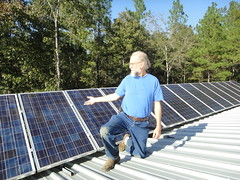
When we installed solar panels on our farm workshop in 2009,
the closest certified solar installer was in Marietta.
There were only four in the state. Now there are forty.
Georgia may yet catch up with North Carolina and even New Jersey!

Hannah Solar had all the paperwork ready when

Okra Paradise Farms

applied for a USDA REAP grant for more solar panels a few weeks ago.
Much to our surprise,

Continue reading

To the people of Valdosta and South Georgia —Occupy Valdosta

Posted today in

Occupy Valdosta’s
facebook page:

To the people of Valdosta and South Georgia


We, the local citizens occupying Valdosta, urge you to assert your power.


Exercise your right to peaceably assemble;
to nonviolently occupy
public space;
to create an open process to address the problems we face, and to generate
solutions accessible to everyone.

Our issues are varied, yet related.

We seek

Continue reading